

A knowledge transfer plan is a manager-owned project that names what only one person knows, assigns who will learn it, sets a timeline, and proves the transfer worked before that person’s last day. The primary outcome is operational continuity: the work keeps running at the same quality after someone leaves a role. Documentation alone rarely gets there. Tacit, judgment-based knowledge needs active methods like shadowing and recorded walkthroughs, not just a folder of files.
TL;DR:
- Transferring critical knowledge should prioritize high-risk roles with single-person dependency, aiming for completion within 2 to 12 weeks depending on complexity.
- A comprehensive knowledge transfer plan must include role responsibilities, key processes, systems access, decision rules, transfer methods, milestones, and validation steps.
- Effective transfer of tacit knowledge requires active methods like shadowing, recorded walkthroughs, and joint meetings, not just documentation.
- Regular verification through dry runs, progress checkpoints, and evidence collection is essential to ensure the transfer has succeeded before departure.
- The plan should be owned by the manager with clear documentation, review cadences, and leadership support to foster a culture of continuous knowledge sharing.
Table of Contents
- What Is Knowledge Transfer, and What Are Its Four Stages?
- What Should a Knowledge Transfer Plan Include?
- How Do You Match Transfer Methods to the Type of Knowledge?
- What Should You Transfer First, and How Long Does It Take?
- Who Owns the Knowledge Transfer Plan?
- How Do You Verify That a Knowledge Transfer Actually Worked?
- Where Should Transferred Knowledge Live?
- Step-by-Step Knowledge Transfer Plan Checklist and Template
- How Dynamicgrowthsolutions Supports Knowledge Transfer at Scale
- Treat Knowledge Transfer as a Project, Not Paperwork
- Get Help Building and Running Your Knowledge Transfer Plan
- Sources
- FAQ
What Is Knowledge Transfer, and What Are Its Four Stages?
Knowledge transfer is the deliberate movement of expertise from the person who hold it to the person who needs it next. It splits into two categories: explicit knowledge (procedures, credentials, contracts, anything you can write down) and tacit knowledge (the judgment calls, shortcuts, and relationship context that live in someone’s head). About 42% of institutional knowledge is unique to individual employees and never gets documented, which is exactly why a knowledge sharing strategy built only on document dumps fails so often.
Every effective transfer of knowledge moves through four stages:
- Identify: the manager maps who holds critical knowledge and where the gaps are.
- Capture: the subject matter expert records processes, decisions, and context in a usable format.
- Share: the receiving employee gets access, walkthroughs, and direct instruction.
- Apply: the recipient performs the work independently while the expert is still available to correct course.
Skip capture and you get scattered tribal knowledge. Skip apply and you get a binder nobody can actually use under pressure.
What Should a Knowledge Transfer Plan Include?
A knowledge transfer plan works like a project charter, not a memo. It needs specific fields, specific owners, and a way to prove each field is done. Based on established knowledge transfer plan frameworks, here’s what belongs in the document:
- Role responsibilities — what the departing person actually owns day to day, written by the manager with input from the subject matter expert.
- Critical processes — the recurring workflows only this person runs, documented by the subject matter expert.
- Active projects — anything mid-flight, with current status, deadlines, and blockers, logged by the subject matter expert.
- Key contacts — clients, vendors, internal stakeholders who expect this person’s involvement, compiled jointly.
- Systems and access — logins, permissions, tools, and who needs to grant them, tracked by IT or the manager.
- Decision rules — the informal judgment calls this person makes (“we always expedite orders over $5,000”), captured through interviews.
- Transfer method — documentation, shadowing, recorded walkthrough, or mentoring, assigned per knowledge item.
- Timeline with milestones — target dates for each transfer, set by the manager.
- Validation step — a dry run or test task, evaluated by the manager or a designated verifier.
Record status with actual evidence: a link to the document, a recording timestamp, a sign-off date. “In progress” with no evidence is not a status; it’s a guess.
How Do You Match Transfer Methods to the Type of Knowledge?
Documentation works fine for explicit knowledge: step-by-step procedures, compliance checklists, system logins. Write it once, store it somewhere findable, and it holds its value for months. It falls apart the moment you use it for tacit knowledge, because a written procedure can’t capture why an expert deviates from the procedure when a client is upset or a system is glitching.
That’s where shadowing earns its place. Have the successor sit in on real client calls, real troubleshooting sessions, real budget reviews for two to three cycles before taking over. Recorded walkthroughs solve a related problem: instead of writing a wiki page about how to close month end, record the subject matter expert doing it while narrating each decision. Anyone joining later watches the same context an in-person shadow would have caught.
Mentoring covers the slowest-moving layer: relationship and political knowledge. Which client hates being emailed after 4 PM. Which vendor will bend on pricing if you ask the right way. That knowledge only transfers through direct introductions and a few joint meetings where the outgoing person visibly hands off the relationship, not just the account number. A structured onboarding cadence helps new managers absorb this kind of context without waiting for it to surface accidentally.
Practical methods to combine, depending on the knowledge type:
- Written SOPs and checklists for explicit, repeatable steps
- Shadowing sessions for judgment calls and exception handling
- Recorded walkthroughs for processes too complex to fully script
- Joint client or vendor meetings for relational knowledge
- Short workshops when several people need the same knowledge at once
Pro Tip: Never rely on a single shadowing session. Judgment surfaces in edge cases, and edge cases don’t show up on schedule. Plan at least three sessions spread across different weeks so the successor sees more than one version of “normal.”
What Should You Transfer First, and How Long Does It Take?
Start with concentration risk, not seniority or job title. If only one person can process payroll, approve vendor payments, or maintain a compliance filing, that item jumps to the front of the line regardless of how senior the role is. Prioritizing by business impact and single-person dependency beats working through an org chart alphabetically.

Rank knowledge areas by asking two questions: how many people currently understand this, and what breaks if it’s not transferred in time? Anything touching revenue, customer commitments, payroll, security access, or regulatory deadlines gets flagged first.
Timelines vary by role complexity:
- Simple, procedural roles: 2 to 4 weeks
- Standard operational roles: 4 to 6 weeks
- Deep technical or client-facing roles: 8 to 12 weeks
- Emergency departures: compress to whatever notice period exists, and prioritize ruthlessly. You will not transfer everything. Transfer the highest-risk 20 percent.
Set interim checkpoints at the 25 percent, 50 percent, and 75 percent marks of the timeline, not just at the end. A manager who only checks in on day one and the last day has no way to catch a stalled transfer until it’s too late to fix.
Who Owns the Knowledge Transfer Plan?
The manager owns the plan, full stop. Subject matter experts contribute content. Recipients verify they can actually perform the work. Blurring these roles is how plans stall: nobody documents anything because everyone assumes someone else is tracking it.
Governance needs the same rigor as any other operational process, supported by practical tools and leadership resources to ensure manager-led implementation. That means:
- A named owner for every knowledge area, not “the team” or “whoever gets to it”
- A review cadence (quarterly works for most mid-market operations) to catch outdated procedures before they cause a mistake
- An expiration or refresh policy so nobody trusts a two-year-old process document by default
Deloitte’s research on organizational knowledge management makes a point worth taking seriously: successful knowledge transfer functions as a leadership and culture issue, not a documentation task. Employees resist contributing when nobody notices or rewards it. Tie knowledge contribution into performance objectives and recognize subject matter experts publicly, and participation stops being optional in practice.
How Do You Verify That a Knowledge Transfer Actually Worked?
A plan without verification is a hope, not a plan. The only way to know a transfer succeeded is to test it before the person with the knowledge is gone.
- Schedule a dry run two to three weeks before departure, not on the last day. Give the successor a real task, remove the expert from the room, and watch what happens.
- Build a verification checklist specific to the role: can they process the month-end close unaided, respond correctly to a top client’s standard request, or navigate the compliance filing without a script?
- Score the dry run honestly. Partial success still counts as a gap, not a pass.
- Log remaining gaps and schedule a follow-up review, ideally with the departing expert still reachable by phone or email for a defined window.
Roughly 42% of what departing employees know never got written down in the first place, which is exactly why the dry run matters more than the document. A checklist proves someone read the material. A dry run proves they can use it under real conditions.
Where Should Transferred Knowledge Live?
Pick a destination before you start capturing content, because “we’ll figure out storage later” is how knowledge ends up scattered across six personal drives that nobody can search. Knowledge management systems, learning management systems, and internal wikis each solve a different piece: KM systems handle searchable reference material, LMS platforms handle structured training with completion tracking, and wikis work well for living, frequently updated procedures.
Whatever platform you pick, tagging determines whether anyone finds the content again. Use consistent categories (by department, by process, by system) rather than letting each contributor invent their own labels.
Salesforce’s guidance on knowledge management strategy makes a blunt point: dumping files into a shared drive creates what amounts to a digital graveyard unless someone actively governs it. That means:
- A named owner responsible for accuracy on every major content area
- A review cadence built into someone’s actual job, not a “someday” task
- Clear archival rules so outdated procedures get flagged or removed, not left to confuse the next person who finds them
Step-by-Step Knowledge Transfer Plan Checklist and Template
Once you know a transition is coming, whether planned or sudden, work through this sequence:
- Scope the role. List every responsibility, then flag which ones only this person currently understands.
- Assign the receiving employee and confirm they have the time allocated, not just the title.
- Build the knowledge inventory using the component fields covered earlier: processes, projects, contacts, systems, decision rules.
- Match each knowledge item to a transfer method based on whether it’s explicit or tacit.
- Set the session cadence. Weekly shadowing blocks, biweekly documentation reviews, whatever fits the timeline you set by risk.
- Run the dry run at the two-thirds mark of the timeline, never on the last day.
- Log verification results and remaining gaps, then schedule a follow-up check three to four weeks after departure.
For the actual document or spreadsheet, these are the fields worth pasting into a template today:
| Field | What It Captures |
|---|---|
| Knowledge area | What only this person currently knows |
| Type | Explicit or tacit |
| Current owner | Who holds the knowledge now |
| Receiving employee | Who is learning it |
| Transfer method | Documentation, shadowing, recorded walkthrough, mentoring |
| Timeline | Target completion date |
| Verifier | Who confirms the transfer succeeded |
| Evidence | Link, recording, or sign-off date |
| Status | Not started, in progress, verified |
This structure mirrors what established knowledge transfer plan templates recommend, and it works equally well for a single role change or a department-wide restructuring. Copy it into a shared spreadsheet, assign the manager as owner, and update it weekly until every row shows “verified.”
How Dynamicgrowthsolutions Supports Knowledge Transfer at Scale
Building one knowledge transfer plan for a single departure is manageable with a spreadsheet and a checklist. Building a repeatable system across every role in a growing company is a different problem, and it’s the one Dynamicgrowthsolutions was built to solve through its AOS operating system.
The overlap with knowledge transfer work is direct:
- Documented playbooks replace one-off transfer plans with a standing library of role procedures
- A 30/60/90 manager onboarding cadence builds validation checkpoints into every leadership transition, not just emergency ones
- Fractional executive coverage fills gaps while a permanent successor is still being trained
- Operational assessments identify which roles carry the highest single-person concentration risk before a departure forces the issue
Treat Knowledge Transfer as a Project, Not Paperwork
Most managers treat a knowledge transfer plan like an exit formality, something to hand the departing employee on their last week along with the equipment return form. That’s backwards. The plan works best as a short operating project run weeks before anyone leaves, with the same rigor you’d apply to a client deliverable.
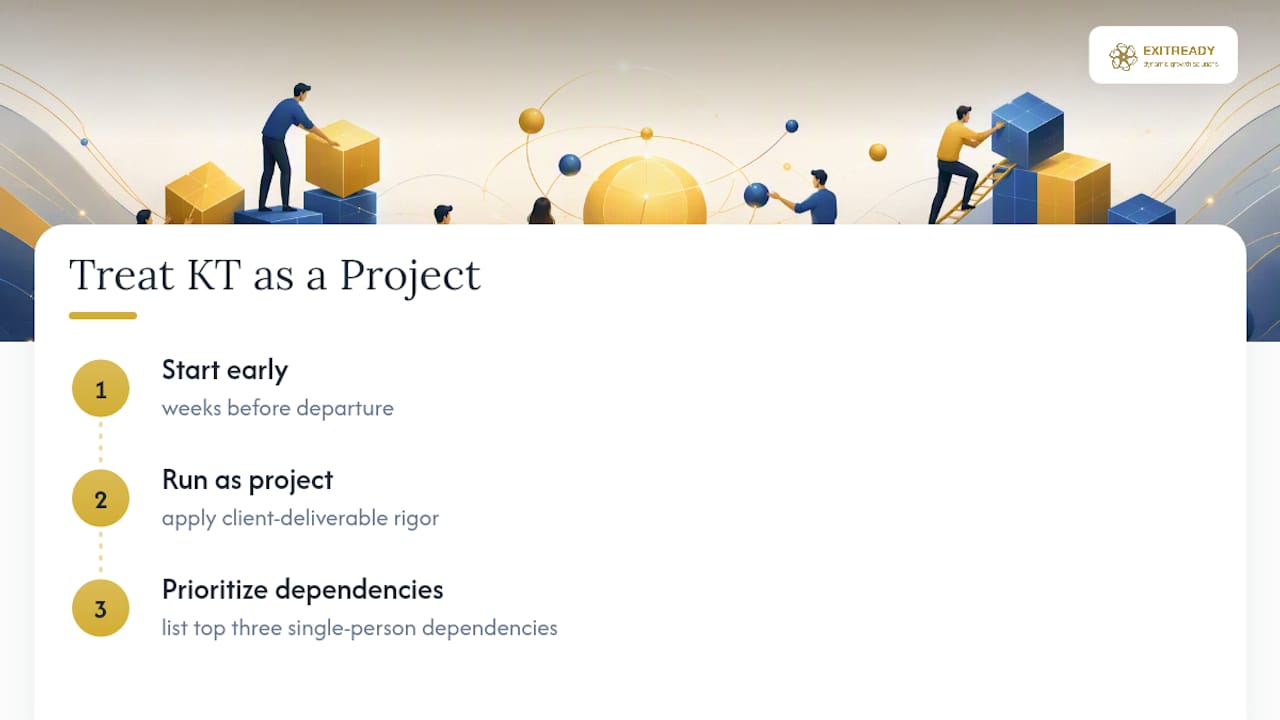
The payoff goes beyond avoiding a rocky transition. A business that can move people in and out of roles without operational disruption is a business that scales without the owner personally absorbing every gap. That’s the same quality buyers look for when assessing whether a company is exit-ready.
Start this week with one action: list your top three single-person dependencies. Whatever role would cause the most damage if that person quit tomorrow, that’s where your first plan belongs, not the role that happens to be easiest to document.
— Andre
Get Help Building and Running Your Knowledge Transfer Plan
Most mid-market leaders don’t lack the desire to document their operations. They lack the hours. Dynamicgrowthsolutions exists for exactly that gap: instead of building a knowledge transfer plan alone on top of an already full week, you get a diagnostic-first process that identifies your highest-risk single-person dependencies before you write a single procedure.

A scoping call through the Growth Sprint or Performance Sprint programs starts with an operational assessment, maps your critical role dependencies against real business impact, and produces a suggested playbook structure your team can execute immediately, priced from $7,500 for the Growth Sprint. For leaders who want the knowledge transfer work embedded directly into their own leadership routine rather than delegated, Elite 1-on-1 Coaching at $3,200 per month builds documentation habits and validation checkpoints into your regular schedule. Either way, the next step is the same: schedule a strategy call and get a concrete plan for your highest-risk roles before the next departure forces your hand.
Sources
- Knowledge transfer plans: the key to your business’s continuity
- 4 practical steps to an effective knowledge transfer plan
- Knowledge management and transfer (Deloitte Insights)
- Knowledge management strategy: A 2026 guide (Salesforce)
FAQ
What Should a Knowledge Transfer Plan Include?
A complete plan includes role responsibilities, critical processes, active projects, key contacts, systems and access details, decision rules, a transfer method for each knowledge item, a timeline with milestones, and a validation step such as a dry run. Every field needs a named owner and a way to record evidence, not just a checkbox.
What Is a Knowledge Transfer Program?
A knowledge transfer program is a structured, often company-wide system for moving critical expertise between employees during role changes, promotions, or departures. It usually pairs individual transfer plans with broader governance: named content owners, a review cadence, and a documentation platform that keeps knowledge current rather than letting it decay.
What Is a KT Checklist?
A KT checklist is the verification tool a manager uses to confirm a knowledge transfer plan is actually complete, covering items like documented processes, granted system access, completed shadowing sessions, and a passed dry run. It’s the difference between assuming a handover worked and proving it.
What Are the Four Stages of Knowledge Transfer?
The four stages are identify, capture, share, and apply. A manager identifies who holds critical knowledge, the subject matter expert captures it in a usable format, the receiving employee learns it through shared instruction, and then applies it independently while the expert is still available to correct mistakes.