
A management meeting agenda is a one-line purpose plus a short list of items framed as questions or decisions, each with an owner, a timebox, and a labeled outcome (Decide, Discuss, or Inform). Attach pre-reads, share it 24 to 48 hours ahead, and close with named action items and deadlines. Everything else below is template and process.
TL;DR:
- Clear agenda items should be framed as specific questions with assigned owners and strict timeboxes to ensure focused decision-making.
- Distributing agendas 24 to 48 hours in advance maximizes preparedness and reduces unproductive status updates during the meeting.
- Limiting meeting content to 3 to 6 high-priority items prevents agenda overload and maintains urgency for essential topics.
- Using templates for different meeting types standardizes structure and enhances efficiency, especially for recurring leadership or strategy sessions.
- Recording decisions, action items, and deadlines immediately after the meeting is crucial for follow-through and turning discussions into results.
Table of Contents
- What Should a Management Meeting Agenda Include? A Quick Checklist
- The Anatomy of an Effective Management Meeting Agenda
- How to Write a Management Meeting Agenda in Under 10 Minutes
- Four Ready-to-Use Management Meeting Agenda Templates
- Running the Meeting: Facilitation, Closeout, and Follow-Up
- Tools and Timing: Getting the Agenda in Front of People Early
- How Dynamic Growth Solutions Turns Agendas Into Leadership Systems
- An Editorial Take on Agenda Discipline and Leadership Capacity
- Build the System Behind the Agenda
- Sources
What Should a Management Meeting Agenda Include? A Quick Checklist
Before you open a blank doc, run through this list. It works for almost any recurring management meeting and takes less time to apply than it does to read.
- Purpose: one sentence stating why this meeting exists this week.
- Attendees: required vs. optional, so people who don’t need to be there aren’t stuck sitting through it.
- Date, time, and length: stated up top, not buried in a calendar invite nobody reopens.
- Items as outcomes: each line answers “what happens when this item is done?”
- Owner per item: the person driving the topic, not just the person who raised it.
- Timebox per item: a number of minutes, visible next to the item.
- Pre-reads: linked documents attendees review before, not during, the meeting.
- Action items: a reserved block at the end, not an afterthought.
Match the template to the meeting. A weekly coordination sync runs 15 to 30 minutes with 3 to 5 items and the whole team. A weekly manager meeting runs 30 to 45 minutes between a manager and direct reports or peer leads. Monthly strategy sessions run 60 to 90 minutes with department heads reviewing metrics and resource needs. Executive decision sessions run 90 minutes or more, with a small group and a small number of high-stakes calls. As the stakes rise, the item count should shrink, not grow.
The Anatomy of an Effective Management Meeting Agenda
Every strong business meeting agenda is built from five parts, and each one does a specific job.
Purpose and desired outcome. State what the meeting needs to produce, not just what it will cover. “Discuss Q3 hiring” is a topic. “Decide whether to approve two new headcount requests for Q3” is an outcome.
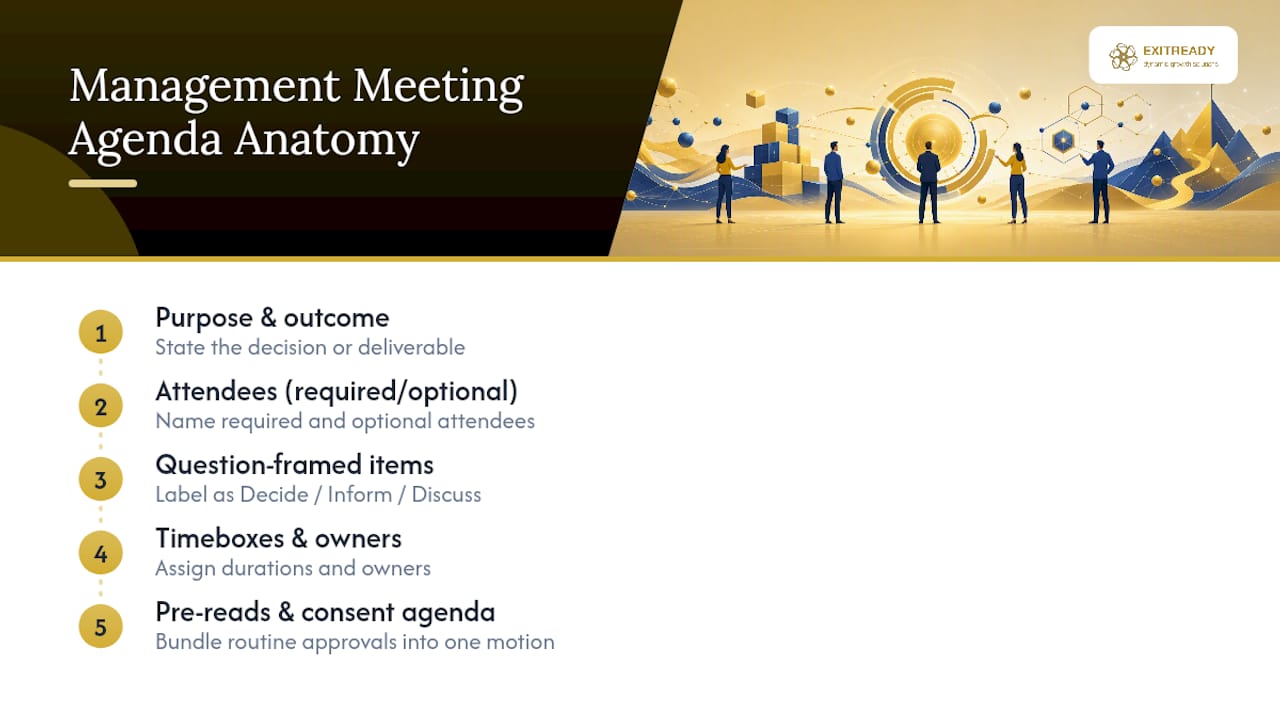
Attendees, required and optional. Naming optional attendees explicitly gives people permission to skip a meeting that doesn’t need them, which is half the battle in most companies with too many meetings.
Items framed as questions, not topics, and labeled by type. Instead of “marketing budget,” write “Should we shift $15,000 from paid social to events for Q4?” Label it Decide. A status update gets labeled Inform. An open problem with no clear answer yet gets labeled Discuss. This single habit, recommended by UseCarly’s meeting agenda guide, does more to focus a meeting than any other change on this list.
Timeboxes and owners. A number next to each item, and a name attached to who’s driving it, turns a wish list into a working plan.
Pre-reads and a consent agenda. Routine approvals (last meeting’s minutes, a report everyone already saw) get bundled into a consent agenda that’s approved in one motion, a structure common in senior leadership meeting formats, freeing live time for the items that actually need a room full of people.
Pro Tip: If you can’t turn an agenda item into a question with a clear answer, it probably doesn’t need a meeting. Send an email instead.
How to Write a Management Meeting Agenda in Under 10 Minutes
Building a useful agenda doesn’t require a long planning session. Here’s the sequence that gets you there fast.
- Write the one-sentence outcome first. Before listing a single topic, finish this sentence: “By the end of this meeting, we will have ______.” If you can’t finish it, reconsider whether the meeting is necessary at all.
- Collect raw topics from your team or your notes, then rewrite each one as a decision question or a stated outcome. “Budget review” becomes “Approve or revise the Q3 marketing budget.”
- Assign an owner to each item. The owner presents it, drives the discussion, and is accountable for the follow-up.
- Give each item a realistic timebox, and put your highest-priority items first. If the meeting runs long, you want the important stuff already decided.
- Attach pre-reads so people arrive having already reviewed the numbers, deck, or memo. A structured agenda with time allocations and pre-reads turns meeting time into decision time instead of discovery time.
- Circulate the agenda 24 to 48 hours in advance. Anything shorter and people show up unprepared anyway.
- Name a facilitator and a note-taker, and reserve the last five to ten minutes for questions, action-item readback, and wrap-up.
Do this weekly and it stops taking ten minutes. It takes three.
Four Ready-to-Use Management Meeting Agenda Templates
Copy any of these into a shared doc or calendar invite and fill in the blanks. All four follow the same anatomy: purpose, items as outcomes, owner, timebox, pre-reads.
Template 1: Weekly coordination sync (45 minutes)
- Purpose: align on this week’s priorities and surface blockers.
- Items: top 3 priorities per person (Inform, 15 min, each owner); blockers needing help (Discuss, 15 min, whole group); decisions needed this week (Decide, 10 min, relevant owner).
- Pre-reads: shared task tracker updated before the meeting.
Template 2: Weekly manager meeting (30 to 45 minutes)
- Purpose: review team health, escalate risks, unblock direct reports.
- Items: manager updates by exception (Inform, 10 min); active blockers or escalations (Discuss, 15 min); one decision the manager needs from leadership (Decide, 10 min).
- Pre-reads: a one-page status summary from each manager.
Template 3: Monthly strategy meeting (60 to 90 minutes)
- Purpose: review performance against goals and set resourcing for next month.
- Items: metrics review against targets (Inform, 15 min); top three strategic risks (Discuss, 30 min); resource or budget requests (Decide, 30 min).
- Pre-reads: dashboard export and department summaries. A monthly cadence tied to an execution framework keeps these meetings from drifting into status theater.
Template 4: Executive decision session (90+ minutes)
- Purpose: make a small number of high-stakes calls.
- Items: consent agenda for routine approvals (Inform, 5 min); one to three core decisions (Decide, 60 to 75 min); executive session for sensitive topics (Discuss, 15 min, restricted attendance).
Standardizing around a small set of templates for recurring meeting types means new managers stop rebuilding the wheel every Monday morning.
Running the Meeting: Facilitation, Closeout, and Follow-Up
The agenda gets you to the room prepared. What happens next determines whether the meeting was worth holding.
During the meeting, the facilitator’s job is timekeeping, steering discussion back to the labeled outcome, and managing a parking lot for good ideas that don’t belong in this meeting. A visible parking lot lets you say “great point, let’s capture that and move on” without losing it or derailing the agenda. When an item runs over its timebox, the facilitator has three real options: extend it and cut something else, park it for offline resolution, or push it to the next meeting. Whichever you pick, write it in the minutes.
At closeout, every decision gets recorded with an owner, a due date, and a way to verify it happened. Read the action items back out loud before anyone leaves. Sending minutes within 24 hours of the meeting keeps that momentum intact, a habit Slack’s research on team meetings ties directly to follow-through. Track those items in a shared tracker or project tool rather than a static document, since pairing agendas with a minutes template and action tracker is what actually converts decisions into completed work instead of good intentions that quietly die in a doc nobody reopens.
Tools and Timing: Getting the Agenda in Front of People Early
The single highest-leverage habit in this entire guide is timing. Agendas distributed 24 to 48 hours before a meeting give people time to prepare; agendas that show up minutes before the call are effectively useless, because nobody has read the pre-reads and the meeting reverts to status reporting.
A few practical notes on execution:
- Shared docs, calendar attachments, or dedicated agenda software all work. Pick whichever your team already checks daily.
- Integrating with tools like Slack, Asana, or your calendar system cuts the friction of circulating agendas every week.
- Recurring meetings deserve a recurring template you duplicate, not a fresh document each time.
- For distributed teams across time zones, schedule the highest-priority decision items early, before anyone starts watching the clock. Planning around time zones prevents your most important agenda item from landing in the last five minutes for half the room.
- Keep it to 3 to 6 items for most meetings. More than that, and something on the list didn’t need this meeting at all.
How Dynamic Growth Solutions Turns Agendas Into Leadership Systems
A company may build documented playbooks so meeting discipline doesn’t live in one manager’s head. Two examples from that library:
- A minute-by-minute daily huddle script that keeps a 12-minute standup on rails without a facilitator improvising each time.
- A 30/60/90-day onboarding cadence for new managers, where each meeting in the sequence has a defined outcome, from “understand the team’s current blockers” at day 30 to “own the weekly agenda independently” by day 90.
Documented runbooks like these are what let business transformation efforts hold together after the owner stops running every meeting personally.
An Editorial Take on Agenda Discipline and Leadership Capacity
Most managers treat agendas as paperwork. They’re actually the cheapest leverage a leader has. A team that runs disciplined, decision-labeled meetings frees its leadership to focus on the few calls that matter, instead of narrating updates that a shared doc could have handled. That’s not a scheduling fix. It’s a capacity fix.
— Andre
Build the System Behind the Agenda
A better agenda template fixes one meeting. A documented operating system fixes every meeting, because it defines who owns what before the invite even goes out. That’s the gap between a manager running good meetings and a business that doesn’t depend on any one person to run them. If your leadership team is still rebuilding structure from scratch every week, it’s worth looking at how a business operating system replaces that improvisation with a repeatable framework, one built for mid-market companies working toward operational independence and a stronger eventual valuation.
Sources
- Making the most of your meetings: agendas and action items (Berkeley BPMO)
- How to create effective team meeting agendas — Slack
- How to Write a Meeting Agenda (With 5 Free Templates) — UseCarly
- Parking lot (Facilitator School)
- Meeting agenda examples: 10 templates for every team meeting — Meistertask