
Reps and warranties insurance shifts the financial risk of an unknown breach of a seller’s representations from the deal parties to an insurer, and buyers hold the majority of these policies. It typically replaces or shrinks the escrow a seller would otherwise leave behind, stretches the window for recovery well past the usual 12 to 18 month indemnity period, and speeds up how fast a deal closes without a drawn-out indemnity fight.
TL;DR:
- Buyers typically purchase most R&W policies, which can replace or reduce escrow, and offer longer recovery periods than the usual 12 to 18 months.
- Coverage is primarily useful in competitive auctions, private equity exits, and small growth investments, but excludes known risks and flagged liabilities.
- Program costs depend on deal size, with retention levels usually between 0.3% and 1.0% of enterprise value, and policies often last three to six years.
- Underwriters review existing diligence rather than performing independent checks, making early broker engagement crucial for comprehensive coverage.
- Post-closing, the insurer replaces the seller in claims, incentivizing broader representations upfront and requiring seller cooperation during claims investigations.
Table of Contents
- What Is Reps and Warranties Insurance, and What Does a Policy Actually Cover?
- When Does R&W Insurance Actually Pay Off for a Deal?
- How Much Does R&W Insurance Cost, and What Are the Standard Terms?
- How Does the Underwriting Process Work, and How Long Does It Take?
- What Happens When a Claim Gets Filed?
- How Are Advisors Using R&W Insurance to Structure Deals?
- Does Jurisdiction Change What an R&W Policy Actually Covers?
- Are There Tax Consequences to Buying or Using an R&W Policy?
- What Does an R&W Insurance Broker Actually Do, and How Do You Pick One?
- What Exclusions Should You Expect, and How Does Fraud Change the Picture?
- How Does R&W Coverage Change the Indemnity Conversation After Closing?
- Building R&W Coverage Into Exit Planning, Not Just Closing Mechanics
- How Dynamicgrowthsolutions Helps Sellers Get Underwriting Ready
- Sources
What Is Reps and Warranties Insurance, and What Does a Policy Actually Cover?
Reps and warranties insurance (often shortened to R&W insurance or RWI) pays out when a seller’s representations in a purchase agreement turn out to be false, and that breach causes a covered financial loss. The insurer steps into the shoes of the seller’s indemnity obligation, so the buyer collects from a carrier instead of chasing a former owner who may have already spent the sale proceeds.
Buyer-side and seller-side policies work differently. A buyer-side policy is purchased by the buyer, pays claims directly to the buyer, and usually includes coverage for seller fraud, a feature seller-side policies rarely offer. A seller-side policy sits behind the seller’s own indemnity obligation and only reimburses the seller after they’ve paid a buyer claim, which is why buyer-side has become the dominant structure in the middle market.
Every policy excludes certain categories:
- Known or disclosed matters flagged anywhere in diligence or disclosure schedules
- Purchase price adjustments, covenant breaches unrelated to reps, and forward looking projections
- Certain environmental, pension, or transfer pricing exposures unless specifically underwritten
- Criminal fines, punitive damages in most jurisdictions, and asbestos or PFAS liabilities in many programs
When Does R&W Insurance Actually Pay Off for a Deal?
The clearest benefit is capital efficiency.
R&W insurance tends to earn its premium in these situations:
- Competitive auctions, where a buyer offering low escrow and a short seller survival period stands out to sellers
- Private equity exits, where funds need to distribute proceeds to limited partners on a schedule and can’t wait on a multiyear escrow release
- Minority or growth equity investments, where ongoing relationships between buyer and seller make a direct indemnity claim awkward
It’s the wrong tool when the target has known regulatory exposure, pending litigation, or liabilities the buyer has already identified and priced into the deal. Insurers won’t cover what’s already flagged, so those risks still need a negotiated indemnity, a specific escrow, or a purchase price adjustment.
How Much Does R&W Insurance Cost, and What Are the Standard Terms?
Program size scales with the deal. Limits typically run a moderate percentage of total enterprise value, and pricing follows a rate on line convention that most brokers can quote within a range once they see the target’s industry and diligence quality, according to Vanbridge’s reference guide.
A few structural norms show up on nearly every deal:
- Retentions now trend between 0.3% and 1.0% of enterprise value, often dropping to zero for a limited period, then stepping down further
- Underwriting fees are charged separately from the premium, are non-refundable, and should be budgeted before the process starts
- Policy terms run 3 years for general representations and stretch to 6 years for fundamental and tax representations, matching standard market convention
- Fundamental reps (organization, capitalization, authority) commonly get a reduced or zero retention, since they carry a lower breach risk than operational reps
Sellers negotiating survival periods and escrow size should treat these figures as a starting point, not a ceiling. A seller-focused breakdown of escrow and survival tactics shows how much room there often is to push retention and survival lower than a first quote suggests.
How Does the Underwriting Process Work, and How Long Does It Take?
Underwriters describe their job as “diligencing the diligence.” Rather than running independent due diligence from scratch, the insurer reviews what the buyer’s own legal, financial, and tax advisors already found, then decides what to insure and what to exclude.
- The broker circulates a summary of the deal to multiple carriers, who respond with a non-binding indication letter (NBIL) covering estimated pricing, retention, and coverage scope.
- The buyer pays a one-time underwriting fee, and the selected insurer’s team, often including outside counsel, gets access to the data room and diligence memos.
- Underwriting counsel holds a call with buyer’s counsel to walk through open issues, then drafts the policy with specific exclusions for anything not adequately diligenced.
- The policy binds either at signing or at closing, depending on deal timeline pressure and how quickly underwriting can finish.
Pro Tip: Get the broker engaged the same week you sign the letter of intent. Underwriting on a tight signing-to-closing window is the single most common reason coverage ends up narrower than a buyer expected.
What Happens When a Claim Gets Filed?
A covered breach means a representation was false as of signing or closing, and that falsehood produced a quantifiable loss that isn’t caught by an exclusion. Materiality scrapes, which strip out materiality qualifiers when calculating damages, and knowledge qualifiers tied to specific individuals both shape whether a claim even clears the threshold.
Insurers retain subrogation rights against a seller in cases of actual fraud, since fraud coverage protects the buyer, not the party who committed it. Practical claim prep looks like this:
- Document the loss with the same rigor a forensic accountant would use, tying the number back to specific financial statement line items
- Identify exactly which representation was breached and cite the underlying evidence
- Loop in coverage counsel early, since ambiguous survival and materiality language is where most disputes actually get decided
How Are Advisors Using R&W Insurance to Structure Deals?
Private equity buyers now use R&W insurance on a large share of their middle-market acquisitions, and adoption keeps climbing among strategic buyers who once relied only on traditional indemnity. Roughly one-third of North American M&A disputes trace back to alleged breaches of reps and warranties, which is exactly the exposure this coverage is built to absorb.
Deal teams lean on it in a few specific ways:
- Buyers offer minimal escrow and short seller survival in an auction to make their bid stand out against competing offers
- Sellers push for R&W specifically so they can distribute sale proceeds to partners or reinvest without a multiyear holdback hanging over them
- Advisors use the policy’s fraud coverage as a selling point to sellers who are nervous about personal liability lingering after closing
Does Jurisdiction Change What an R&W Policy Actually Covers?
Where the target company operates, and which state’s or country’s law governs the purchase agreement, changes more about an R&W policy than most first-time buyers expect. Coverage interpretation follows the governing law clause in the underlying purchase agreement, so a policy written for a Delaware-governed deal reads differently than one covering a target with California employment exposure or a multinational subsidiary structure.
Cross-border deals add real complexity. Insurers frequently exclude or heavily sublimit coverage for jurisdictions with weak corporate disclosure norms, and they’ll often require local counsel opinions before extending full limits to a foreign subsidiary. Tax representations get scrutinized hardest, since tax authorities in different countries treat successor liability and transfer pricing very differently, and an insurer won’t take on exposure it can’t model.
Domestically, state-level differences still matter. Employment law, environmental liability, and licensing requirements vary enough between states that a target operating across a dozen jurisdictions can trigger a longer underwriting review than a single-state business of the same size. Insurers may carve out state-specific regulatory exposure entirely, pushing that risk back onto a negotiated indemnity rather than the policy.
Claims disputes follow the same pattern. Where the policy specifies arbitration versus litigation, and under which jurisdiction’s procedural rules, shapes how fast a dispute resolves and how much it costs to fight. Deal teams working across multiple states or countries should ask their broker for jurisdiction-specific underwriting notes before assuming a quote from one deal will transfer cleanly to another.
Are There Tax Consequences to Buying or Using an R&W Policy?
The premium itself is generally treated as a transaction cost, and how it gets characterized, capitalized as part of the deal or expensed, depends on which party pays it and how the payment is structured in the purchase agreement. Buyers who pay the premium often look to allocate a portion of that cost into the overall transaction expense analysis, which can affect deductibility depending on the structure of the acquisition.
Insurance proceeds received under a claim generally follow the tax treatment of the underlying loss they’re replacing. If the policy pays out for a breach that would have reduced the seller’s indemnity obligation, and that obligation would have been treated as a purchase price adjustment, the insurance recovery often gets the same characterization. That distinction affects whether the recovery is taxable income to the buyer or simply treated as a reduction in the amount originally paid for the business.
Cross-border deals introduce another layer: insurance proceeds paid to a buyer in one country from a carrier domiciled in another can trigger withholding tax questions or treaty analysis that a purely domestic deal never faces. None of this is a substitute for a real opinion from deal counsel and a tax advisor who’s looked at the actual purchase agreement language, because premium allocation and proceeds characterization get negotiated deal by deal, not set by a fixed rule. Any tax position taken on an R&W program should get sign off from the transaction’s tax counsel before the return is filed, not after.
What Does an R&W Insurance Broker Actually Do, and How Do You Pick One?
A broker’s job starts well before the policy is placed. They run the NBIL process across multiple carriers simultaneously, translate underwriter feedback into language deal counsel can act on, and negotiate exclusions down to something narrower than the first draft. A broker who’s placed dozens of programs a year has real leverage with underwriters that a generalist commercial insurance broker simply doesn’t.
Experience shows up in a few concrete ways. A seasoned R&W broker can usually predict which representations will draw underwriter pushback before the data room even opens, because they’ve seen the same fact pattern on other deals. They also know which carriers move fastest on a compressed timeline and which ones specialize in specific industries like healthcare or software, where regulatory or IP risk needs an underwriter who actually understands the sector.
When picking a broker, ask about deal volume in the past 12 months, not just years in the business. Ask for references from deal counsel who’ve worked with them on a claim, not just a placement, since claims handling is where a mediocre broker relationship becomes obvious. The role advisors play across an exit transaction extends well past the broker, and coordinating broker, coverage counsel, and deal counsel early tends to produce a tighter, cheaper policy than bringing the broker in after terms are already set.
What Exclusions Should You Expect, and How Does Fraud Change the Picture?
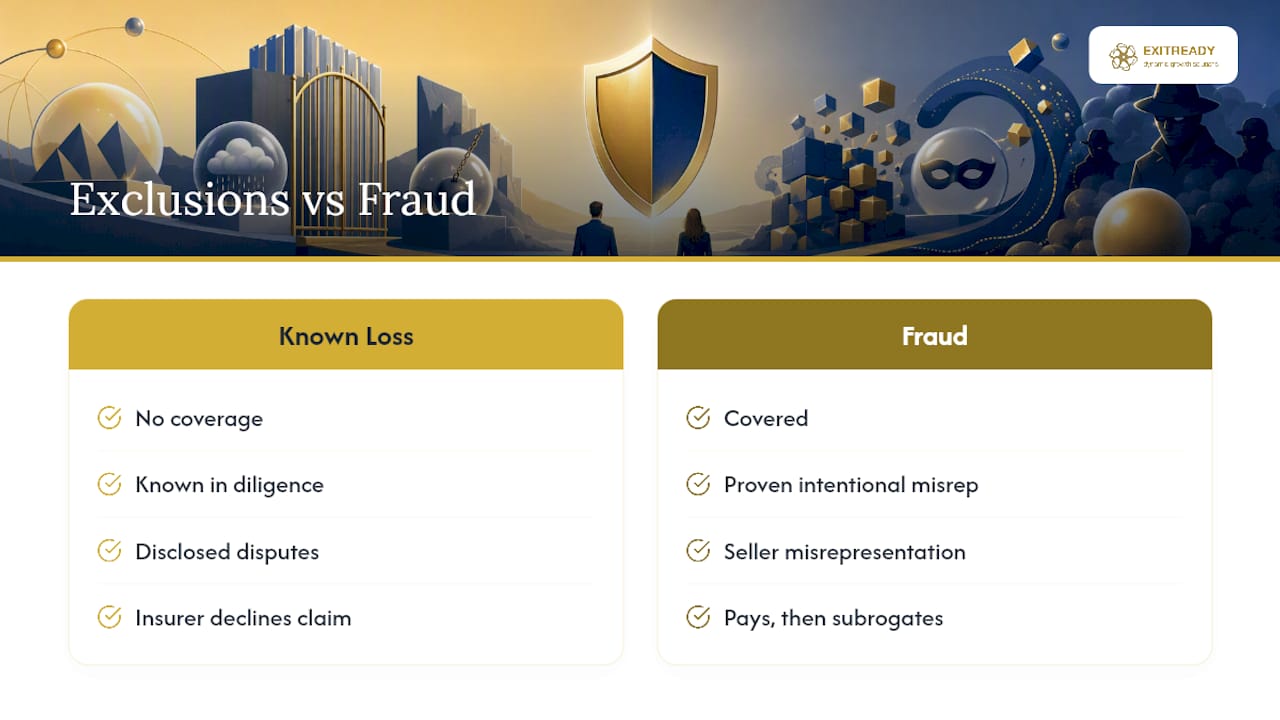
The known loss endorsement is the exclusion that catches the most first-time buyers off guard. It bars coverage for any matter identified during diligence, disclosed in the schedules, or otherwise known to the buyer’s deal team before signing, regardless of whether that item made it into a specific representation. If diligence flagged a pending customer contract dispute, that dispute is excluded even if the seller never separately disclosed it, because the insurer treats “known to buyer” as the trigger, not “disclosed by seller.”
Fraud sits in a different category entirely. Buyer-side policies typically extend coverage for seller fraud, meaning the buyer can still collect from the insurer even when the breach involved intentional misrepresentation, something a seller-side policy generally won’t offer since it would let a fraudulent seller profit from their own insurance. When actual fraud is proven, insurers retain the right to pursue the seller directly through subrogation, recovering what they paid the buyer from the party who committed the fraud.
Other standard carve outs include forward-looking projections, purchase price adjustment mechanisms already covered elsewhere in the agreement, and covenant breaches unrelated to a specific representation. Environmental and pension liabilities often need a separate rider rather than falling under the base policy. The practical lesson: thorough due diligence before signing isn’t optional groundwork, it’s what determines how broad the eventual coverage actually is, since anything the buyer’s team missed in diligence but should have caught can still get excluded after the fact.
How Does R&W Coverage Change the Indemnity Conversation After Closing?
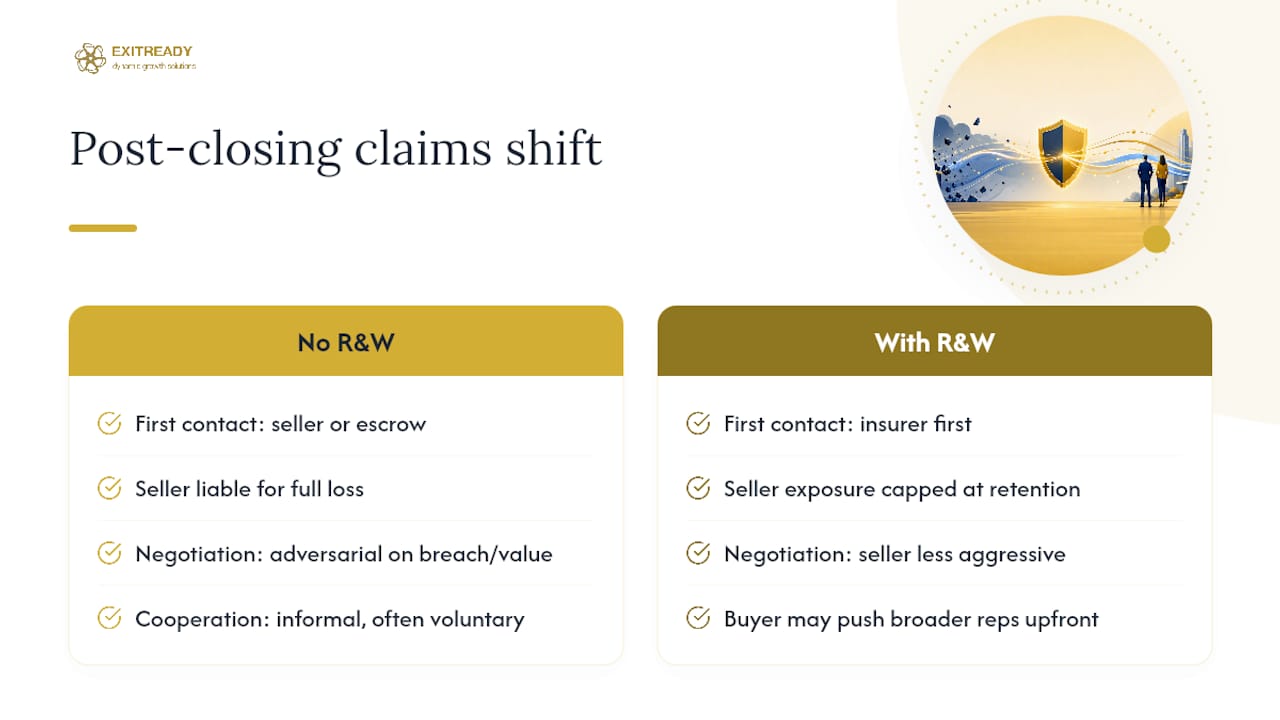
Post-closing, the presence of an R&W policy fundamentally changes who the buyer calls first when a problem surfaces. Without insurance, a buyer goes straight to the seller (or the escrow agent) and often ends up in a direct, adversarial negotiation over whether a breach occurred and how much it’s worth. With a policy in place, that first call goes to the insurer, and the seller is frequently insulated from the claim entirely once the retention is exhausted.
That shift changes incentives during negotiation. Sellers who know a buyer has full R&W coverage tend to negotiate the underlying purchase agreement’s indemnity language less aggressively, since their actual exposure is capped at the retention rather than the full loss. Buyers, in turn, sometimes push harder for broader representations up front, knowing the insurer, not the seller, will bear most of the cost if something goes wrong later.
Claims cooperation becomes a defined contractual obligation rather than a courtesy. Most policies require the seller to cooperate with the insurer’s investigation of a claim, since the insurer often needs seller testimony or documents to evaluate whether a breach actually occurred. That cooperation requirement gets written directly into the purchase agreement, meaning a seller who’s fully exited the business still has a lingering obligation to respond to information requests tied to a claim years after closing. Deal counsel should flag this cooperation clause during negotiation, since a seller who’s moved on to a new venture may resist a demand to produce records or personnel for a claim investigation long after the deal closed.
Building R&W Coverage Into Exit Planning, Not Just Closing Mechanics
R&W insurance closes deals faster when preparation starts months before a term sheet exists, not the week diligence begins. Sellers who already have clean financials, documented processes, and a clear disclosure history give underwriters less to question and get tighter, cheaper terms. Treat readiness as part of the exit strategy, not a scramble triggered by a signed letter of intent.
— Andre
How Dynamicgrowthsolutions Helps Sellers Get Underwriting Ready
Underwriters move fastest on sellers who can hand over clean financials, a documented history of operations, and disclosure schedules that don’t require three follow up calls to clarify. That’s the exact gap Dynamicgrowthsolutions closes. Instead of scrambling to assemble records once a term sheet lands, sellers who’ve already built out a documented business operating system walk into underwriting with the playbooks, delegation records, and remediation history that insurers ask for anyway.

The exit-readiness certification process built into a proprietary program specifically targets the documentation gaps that slow down NBIL-to-bind timelines: financial hygiene, contract organization, and a defensible No Claims Declaration a seller can actually stand behind. Fewer open questions for underwriters means fewer excluded representations and a faster path to a bound policy. If you’re planning a sale in the next 12 to 24 months, consider how a documented operating system can shrink that underwriting friction before your broker ever sends the first NBIL request.
Sources
- Representations and warranties insurance
- The Continued Rise of Representations and Warranties Insurance
- Representations and warranties insurance: fundamentals and practical considerations
- Reps & Warranties Reference Guide (Vanbridge)