
A revenue operations framework, in the AOS sense, is a documented operating system of processes, playbooks, decision rights, and leadership roles that runs the business without the owner in the room. Building one lowers owner workload, makes revenue transferable, and directly raises what a buyer will pay. Dynamic Growth Solutions built its Accelerated Operating System (AOS) around exactly this sequence: assess, document, delegate with real authority, and certify the result.
TL;DR:
- Most owner-dependent processes should be documented first, focusing on high-risk areas like customer onboarding and order fulfillment to reduce reliance.
- Delegating authority involves setting explicit decision limits and testing with controlled absences to ensure processes can run independently.
- Building a robust revenue operations framework takes three to five years, with 12 to 24 months of focused effort needed to significantly reduce owner dependency.
- The framework’s effectiveness is proven when a business can operate smoothly during owner absence, verified through milestone certification and regular testing.
- Implementing structured programs with assessment, documentation, delegation, and certification outperforms trial-and-error approaches and shortens the path to exit readiness.
Table of Contents
- What Are the Core Components of a Revenue Operations Framework?
- How Do You Build a Revenue Operations Framework Step by Step?
- What Metrics and Dashboards Prove the Framework Is Working?
- What Are the Biggest Pitfalls in Building This Framework?
- What Timeline Should You Expect to Remove Owner Dependency?
- How Should Sales, Marketing, and Customer Success Stay Aligned?
- What Technology Should Support the Framework?
- What Does a Successful Framework Look Like in Practice?
- Why Applying Fortune 500 Systems to Mid-Market Companies Works Differently
- Build the Framework With a Structured Program Instead of Trial and Error
- Sources
What Are the Core Components of a Revenue Operations Framework?
Every mid-market company runs on tribal knowledge before it runs on documentation. The fix starts with naming the handful of processes where the owner is the single point of failure and writing them down before anything else.
Start documenting in this order: customer onboarding, pricing exceptions, order fulfillment, and escalation handling. These four areas cause the most fires when the owner is unreachable, and they’re usually the least documented because they live entirely in someone’s head. PCE’s guidance on reducing owner dependency points to the same pattern: systematized operations and shared customer relationships are what actually move the needle on buyer confidence, not vague intentions to “delegate more.”
A framework also needs a decision-rights matrix, not just a task list. Assigning someone a task is not the same as giving them authority to decide. If every pricing exception still routes back to the owner for a yes or no, nothing has actually changed, no matter how many tasks got reassigned.
The building blocks worth auditing:
- One-page SOPs for the highest-risk recurring processes, each with named acceptance criteria.
- A decision-rights matrix that states who can approve what, up to what dollar or scope threshold, without asking permission.
- Second-tier leadership roles (an operations lead, a sales manager, a client success owner) who hold real authority, not just oversight.
- A single source of truth where SOPs, contracts, and KPIs live, typically the CRM for process and a shared drive or knowledge base for documentation, feeding one financial dashboard everyone reads from.
Pro Tip: If you can’t find the current version of a process document in under 60 seconds, your “documentation” is decoration, not infrastructure. Fix retrieval before you write another SOP.
Buyers weigh this heavily. Legacy Advisors’ research on exit readiness found that missing documentation, at both the SOP level and the organizational level (org charts, contracts, decision logs), lengthens due diligence and pulls valuation down. Documentation isn’t paperwork. It’s proof the company runs on systems instead of memory.
How Do You Build a Revenue Operations Framework Step by Step?
You don’t overhaul everything at once. You find the riskiest owner-dependent tasks, fix those first, and prove the fix works before moving to the next layer.
- Run a rapid assessment. List every task that only the owner can do, then rank each by how often it happens and how badly the business would suffer if the owner vanished for a week.
- Prioritize by impact and replaceability. Attack the tasks that are both high-frequency and hardest to hand off first. Low-stakes busywork can wait.
- Write one-page SOPs with acceptance criteria. Keep each document to a single page with a training checklist attached, so a new hire can self-certify against it. Owner Financial’s approach recommends the “70% rule”: hand off a process once someone can do it 70% as well as you, then improve it in place instead of waiting for perfection.
- Delegate with actual authority, not just tasks. Set explicit decision bands (dollar limits, scope limits) and run trial transfers before making them permanent. Delegation that keeps approval power with the owner isn’t delegation. Careerminds’ research on delegation confirms this is the single biggest behavioral shift owners have to make, and the one most skip.
- Test it with a controlled absence. Step away for five to ten business days and let leadership run the company. Baton Market’s data on owner dependency shows this is one of the most reliable ways to surface exactly where decisions stall and where the team still defaults back to the owner.
- Certify and iterate. Use milestone checkpoints, similar to how AOS structures its certification process, to confirm each function actually operates independently before calling it done, then revisit quarterly.
The absence test tends to be the most humbling step in this list. Owners routinely discover that three or four “delegated” processes still funnel back to them through a side channel, a text message, a hallway conversation, that never showed up on the org chart.
Our business scalability checklist walks through this assessment in more detail if you want a structured starting point.
What Metrics and Dashboards Prove the Framework Is Working?
A framework only counts as real once you can see, in numbers, that the business runs without the owner’s daily input. That means tracking outputs, not activity.
The core KPI set worth building a dashboard around:
- Revenue by channel (not just total revenue, since channel mix reveals concentration risk)
- Customer acquisition cost (CAC) and lifetime value (LTV)
- Gross margin by product or service line
- Cash conversion cycle
- Retention and churn rate
- Sales and fulfillment backlog
Reporting needs a fixed cadence, not an ad hoc one. Weekly scorecards should cover leading indicators like pipeline and backlog. Monthly reviews belong to the financials: margin, cash position, and burn. Quarterly reviews should tie performance back to strategic goals, with a named owner presenting each metric, not the CEO relaying secondhand numbers.
| Cadence | Who presents | Primary focus |
|---|---|---|
| Weekly | Function leads | Pipeline, backlog, escalations |
| Monthly | Finance lead | Margin, cash, CAC/LTV trend |
| Quarterly | Leadership team | Strategic KPIs, goal tracking |
Dashboard design matters more than most owners assume. One single-page leadership view, backed by function-specific dashboards underneath it, keeps everyone reading from the same numbers instead of arguing over whose spreadsheet is right. Our guide to business performance metrics breaks down which numbers matter most by function, and Kelliworks’ explainer on financial dashboards is a solid resource for the underlying design principles.
What Are the Biggest Pitfalls in Building This Framework?
The most common failure is delegation without authority. A manager gets a task but still needs the owner’s sign off, so every handoff stays brittle and the owner never actually steps back.

The second failure is quieter: undocumented exceptions. Pricing exceptions and client handoffs that never make it into an SOP become invisible dependencies that resurface the moment the owner is unavailable.
Governance prevents backsliding:
- Set a fixed meeting rhythm with clear escalation rules, so decisions have a defined path that doesn’t default to the owner.
- Require acceptance criteria before any role is considered “trained,” not just “briefed.”
- Schedule a controlled absence periodically, not once, to catch new dependencies as the business grows.
- Review SOPs on a quarterly cycle since a process that was accurate a year ago rarely still is.
Pro Tip: Run a mock diligence exercise once a year, treating your own documentation the way a buyer’s advisor would. It exposes gaps faster than any internal review.
What Timeline Should You Expect to Remove Owner Dependency?
This is architectural work, not a weekend project. Owner Financial’s research puts full readiness at three to five years, with 12 to 24 months of focused effort enough to move the needle meaningfully.
- Months 3 to 6: Document the highest-risk owner tasks and delegate one or two roles with real decision authority.
- Months 12 to 24: Build stable second-tier leadership, establish consistent financial reporting cadence, and document the majority of revenue-generating processes.
- Month 36: Complete the architectural redesign, transfer routine decision-making fully, and reach certified exit readiness.
Each phase changes how a buyer reads the business. Beckley & Associates’ valuation research points to a direct link: businesses that reduce owner dependency through leadership multiplication and operational scalability face fewer valuation discounts and shorter diligence timelines. Buyers aren’t just paying for revenue. They’re paying for revenue that keeps flowing after the owner leaves the building.
How Should Sales, Marketing, and Customer Success Stay Aligned?
Revenue leaks at the handoffs. A lead that marketing qualifies but sales ignores, a deal sales closes with promises customer success never hears about, an expansion opportunity customer success spots but never routes back to sales. None of that is a talent problem. It’s a structure problem.
The fix is a shared definition of the customer journey with explicit handoff criteria at each stage. Marketing needs a documented standard for what counts as a qualified lead before it reaches sales. Sales needs a documented handoff packet, contract terms, promised timelines, any custom commitments, before an account reaches customer success. Customer success needs a defined trigger point for flagging expansion or renewal risk back to sales.
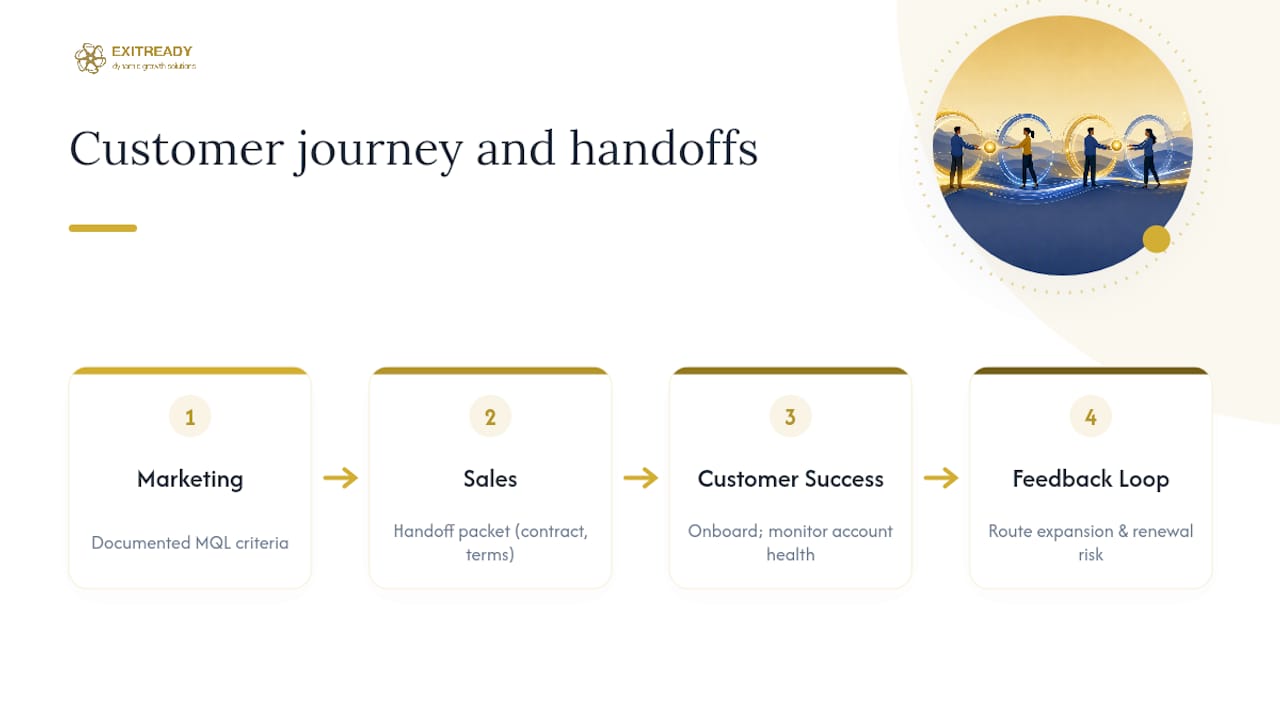
Without those documented handoffs, each function optimizes for its own metrics and the customer feels the seams. Marketing hits lead volume targets while sales complains the leads are junk. Sales hits closing targets while customer success inherits accounts nobody prepared them for.
The practical fix is a shared dashboard, not three separate ones. If marketing, sales, and customer success are each reporting numbers that don’t reconcile against a common revenue view, alignment is a slogan, not a system. Weekly cross-functional syncs with a fixed agenda, pipeline health, handoff exceptions, at-risk accounts, tend to catch the leaks before they become churn. This is one of the areas an AOS-style build addresses directly, since decision rights and reporting cadence get defined once for the whole revenue engine instead of separately for each department.
What Technology Should Support the Framework?
The temptation is to buy software before the process is documented. That order is backwards. A CRM configured around an undocumented sales process just automates the chaos faster.
Get the process right first, then choose tools that enforce it. A CRM should mirror the decision-rights matrix, not just track contacts, meaning pricing exceptions and approval thresholds get built into the workflow so they can’t be skipped informally. Financial dashboards should pull from the same source of truth as the SOPs, so the numbers leadership reviews weekly match what the documentation says should be happening.
Integration matters more than any single tool’s feature list. A CRM, a financial reporting tool, and a project or fulfillment system that don’t talk to each other force someone to manually reconcile data every week, which quietly reintroduces the owner as the human integration layer. Magnifi2’s resources on rollout planning cover how to sequence a technology rollout so it reinforces the documented process instead of working around it.
Keep the stack as lean as the business can operate with. Adding a new platform for every function sounds thorough but usually creates more reconciliation work than it saves, and it’s a common reason mid-market companies stall on scaling in the first place, a pattern our guide to why revenue growth stalls covers in more depth.
What Does a Successful Framework Look Like in Practice?
Picture a mid-market services company where the owner personally approved every contract over a modest threshold, ran weekly sales calls, and was the only person who understood the pricing exceptions given to long-term clients. None of that is unusual. It’s the default state for most owner-led businesses at this size.
The fix followed the sequence above almost exactly. Pricing exceptions got written into a one-page SOP with clear bands: anything within the documented range, a sales manager could approve outright; anything outside it required a defined escalation path instead of an open-ended “ask the owner.” Weekly sales calls became a second-tier leader’s responsibility, with a scorecard reporting results up rather than the owner running the room.
The proof came during a controlled absence test. The owner stepped away for two weeks and tracked every question that came up. The first attempt surfaced four processes still quietly routing back through informal channels. Each one got turned into an SOP or reassigned with real authority, and the second absence test months later ran clean.
That’s the pattern across most successful builds: the framework isn’t finished when the documents exist. It’s finished when a controlled absence produces no emergency calls, and buyers evaluating the business can see that proof in the operating history, not just take the owner’s word for it.
Why Applying Fortune 500 Systems to Mid-Market Companies Works Differently
Large enterprises have entire departments dedicated to process design. Mid-market companies have an owner wearing six hats and no time to build a decision-rights matrix from scratch, which is exactly the gap Andre has spent his career closing at Dynamic Growth Solutions.
The AOS methodology sequences assessment, playbook creation, and certification in that order deliberately, because owners who skip the assessment step tend to document the wrong things first. Certification checkpoints and scorecards, the same instinct behind Fortune 500 operating reviews, give both leadership and prospective buyers a concrete artifact instead of a verbal assurance that “things run fine without me.”
The uncomfortable truth most owners resist: the framework isn’t primarily about growth. It’s about proving the growth doesn’t depend on you.
— Andre
Build the Framework With a Structured Program Instead of Trial and Error
Most owners try to build this themselves, one SOP at a time, over a weekend here and a slow quarter there, and lose momentum before the decision-rights work ever gets done. Some consulting firms run this as a structured engagement instead: an operational assessment to find your highest-risk dependencies, playbook development with acceptance criteria built in, a certification process to prove readiness, and a strategic finance cadence to keep leadership reporting on track after the engagement ends.
The engagement follows the same sequence outlined above: assess, document, delegate with real authority, and certify, applied by people who’ve run it across mid-market companies instead of built from scratch under deadline pressure. If you want to see what a structured build actually includes, review Business Transformation Best Practices for Executives, or start with the AOS entrepreneur application to find out where your business stands today.
Sources
- Why Documentation Drives Exit Readiness
- Delegation of authority
- Reducing owner-dependence: how to make your business more valuable | Owner Financial