
Middle management is the organizational layer that turns executive strategy into daily execution, and its role in scaling is the single biggest determinant of whether growth creates value or chaos. Companies moving through the critical 50 to 500 employee growth phase depend on middle managers to carry decisions, culture, and accountability that founders can no longer handle alone. Without this layer functioning well, strategy stalls at the top while frontline teams operate without direction. The businesses that scale cleanly are the ones that invest in this layer before they need it, not after the cracks appear.
What role does middle management play in scaling?
Middle management is the execution engine of any growing organization. Executives set direction. Frontline teams do the work. Middle managers are the mechanism that connects the two. They translate quarterly priorities into weekly tasks, hold teams accountable to outcomes, and surface problems before they reach the boardroom.
The term “middle management” is sometimes used loosely, but the standard organizational behavior definition is precise. Middle managers sit between senior leadership and front-line supervisors or individual contributors. They own a defined scope of operational output and carry responsibility for both people and results within that scope. In scaling companies, this definition matters because the role must be designed, not just filled.
Scaling a mid-market business systematically requires this layer to function as a relay system. When it works, decisions move fast, teams stay aligned, and the CEO stops being the bottleneck. When it fails, every problem escalates upward and growth slows under its own weight.

What challenges does scaling present that middle management must address?
The transition from founder-led to manager-led operations is where most mid-sized companies break down. A founder who managed 15 people through instinct and proximity cannot manage 150 the same way. The organizational complexity multiplies faster than headcount, and without a functioning middle layer, decision quality drops and executive escalation increases.
Three specific problems emerge during this phase:
- Span of control overload. As teams grow, each manager covers more people. Without a formal reset of decision rights, managers become traffic cops rather than coaches. Work piles up, response times slow, and accountability blurs.
- Silent attrition. Employees who feel unsupported or directionless do not always quit loudly. They disengage quietly, reducing output and pulling team morale down before anyone notices.
- Execution gaps. Strategy documents get written, but the gap between strategy and execution widens when no one owns the translation layer. Priorities shift at the top but never reach the team level.
One pattern that catches companies off guard is the instinct to cut middle management during a cost reduction phase. Thinning this layer without redesigning roles pushes decisions back to the C-suite and widens the execution gap further. The fix is not fewer managers. The fix is better-designed management roles.
Pro Tip: Before your next growth phase, audit your current spans of control. If any manager oversees more than eight direct reports without a defined decision framework, treat that as a risk variable, not a staffing efficiency.
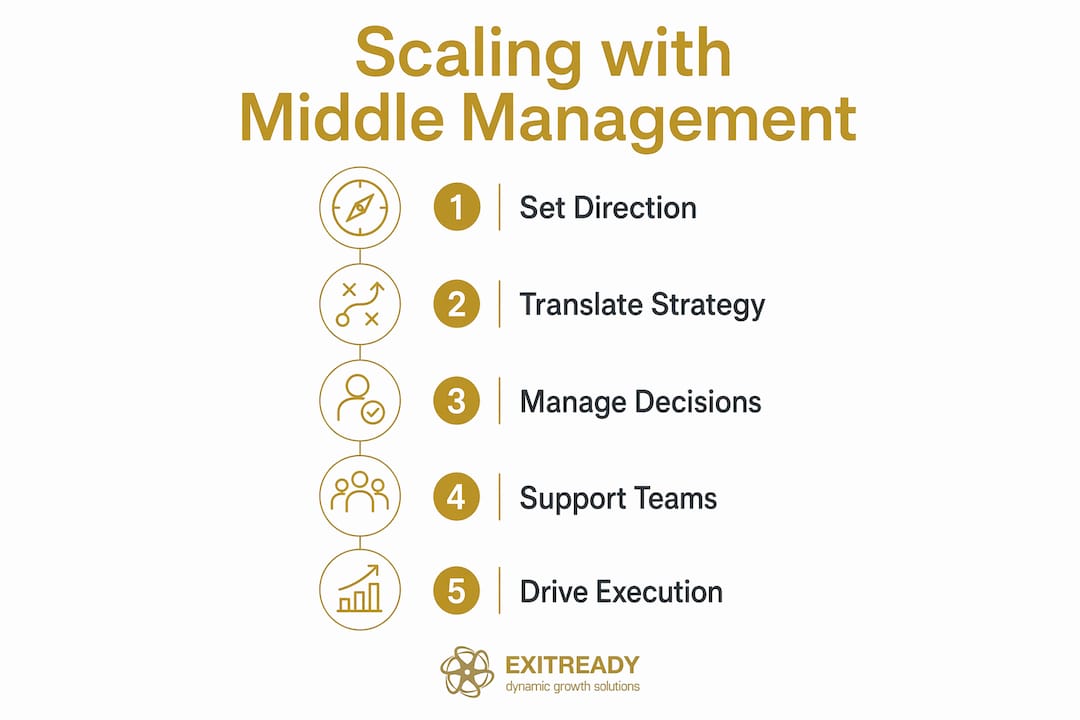
How do middle managers translate strategy into execution?
Middle managers drive performance through five specific functions that no other organizational layer can replicate at scale.
- Breaking down priorities. A strategic goal like “grow revenue by 30% this year” means nothing to a frontline team without a manager who converts it into weekly targets, pipeline reviews, and individual coaching conversations.
- Monitoring performance in real time. Middle managers catch variance early. They see when a team member is struggling, when a process is breaking, or when a client relationship is at risk, before the data shows up in a quarterly report.
- Creating feedback loops. Feedback loops from frontline to leadership allow companies to adjust strategy faster than those relying on top-down directives alone. A manager who surfaces a recurring customer complaint in a weekly leadership meeting gives the executive team a 90-day head start on a product fix.
- Developing people. Retention is a growth metric. Middle managers who coach, mentor, and develop their teams reduce turnover costs and build the internal bench strength that scaling requires.
- Sense-making during change. When the company pivots, restructures, or enters a new market, employees look to their direct manager for context. A middle manager who can explain the “why” behind a decision reduces anxiety and keeps productivity stable.
Middle managers are not just messengers between leadership and teams. They are the people who make strategy real. Without them, a growth plan is a document. With them, it becomes daily behavior across the organization.
Emotional intelligence and sense-making are the capabilities that separate effective middle managers from those who simply relay information. These are not soft skills. They are the mechanisms through which trust, coherence, and sustained performance get built at the team level.
What organizational design strategies optimize middle management for scaling?
The structure around middle managers matters as much as the people in those roles. Most scaling problems are not people problems. They are design problems. The right organizational design gives middle managers the conditions to succeed.
Treat spans of control as a risk variable
A span of control is the number of direct reports a manager oversees. As companies grow, this number tends to drift upward without anyone making a deliberate decision. When a manager’s span exceeds their capacity to coach and develop each person, decision-making pushes back upward to the executive level. The fix is a formal span-of-control review tied to each growth milestone.
Split the role into people leaders and work leaders
High-growth companies separate two distinct functions that are often bundled into one middle management role.
| Role type | Primary focus | Key responsibility |
|---|---|---|
| People leader | Team development | Coaching, retention, performance conversations |
| Work leader | Operational output | Project delivery, process quality, cross-team coordination |
Splitting these roles reduces cognitive overload and burnout. A manager who is responsible for both a team’s emotional wellbeing and a complex technical delivery is being asked to context-switch constantly. Separating these functions improves both people outcomes and operational results.
Align incentives with strategic outcomes
Middle managers who are measured on activity rather than outcomes focus on activity. If the metric is “hours logged” or “meetings held,” that is what you get. Aligning middle management incentives with business-level goals, such as team retention rate, project delivery speed, or customer satisfaction scores, produces managers who think like owners.
Pro Tip: Build a scalable business infrastructure review into your annual planning cycle. Assign a middle manager to own each strategic priority, not just execute tasks within it. Ownership changes behavior.
How do middle managers create psychological safety during growth?
Psychological safety is the belief that speaking up, asking questions, or admitting a mistake will not result in punishment. Middle managers are the primary source of this safety for frontline employees. Executives set culture in speeches. Middle managers set it in one-on-one conversations every week.
During scaling, employees face constant change. New processes, new reporting lines, new priorities, and new colleagues create anxiety that reduces performance. Middle managers serve as the psychological safety net that keeps employees grounded during this uncertainty. Their ability to communicate clearly, back their team publicly, and provide honest coaching determines whether employees stay engaged or quietly check out.
The practical behaviors that build psychological safety include:
- Holding regular one-on-one meetings where employees can raise concerns without an audience.
- Publicly crediting team members for contributions in leadership forums.
- Addressing performance issues privately and constructively, not in group settings.
- Communicating the reasoning behind leadership decisions, not just the decisions themselves.
Emotional support and psychological safety from middle managers directly reduce attrition during high-growth phases. Replacing a mid-level employee costs significantly more than retaining one. Middle managers who invest in this kind of culture work are delivering measurable financial value, even when it does not show up on a dashboard.
The companies that scale without losing their best people are the ones where middle managers are trained, supported, and given the time to do this work. When managers are overloaded with operational tasks, coaching disappears first. That is when attrition starts.
Key Takeaways
Middle management is the execution layer that determines whether a scaling company grows with control or collapses under its own complexity, making role design and investment in this layer a non-negotiable part of any growth plan.
| Point | Details |
|---|---|
| Middle management drives execution | They translate strategy into daily team behavior, closing the gap between vision and results. |
| Spans of control are a risk variable | Reset decision rights and manager scope at each growth milestone to prevent upward delegation. |
| Role splitting reduces burnout | Separating people leadership from work leadership improves retention and operational output. |
| Psychological safety reduces attrition | Middle managers who coach and support teams keep talent engaged during high-change periods. |
| Feedback loops accelerate agility | Frontline data surfaced by middle managers allows leadership to adjust strategy faster. |
Why middle management is the most underestimated lever in scaling
Most business leaders I work with understand the importance of middle management in theory. In practice, they treat it as an afterthought. They hire for the role after the org chart breaks, not before. They promote their best individual contributors into management without training them. Then they wonder why execution slows down as headcount grows.
The uncomfortable truth is that middle management effectiveness is a design problem before it is a people problem. You cannot hire your way out of a structure that sets managers up to fail. I have seen companies with genuinely talented middle managers produce poor results because spans of control were too wide, decision rights were unclear, and incentives pointed in the wrong direction.
The other thing I have observed consistently: companies that invest in scalable project management and clear operational rhythms give their middle managers the tools to succeed. The ones that skip this step create a layer of frustrated, burned-out managers who eventually leave, taking institutional knowledge with them.
Treating middle management as overhead is the most expensive mistake a scaling company can make. Treat it as a strategic asset, design the roles deliberately, and invest in the emotional intelligence and sense-making skills that make these managers effective. That is where sustainable growth actually lives.
— Andre
How Dynamicgrowthsolutions helps you build a management layer that scales
Building a middle management layer that actually works requires more than good intentions. It requires documented systems, clear decision rights, and an operating rhythm that keeps everyone aligned without constant executive intervention.
Dynamicgrowthsolutions works with mid-market owners to build exactly this kind of infrastructure through the AOS (Accelerated Operating System). The AOS replaces owner dependency with self-sustaining operational structures, giving middle managers the frameworks, playbooks, and accountability systems they need to execute at scale. If you are ready to assess where your management layer stands today, the business scalability checklist is a practical starting point. For owners who want to go deeper, the business operating system for owners explains how the full AOS framework supports every layer of your organization.
FAQ
What is the role of middle management in scaling?
Middle management translates executive strategy into team-level execution, manages decision rights, and maintains operational alignment during growth. They are the primary mechanism for preventing chaos in the 50 to 500 employee growth phase.
Why do companies struggle with middle management during growth?
Spans of control widen without deliberate redesign, pushing decisions back to the executive level and creating execution gaps. Most scaling failures trace back to under-designed management roles, not under-talented managers.
How do middle managers support employee retention?
Middle managers provide psychological safety, coaching, and clear communication that keep employees engaged during organizational change. Attrition rises fastest when managers are overloaded and coaching time disappears.
What is the difference between a people leader and a work leader?
A people leader focuses on team development, coaching, and retention. A work leader focuses on operational output and project delivery. Splitting these functions reduces burnout and improves results in high-growth companies.
How does emotional intelligence affect middle management effectiveness?
Emotional intelligence enables middle managers to stabilize teams during change, build trust, and maintain performance under pressure. These capabilities are often labeled as soft skills but are the primary drivers of organizational coherence at scale.