
Systems, not star talent, are what let companies scale predictably. The mechanism is straightforward: a well-built system produces the same output whether your best person is in the room or on vacation. Talent varies. Systems compound. That gap widens every time you add a location, a product line, or fifty new hires.
If you recognize your business in that description, here is where to start this week:
- Diagnose your bus factor. Identify the three people whose departure would most disrupt operations. That list is your systematization priority queue.
- Document one process end-to-end. Pick the highest-frequency customer-facing workflow and write the canonical version this week. Not a rough draft. The real one.
- Assign a process owner. Give one person accountability for that workflow’s performance, not just its execution.
Those three steps will not fix everything. They will show you exactly where the real work is.
Table of Contents
- Why talent alone creates a ceiling you cannot break through
- What a Business Operating System actually is
- How systems produce predictable, repeatable growth
- A practical 6-step plan to move from talent-led to system-led operations
- Common pitfalls that undermine system adoption
- What to measure: KPIs that confirm your systems are working
- How an AOS-style operating system closed one client’s scaling gap
- Key Takeaways
- The leadership blind spot that keeps talented teams stuck
- What a Dynamicgrowthsolutions AOS engagement actually delivers
- Further reading and recommended sources
Why talent alone creates a ceiling you cannot break through
Every founder has hired someone exceptional and felt the relief. The numbers moved. Problems got solved. Then that person left, or burned out, or became the only one who knew how anything worked. That is the talent trap in its purest form.
Scaling amplifies existing operational flaws. A bottleneck that is manageable at 20 employees becomes a systemic failure at 80. Owner dependency that feels like leadership at $3M in revenue looks like a liability to a buyer at $15M. The flaw was always there. Growth just made it visible.
The “hero cycle” is the most expensive version of this problem. A founder or senior leader runs operations by exception, stepping in to resolve issues that the system should have caught. Every intervention feels like leadership. What it actually does is hide the gap between what the process is supposed to do and what it actually does. Nobody documents the fix. The next time the same issue surfaces, the hero steps in again.
Hiring superstars into a dysfunctional, system-less environment often fails. The real fix is engineering performance conditions: clarifying roles, removing approval friction, and automating feedback so that good people can actually do good work.
Tribal knowledge compounds this risk. When the only person who knows how to handle a key account escalation is the VP of Sales, that knowledge is not an asset. It is a single point of failure. Buyers and private equity investors price this risk into their offers, and they do it aggressively.
Pro Tip: Run a “bus factor audit” before your next planning cycle. For each critical process, ask: if this person left tomorrow, how long before the output degrades? Anything under 30 days is a red flag.
What a Business Operating System actually is
A Business Operating System (BOS), or an Accelerated Operating System (AOS) in the Dynamicgrowthsolutions framework, is the architecture that runs your company when you are not in the room. It is not a software platform. It is the combination of documented workflows, decision architecture, feedback loops, and integrated tooling that converts individual expertise into repeatable organizational output.
The essential components:
- Playbooks and SOPs. Written, versioned documentation of how work gets done. Not aspirational. Descriptive of the current best-known method.
- Decision rights. Who can approve what, at what dollar or risk threshold, without escalating. Removes the approval bottleneck that slows every growing team.
- Handoff protocols. Explicit rules for how work moves between people, teams, or systems. Most quality failures happen at handoffs, not within tasks.
- Metrics and dashboards. A short list of leading indicators that tell you whether the system is performing before the lagging financials confirm it.
- Automation and integration. Technology that removes manual variance from repetitive steps. Not a replacement for process design. A multiplier of it.
- Training and certification. A structured loop that brings new people to competency faster and confirms they are operating to standard before they work independently.
The moment you decide to write a process down is the moment you stop depending on heroes. Documentation is a strategic asset, not an administrative chore.
McDonald’s did not scale to tens of thousands of outlets by hiring exceptional cooks. Hamburger University and its documented, inspectable standards made consistent performance possible across every franchise, regardless of who was behind the counter. That is what a BOS does for a mid-market company.
How systems produce predictable, repeatable growth
The causal chain is not complicated. Documented processes reduce variance. Lower variance improves forecasting. Better forecasting lets you allocate capital with confidence. That sequence is what investors and buyers are actually paying for when they assign a premium multiple.

Consider onboarding. A new sales rep in a talent-led company learns by shadowing the top performer. Ramp time depends on that person’s availability, teaching style, and patience. In a system-led company, the new rep follows a structured onboarding playbook, completes certification checkpoints, and hits a defined competency standard before working independently. The output is predictable. The ramp time shrinks.
| Metric | Talent-Led Outcome | System-Led Outcome |
|---|---|---|
| New hire ramp time | Highly variable, dependent on mentor | Defined and measurable against a standard |
| Process adherence | Inconsistent across team members | Auditable and improvable |
| Revenue per rep variance | Wide spread between top and bottom | Narrower spread as floor rises |
| Gross margin consistency | Fluctuates with personnel changes | Stable because delivery is documented |
| Buyer/investor confidence | Low (key-person risk) | High (repeatable, transferable ops) |
Institutional memory is the less-discussed benefit. When a senior leader leaves a talent-led company, they take years of context with them. In a system-led company, that context lives in the playbook. The organization does not reset every time someone exits.
With tighter capital markets and greater investor scrutiny, predictable unit economics from documented systems matter more than flashy growth numbers. Buyers discount key-person risk heavily. Replaceable, documented workflows materially improve exit multiples.
The valuation implication is direct. A business where the owner is the system is worth less than a business where the system runs without the owner. That gap can represent millions of dollars at exit.
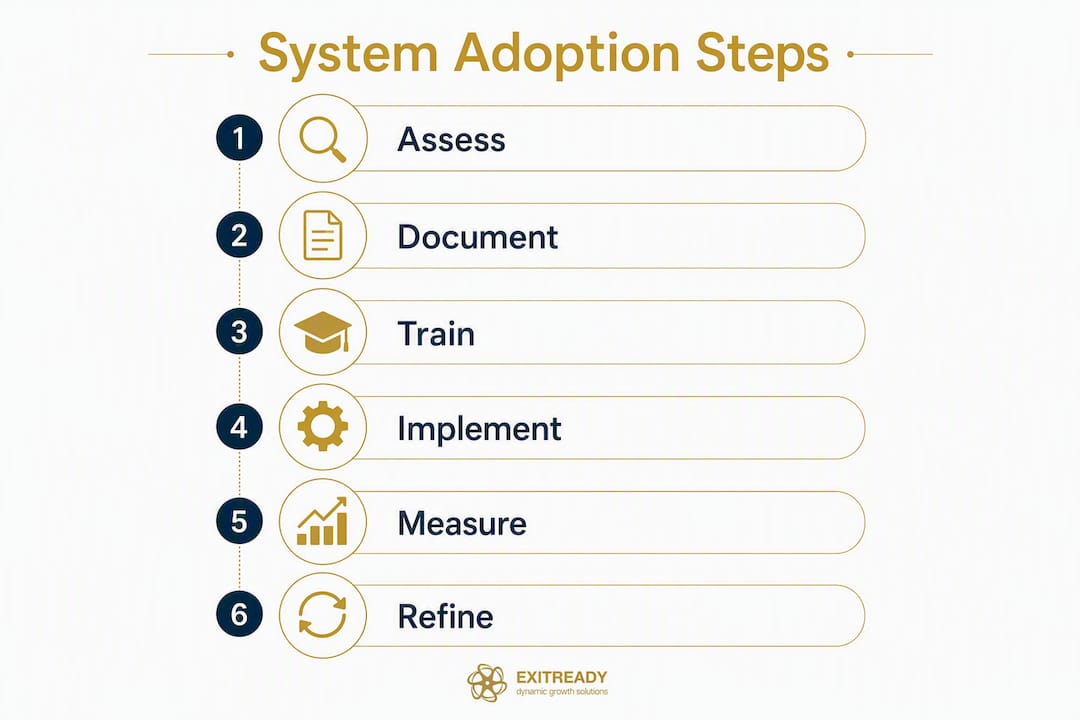
A practical 6-step plan to move from talent-led to system-led operations
This sequence works for mid-market companies at any revenue level. Budget 90–180 days for the full cycle, depending on your team’s bandwidth.
-
Diagnose your bus factor and top failure modes. Run a one-day workshop with your leadership team. Map the five processes most critical to revenue and delivery. For each, identify the single person whose absence would cause the most disruption. That is your priority list. Cost: internal time only.
-
Prioritize by leverage. Not every process deserves equal attention. Customer-facing workflows (onboarding, first response, escalation handling) and revenue operations (lead qualification, proposal, close) produce the most leverage when systematized. Fix these before back-office processes. Onboarding, handoffs, and first-response workflows often produce the largest leverage when fixed first, reducing both churn and cost-per-hire.
-
Document one canonical playbook. Write the current best-known method for your top-priority process. Not the ideal version. The real one. Include decision points, escalation triggers, and the tools used at each step. Then build a training loop: a new hire should be able to reach competency using only that document and a structured review. Timeline: 2–3 weeks per process.
-
Assign owners and embed decision rights. Every process needs one accountable owner, not a committee. Define what that owner can decide independently, what requires escalation, and at what threshold. Redesign handoffs explicitly: who passes what to whom, in what format, by when. This step alone removes most of the approval friction that slows growing teams.
-
Automate repetitive steps. Once a process is documented and stable, identify the steps that are purely mechanical: data entry, status updates, routing, reminders. Tools like Zapier, HubSpot workflows, or Monday.com automations can handle these without adding headcount. Automate after you document. Automating a broken process just makes the errors faster. Cost: typically $200–$2,000/month depending on tooling stack.
-
Implement feedback loops and a review cadence. A system without measurement calcifies. Run weekly ops reviews against your leading indicators. Conduct monthly audits of process adherence. Measurement and regular audits keep systems improving rather than drifting back toward hero-dependence. Archive deprecated SOPs so teams are not following outdated versions.
Pro Tip: During the transition, ask your team three questions weekly: “What slowed you down this week?” “What did you have to escalate that you should have been able to decide yourself?” “What did you do twice that a system should handle?” The answers will surface your next three documentation priorities.
For a detailed mid-market scaling roadmap, the sequencing above maps directly to what works at the $5M–$50M revenue range.
Common pitfalls that undermine system adoption
Building systems is not the hard part. Getting an organization to actually use them is.
The first mistake is documenting the wrong things. Process-for-process’s sake produces binders nobody reads. The red flag: you have SOPs for low-frequency, low-impact tasks but nothing written for your top revenue-generating workflow. If your onboarding process is undocumented but your expense reimbursement policy runs to four pages, your priorities are inverted.
Leaders should promote stewards, not firefighters. Reward the people who prevent fires and maintain processes, not just the ones who put out the immediate blaze. Incentive structures that celebrate heroics actively discourage system-building.
The second mistake is rewarding the wrong behavior. If your culture celebrates the person who stayed until midnight to save the deal, you are signaling that heroics matter more than process. The person who built the system that prevents the crisis in the first place gets no recognition. That incentive structure will kill adoption faster than any technical problem.
The third mistake is building brittle automations. An automation without a feedback loop is a liability. When the underlying process changes, the automation keeps running the old version. Build every automation with an alert for exceptions and a monthly review checkpoint.
Corrective actions that actually work: run small experiments before full rollout, measure the lift against a baseline, promote the people who steward processes rather than bypass them, and archive deprecated SOPs on a defined schedule so teams are not navigating conflicting versions.
Pro Tip: When you catch someone bypassing a documented process, treat it as a system design problem, not a performance problem. Ask why the workaround felt necessary. The answer usually reveals a gap in the SOP.
What to measure: KPIs that confirm your systems are working
Measurement is where most systematization efforts fall apart. Leaders implement processes and then wait for revenue to confirm it worked. By the time the lagging indicators move, months of drift have already occurred.

Lead with leading indicators:
| KPI | Why It Matters | Target Improvement Window |
|---|---|---|
| New hire ramp time to full productivity | Measures onboarding system effectiveness | 30–90 days post-implementation |
| Process adherence rate | Confirms teams are following documented workflows | 30 days post-rollout |
| Conversion rate variance across reps | Narrow variance signals system lift vs. individual skill | 90 days |
| SLA compliance rate | Measures handoff and delivery system reliability | 30 days |
| Time-to-first-value for new customers | Reflects onboarding and delivery system quality | 90 days |
| Owner hours in operations per week | Tracks reduction in hero-dependence | 90–180 days |
The 30/90/180-day milestone structure gives you a realistic view. At 30 days, you should see process adherence improving and early ramp-time data. At 90 days, conversion variance should narrow and SLA compliance should stabilize. At 180 days, the financial metrics, gross margin consistency and revenue per rep, should reflect the system’s impact.
Companies that treat growth as a configuration rather than a single campaign consistently outperform peers who lack connective operational tissue. The measurement plan is what makes that configuration visible and improvable.
Cost-range callout by phase: diagnostic workshops run $5,000–$15,000 with an external facilitator; documentation and playbook development typically costs $10,000–$40,000 depending on scope; automation tooling and integration runs $2,000–$25,000 for a mid-market stack. These are back-of-envelope ranges. The actual cost of not systematizing, measured in key-person departures, inconsistent delivery, and discounted exit multiples, is almost always higher.
How an AOS-style operating system closed one client’s scaling gap
A mid-market professional services firm, roughly $12M in annual revenue with 45 employees, came to Dynamicgrowthsolutions with a familiar problem. Revenue had grown steadily for three years, but gross margin was compressing and the owner was working more hours than ever. Three senior people held most of the client relationship knowledge. The owner was the de facto escalation path for every significant decision.
The scaling challenge was not a talent shortage. The team was capable. The problem was architectural: no documented delivery workflows, no defined decision rights below the owner level, and no measurement system that could distinguish a process failure from a personnel failure.
The scaling chasm is usually an architectural issue, not a talent shortage. Engineering performance conditions — clarifying roles, reducing approval friction, automating feedback — is the higher-leverage fix.
The engagement followed a five-step sequence:
- Diagnose. A one-day leadership workshop mapped the five highest-impact processes and identified the three people whose departure would most disrupt operations.
- Document. The client delivery workflow was written as a canonical playbook over three weeks, including decision points, escalation triggers, and handoff protocols.
- Delegate. Decision rights were redesigned so that two senior managers could handle 80% of client escalations without owner involvement.
- Automate. Status updates, client check-in reminders, and internal routing were automated using the firm’s existing project management tooling.
- Measure. Weekly ops reviews tracked SLA compliance and owner hours in operations. Monthly audits reviewed process adherence.
Within 90 days, owner involvement in day-to-day operations dropped materially. New hire ramp time shortened because the delivery playbook gave new team members a structured path to competency. The documented, inspectable workflows also positioned the firm more favorably for a future exit, with buyers able to evaluate the business as a system rather than a collection of relationships.
For leaders who want to see what systematized business processes look like in practice, the pattern above is replicable across industries.
Key Takeaways
Systems, not individual talent, are the only reliable foundation for predictable, repeatable scaling in a mid-market business.
| Point | Details |
|---|---|
| Diagnose your bus factor first | Identify the three people whose departure would most disrupt operations — that list is your priority queue. |
| Document one process this week | Write the canonical version of your highest-frequency customer-facing workflow before adding any new hires. |
| Assign ownership, not just accountability | Every process needs one named owner with defined decision rights, not a committee. |
| Measure leading indicators at 30/90/180 days | Track ramp time, process adherence, and SLA compliance before waiting for financial results to confirm system impact. |
| Dynamicgrowthsolutions AOS engagement | Delivers a diagnostic, 90-day playbook, and owner handoff plan that reduces hero-dependence and improves exit readiness. |
The leadership blind spot that keeps talented teams stuck
The hardest part of this shift is not the documentation. It is the identity change.
Most founders built their companies by being the smartest, fastest, most connected person in the room. That skill is real. It is also the thing that prevents the business from scaling past them. When the owner is the system, every growth decision runs through a single human bottleneck. The team learns to wait. Initiative atrophies. The owner works harder and wonders why the team is not stepping up.
What I see repeatedly is leaders who praise the person who saved the quarter and ignore the person who built the process that prevented the crisis. That incentive structure is not accidental. It reflects a genuine belief that heroics are leadership. They are not. Heroics are a symptom of a system that is not working.
The reframe that matters: your job as a leader is not to be the best at the work. It is to build the conditions in which good people consistently produce great work without needing you in the room. That is a design problem, not a talent problem.
A few prompts worth taking to your next leadership team meeting: Which decisions require your personal involvement that should not? Where does work slow down waiting for approval? Who on your team is rewarded for firefighting rather than fire prevention? The answers will tell you more about your scaling constraints than any revenue forecast.
Run a team diagnostic this quarter. Not a survey. A working session where you map your five most critical processes and ask honestly: does this system work without me? If the answer is no for more than two of them, you have architectural work to do.
What a Dynamicgrowthsolutions AOS engagement actually delivers
Mid-market owners who have outgrown their current operating model but have not yet built the systems to replace it face a specific problem: the business depends on them more than it should, and every new hire adds complexity without adding capacity.
Dynamicgrowthsolutions addresses this directly through the Accelerated Operating System (AOS). An engagement starts with a structured diagnostic that maps your current bus factor, identifies your highest-leverage process gaps, and produces a prioritized action plan. From there, the team builds your 90-day playbook: documented workflows, redesigned decision rights, and an owner handoff plan that reduces your operational involvement without reducing output quality. The result is a business that runs on a system, not on you, which is exactly what buyers and investors pay a premium for when you are ready to exit or raise capital.
If you are a mid-market owner who is working harder than the business should require, the right next step is a business transformation assessment with Dynamicgrowthsolutions. You can also apply directly to the AOS program to see whether your business qualifies for a full engagement.
Further reading and recommended sources
The sources below are worth your time if you want to go deeper on any of the frameworks covered in this article.
- The Only Thing That Actually Scales Is a System — Epirus Ventures. The clearest single-source argument for why systems compound independently of founder attention. Start here if you want the foundational case made concisely.
- Scaling Growth: Systems Over Talent — The CEO Project. Practical framing for mid-market leaders on how scaling amplifies existing flaws and why small process fixes (onboarding, handoffs) produce outsized leverage.
- You Don’t Have a Growth Problem. You Have a Systems Problem. — Ikaros. Introduces the Compass/Engine/Driver framework for treating growth as a configuration rather than a campaign. Useful for leaders building a measurement architecture.
- Why Great Leaders Build Systems, Not Heroes — Jennifer Bagley. The best short read on incentive design and why rewarding firefighters actively undermines system adoption.
- The Operator’s Playbook: Why Talent Is the Most Overrated Thing in Business — Daniel R. Kaufman. Covers feedback loops, measurement cadence, and the minimal testable rollout pattern (document, pilot, measure, iterate). Practical and direct.
- Stop Calling It Talent — Is It Working? The performance-conditions argument in its sharpest form. Read this before your next senior hire.
- Systems Clarity Creates Smarter Teams and Faster Growth — Inc. A founder-facing explainer on why systems clarity is the hidden differentiator between businesses that scale and those that plateau.
- The Key to Scaling Growth: Prioritizing Systems Over Superstar Talent — Inc. Jim Schleckser’s case for why superstar hiring is a short-term fix and systems are the durable answer. Good for sharing with leadership teams who are skeptical of the shift.
Recommended books: Michael Gerber’s The E-Myth Revisited remains the clearest argument for why founders must work on the business rather than in it. Jim Collins’s Good to Great covers the flywheel concept, the idea that systems compound over time, better than almost anything else written on organizational design.