
Founder leadership is defined as the stage where a company’s growth depends entirely on the founder’s decisions, relationships, and daily involvement. This model works brilliantly at the start. It breaks down fast as the company scales. Founder-dependent companies grow 3.5x slower and sell for 50% lower valuation multiples than businesses with distributed leadership. That single data point explains why understanding the shift from founder control to system-led growth is not optional for mid-market owners. It is the difference between a business that scales and one that stalls.
Why businesses outgrow founder leadership
The core reason businesses outgrow founder leadership is structural. The founder’s role as the central decision node creates a ceiling on how fast the company can move. Every approval, every client relationship, and every operational call that runs through one person creates a bottleneck. 58% of founders struggle to let go of control, and that reluctance directly limits decision-making speed across the organization.
The business growth challenges that surface at scale are not random. They follow a predictable pattern tied to founder behavior. A founder who thrives on direct involvement at $2M in revenue becomes the single point of failure at $8M. The scrappy, hands-on style that closed early deals and solved early crises now slows the team down. Employees wait for sign-off instead of acting. Customers escalate to the founder instead of trusting the team.
Valuation impact makes this concrete. Founder-operated companies that fail to delegate beyond $5M in revenue typically achieve acquisition multiples of 2–3x EBITDA. Companies with distributed leadership command 4–6x EBITDA. That gap represents millions of dollars left on the table, and it traces directly back to founder dependency.
- Decision bottlenecks: Every major call routes through the founder, slowing execution across departments.
- Talent attrition: High performers leave when they cannot make decisions or grow without founder approval.
- Revenue ceiling: Growth stalls because the founder’s bandwidth caps the company’s output.
- Valuation discount: Buyers price in the risk of a business that cannot operate without its founder.
Pro Tip: Map every decision made in a week and flag which ones required your personal involvement. If more than 40% of operational decisions touched you, your company has a founder dependency problem.
How does founder identity affect business scalability?
80% of founders experience a significant identity crisis when transitioning from operator to leader, particularly near the $7M revenue mark. This is not a personality flaw. It is a structural consequence of building something from nothing. The founder’s identity becomes fused with the business. Stepping back feels like abandonment, not growth.
The concept known as the “Founder Ceiling” captures this precisely. The traits that built the company become liabilities at scale. Speed of decision-making becomes impulsiveness. Hands-on involvement becomes micromanagement. Deep product knowledge becomes an inability to trust specialists. The founder’s greatest strengths flip into the organization’s greatest constraints.
“The founder identity problem is more critical than any strategy problem. Founders who succeed at scale evolve their leadership identity faster than their company needs them to.”
This identity shift requires conscious work, not just awareness. A founder who intellectually understands delegation but emotionally resists it will still create bottlenecks. The psychological transition from “I do the work” to “I build the people who do the work” is the hardest and most important move a founder makes. Leadership coaching frameworks, including those outlined in executive coaching models, provide structured paths through this transition.
Common psychological pitfalls during this phase include:
- Control reluctance: Believing no one else can do the work to your standard.
- Validation dependency: Needing to be involved to feel valuable to the business.
- Perfectionism paralysis: Waiting until a process is perfect before handing it off.
- Culture confusion: Assuming the team shares your values without ever documenting them.
The founder’s leadership style also shapes team culture in ways that either enable or block growth. Teams that watch a founder second-guess every delegated decision learn quickly not to take initiative. Culture signals whether decision-making is safe or risky for everyone below the founder.
What are effective strategies for transitioning from founder-led to system-led growth?

The transition from founder-led to system-led growth follows three stages: doer, manager, and leader. Most founders get stuck between doer and manager. The goal is to reach the leader stage, where the founder sets direction, builds culture, and develops other leaders rather than managing tasks.
The 85% Ready Framework is the most practical delegation model for this transition. Waiting for a process to be 100% ready before handing it off guarantees you never hand it off. Delegating too early causes rework and erodes team confidence. The 85% threshold is the point where the process is documented well enough to hand over without chaos, and the team member is capable enough to learn the remaining 15% through doing.
- Document before delegating. Write down the process at 85% completeness. A documented process can be improved. An undocumented one stays with you forever.
- Delegate outcomes, not tasks. Tell your team what success looks like, not how to achieve it. This builds ownership and reduces your involvement.
- Build a leadership layer. Hire or develop at least two direct reports who can make decisions without you. This is the single highest-leverage move a founder can make.
- Schedule strategic time. Block 30% of your week for work that only you can do: vision, key relationships, and capital allocation.
- Review, don’t redo. When a team member’s output is 80% as good as yours, approve it. Redoing their work teaches them that initiative is punished.
Rapid-growth leaders prioritize three capabilities above all others: building high-performing teams (48%), developing AI and data literacy (44%), and enabling cross-functional collaboration (33%). These are not founder intuition skills. They are organizational design skills that require a deliberate shift in how the founder spends time.
| Leadership stage | Founder focus | Key output |
|---|---|---|
| Doer | Executing tasks directly | Revenue and product |
| Manager | Overseeing people and processes | Team performance |
| Leader | Setting vision and building leaders | Organizational capacity |
Pro Tip: Use a weekly “CEO filter” question: “Is this something only I can do?” If the answer is no, it belongs on someone else’s plate.
What operational and cultural changes come with outgrowing founder leadership?
Moving beyond founder leadership requires changing how the organization makes decisions, not just who makes them. A founder-centric culture routes all significant choices upward. A system-led culture routes decisions to the person closest to the information. That shift requires documented processes, clear authority levels, and a team that trusts it will not be punished for deciding.
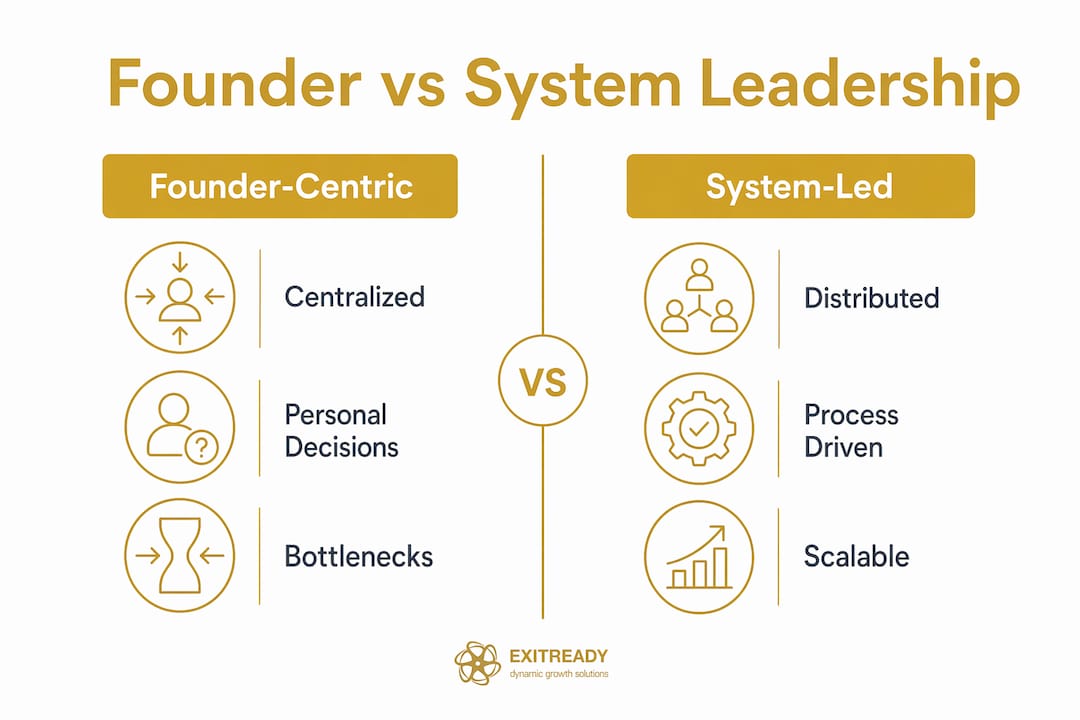
Polite paralysis is the most dangerous symptom of founder bottleneck. The team stays busy. Meetings happen. Reports get filed. But no critical directional decisions get made because everyone is waiting for the founder to weigh in. Growth stalls quietly, without a visible crisis. By the time the founder notices, months of momentum have been lost.
The operational changes that break this pattern are specific and measurable:
- Decision rights matrix: Define which decisions require founder approval, which require manager approval, and which the team owns outright.
- Documented playbooks: Every repeatable process needs a written standard. This is the foundation of operational independence and the core of what Dynamicgrowthsolutions builds through its AOS framework.
- Financial oversight structure: A CFO or finance director who owns the numbers removes the founder from a role that rarely plays to their strengths at scale.
- Culture signals: Leaders model the behavior they want. If the founder makes every call, the team learns that autonomy is theater.
| Operational area | Founder-centric model | System-led model |
|---|---|---|
| Decision-making | Routes to founder | Defined authority levels |
| Process knowledge | Lives in founder’s head | Documented playbooks |
| Financial oversight | Founder reviews everything | Dedicated finance leadership |
| Team initiative | Waits for approval | Acts within defined boundaries |
How can mid-market entrepreneurs navigate the founder leadership transition?
The practical signs that it is time to evolve your leadership role are rarely dramatic. They accumulate quietly. Signs of founder burnout often appear before the business shows visible strain. You feel indispensable and exhausted at the same time. Your team is capable but underused. Revenue has plateaued despite a full pipeline.
Recognizing these signals early gives you time to plan the transition rather than react to a crisis. Mid-market owners who wait until the business forces the change have far less leverage in how it unfolds.
Practical steps for navigating this transition:
- Audit your calendar. Track where your time goes for two weeks. Operational tasks that consume more than 50% of your week signal a delegation gap.
- Identify your replacement tasks. List the five things you do most often that someone else could do with proper training and documentation.
- Invest in executive coaching. Decision-making under pressure is a learnable skill. Coaching accelerates the identity shift that makes delegation feel safe rather than threatening.
- Build peer networks. Other founders who have navigated this transition are the most credible source of practical wisdom. Mastermind groups and CEO peer networks provide accountability and pattern recognition.
- Set milestone targets. Define what “less involved” looks like at 90 days, 6 months, and 12 months. Vague intentions do not produce behavior change.
- Plan for hidden growth opportunities. Founders who step back from operations consistently report seeing strategic opportunities they were too busy to notice before.
The leadership qualities that matter most at this stage are resilience, adaptability, curiosity, and active listening. These are not the traits that built the company in year one. They are the traits that carry it through the next decade.
Key Takeaways
Businesses outgrow founder leadership because founder dependency caps decision speed, limits valuation, and creates cultural bottlenecks that only deliberate identity evolution and system-building can resolve.
| Point | Details |
|---|---|
| Valuation impact is real | Founder-dependent companies sell at 2–3x EBITDA versus 4–6x for distributed leadership models. |
| Identity shift is the hardest part | 80% of founders face an identity crisis near $7M revenue; resolving it requires conscious leadership evolution. |
| The 85% Ready Framework works | Delegate processes at 85% completion to balance quality and speed without creating rework. |
| Polite paralysis is a warning sign | When teams stay busy but make no critical decisions, the founder is the bottleneck. |
| Systems replace the founder | Documented playbooks and decision rights matrices are what allow a business to scale without its founder. |
The part most founders miss entirely
Working with mid-market owners over the years, the pattern that surprises me most is not the reluctance to delegate. It is the belief that delegation is a management technique rather than an identity shift. Founders read the frameworks, attend the workshops, and still find themselves back in the weeds six weeks later. The reason is almost always the same: they changed their behavior without changing how they see themselves.
The founders I have watched scale successfully did something counterintuitive. They got uncomfortable on purpose. They hired people who were better than them in specific domains and then resisted the urge to override those people. They let decisions be made imperfectly. They sat in the discomfort of not knowing every detail of their own business. That discomfort is not a sign something is wrong. It is the signal that the transition is actually happening.
The other thing most articles skip is the grief. Stepping back from the day-to-day of a business you built is a genuine loss. The energy, the identity, the sense of purpose tied to being needed. Founders who acknowledge that grief move through it faster than those who pretend the transition is purely rational. Give yourself permission to find it hard. Then build the systems anyway.
— Andre
How Dynamicgrowthsolutions helps founders scale beyond themselves
Transitioning out of the founder-operator role is not something most owners can figure out alone. The patterns are too close to see clearly from the inside.

Dynamicgrowthsolutions works with mid-market owners to build the operational infrastructure that makes a business run without the founder at the center of every decision. The AOS (Accelerated Operating System) replaces founder dependency with documented processes, defined leadership layers, and measurable performance systems. For founders ready to make this shift, the CEO mastermind retreats bring together peers who are navigating the same transition, with structured frameworks and expert facilitation. If you want to see where your business stands today, the 360-ProfitDriver assessment identifies the specific bottlenecks limiting your growth and valuation right now.
FAQ
Why do businesses outgrow founder leadership?
Businesses outgrow founder leadership because the founder’s direct involvement becomes a bottleneck as complexity increases. Companies with high founder dependency grow 3.5x slower and achieve 50% lower valuation multiples than those with distributed leadership.
What is the founder ceiling?
The founder ceiling is the growth plateau created when a founder’s hands-on traits, which built the company, begin limiting its scale. Leadership identity shifts and documented systems are required to break through it.
When should a founder start delegating leadership?
Delegation should begin before the founder feels ready. The 85% Ready Framework recommends handing off processes when they are sufficiently documented and the team member is capable of learning the remaining gap through experience.
What is polite paralysis in a founder-led business?
Polite paralysis occurs when a team stays active and busy but makes no critical directional decisions because the founder remains the bottleneck. Growth stalls quietly without any visible collapse or crisis.
How does founder leadership affect business valuation?
Founder-dependent companies typically sell at 2–3x EBITDA. Businesses with distributed leadership and documented systems command 4–6x EBITDA, representing a significant premium that buyers assign to operational independence.