
Business transferability is defined as the ability of a company to sustain its operations, revenue, and customer relationships independently of its current owner. Why business transferability matters buyers is straightforward: a business that cannot function without its founder is not an asset buyers are acquiring. It is a job they are inheriting. Transferability ranks among the top nine criteria buyers assess before signing a Letter of Intent, with owner dependency and employee retention evaluated early in due diligence. The industry term for this concept is “operational independence,” and it sits at the center of every serious acquisition conversation in 2026.
What are the key elements that make a business transferable to buyers?
Transferability is not a single checkbox. It is a combination of structural factors that collectively signal whether a business can survive and grow under new ownership.
Documented systems and repeatable processes are the foundation. A business where the founder holds all the knowledge in their head cannot be transferred. Buyers need written standard operating procedures, process maps, and training materials that allow any capable manager to step in and maintain output. Profitability alone does not equal transferability; buyers want documented processes and capable management to confidently forecast earnings after owner departure.
Leadership depth is the second critical factor. A management team that can make decisions, manage staff, and serve customers without daily founder input signals operational independence. Businesses where every significant decision flows through the owner present a clear transition risk.

Customer diversification protects revenue predictability. Customer concentration above roughly 18% of revenue from a single client creates significant transferability risk. Buyers respond with price discounts or protective deal structures like earnouts. A well-distributed customer base tells buyers that revenue will survive the founder’s exit.
Clean financial reporting removes uncertainty. Buyers need three to five years of clear, auditable financials that separate personal expenses from business costs. Messy books signal either incompetence or concealment, and both kill deals.
Employee retention and culture round out the picture. High turnover or a workforce loyal only to the founder creates post-sale instability. Buyers assess whether key employees have contracts, competitive compensation, and reasons to stay.
Pro Tip: Ask the seller to step away from operations for 30 days before closing. What breaks without them tells you exactly where the transferability gaps are.
How does transferability affect valuation and deal structure?
Transferability directly controls the multiple a buyer is willing to pay. Low transferability consistently results in lower valuation multiples, lengthy transition periods of 6–24 months, and the need for seller financing or earnouts. These are not minor inconveniences. They represent real financial exposure for the buyer and reduced net proceeds for the seller.
Buyers underwrite future cash flow, not current revenue. The core question in every acquisition is: will this business generate the same earnings after the founder leaves? When the answer is uncertain, buyers protect themselves through deal structure rather than walking away.
- Earnouts tie a portion of the purchase price to post-sale performance metrics. If revenue drops after the founder exits, the buyer pays less.
- Seller financing keeps the seller financially invested in a successful transition. It also signals that the seller believes in the business’s ability to perform independently.
- Holdbacks retain a portion of the sale price in escrow for 12–24 months, released only if agreed performance benchmarks are met.
- Extended consulting agreements require the seller to remain available post-close, often for 12–24 months, to transfer relationships and institutional knowledge.
Buyers view purchasing a business as acquiring a living system. If operational performance collapses after the founder exits, the business was not truly transferable and was likely overvalued from the start. Buyers who understand this principle use transferability as their primary underwriting metric, not EBITDA alone.
Why do buyers prioritize reducing owner dependency?
Owner dependency is the single most common reason acquisitions fail to close or fail post-close. It occurs when the founder acts as the operational linchpin: the primary relationship holder with customers, the decision-maker for all significant issues, and the face of the brand. A company reliant on the founder for critical functions is effectively a founder transition problem, not a business sale.
The risks buyers face are concrete and measurable:
- Revenue loss: Key customers who bought from the founder personally may not transfer loyalty to new ownership.
- Operational disruption: Processes that exist only in the founder’s memory break down immediately post-close.
- Employee departures: Staff who joined because of the founder may leave when the founder does.
- Knowledge gaps: Supplier relationships, pricing agreements, and informal understandings disappear with the founder.
There is an important distinction between founder-led success and transferability readiness. A business can be highly profitable because of the founder’s talent, network, and drive. That same business can be completely untransferable for the same reasons. Profitability from founder effort without documented systems lowers buyer confidence in sustainable earnings.
Pro Tip: Review the post-exit transition planning process before you close. Buyers who map transition risks before signing protect themselves from the most common post-close failures.
Documented leadership roles and a formal transition plan are the two most effective tools for reducing owner dependency risk. When a business has a COO, department heads, and written succession protocols, buyers can model the post-close operation with confidence.
What should buyers look for when assessing transferability?
Due diligence on transferability follows a structured evaluation across four areas. Buyers assess transferability through systems review, customer contracts, employee retention, and leadership depth as key indicators of a stable revenue base transferable to new ownership.
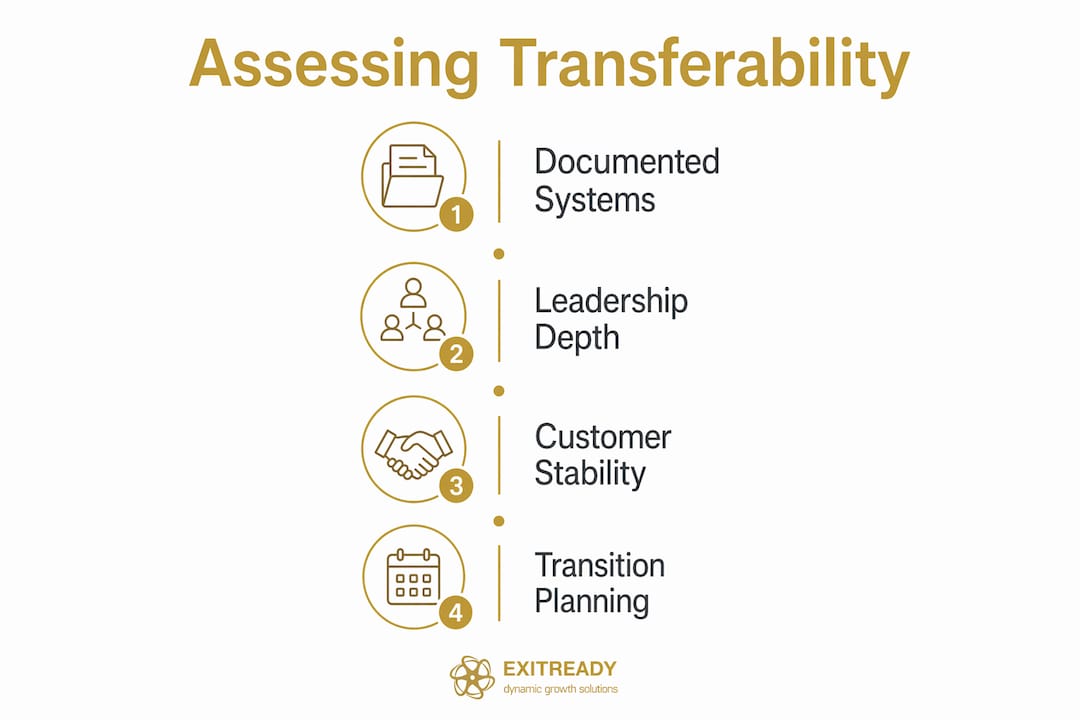
Systems and process documentation
Request the operations manual, employee handbooks, and process documentation for every core function. If these do not exist or are incomplete, the business depends on tribal knowledge. That is a red flag, not a negotiating point.
Customer and contract stability
Review the customer list for concentration risk. Examine contract terms, renewal rates, and whether contracts are assignable to a new owner. Contracts that require customer consent to transfer create closing risk and post-sale revenue uncertainty.
Leadership and team stability
Interview the management team independently of the founder. Assess whether they can describe their roles, make decisions, and articulate the business’s direction. A team that defers every question to the founder confirms the dependency problem.
Transition planning
Most failed acquisitions unravel post-close due to informal ties the founder held with customers and employees. Best practice is a written transition plan and seller consulting extending up to 24 months. Buyers should negotiate this into the deal structure before signing.
| Transferability indicator | What buyers look for | Red flag |
|---|---|---|
| Process documentation | Written SOPs for all core functions | Verbal-only processes |
| Customer concentration | No single client above 18% of revenue | One client over 25% of revenue |
| Leadership depth | Management team operates independently | All decisions require founder approval |
| Financial reporting | Clean, auditable books for 3+ years | Personal expenses mixed with business costs |
| Employee retention | Key staff under contract with competitive pay | High turnover or founder-dependent loyalty |
Pro Tip: Ask the seller to demonstrate the business running for one week without their involvement before due diligence closes. Observation beats documentation every time.
Key Takeaways
Business transferability is the single most important factor separating a premium acquisition from a discounted or failed one.
| Point | Details |
|---|---|
| Transferability drives valuation | Low transferability leads to discounted multiples, earnouts, and extended transition periods of 6–24 months. |
| Owner dependency is the top risk | Businesses where the founder controls all key relationships and decisions are not acquisition-ready. |
| Documentation is non-negotiable | Written SOPs, customer contracts, and financial records are the evidence buyers need to underwrite future earnings. |
| Customer concentration caps value | A single client above 18% of revenue triggers buyer protections and price reductions. |
| Transition planning prevents failure | A written transition plan with seller consulting up to 24 months is the best defense against post-close collapse. |
The deal breaker most buyers discover too late
The most expensive mistake I see buyers make is treating transferability as a post-LOI concern. By the time you are negotiating deal structure, you have already spent legal fees, advisor fees, and months of time. Discovering that the business cannot run without the founder at that stage forces a painful choice: walk away and absorb sunk costs, or accept a deal with serious structural risk.
The buyers who consistently close strong deals start their transferability assessment at first contact. They ask simple questions early: Who runs operations when the owner is on vacation? What percentage of revenue comes from the top three customers? Does the management team have authority to hire and fire? The answers to those three questions tell you more about transferability than any financial model.
I have also seen the opposite mistake: buyers who over-discount genuinely transferable businesses because the founder is charismatic and visible. A founder who has built documented systems, a capable team, and diversified revenue is not a dependency risk. They are a builder who created something that outlasts them. That distinction is worth paying a premium for.
The multi-year exit planning process exists precisely because transferability cannot be built in 90 days. Buyers who understand this push sellers to start the work early, which ultimately produces better businesses to acquire.
— Andre
How Dynamicgrowthsolutions supports buyers focused on transferability
Buyers who want to acquire businesses with genuine operational independence need a structured way to evaluate and close those gaps before signing. Dynamicgrowthsolutions works with mid-market owners to build the documented systems, leadership depth, and financial clarity that buyers require.

The 360-ProfitDriver assessment identifies operational gaps that reduce transferability and provides a clear picture of where a business stands before acquisition conversations begin. For buyers who want to go deeper, Dynamicgrowthsolutions hosts exclusive CEO events where buyers, sellers, and advisors work through transferability frameworks together. If you are evaluating a mid-market acquisition and want a clear transferability scorecard, exit planning resources from Dynamicgrowthsolutions give you the framework to assess and act with confidence.
FAQ
What is business transferability in an acquisition?
Business transferability is the degree to which a company can sustain its operations, revenue, and customer relationships after the current owner exits. Buyers use it as a primary criterion to assess acquisition risk and justify valuation multiples.
Why does owner dependency lower a business’s sale price?
Owner dependency signals that revenue and operations rely on one person’s relationships and knowledge. Buyers price that risk through lower multiples, earnouts, or seller financing rather than paying full value for uncertain future earnings.
What customer concentration level concerns buyers most?
Customer concentration above roughly 18% of revenue from a single client is a recognized risk threshold. Buyers typically respond with price discounts or protective deal structures like earnouts to hedge against post-sale revenue loss.
How long should a seller transition period last?
Best practice calls for a written transition plan with seller consulting extending up to 24 months post-close. This period allows the buyer to absorb institutional knowledge and stabilize key customer and employee relationships.
Can a profitable business still fail a transferability test?
Yes. A business profitable because of the founder’s personal effort, network, or skill can be completely untransferable. Buyers require documented processes and an independent management team to forecast sustainable earnings after the founder departs.