

Post-exit transition is defined as the structured period after selling a business where the founder transfers operational control, fulfills contractual obligations to the buyer, and adjusts personally to life outside the company. This period covers far more than handing over the keys. It includes formal agreements, knowledge transfer, customer introductions, and a psychological shift that catches most founders off guard. Understanding post-exit transition fully, before the deal closes, is the difference between a clean exit and months of frustration. Dynamicgrowthsolutions works with mid-market owners on exit planning fundamentals that make this period predictable rather than painful.
What does post-exit transition mean in practice?
Post-exit transition is the industry term for the handoff phase that follows a business sale. Practitioners also call it the “founder transition period,” and it is governed by a legal instrument called a Transition Services Agreement, or TSA. The TSA defines exactly what the seller must do, for how long, and for what compensation after the deal closes.
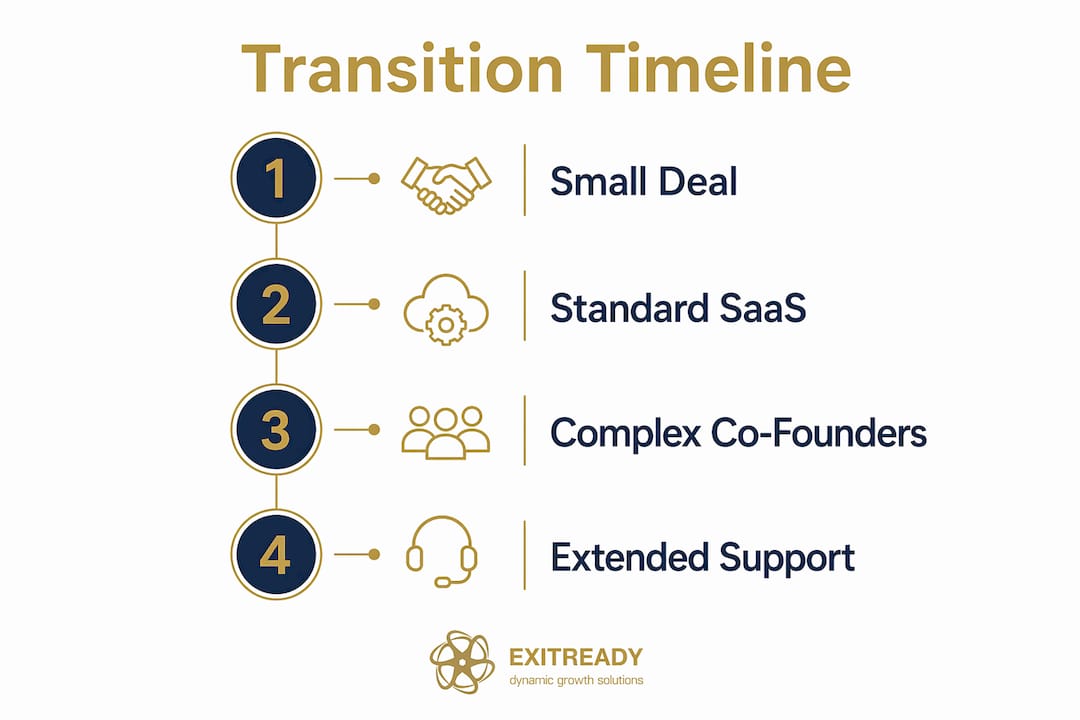
Transition durations vary by deal type: simpler acquisitions run 3–6 months, standard SaaS deals run 6–12 months, and complex operations can extend to 24 months. That range matters because it directly affects your income, your freedom, and your ability to move on. A founder who signs a vague two-year commitment without clear terms is not exiting. They are changing employers.
The post-exit transition process covers three distinct layers. The first is operational: transferring systems, processes, and institutional knowledge to the new owner or management team. The second is relational: introducing key customers, suppliers, and partners to their new contacts. The third is financial: receiving transition compensation, managing earn-out milestones, and tracking any deferred payments tied to performance.

Pro Tip: Treat the TSA as its own negotiation, not a footnote to the purchase agreement. The terms you accept here govern your daily life for the next 6–24 months.
What does the post-exit transition process typically involve?
The post-exit transition process follows a predictable sequence, even if the timeline varies. Knowing the steps in advance lets you negotiate from a position of clarity rather than react under pressure.
- TSA drafting and negotiation. Before the deal closes, both parties define the scope of the founder’s post-sale role. This includes hours per week, specific deliverables, and which decisions the founder can still make versus which belong to the buyer.
- Operational knowledge transfer. The founder documents processes, trains the incoming leadership team, and creates reference materials. This phase is where undocumented businesses suffer most. If your operations live in your head, the buyer pays for your time to extract them.
- Customer and partner introductions. The founder personally introduces key relationships to the new ownership. Buyers pay a premium for retained relationships, so this step directly protects earn-out payments.
- Financial settlement. Transition compensation is paid according to the TSA terms. Consulting retainers or hourly rates typically fall between $200 and $500 per hour, with total transition costs ranging from $200,000 to over $1 million depending on deal size and scope.
- Role wind-down. The founder steps back from daily involvement, either on a fixed date or through a gradual reduction in hours.
The table below shows how transition scope typically scales with deal complexity.
| Deal type | Typical duration | Compensation structure |
|---|---|---|
| Small business acquisition | 3–6 months | Flat monthly retainer |
| Mid-market SaaS or services | 6–12 months | Hourly rate plus milestones |
| Complex multi-site operations | 12–24 months | Consulting contract with earn-out |
A standalone TSA is always preferable to burying transition terms inside the purchase agreement. A separate document defines scope, hours, compensation, and termination provisions clearly. When transition terms are folded into the main agreement, disputes about scope become disputes about the entire deal.
What psychological and identity adjustments do founders face after exit?
The operational handoff is the visible part of post-exit transition. The identity shift is the part nobody warns you about. Founders who have built companies over 10 or 20 years often discover that the business was not just their job. It was their purpose, their social network, and their daily structure.
Over 50% of founders leave their roles within two years after a sale, and the first 90 days post-exit carry the highest risk for regret and poor decision-making. That statistic reflects a real pattern: the absence of external structure hits hardest in the first three months, before new routines form.
Transition theorists describe this phase as the “neutral zone.” Old professional identities dissolve before new ones form. Founders in this zone commonly experience:
- Loss of purpose and daily direction
- Decision regret, especially if the sale price felt lower in hindsight
- Social disorientation from losing a team and workplace community
- Restlessness that pushes toward premature new commitments
“The neutral zone is not a failure state. It is a necessary passage. The founders who resist it tend to rush into decisions that compound their disorientation.”
Post-exit psychological adjustment typically moves through three phases: disorientation, experimentation, and eventually finding new purpose through portfolio activities or new ventures. Most founders reach genuine clarity within two to three years, not two to three months.
Pro Tip: Schedule a check-in with a peer group or advisor at the 30, 60, and 90-day marks after closing. External accountability prevents the isolation that accelerates poor decisions.
How to negotiate and plan post-exit transition terms effectively
Negotiating transition terms before the deal closes is the single most protective step a founder can take. Clarity negotiated early is far easier to maintain than clarity requested after the fact. Once the deal closes, the buyer holds most of the leverage.
The key elements every TSA must address:
- Scope of work. Define exactly which tasks you will perform, which decisions you retain authority over, and which belong entirely to the buyer from day one.
- Hours and availability. Specify weekly hour commitments and whether you are available on-site, remotely, or both.
- Compensation. Agree on rate, payment schedule, and what triggers additional fees if the buyer expands the scope.
- Termination and off-ramp clauses. Without clear termination clauses, founders risk being locked into unwanted roles or forfeiting earn-outs if they exit early. A well-drafted off-ramp protects both parties.
- Dispute resolution. Define how disagreements about scope or performance are resolved before they become legal conflicts.
Working with experienced exit advisors during this negotiation phase pays for itself. Advisors who specialize in mid-market transactions know which clauses buyers routinely push and where founders give up value unnecessarily.
One risk that founders consistently underestimate: the buyer’s legal team drafts the first version of the TSA. That draft protects the buyer. Your job is to negotiate a version that protects you equally. Accepting the first draft without revision is one of the most common and costly mistakes in post-exit transitions.
Pro Tip: Ask for a standalone TSA, not transition language buried in the purchase agreement. Separate documents are easier to enforce, easier to amend, and far less likely to create ambiguity.
What strategies help founders successfully manage the post-exit phase?
Managing the post-exit phase well requires a plan for both the operational wind-down and the personal rebuild. Founders who treat the transition as purely a business event tend to struggle most in months three through twelve.
- Build structured daily routines immediately. The loss of external structure is the primary driver of post-exit disorientation. Scheduled exercise, advisory work, or learning projects fill the gap without requiring high-stakes commitments.
- Avoid major financial or career decisions in the first six months. Founders commonly make premature decisions in the first year post-exit due to disorientation. This pattern, sometimes called the “$10 million trap,” describes founders making consequential errors precisely when they are least equipped to manage them.
- Join a peer community of other founders. Shared experience with people who have been through exits reduces isolation and provides a reality check on new ideas before they become expensive commitments.
- Use low-consequence activities to test new interests. Advisory board seats, angel investing at small scale, or part-time consulting let you explore new directions without betting your post-exit capital on an untested hypothesis.
- Plan your next purpose before you need it. Post-exit identity shifts are natural. Founders who define a rough vision for their next chapter before closing tend to move through the neutral zone faster than those who expect clarity to arrive on its own.
Reviewing exit-ready business systems before the sale closes also reduces transition friction. When your business runs on documented processes rather than founder knowledge, the operational handoff takes weeks instead of months.
Key Takeaways
A successful post-exit transition requires equal attention to contractual clarity, operational handoff, and personal identity planning before the deal closes.
| Point | Details |
|---|---|
| Define the TSA separately | A standalone Transition Services Agreement prevents scope creep and protects your time and compensation. |
| Negotiate before closing | Founder leverage drops sharply after the deal closes; lock in scope, hours, and off-ramp terms early. |
| Expect the neutral zone | The first 90 days carry the highest risk for regret; build structure and avoid major decisions during this period. |
| Plan your next chapter early | Founders who define new purpose before closing move through identity adjustment faster and with fewer costly mistakes. |
| Document operations before exit | Businesses running on documented systems hand off in weeks; owner-dependent businesses hand off in years. |
The part of post-exit transition most founders learn too late
I have worked with enough mid-market founders to know that the TSA conversation almost always happens too late. By the time a founder asks about transition terms, the purchase agreement is already drafted and the buyer’s attorney has set the default. That default is never founder-friendly.
The founders who come out of transitions cleanly share one habit: they treated the post-exit period as a core deal component from the first letter of intent, not an administrative detail to sort out at closing. They knew their weekly hour commitment, their compensation rate, and their off-ramp date before they signed anything.
The emotional side is harder to prepare for, and I will not pretend otherwise. Losing the daily rhythm of running a company hits differently than most founders expect, even the ones who were desperate to sell. The neutral zone is real. The identity disorientation is real. The founders who navigate it best are the ones who give themselves permission to move slowly, build new routines without pressure, and resist the urge to fill the void with a new venture before they are ready.
The practical lesson: plan your transition terms like a deal, and plan your personal transition like a recovery. Both deserve the same rigor.
— Andre
How Dynamicgrowthsolutions helps owners prepare for a clean exit
Founders who build documented, system-driven businesses before they sell face shorter transition periods, fewer disputes, and stronger earn-out outcomes. Dynamicgrowthsolutions works with mid-market owners to build the operational infrastructure that makes post-exit handoffs predictable.

The AOS (Accelerated Operating System) replaces owner dependency with documented playbooks, defined processes, and leadership structures that run without the founder at the center. That foundation is exactly what buyers want and what makes your business operating system a valuation asset rather than a liability. If you are planning a sale in the next one to three years, the time to build that system is now. You can also review management systems for sustainable growth to see how structured operations reduce transition risk from day one.
FAQ
What does post-exit transition mean?
Post-exit transition is the structured period after selling a business where the founder transfers operational control, fulfills TSA obligations, and adjusts personally and financially to life after the sale.
How long does a post-exit transition typically last?
Transition periods range from 3 months for simple deals to 24 months for complex operations, with most mid-market SaaS and services businesses falling in the 6–12 month range.
What is a Transition Services Agreement?
A Transition Services Agreement (TSA) is a standalone legal contract that defines the founder’s post-sale role, including scope of work, weekly hours, compensation rate, and termination provisions.
Why is the first 90 days after exit considered high risk?
The first 90 days carry the highest risk for regret and poor decision-making because founders lose external structure suddenly and have not yet built replacement routines or clarity about their next chapter.
How should founders prepare emotionally for post-exit transition?
Founders benefit most from building structured daily routines immediately after closing, joining peer communities of other exited founders, and avoiding major financial or career commitments until the neutral zone passes, typically within six months.