
You’ve put in the hours, hired more people, pushed harder on sales, and still your revenue sits at the same number it did eighteen months ago. That is not bad luck. That is a business growth ceiling, and it is one of the most frustrating and misunderstood problems a business owner can face. Understanding what a business growth ceiling is, how it differs from a normal slow patch, and what it takes to break through it can be the difference between a business that scales and one that quietly runs its owner into the ground.
Thank you for reading this post, don't forget to subscribe!Table of Contents
- Key takeaways
- What is a business growth ceiling
- Signs you have hit a growth ceiling
- The theory of constraints and how it explains growth ceilings
- Practical strategies for breaking through a growth ceiling
- Measuring and anticipating your growth ceiling
- My take on the growth ceiling problem
- Ready to diagnose your growth ceiling
- FAQ
Key takeaways
| Point | Details |
|---|---|
| Ceilings are structural, not cyclical | A growth ceiling requires operating model changes, not more sales effort or ad spend. |
| Internal constraints drive most ceilings | Growth ceilings are almost always internal inefficiencies, not market or competitive limits. |
| One bottleneck controls all output | Every system has a single limiting constraint; fixing non-bottleneck areas produces no real throughput gain. |
| Unit economics reveal your ceiling early | Churn rate, customer lifetime value, and acquisition costs can forecast your revenue ceiling before you hit it. |
| System redesign beats working harder | Sustainable breakthroughs come from redesigning operations and leadership capacity, not grinding more hours. |
What is a business growth ceiling
A business growth ceiling is the theoretical maximum output a company can generate given its current operational structure, resources, and business model. Think of it as the physical roof on your business. You can add furniture, repaint the walls, and rearrange everything inside, but until you raise the roof, you cannot build another story.
This is meaningfully different from a temporary plateau. A temporary slowdown often has fixable, surface-level causes: a weak quarter, a bad hire, a marketing campaign that missed. Those are execution problems, and fixing execution solves them. A structural ceiling, by contrast, exists because the system itself cannot process more growth. No amount of optimization resolves it. You need fundamental change to the operating model.
Here are the most common forms a growth ceiling takes:
- Revenue ceiling: Your top-line income hits a number and stops growing regardless of sales activity.
- Founder capacity ceiling: The owner is the bottleneck because every decision runs through them.
- Process ceiling: Your operational processes cannot handle more volume without breaking down.
- Model ceiling: Your business model has an inherent cap on the customers or revenue it can serve.
One useful way to quantify this ceiling is through unit economics. Revenue ceiling calculations combine average customer monthly revenue, monthly churn rate, and new customers added per month to estimate the maximum sustainable revenue point. When churn balances acquisition, growth mathematically stops, regardless of how much you spend on marketing. That formula makes the invisible visible, which is exactly where you need to start.
Signs you have hit a growth ceiling
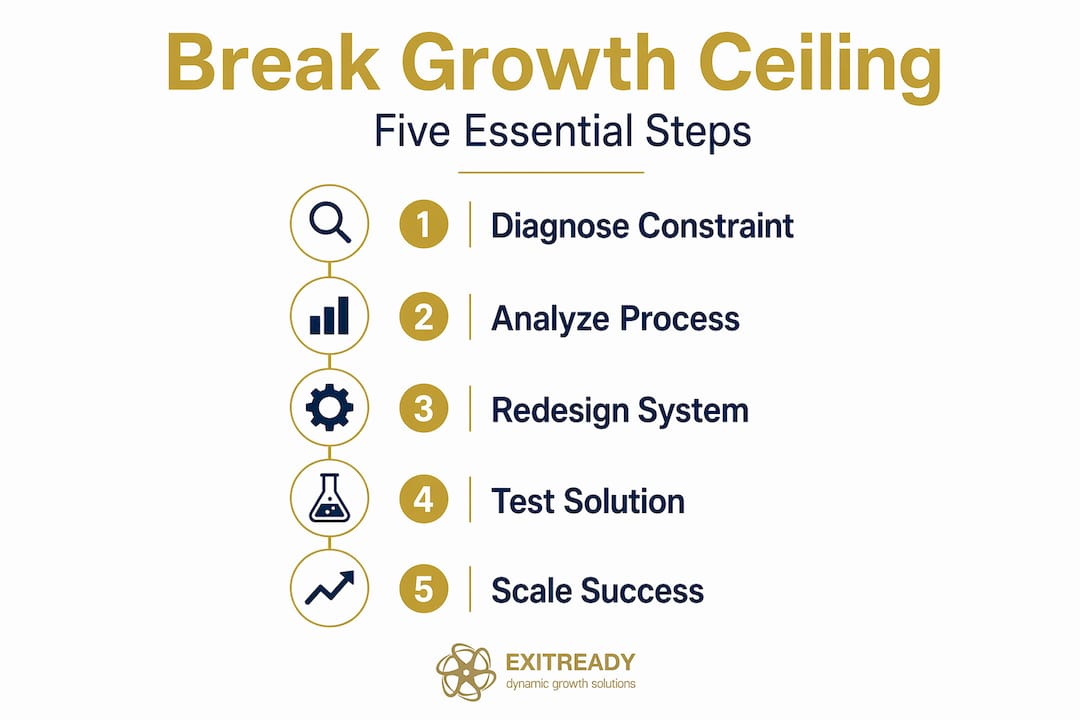
Most owners feel the ceiling before they can name it. The work gets heavier. Progress feels slower. And yet the revenue line barely moves.
Symptoms include declining morale, diminishing returns despite more effort, and a persistent sense that the owner personally is the lid on the jar. These are not character flaws or market problems. They are diagnostic signals that the system has maxed out its current capacity.
The root causes are almost always internal. Owners frequently blame market saturation or competitive pressure, but growth constraints are mostly internal operational issues. Process bottlenecks, underdocumented workflows, founder decision dependency, and outdated pricing models are the usual culprits. The market did not stop cooperating. Your operating architecture stopped scaling.

This distinction matters enormously. If you believe the problem is external, you will waste resources on more advertising, more salespeople, and more hustle. If you correctly identify it as internal, you will redesign the structures that are holding output back.
Pro Tip: Ask yourself this question: “If I doubled our lead volume tomorrow, would our operations handle it?” If the honest answer is no, you have a structural ceiling, not a marketing problem.
The theory of constraints and how it explains growth ceilings
The single most useful framework for understanding and addressing a business growth ceiling is the Theory of Constraints, or TOC. Developed by physicist and business theorist Eliyahu Goldratt, it contains one central truth that changes how you see your business.
Every system has exactly one bottleneck that controls total throughput at any given time. Not two. Not five. One. Improving anything that is not that bottleneck produces zero gain in system output. You can make your accounting team faster, your website load quicker, and your warehouse more organized, but if your bottleneck is your sales team’s capacity, none of those improvements will move your revenue ceiling.
TOC outlines a five-step cycle for continuous constraint management:
- Identify the single constraint currently limiting your system’s throughput.
- Exploit it by getting maximum output from it without major investment.
- Subordinate everything else in the system to support the constraint’s performance.
- Elevate the constraint by investing in expanding its capacity when exploitation is not enough.
- Repeat because once you resolve one constraint, another immediately becomes the binding limit.
That fifth step is where most owners get discouraged. They fix the bottleneck, see a burst of growth, and then stall again. They interpret the new stall as failure. It is not. After fixing one bottleneck, another always emerges. This is the mechanism of progress. Each resolved bottleneck permanently raises the ceiling, and the next one becomes your new growth priority.
“Throughput accounting values decisions by their impact on throughput rather than standard cost measures, enabling owners to make far better investment decisions about where to apply resources.” — Theory of Constraints, The 5-Step Framework
The critical mindset shift here is from local efficiency to system throughput. Making a non-bottleneck process 30% faster does not help your output. Identifying the single active constraint and applying focused improvements to it yields disproportionate gains in profit and throughput compared to spreading effort across the whole business.
Practical strategies for breaking through a growth ceiling
Knowing you have a ceiling is half the battle. Breaking through it requires a specific sequence of decisions, not a general push to “do more.”
The first move is accurate diagnosis. A common and costly mistake is mistaking a structural ceiling for a temporary performance issue, then pouring budget into marketing or sales when the real bottleneck is in operations or leadership capacity. Before you spend anything, map your entire value delivery process and find where work piles up, where decisions stall, and where your time personally gets consumed.
The table below shows the difference between symptom treatment and constraint-level solutions:
| Symptom treatment | Constraint-level solution |
|---|---|
| Hire more salespeople | Redesign the sales process to close at higher volume |
| Increase ad spend | Reduce churn to raise the revenue ceiling formula ceiling |
| Push team to work longer | Document and delegate the founder bottleneck decisions |
| Add features to the product | Redesign pricing to improve unit economics |
| Optimize a non-bottleneck process | Identify and elevate the one true system constraint |
Once you have identified the true constraint, the paths for elevating it fall into three broad categories. Process redesign means rebuilding how work flows through the bottleneck so it handles more volume per unit of time. Leadership capacity expansion means either training leaders to take on decisions the founder currently owns or redesigning leadership decision rights and organizational structures. Business model innovation means questioning whether the model itself is the ceiling, particularly when you have outgrown the original model or founder capacity.
Pro Tip: After you identify your bottleneck, run a 30-day experiment focused exclusively on improving throughput at that single point. Track output before and after. The results will tell you more than any consultant’s report.
Scalable infrastructure is the foundation underneath all of this. You cannot repeatedly raise your ceiling without documented processes, defined decision frameworks, and systems that run independently of the owner. Businesses that break through multiple ceilings consistently have one thing in common: they have replaced reliance on individual heroics with replicable operating systems.
Measuring and anticipating your growth ceiling
The best time to address a business growth ceiling is before you hit it hard. The metrics needed to forecast your ceiling are already inside your business.
The core indicators to track are:
- Churn rate: The percentage of customers leaving each month. High churn compresses your revenue ceiling fast.
- Customer lifetime value (CLV): Higher CLV expands how much revenue your customer base can generate.
- Customer acquisition cost (CAC): When CAC approaches or exceeds CLV, growth becomes structurally unprofitable.
- Gross margin: Thin margins leave no room to invest in constraint elevation, keeping your ceiling permanently low.
The revenue ceiling formula makes this concrete: divide average monthly revenue per customer by your monthly churn rate, then multiply by new customers added per month. The result is your theoretical maximum revenue under current conditions. If that number is close to your current revenue, you are approaching the ceiling. If it is below, you are already past it and losing ground.
Integrating these metrics into your monthly business review creates an early warning system. Spotting a narrowing gap between your current revenue and the ceiling gives you time to redesign before growth stops completely, rather than responding in crisis mode after the stall.
My take on the growth ceiling problem
I have worked with enough mid-market owners to recognize a pattern that almost no one talks about honestly. The owners who hit ceilings hardest are usually the most capable. They built something real by outworking competitors, staying close to every decision, and solving problems personally. That same capability becomes the ceiling.
When I see an owner grinding at 70-hour weeks with flat revenue, my first instinct is not to look at their marketing. I look at how decisions get made and where work actually stops moving. Nine times out of ten, the bottleneck is somewhere in the leadership layer, not the frontline execution. And fixing it requires admitting that the way you built the business to $5M will not take it to $15M.
The owners who break through are not smarter or better funded. They are the ones willing to redesign how the business works rather than just push harder inside the current design. Systems thinking is not a corporate concept. It is how you permanently raise the ceiling instead of constantly running into it.
— Andre
Ready to diagnose your growth ceiling
If this article has you thinking about where your own ceiling might be, that instinct is worth acting on. Dynamicgrowthsolutions built its 360-ProfitDriver analysis specifically to uncover the hidden constraints and revenue gaps that owners cannot see from inside their own operations. It is the diagnostic step most businesses skip and later regret.

For owners ready to work through their growth constraints at a deeper level, the CEO mastermind retreats at Dynamicgrowthsolutions bring together mid-market leaders to share constraint management strategies, operational redesign frameworks, and the kind of peer accountability that accelerates results. You can also explore how a scalable business infrastructure approach addresses the operating system gaps that sit underneath most growth ceilings.
FAQ
What is a business growth ceiling exactly?
A business growth ceiling is the maximum revenue or output a company can produce under its current structure. It is a structural limit, not a temporary dip, and requires operating model changes to overcome.
How is a growth ceiling different from a normal slow period?
A slow period is usually caused by fixable execution problems like weak marketing or seasonal dips. A growth ceiling is a structural constraint inside the operating model that effort alone cannot resolve.
What causes most business growth ceilings?
Most growth ceilings stem from internal constraints such as founder decision dependency, process bottlenecks, or a business model that cannot scale further, not from market saturation or competition.
How do you calculate a revenue ceiling?
Divide your average monthly revenue per customer by your monthly churn rate, then multiply by the number of new customers you add each month. The result estimates your maximum sustainable revenue under current conditions.
Can a growth ceiling be broken permanently?
Breaking one ceiling permanently raises throughput to a new level, but a new constraint will emerge. Growth ceiling management is a continuous cycle of identifying and resolving the next binding constraint.