

Exit timeline planning is the process of mapping a structured, time-phased roadmap that prepares your business, your finances, and your post-exit life for a successful ownership transition. Most advisory consensus, including guidance from the Exit Planning Institute and its Value Acceleration Methodology, points to a 3–5 year window as the minimum runway to materially change the inputs that drive your valuation. Start earlier and you have real options. Start later and you are managing damage.
Only about 32% of U.S. business owners have a documented exit plan. That gap is not a knowledge problem. It is a timing problem. Owners who treat exit planning as something to handle “when the time comes” routinely leave one to two turns of EBITDA multiple on the table. The owners who capture full value treat the exit as a multi-year operating project, not a transaction event. That distinction shapes everything that follows.
Table of Contents
- What does exit timeline planning actually include?
- What factors will lengthen or shorten your timeline?
- Which timeline framework fits your runway?
- Who should be on your exit planning team?
- How to build your own exit timeline step by step
- What mistakes derail exit timelines most often?
- How do you measure exit readiness objectively?
- How the AOS approach accelerates your exit timeline
- Key Takeaways
- The mindset shift that changes everything
- Dynamicgrowthsolutions helps you build an exit-ready business
- Useful sources and further reading
What does exit timeline planning actually include?
Every credible exit timeline is built on the same core components, even if the sequencing varies by runway. Think of these as the building blocks of a plan you can audit against right now.
- Valuation baseline. A formal third-party or advisor-led valuation of the business as it stands today. Without this number, every other priority is a guess.
- Value driver analysis. Identification of the specific levers that will move your multiple: EBITDA margin, recurring revenue, customer concentration, management depth, and documented systems.
- Management and delegation milestones. A written plan showing which owner responsibilities transfer to whom, by when, and how performance is measured.
- Financial and tax planning. Coordination between your CPA and financial advisor on deal structure, entity type, installment sales, and capital gains timing.
- Legal and entity work. Clean corporate records, updated operating agreements, IP assignments, and any entity restructuring needed before a transaction.
- Customer and contract remediation. Reviewing customer concentration, transferability of key contracts, and any change-of-control clauses that could spook a buyer.
- HR and retention planning. Key-employee retention agreements, compensation benchmarking, and succession depth for critical roles.
- Data room and documentation. Three years of clean financials, tax returns, customer lists, org charts, and standard operating procedures organized for due diligence.
The sequencing matters as much as the list. Valuation and management independence come first because they tell you how much time you actually need and where the biggest gaps are. Everything else flows from those two anchors.
Pro Tip: Get a baseline valuation before you hire any other advisor. It costs a fraction of what a missed multiple does, and it immediately tells you whether your plan should be 18 months or five years.
What factors will lengthen or shorten your timeline?
Two categories of factors shape how long your exit preparation realistically takes. Some you control. Some you do not.
Internal factors you can influence
- Owner dependency. If the business cannot operate for two weeks without you making decisions, buyers will discount heavily or walk. Reducing this is the single longest-lead-time item on any exit plan.
- Management depth. A leadership team that can run the business post-close is a premium asset. Building it takes 18–36 months minimum.
- Financial record quality. Accrual-basis, GAAP-compliant financials with clean add-backs shorten due diligence and protect your multiple. Cash-basis books with messy owner expenses do the opposite.
- Customer concentration. A single customer representing more than 20% of revenue is a red flag for most buyers. Diversifying takes time and deliberate sales strategy.
- EBITDA trend. Buyers pay for trajectory. A business with three years of growing EBITDA commands a premium over one with flat or declining margins, even at the same absolute level.
External factors you have to work around
- Market cycles and buyer appetite. Private equity dry powder, interest rate environments, and sector-specific M&A activity all affect what buyers will pay and how quickly deals close. You cannot control the cycle, but you can time your go-to-market within it.
- Interest rates. Higher rates compress leverage multiples and reduce what financial buyers can pay. Lower rates have the opposite effect.
- Regulatory and tax changes. Capital gains rate changes, estate tax thresholds, and industry-specific regulations can shift the optimal timing of a transaction by months or years.
- Industry cycles. Some sectors have predictable consolidation windows. Missing one can mean waiting years for the next.
How exit route affects the timeline
The path you choose changes the clock significantly. A third-party sale to a strategic or financial buyer typically takes 6–12 months for the active process alone, after 2–5 years of preparation. Family succession can take a decade if ownership transfer, estate planning, and management development all need to happen in sequence. An ESOP requires 12–24 months of legal and financial structuring even after the business is ready. A recapitalization with a private equity partner can move faster but requires institutional-quality financials and a management team that can operate independently. An IPO is the longest path of all, typically requiring 3–7 years of preparation for a mid-market company.
Which timeline framework fits your runway?
The right framework depends on how much time you have and what condition the business is in today. The table below maps four common frameworks to their core tradeoffs.
| Framework | Runway | Primary Focus | What You Gain | Key Tradeoff |
|---|---|---|---|---|
| 10+ year strategic succession | 10+ years | Value creation and ownership structure | Maximum optionality, highest multiples | Requires sustained discipline over a decade |
| 5-year value acceleration | 5–7 years | EBITDA growth, management depth, systems | Strong multiple, competitive buyer pool | Moderate urgency; most owners underestimate scope |
| 24-month aggressive prep | 18–30 months | Documentation, financial cleanup, advisor assembly | Credible transaction at market multiple | Limited time to move the multiple meaningfully |
| 6–12 month emergency sprint | 6–12 months | Financial cleanup, management positioning, advisor team | A transaction is possible | Measurable value left on the table; reduced buyer competition |
Sample 24-month sprint: quarterly milestones
Months 1–3: Commission a baseline valuation. Engage a CPA to recast financials. Identify the top three value gaps. Hire or designate an M&A advisor.

Months 4–6: Begin management delegation. Document the top 10 operating processes. Resolve any customer concentration issues. Clean up the cap table and corporate records.
Months 7–9: Build a 36-month financial model. Establish a data room. Conduct a mock due diligence review. Finalize key-employee retention agreements.
Months 10–12: Engage a corporate attorney. Confirm tax structure for the deal. Begin quiet buyer outreach or prepare a confidential information memorandum (CIM).
Months 13–18: Run a structured sale process. Manage buyer LOIs. Negotiate deal terms and representations and warranties.
Months 19–24: Due diligence, final negotiations, closing, and transition planning.
The 10-year view: what strategic value creation looks like
Years 1–3 focus on building the business itself: revenue diversification, margin improvement, and hiring the management layer that will eventually run the company without you. Years 4–6 shift to systematizing operations, documenting playbooks, and beginning formal exit planning conversations with advisors. Years 7–9 are about optimization: cleaning up any remaining structural issues, stress-testing the management team, and timing the market. Year 10 is the transaction.
Owners who follow this arc consistently achieve higher multiples because buyers are paying for a business that does not need the seller to function. That is the whole game.
Who should be on your exit planning team?
Most owners think about hiring a broker when they decide to sell. The real work starts years earlier, with a different set of advisors. Here is who you need and when.
Core advisor roles
- Owner/CEO. Sets the vision, owns the timeline, and makes the final calls. No advisor can substitute for owner commitment to the process.
- CFO or fractional CFO. Manages financial reporting quality, builds the financial model, and coordinates with the CPA on tax structure. Bring in early, ideally 3–5 years out.
- CPA and tax advisor. Structures the deal to minimize tax drag. Critical from the start; tax decisions made in year one affect what you net at closing.
- M&A advisor or investment banker. Runs the sale process, manages buyer outreach, and negotiates deal terms. Engage 12–18 months before go-to-market.
- Corporate attorney. Handles entity structure, IP, contracts, and the purchase agreement. Needed throughout but most intensively in the final 12 months.
- HR and retention specialist. Designs key-employee retention plans and compensation structures that survive a change of control. Engage 18–24 months out.
- Operations coach or business consultant. Builds the systems and delegation structures that reduce owner dependency. This is the longest-lead-time role; engage 3–5 years out.
- Exit planning advisor. Coordinates the full team, aligns business, personal, and financial readiness, and keeps the timeline on track. The role of advisors in a transaction is often underestimated until it is too late.
What advisors will ask for in the first 90 days
- Three years of tax returns and financial statements (P&L, balance sheet, cash flow)
- A current organizational chart with compensation detail
- A customer list with revenue concentration by account
- Copies of key contracts (leases, customer agreements, supplier agreements)
- A summary of any pending litigation, liens, or regulatory issues
- The current cap table and any shareholder agreements
- A list of owner add-backs and personal expenses run through the business
Getting these documents organized before your first advisor meeting saves weeks and signals that you are a serious seller.
How to build your own exit timeline step by step
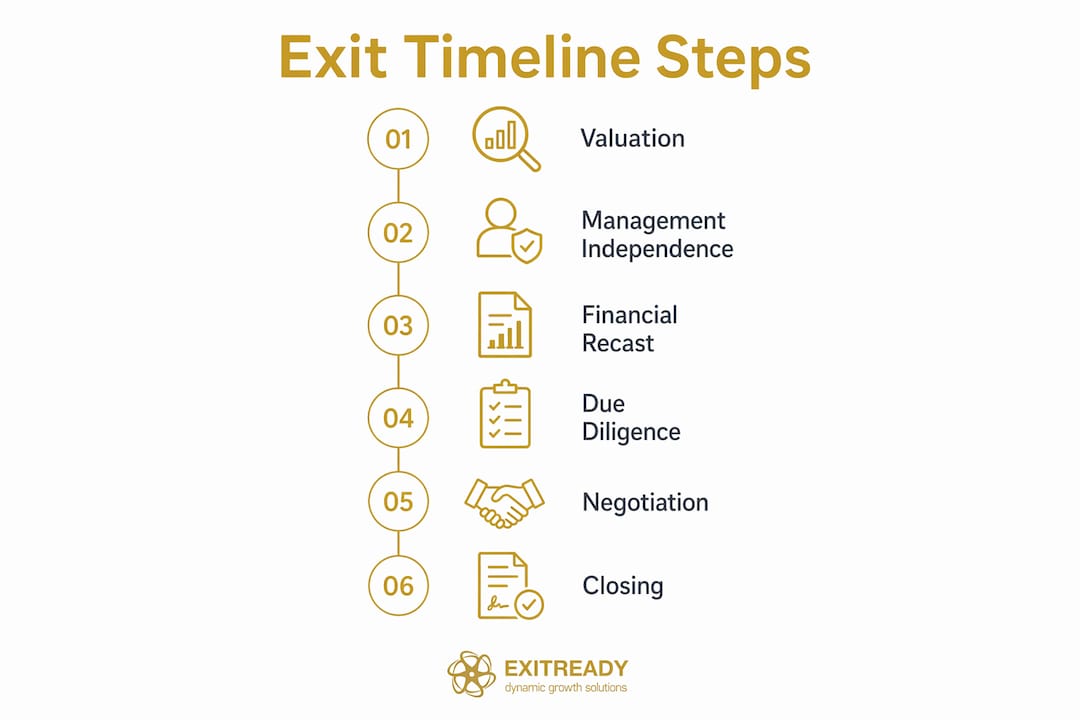
Converting intent into a working plan takes six steps. Run through them in order.
- Assess your baseline. Get a valuation. Map your owner dependency score. Identify the three biggest gaps between where the business is and where a buyer wants it to be.
- Prioritize by impact and effort. Not every gap is worth fixing. A simple 2×2 matrix with impact on multiple on one axis and effort to fix on the other tells you where to spend year one. High impact, lower effort items go first.
- Assign ownership. Every initiative needs a named owner and a deadline. If it is not assigned, it does not get done.
- Fund the plan. Exit preparation costs money: advisor fees, system investments, key-employee retention bonuses. Build these into your operating budget 2–3 years before go-to-market.
- Execute in 90-day sprints. Break the multi-year plan into quarterly deliverables. Review progress at the end of each quarter and adjust.
- Measure and re-check valuation. Run an updated valuation every 12–18 months to confirm that the work is moving the multiple. If it is not, the priorities need to change.
Quarterly milestone template (3–5 year plan)
Year 1, Q1–Q2: Baseline valuation, owner dependency audit, top-3 gap identification, advisor team assembly.
Year 1, Q3–Q4: Management delegation plan drafted, financial reporting upgraded, first SOP documentation sprint.
Year 2: Management team development, customer concentration reduction, recurring revenue initiatives, legal cleanup.
Year 3: Systems fully documented, management team operating independently, financial model built, data room started.
Year 4: Mock due diligence, advisor team finalized, market timing assessment, CIM drafted.
Year 5: Go-to-market, structured sale process, close.
Adjusting when time runs short
If you have 6–12 months, the emergency sprint approach shifts priorities sharply. Financial cleanup and management positioning come first. Buyer competition will be limited, and the multiple will likely reflect the compressed timeline. That is a real cost, but a credible transaction is still possible with the right advisor team assembled quickly.
Pro Tip: Build a strategic finance cadence into your operating rhythm from year one. Monthly management accounts, quarterly reforecasts, and an annual valuation re-check are the governance habits that keep the plan on track and the multiple moving.
What mistakes derail exit timelines most often?
The mistakes that cost owners the most are almost always predictable. Here is what to watch for.
- Waiting too long. Starting the formal process 6–12 months before a desired exit compresses a 3–5 year value-building roadmap into a sprint. Compressing that roadmap can reduce EBITDA multiples by 1x–2x compared to a prepared business.
- Owner dependency left unresolved. Buyers do not pay a premium for a business that walks out the door when the owner does. If you are still the primary relationship holder for key customers, the main decision-maker on operations, and the face of the brand, your multiple reflects that.
- Unclean financials. Cash-basis books, personal expenses mixed with business expenses, and inconsistent revenue recognition all create due diligence friction that kills deals or reduces price.
- Customer concentration. A single customer above 20% of revenue is a structural problem. Most buyers will either reprice the deal or walk.
- No management succession plan. A business with no second-in-command is a business a buyer has to staff before they can operate it. That cost comes out of your price.
- Missing employment and retention agreements. Key employees who are not locked in before a sale process are a flight risk during due diligence. Buyers notice.
- Ignoring the personal financial plan. Owners who plan only for the transaction often discover post-close that the net proceeds do not support the lifestyle they expected. Aligning the three legs of exit planning — business, personal, and financial — prevents that outcome.
Red flags to fix in the first 6–12 months if time is short
- Recast financials to GAAP or accrual basis and document all add-backs.
- Identify and begin reducing your single largest customer concentration.
- Designate a second-in-command and begin transferring owner-held decisions.
- Assemble your core advisor team: CPA, M&A advisor, and corporate attorney.
Pro Tip: Process compression is the single most expensive mistake in exit planning. If a buyer senses you are in a hurry, they will use that urgency against you in negotiations. The best protection is time. The second-best protection is a clean, well-documented business that does not need you to explain it.
How do you measure exit readiness objectively?
Readiness is not a feeling. It is a score. The table below gives you the measurable indicators that buyers and advisors use to assess how prepared a business actually is.
| Readiness Indicator | Target Range | Red Flag Threshold | Measurement Method |
|---|---|---|---|
| Owner dependency score | Low (1–2 on a 5-point scale) | High (4–5) | Owner absence test; decision log audit |
| Management depth | 2+ layers below owner | Owner is sole decision-maker | Org chart review; delegation audit |
| EBITDA trend | 3-year growth trajectory | Flat or declining | Recast P&L, year-over-year comparison |
| Recurring revenue % | More than one-fifth of total revenue | Low percentage | Revenue cohort analysis |
| Customer concentration | No single customer above 20% | Any customer above 30% | Customer revenue report |
| Financial reporting quality | Accrual, GAAP-compliant, audited or reviewed | Cash-basis, unreviewed | CPA assessment |
| SOP documentation coverage | Most core processes documented | Less than half | Process inventory audit |
Checkpoint intervals
Run a full readiness review annually if you are 3+ years out. At 24 months, review every six months. Inside 12 months, review quarterly. The exit readiness assessment framework gives you a structured way to score each dimension and track progress over time.
The Value Acceleration Methodology from the Exit Planning Institute frames this as a three-gate process: Discover (where are you now?), Prepare (what needs to change?), and Decide (are you ready to go to market?). Each gate has measurable criteria. Passing all three is what separates a business that commands a premium from one that gets repriced in due diligence.
Statistic to know: Only about 32% of U.S. business owners have a documented exit plan. Among those who do, the ones who started 3–5 years before their intended exit consistently report better outcomes on both price and transition quality than those who started inside 18 months.
How the AOS approach accelerates your exit timeline
Most owners think exit preparation means hiring a broker. The real bottleneck is operational: a business that depends on its owner cannot be sold at a premium, regardless of how good the financials look. The Accelerated Operating System (AOS) that Dynamicgrowthsolutions uses addresses that bottleneck directly.

The AOS approach replaces owner dependency with documented systems, delegation structures, and governance cadences that let the business run without the owner in every operational decision. That is exactly what buyers are paying for. A business that can operate independently is a business with a defensible multiple.
Here is what the AOS checklist looks like in practice:
- Process documentation. Every core function has a written SOP that a new hire could follow without asking the owner.
- Delegation architecture. Decision rights are mapped and assigned. The owner approves strategy; operators handle execution.
- Management accountability system. Weekly scorecards, monthly reviews, and quarterly planning sessions replace ad hoc owner oversight.
- Financial visibility. Management accounts are produced monthly, not annually. The owner can see the business’s health without being in it.
- Buyer-ready data room. Documentation is organized, current, and accessible. Due diligence does not start from scratch.
The business operating system concept is not just an exit tool. As the Exit Planning Institute’s research confirms that [exit planning treated as value acceleration](https://exit-planning-institute.org/hubfs/EPI Exit Planning Paper updated 01.31.25-v3.pdf) makes the business stronger whether or not the owner ever sells. That is the real argument for starting early.
Pro Tip: The fastest way to reduce owner dependency is to document the decisions you make most often, then train someone else to make them. Start with the ten decisions you make every week. Within 90 days, most of those should be off your plate.
Key Takeaways
Exit timeline planning works when it starts early, runs as a structured operating project, and aligns business readiness, financial readiness, and the owner’s post-exit vision simultaneously.
| Point | Details |
|---|---|
| Start 3–5 years out | Advisory consensus puts the minimum effective runway at 3–5 years to materially move your valuation multiple. |
| Valuation baseline first | A formal valuation is the cheapest first step and sets every other priority in the plan. |
| Owner dependency is the longest fix | Reducing owner dependency takes 18–36 months minimum; it is the highest-impact item and the longest lead time. |
| Process compression costs multiples | Compressing a multi-year roadmap into 12–18 months can reduce EBITDA multiples by 1x–2x versus a prepared business. |
| Dynamicgrowthsolutions AOS approach | The AOS framework replaces owner dependency with documented systems and governance, accelerating exit readiness for mid-market owners. |
Immediate next steps
Next 30 days: Commission a baseline valuation and complete an owner dependency audit. Identify your top three value gaps.
Next 90 days: Assemble your core advisor team (CPA, M&A advisor, corporate attorney). Begin financial recast and SOP documentation for your top ten processes.
Next 180 days: Draft a management delegation plan with named owners and deadlines. Establish a quarterly governance cadence. Set a 12-month valuation re-check date.
The mindset shift that changes everything
There is a version of exit planning that feels like preparing to leave something you built. That version is hard to start. It triggers identity questions, loss of control anxiety, and a vague sense that planning the exit means the business is already over.
The owners who execute well on exit timelines have made a different mental move. They treat exit planning as building a better business, not preparing to abandon one. Every system they document makes the company more valuable whether they sell or not. Every management layer they build gives them more time and more options. Every financial cleanup they do makes the business easier to run, not just easier to sell.
That reframe changes what gets prioritized. Instead of “what do buyers want to see,” the question becomes “what would make this business excellent to own.” The answer to both questions is almost identical. A business that runs without the owner, grows predictably, and has clean financials is both a great business to keep and a premium asset to sell.
The owners who regret their exits are almost always the ones who planned only for the transaction. They optimized the deal and neglected the life on the other side. Aligning your personal financial plan and your post-exit vision with the business timeline is not a soft add-on. It is what separates a low-regret exit from one that leaves you wondering what you did it for.
Dynamicgrowthsolutions helps you build an exit-ready business
Mid-market owners who want a structured path to a premium exit need more than a checklist. They need a system that replaces owner dependency with documented operations, a team that coordinates the financial and strategic work, and a clear picture of where the business stands today versus where it needs to be.

Dynamicgrowthsolutions works with mid-market business owners to implement the AOS framework, run an exit readiness assessment, and build the governance cadence that keeps the plan on track. An initial engagement delivers a valuation baseline, a 90-day action plan, and a prioritized gap analysis. From there, the work is quarterly: systems built, management depth developed, financials cleaned, and multiple moved. Owners who want to prepare for a premium exit with a structured program can apply for the AOS Entrepreneur program or request a business analysis to see exactly where they stand. Independent advisor checks are always encouraged. The goal is a plan that works regardless of who executes it.
Useful sources and further reading
The resources below support the research and frameworks in this guide. Each is annotated for the sections it is most relevant to.
-
Exit Planning Institute: Value Acceleration Methodology — The primary industry framework for treating exit planning as a multi-gate value-creation process. Relevant to sections on core components, timeline frameworks, and the AOS approach.
-
Iconic: Complete Guide to Business Exit Planning — Covers the 3–5 year consensus window, baseline valuation as a first step, and the statistic on documented exit plans. Relevant to the BLUF, timeline frameworks, and readiness measurement sections.
-
Iconic: What Is Exit Planning? — Explains the three-legs framework (business, personal, financial) and the operational independence imperative. Relevant to the components, team, and common mistakes sections.
-
Certified Exit Planners: 5-Year Roadmap — Details on process compression costs, the 6–12 month emergency sprint, and multiple impact of compressed timelines. Relevant to the frameworks table and common mistakes section.
-
Entrepreneur: Why You Need an Exit Plan Long Before You’re Ready to Sell — Reinforces the alignment of business, financial, and personal readiness as the key to capturing full value.
-
SBA: Prepare to Sell Your Business — U.S. Small Business Administration guidance on the legal, financial, and operational steps to prepare a business for sale. A primary government reference for U.S. owners.
-
Dynamicgrowthsolutions: Timeline Planning for Business Exit — Detailed multi-year methodology and milestone templates for mid-market owners working through a structured exit timeline.
-
Dynamicgrowthsolutions: Benefits of Exit Planning Early — Quantifies the payoff levers of early planning and the cost of delay for mid-market business owners.