
Most mid-market businesses don’t stall because demand dries up. They stall because the operating model that drove early success quietly becomes the ceiling that blocks the next stage. Understanding what causes business growth stagnation means looking inward first, not at competitors or market conditions. The culprits are almost always internal: leadership bottlenecks, outdated financial infrastructure, and processes built for a smaller company still running a larger one. This article breaks down the real forces behind growth plateaus, gives you a framework to diagnose your own situation, and shows you what actually moves the needle.
Thank you for reading this post, don't forget to subscribe!Table of Contents
- Key takeaways
- What causes business growth stagnation: the scaling gap explained
- Financial infrastructure as a hidden growth barrier
- Operational inefficiencies and leadership bottlenecks
- External challenges and their secondary role
- Practical frameworks to overcome growth stagnation
- My honest take on what’s really going on
- How Dynamicgrowthsolutions helps you move past stagnation
- FAQ
Key takeaways
| Point | Details |
|---|---|
| Internal barriers drive stagnation | Resource limits, operational inefficiencies, and leadership constraints cause most growth plateaus. |
| The scaling gap is the core problem | Early-stage strategies stop working at scale; businesses must reinvent operations, not just optimize them. |
| Financial infrastructure often lags | Legacy financial tools create cash visibility gaps that delay critical investment decisions. |
| Leaders frequently become bottlenecks | Over 60% of leaders identify themselves as limiting factors in sales, strategy, and operations. |
| Structured execution systems work | Companies using habit-driven execution frameworks grow significantly faster than peers who rely on reactive management. |
What causes business growth stagnation: the scaling gap explained
The term “scaling gap” describes the point where a business outgrows the systems, habits, and leadership behaviors that originally built it. It’s not a market problem. It’s a structural mismatch between where the business is headed and how it currently operates.
Here’s what makes it deceptive: the business still looks busy. Revenue is moving. Deals are closing. But meaningful growth has quietly stopped. 59% of leaders admit mistaking busy work for real progress, which means most executives are deep in activity that feels productive without actually advancing the company.
The distinction matters because it changes the diagnosis entirely. If you believe your growth plateau is about market conditions, you might cut pricing or ramp up marketing. If the real cause is the scaling gap, those moves solve nothing. You need to scale a mid-market business differently than you built it.
The most common internal business stagnation factors that feed the scaling gap include:
- Resource limitations cited by 58% of companies as a primary barrier to growth
- Operational inefficiencies that compound as team size grows, flagged by 48% of leaders
- Leadership bottlenecks where decision authority stays concentrated at the top
- Absence of documented processes forcing tribal knowledge to fill execution gaps
Scaling doesn’t mean doing the same things better. It requires doing fundamentally different things, which is the exact reason many capable leaders resist it. Their instinct is to optimize what already works. But businesses willing to fundamentally change how they operate consistently outperform peers who only refine existing approaches.
Pro Tip: If your top leaders are spending more than 30% of their time on daily operational decisions rather than strategic priorities, you are likely already inside the scaling gap. That’s the clearest early warning sign.
Financial infrastructure as a hidden growth barrier
Many mid-market owners assume their financial position is sound because cash is still coming in. The problem isn’t always cash. The problem is visibility. Without real-time cash flow intelligence, investment decisions get delayed, opportunities get missed, and the business reacts instead of plans.

Legacy financial systems cause weak cash visibility, frequent shortfalls, and delayed strategic investments in mid-market firms. These aren’t edge cases. They describe the default financial infrastructure of most companies in the $10M to $100M revenue range.
The typical financial infrastructure gaps that create these problems include:
- Fragmented reporting tools that produce data siloed across departments with no unified view
- Delayed close processes where monthly financials arrive too late to act on
- Inadequate forecasting capability driven by spreadsheets instead of live-connected systems
- Reactive cash management where shortfalls are discovered, not anticipated
The downstream effect is significant. When financial data lags reality by weeks, executives make strategic decisions with outdated information. Growth investments get deferred because the true cash position feels uncertain. What looks like caution is actually a symptom of tool misalignment. Financial infrastructure gaps create the kind of operational strain that quietly erodes growth momentum before it ever registers as a crisis.
Companies that upgrade their financial infrastructure consistently report faster decision cycles, more confident capital allocation, and reduced friction around hiring and expansion planning. The investment pays back quickly, not through cost cutting, but through speed and clarity.
Operational inefficiencies and leadership bottlenecks
When a business grows past 50 employees, processes built for agility often become obstacles. What was once a flexible, founder-driven workflow becomes a tangle of informal workarounds, duplicated effort, and missed handoffs. This is where operational inefficiencies become visible, though most leadership teams blame market timing or talent before they examine their own processes.
Leadership itself is frequently the most costly bottleneck. 61% of leaders identify themselves as bottlenecks in sales and marketing, while 54% admit the same about strategic focus. These numbers reflect a real pattern: executives who built the company want to stay close to everything, but that proximity starts blocking the people around them from executing independently.
The reasons for business slowdown tied to leadership behavior are often cultural, not intentional:
- Approval dependency where teams wait on executive sign-off for routine decisions
- Unclear delegation frameworks leaving middle management without defined authority
- Change resistance where leaders protect existing processes because they built them
- Activity bias, where filling a calendar with calls and meetings substitutes for strategy
The activity bias problem is particularly damaging because it’s self-reinforcing. Busy leaders feel productive. Their teams mirror the behavior. The organization grinds forward without ever gaining real strategic momentum.
Pro Tip: Run a simple audit: list the ten decisions made in your business last week that required your personal input. If more than half of those could have been made by a department head with the right guidelines, you are a bottleneck and your org chart needs to reflect that reality.
Removing leadership bottlenecks requires more than delegation. It requires building the work structure around documented playbooks, clear accountability, and empowered middle management. That shift is where stagnation starts to reverse.
External challenges and their secondary role
Economic headwinds are real. 74% of business owners cite tariffs as a primary cost driver, and uncertainty around trade policy has contributed to fewer businesses reporting revenue growth than at any point in over a decade. Inflation, political instability, and shifting buyer behavior all add friction to growth plans.
But external factors are almost always secondary to internal ones. The common causes of business growth plateaus tied to market conditions matter far less when your internal operations are built to respond quickly. Companies with clear financial visibility, documented processes, and distributed leadership don’t freeze when economic conditions shift. They adapt.
The businesses most damaged by macroeconomic pressure tend to share a common profile: high owner dependency, weak financial infrastructure, and no systematic way to reallocate resources when conditions change. The external challenge didn’t cause the stagnation. It exposed a structural fragility that was already there.
The evidence supports a more optimistic read for companies investing internally. 77% of middle-market executives report a positive growth outlook for their companies, and 51% are actively implementing AI and automation to drive productivity. These companies aren’t ignoring economic reality. They’re competing on operational strength while others wait for conditions to improve.
Understanding the impact of market changes means accepting that you control more than you think, and that internal readiness determines how well external pressures translate into actual damage.
Practical frameworks to overcome growth stagnation
Diagnosing the problem correctly is worth more than any tactic. Before you reorganize leadership or invest in new technology, use structured business assessments to map where the real friction lives. A proper diagnostic surfaces which stagnation factors dominate your specific situation, because the causes aren’t identical across businesses.
| Stagnation cause | Targeted solution |
|---|---|
| Leadership bottleneck | Delegation framework with documented authority levels per role |
| Weak financial visibility | Real-time financial dashboards replacing fragmented spreadsheets |
| Operational inefficiency | Process documentation and cross-functional ownership mapping |
| Scaling gap (strategy mismatch) | Business operating system built for the next stage, not current stage |
| Market pressure without adaptability | Scenario planning embedded into quarterly leadership routines |
Once you’ve identified the primary barriers, the fix for how to avoid stagnation comes down to three categories of work.
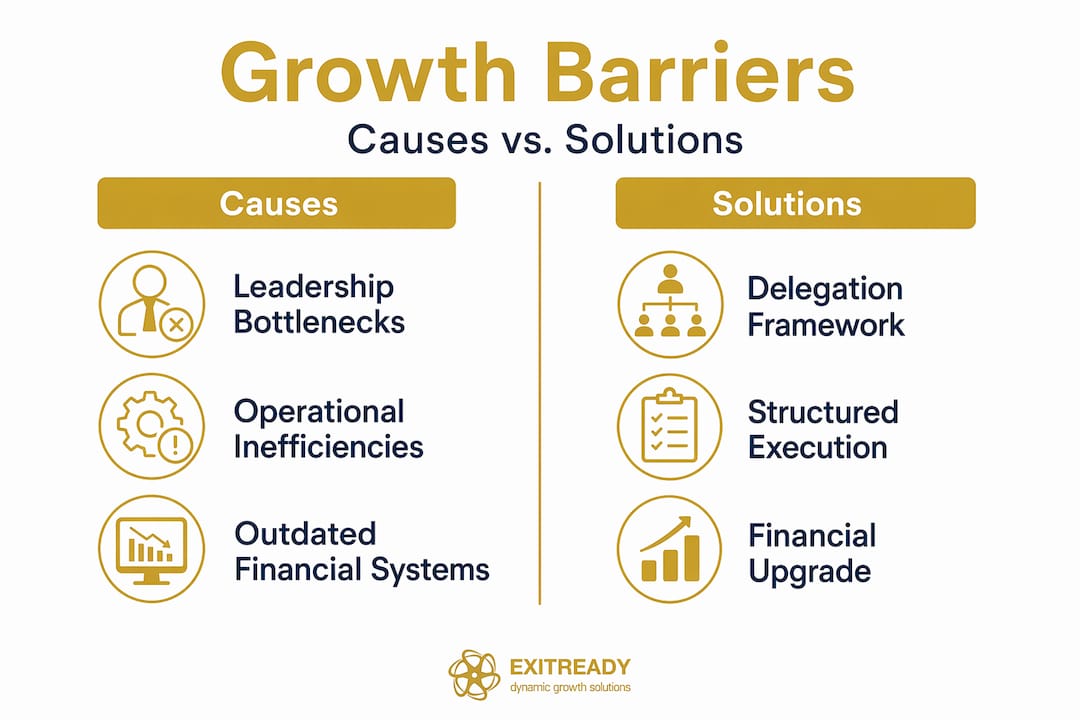
The first is rebuilding financial infrastructure. Upgrading from legacy tools to connected financial systems gives leadership real-time cash visibility, accurate forecasting, and faster investment decisions. The payoff isn’t just efficiency. It’s confidence.
The second is restructuring leadership accountability. This means creating documented playbooks that define how decisions get made without executive input. Business assessments are particularly useful here because they reveal which parts of the business are dependent on individual people rather than systems.
The third, and most impactful, is adopting a habit-driven execution framework. Companies implementing structured frameworks like Rockefeller Habits grow 2.3 to 2.8 times faster than peers operating reactively. Habit-driven execution means replacing ad hoc problem-solving with predictable rhythms: weekly scorecards, quarterly priorities, and annual operating plans that cascade across the organization.
Pro Tip: Don’t try to fix everything at once. Identify your single highest-leverage bottleneck through a structured diagnostic, fix it systematically, then move to the next. Serial execution of focused changes compounds faster than simultaneous partial improvements.
Consider AI productivity tools as an accelerant once systems are documented, not before. Technology amplifies the structure you already have. If processes are unclear before AI adoption, automation makes the confusion move faster.
My honest take on what’s really going on
I’ve worked with enough mid-market owners to recognize a pattern that doesn’t show up in any balance sheet: the leader is often the last person to realize they’re the constraint.
What I see consistently is executives who are genuinely exhausted, genuinely committed, and genuinely stuck. They interpret their exhaustion as evidence of effort and their effort as evidence of progress. But being busy inside a stagnant business isn’t the same as building a growing one. The data reinforces this. The activity bias isn’t laziness. It’s a deeply human trap.
What I’ve learned is that incremental fixes rarely break stagnation. Cutting one underperformer, launching one new marketing channel, or adjusting pricing doesn’t resolve a structural problem. The businesses I’ve watched break through stagnation did one thing consistently: they were willing to challenge the operating model itself, not just the outputs.
The uncomfortable truth is that most growth ceilings are leadership-designed, even when they weren’t leadership-intended. The systems the founder built, the approval culture that formed, the financial tools that never got upgraded because “they still work.” All of it made sense at $5M in revenue. Almost none of it scales to $50M without fundamental change.
My recommendation is direct: start with a structured diagnostic before committing to any solution. Understand which barriers are actually in play for your specific business. Then build around systems, documented processes, and financial infrastructure that can operate without you making every call. That’s not delegation for its own sake. It’s building an asset that grows even when you’re not in the room.
— Andre
How Dynamicgrowthsolutions helps you move past stagnation
If you recognize the patterns described in this article, the next step isn’t reading more about the problem. It’s getting a clear picture of where your specific barriers sit.

Dynamicgrowthsolutions works specifically with mid-market owners to diagnose and remove the structural barriers blocking growth. The AOS (Accelerated Operating System) program replaces owner dependency with documented systems, rebuilds financial infrastructure for real cash visibility, and installs leadership accountability frameworks that let your business scale without you carrying every decision. Whether your goal is scalable growth or a premium exit, the foundation is the same: operational independence.
Explore the sustainable growth systems that have helped mid-market companies rebuild for the next stage, or start with a scalable growth assessment to identify exactly where your business is losing momentum.
FAQ
What is the main cause of business growth stagnation?
The primary cause is the “scaling gap,” where internal systems, leadership behavior, and operational processes fail to evolve alongside business size. Internal constraints like resource limits and operational inefficiencies drive stagnation more often than external market factors.
Why does growth stop even when revenue is still coming in?
Revenue activity can mask structural stagnation. When leadership bottlenecks concentrate decisions at the top and financial infrastructure lacks real-time visibility, the business is unable to allocate capital or expand effectively, regardless of incoming cash.
How do leadership bottlenecks cause stagnation?
When executives retain approval authority over routine decisions, teams can’t execute independently. Over 60% of leaders self-identify as bottlenecks in sales, marketing, and strategic focus, slowing the entire organization’s capacity to grow.
Can external market factors alone cause a growth plateau?
Rarely on their own. While tariffs, inflation, and market saturation create real friction, companies with strong internal systems adapt quickly. External pressure tends to expose existing structural fragility rather than create it independently.
What frameworks help businesses break out of growth stagnation?
Structured execution frameworks like Rockefeller Habits, combined with documented process playbooks and real-time financial systems, produce measurable results. Companies that adopt habit-driven execution grow 2.3 to 2.8 times faster than those operating reactively.