

Intellectual property is defined as the single most undervalued asset class in mid-market business exits, directly determining valuation multiples, buyer confidence, and deal speed. The role of intellectual property in exit transactions goes far beyond legal compliance. Buyers and private equity firms treat IP as a primary risk signal. Well-documented, cleanly owned IP accelerates diligence, supports premium pricing, and reduces the friction that kills deals. Poorly managed IP does the opposite. According to Foot Anstey, IP ownership clarity, operational use, and transferability directly affect deal speed and price leverage. If you are planning an exit, your IP portfolio is not a legal formality. It is a valuation lever.
How does intellectual property impact valuation and buyer confidence during exit?
Buyers do not evaluate IP as an afterthought. They treat it as a threshold question: does this company actually own what it says it owns, and can that ownership survive a transaction? IP ownership clarity and enforceability are the first filters sophisticated acquirers apply during diligence. If the answer is unclear, the deal slows, the price drops, or the buyer walks.
The economic case for registered IP is compelling. SMEs holding registered IP rights generate 44% higher revenue per employee than those without IP protection. That gap reflects the compounding advantage of protected market position, and buyers price it into their offers. A business with a registered trademark, defensible patents, and documented trade secrets commands a structurally different conversation than one with informal know-how and unregistered claims.
The specific factors buyers scrutinize during IP diligence include:
- Ownership validity. Does the company hold clear title to all IP, including work created by contractors, founders, or prior employees?
- Enforceability. Are patents granted and defensible? Are trademarks registered in relevant jurisdictions?
- Strategic alignment. Does the IP map directly to revenue-generating products or future pipeline?
- Transferability. Are there license agreements, encumbrances, or third-party rights that complicate a clean transfer?
- Latent risks. Are there unresolved infringement claims, expired registrations, or gaps in chain of title?
Each deficiency on this list creates a negotiating point for the buyer. Collectively, they can reduce your exit price by millions or trigger deal restructuring. Startups with registered IP are more than twice as likely to reach successful exit outcomes than those without filings. That statistic applies equally to mid-market businesses preparing for acquisition or merger.
Pro Tip: Map every IP asset to a specific revenue stream or product before entering diligence. Buyers pay for IP they can see working, not IP they have to interpret.
What are the key IP due diligence considerations and exit readiness practices?
IP due diligence is not a single document review. It is a structured investigation that confirms whether the IP a business claims to own is actually owned, enforceable, and transferable without hidden costs. PerspireIP’s 2026 guidance identifies ownership gaps, encumbrances, and validity exposures as the primary sources of deal surprises and valuation adjustments. Catching these before a buyer does is the difference between controlling the narrative and defending against it.
The core diligence questions every mid-market owner should answer before going to market follow a clear sequence:
- Confirm actual ownership. Review every IP asset and trace its origin. Work-for-hire agreements with contractors, invention assignment agreements with employees, and founder IP assignments must all be documented and signed.
- Verify chain of title. Missing patent assignments can cause deals to fail or require costly restructuring. Every transfer of IP ownership must be recorded with the relevant patent or trademark office.
- Assess enforceability. Check registration status, renewal deadlines, and any pending office actions. An expired trademark or lapsed patent is not an asset.
- Identify obligations transferring to the buyer. License agreements, co-development contracts, and open-source commitments all travel with the IP. Buyers need to know what they are inheriting.
- Surface latent risks. Review any cease-and-desist letters received, ongoing litigation, or third-party claims that could affect IP value post-close.
Pre-diligence preparation is where mid-market owners gain the most leverage. Conducting an internal IP audit six to twelve months before going to market gives you time to close gaps, obtain missing assignments, and organize documentation into a format that accelerates buyer review. JDSupra’s 2026 guidance specifically highlights clean chains of title, confirmatory assignments, and lifecycle planning as the factors that speed diligence and improve valuation outcomes.
Pro Tip: Create a single IP registry document that lists every asset, its registration status, its owner of record, and its connection to a product or revenue line. This document alone can cut weeks off a buyer’s diligence timeline.

How is intellectual property typically valued during exit transactions?
IP valuation in M&A follows three recognized approaches, and choosing the wrong one for your IP type can either understate your value or invite buyer skepticism. CT Acquisitions’ 2026 framework details the practical application of each method with direct implications for exit transaction structuring and tax planning.
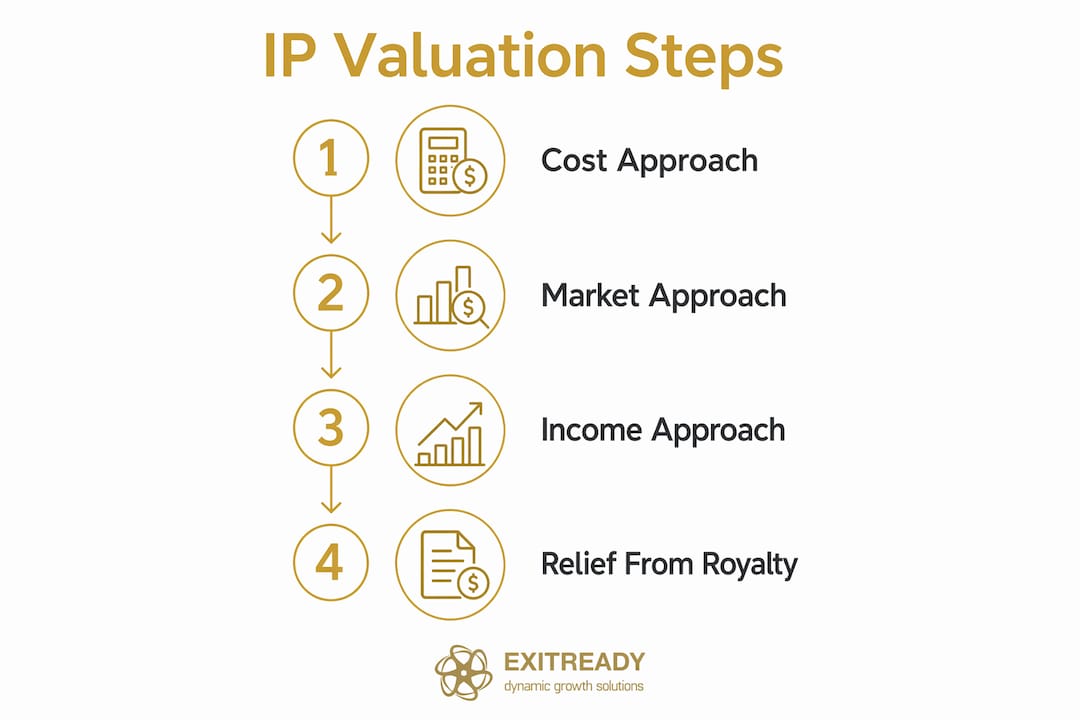
| Valuation method | How it works | Best used when | Key limitation |
|---|---|---|---|
| Cost approach | Estimates what it would cost to recreate the IP from scratch | IP is early-stage or not yet generating revenue | Ignores market demand and earning potential |
| Market approach | Benchmarks against comparable IP transactions or license deals | Active market comparables exist for similar IP | Comparable data is often scarce or confidential |
| Income approach (relief-from-royalty) | Values IP based on royalties the business avoids paying by owning it | IP is actively generating or protecting revenue | Requires defensible royalty rate assumptions |
The income approach, specifically the relief-from-royalty method, is the most commonly accepted method for active IP in acquisition contexts. It produces a number buyers can stress-test against their own revenue projections, which makes it the most defensible in negotiation. A well-supported relief-from-royalty analysis also provides the foundation for tax basis step-ups in asset deals, which can meaningfully affect post-close economics for both parties.
The valuation method you choose signals sophistication. Buyers who see a cost-based valuation for a patent portfolio generating licensing revenue will immediately discount it. Engaging a qualified IP valuation specialist before going to market is not an optional expense. It is a negotiating investment that typically returns multiples of its cost in deal price.
What practical steps can mid-market owners take to enhance IP’s role in maximizing exit value?
The gap between IP that supports a premium exit and IP that creates deal friction is almost always a preparation gap, not an asset gap. Most mid-market businesses have more valuable IP than they realize. The problem is that the IP is undocumented, misaligned, or invisible to buyers. Fixing that requires deliberate action well before you engage an investment banker or begin conversations with acquirers.
Here is where to focus:
- Conduct an IP audit now, not later. Identify every patent, trademark, copyright, trade secret, and domain name the business controls. Flag anything with unclear ownership or expired registration. Closing these gaps takes time, and you want that time before a buyer’s clock starts.
- Align IP to your commercial story. IP-to-product maps that link specific assets to specific revenue programs are among the most effective tools for accelerating diligence and strengthening valuation arguments. A one-page visual showing which patents protect which products is worth more than a 50-page IP schedule.
- Eliminate misaligned IP. Patents that do not connect to your current product roadmap or future growth plans are not neutral. They signal distraction and can weaken your exit narrative. As JDSupra notes, misaligned IP can become a sunk cost that undermines buyer confidence rather than building it.
- Engage expert advisors early. IP counsel, valuation specialists, and M&A advisors who understand IP-intensive deals each play a distinct role. Bringing them in at the start of exit planning, rather than during diligence, gives you control over the narrative. The EUIPO recognizes IP rights as strategic tools that bolster SME growth, funding potential, and exit success probabilities.
- Build an exit-ready IP profile. This is a curated package of IP documentation, ownership confirmations, valuation support, and narrative materials that you hand to buyers at the start of diligence. It signals operational maturity and reduces the back-and-forth that erodes deal momentum.
The most common oversight mid-market owners make is treating IP preparation as a legal task rather than a strategic one. Your IP story is part of your business story. Buyers are not just buying assets. They are buying a competitive position, and your IP is the legal expression of that position. Understanding exit strategy timing in relation to IP readiness can mean the difference between a reactive sale and a planned premium exit.
Pro Tip: Ask your IP counsel to prepare a “buyer’s diligence memo” that anticipates the questions a sophisticated acquirer will ask. Answering those questions before they are asked is the single most effective way to maintain price leverage.
Key takeaways
Intellectual property drives exit valuation, deal speed, and buyer confidence when it is documented, aligned, and defensible before diligence begins.
| Point | Details |
|---|---|
| IP ownership clarity is non-negotiable | Missing assignments and unclear title are the leading causes of deal friction and price reduction. |
| Registered IP commands measurable premium | SMEs with registered IP generate 44% more revenue per employee, a gap buyers price into acquisition offers. |
| Valuation method selection matters | The income relief-from-royalty approach is the most defensible for active IP in acquisition negotiations. |
| Early preparation controls the narrative | Conducting an IP audit 6 to 12 months before exit gives owners time to close gaps and build a buyer-ready IP profile. |
| IP alignment strengthens the exit story | Mapping IP assets directly to revenue programs accelerates diligence and supports stronger valuation arguments. |
Why IP readiness is the exit variable most owners underestimate
I have worked with mid-market business owners across dozens of exit processes, and the pattern is consistent. Owners spend years building IP, then spend weeks scrambling to document it when a buyer appears. That scramble costs money, time, and leverage.
The uncomfortable truth is that IP readiness is not a legal problem. It is an operational discipline problem. The businesses that exit at premium multiples treat their IP portfolio the way they treat their financial statements: current, organized, and audited regularly. They know what they own, why it matters, and how to explain it to someone who has never seen their business before.
The businesses that leave money on the table are the ones who discover during diligence that a key patent was never formally assigned from a founding engineer, or that a core trademark was never registered in the markets where the buyer plans to expand. These are not catastrophic problems in isolation. But they become catastrophic when a buyer’s counsel finds them first.
My recommendation is direct: start your IP audit before you start your exit process. Build the IP-to-product map before you build the pitch deck. Engage IP counsel before you engage an investment banker. The sequence matters because IP preparation takes time, and time is the one resource you cannot buy back once a buyer is at the table.
The business exit planning process rewards owners who treat IP as a strategic asset from day one, not a legal checkbox at the end.
— Andre
How Dynamicgrowthsolutions helps you build an exit-ready IP foundation
Preparing your IP for a premium exit requires the same systematic discipline that drives operational excellence across every other part of your business. Dynamicgrowthsolutions works with mid-market owners to build the documented systems, organized asset profiles, and strategic alignment that buyers expect and reward.

Through the AOS (Accelerated Operating System), Dynamicgrowthsolutions helps you create the operational infrastructure that makes IP management a repeatable process, not a last-minute scramble. From IP documentation frameworks to exit-ready business systems that support valuation and diligence, the platform is built for owners who want to exit on their terms. If you are ready to take the first step, explore the entrepreneur application to see how the program applies to your business.
FAQ
What is the role of intellectual property in exit transactions?
Intellectual property directly affects business valuation, buyer confidence, and deal speed in exit transactions. Buyers treat IP ownership clarity and enforceability as threshold issues that determine both deal structure and final price.
How does IP affect company valuation during an acquisition?
SMEs with registered IP rights generate 44% higher revenue per employee than those without, and buyers price this advantage into acquisition offers. Defensible IP valuation using the income relief-from-royalty method typically produces the strongest negotiating position.
What IP due diligence steps should I complete before going to market?
Confirm ownership of all IP assets, verify chain of title for patents and trademarks, identify any license obligations transferring to the buyer, and surface any latent infringement risks. Completing these steps before engaging buyers keeps you in control of the narrative.
Why do missing IP assignments cause deals to fail?
Missing patent or copyright assignments create ownership disputes that buyers cannot accept without resolution. Acquisition Stars identifies unrecorded IP transfers as one of the most common causes of deal failure or costly restructuring in technology M&A.
How early should I start preparing my IP for exit?
Start at least six to twelve months before engaging buyers or investment bankers. Early preparation gives you time to close ownership gaps, obtain missing assignments, build an IP-to-product map, and engage valuation specialists before a buyer’s diligence clock starts.