
Strategic planning is the structured process of aligning vision, resources, and execution to grow a business without losing operational control. For mid-market owners, the role of strategic planning in scaling is not optional. It is the difference between controlled growth and costly chaos. Frameworks like the 8-stage strategic plan and the Scaling Up methodology give executives a repeatable system to convert ambition into measurable results. Without that structure, growth becomes a liability.
What key components make up strategic planning for scaling?
Effective planning for business scalability starts with five core elements. Each one builds on the last, and skipping any one of them creates gaps that compound as the business grows.
- Vision and mission clarity. Your vision defines where the business is going. Your mission explains why it exists. Together, they filter every major decision during growth. Without them, teams pull in different directions as headcount increases.
- Strategic goals. Goals translate vision into specific, time-bound targets. They act as the connective tissue between long-term direction and daily execution. A goal like “reach $50 million in revenue by Q4 2027” gives every department a shared finish line.
- Competitive positioning. The core strategic questions every scaling business must answer are “Where will we compete?” and “How will we win?” These two questions force clarity on market focus and differentiation before resources are committed.
- Resource allocation. Scaling demands deliberate decisions about where capital, talent, and time go. Spreading resources too thin is one of the most common reasons growth stalls at the $10 million to $30 million revenue range.
- Performance monitoring. Tracking progress through KPIs and regular reviews keeps execution honest. Ongoing evaluation of the plan is more important than rigid adherence to initial assumptions.
Pro Tip: Build your KPI dashboard before you need it. Waiting until a problem surfaces means you are already behind. Set your leading indicators at the start of each planning cycle, not after the first missed quarter.
How does strategic planning prevent common scaling pitfalls?

Scaling without a plan leads directly to overextended staff, missed opportunities, and frustrated clients. These are not abstract risks. They are the predictable outcomes of adding revenue faster than your systems can absorb it.
Here are the four most common pitfalls that structured planning prevents:
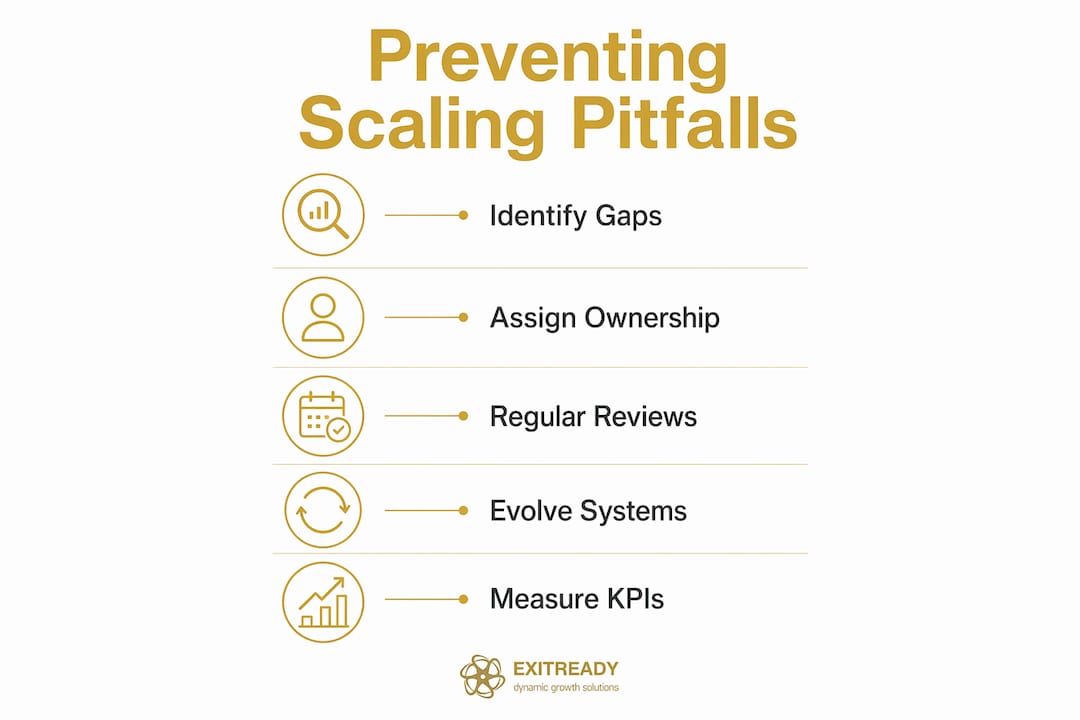
- Staff burnout from undefined ownership. When roles and responsibilities are not documented before scaling, existing employees absorb new work by default. Clear delegation frameworks, built into your plan, prevent this from happening.
- Quality erosion at higher volume. Growth exposes every process weakness. A plan that includes documented operating procedures and quality checkpoints keeps standards consistent as output increases.
- Missed market windows. Without a planning cadence, executives react to opportunities instead of anticipating them. Structured milestones create the mental space to see what is coming.
- Accountability gaps. Leading indicators help businesses detect issues early and adjust execution before small problems become expensive ones. Without them, you are managing by looking in the rearview mirror.
The management systems that worked at $5 million in revenue will not work at $20 million. Planning forces the evolution of those systems before the business outgrows them, not after.
Pro Tip: Assign a single owner to every strategic initiative. Shared ownership is no ownership. If two people are responsible for a goal, neither one is.
Strategic planning frameworks: which one fits your business?
Mid-market executives have several proven frameworks to choose from. The right one depends on your current stage, team maturity, and growth targets.
| Framework | Core Focus | Planning Cadence | Best For |
|---|---|---|---|
| 8-Stage Strategic Plan | Vision through performance monitoring | Annual with quarterly reviews | Businesses building planning discipline from scratch |
| Scaling Up (Verne Harnish) | People, strategy, execution, cash | Quarterly sprints with daily huddles | Companies scaling past $10M with leadership teams in place |
| OKRs (Objectives and Key Results) | Goal alignment across teams | Quarterly cycles | Organizations needing cross-functional alignment |
| EOS (Entrepreneurial Operating System) | Traction and operational accountability | Weekly, quarterly, annual | Owner-led businesses reducing founder dependency |
The 8-stage process moves from vision and mission through environmental analysis, strategy formulation, and into performance monitoring. It is linear by design, which makes it accessible for teams new to formal planning. The Scaling Up methodology, developed by Verne Harnish, runs on a quarterly planning cadence that turns long-term vision into short-term execution. That cadence builds accountability and measurable progress in a way that annual planning alone cannot.
The key distinction between linear and cyclical frameworks is adaptability. Linear plans give you a clear starting point. Cyclical frameworks, like Scaling Up and OKRs, treat the plan as a living document that gets sharper with every review cycle. For most mid-market businesses past the $15 million mark, a cyclical approach produces better results because the business environment changes faster than an annual plan can accommodate.
How can mid-market businesses implement strategic planning to scale?
Reaching $100 million in revenue requires evolving systems, leadership, management rhythms, and operational discipline well beyond founder motivation. That evolution does not happen by accident. It requires a deliberate implementation sequence.
- Start with a measurable vision. Define where the business will be in three to five years with specific revenue, market position, and operational targets. Vague aspirations do not drive execution. Numbers do.
- Build leadership capacity before you need it. Scaling exposes leadership gaps faster than any other business challenge. Identify your next layer of management now and develop them before growth demands it.
- Document your core processes. Every repeatable function in the business needs a written playbook. This is what allows you to scale management systems without the owner becoming the bottleneck.
- Run quarterly reviews without exception. A plan reviewed once a year is not a plan. It is a wish list. Quarterly reviews keep the team aligned, surface problems early, and create a rhythm of accountability that compounds over time.
- Use consultants and operating systems strategically. External advisors bring pattern recognition from dozens of scaling companies. A business scalability checklist gives you a structured starting point for identifying where your systems are ready to scale and where they will break.
Strategic planning aligns teams around measurable outcomes and exposes capability gaps before they become crises. That alignment is what separates businesses that scale cleanly from those that grow into operational chaos.
Pro Tip: Treat your strategic plan as a product, not a document. Assign a version number to each iteration, track what changed and why, and review it with your leadership team at the start of every quarter. Plans that get updated get used.
Key takeaways
Strategic planning is the primary driver of controlled, sustainable scaling for mid-market businesses.
| Point | Details |
|---|---|
| Planning prevents operational breakdown | Structured milestones and clear ownership stop quality erosion and staff burnout during growth. |
| Cyclical frameworks outperform static plans | Frameworks like Scaling Up and OKRs adapt to real-world feedback faster than annual planning alone. |
| Leading indicators are non-negotiable | KPIs and quarterly reviews catch execution problems before they compound into revenue loss. |
| Leadership must evolve ahead of growth | Building management capacity before scaling begins prevents the founder bottleneck that stalls most mid-market companies. |
| Plans require ownership and iteration | A strategic plan without a version history and quarterly review cadence is not a working plan. |
Why most scaling failures are a planning problem in disguise
I have worked with enough mid-market owners to know that most scaling failures get misdiagnosed. Owners blame the market, the economy, or the wrong hire. The real cause is almost always a planning gap that was present long before the failure showed up on the income statement.
The most persistent misconception I encounter is that scaling is a motivation problem. Owners believe that if they just push harder, hire faster, or spend more on marketing, growth will follow. It does not. True scaling requires rigorous systems and management capability evolution, not more effort from the founder.
What I have found is that the businesses that scale well share one habit: they treat their strategic plan as a living document, not a declaration. They update it based on performance data, not pride. They hold quarterly reviews where bad news is welcomed because it means the system is working. That discipline is harder to build than any product or sales process, but it is the only thing that makes growth sustainable.
The other thing I tell owners is this: strategic flexibility is not the same as strategic vagueness. You can hold your three-year vision tightly while adjusting your 90-day execution plan freely. The vision is the anchor. The quarterly plan is the sail. Most owners get this backwards. They change the destination every six months and wonder why the team is confused.
Culture and leadership evolve during scaling whether you plan for it or not. The question is whether that evolution is intentional or reactive. Intentional evolution, built into your planning process, produces a business that runs without you. Reactive evolution produces a business that depends on you more with every dollar of growth.
— Andre
How Dynamicgrowthsolutions supports your scaling strategy
Dynamicgrowthsolutions works with mid-market owners who are ready to replace operational chaos with documented systems and a clear growth plan. The AOS (Accelerated Operating System) gives you the planning structure, leadership frameworks, and performance monitoring tools that scaling demands.
If you are building toward a premium exit or a business that runs without you in the day-to-day, the place to start is understanding what a business operating system actually does for an owner at your stage. Dynamicgrowthsolutions also offers a systematic scaling framework built specifically for mid-market companies that need to grow without adding owner dependency. The methodology draws on Fortune 500 processes adapted for businesses between $5 million and $100 million in revenue.
FAQ
What is the role of strategic planning in scaling a business?
Strategic planning creates a measurable roadmap that aligns vision, systems, and leadership to manage growth without operational breakdown. It is the primary tool for converting growth ambition into disciplined, repeatable execution.
How does strategic planning differ from a business plan?
A business plan is a static document, typically written for investors or lenders. Strategic planning is an ongoing cycle of goal-setting, execution, monitoring, and adaptation that guides daily and quarterly decisions.
Which strategic planning framework works best for mid-market companies?
The Scaling Up methodology and the 8-stage strategic planning process are both well-suited to mid-market businesses. Scaling Up works best for companies with an established leadership team; the 8-stage process suits businesses building formal planning discipline for the first time.
How often should a mid-market business review its strategic plan?
Quarterly reviews are the minimum standard for any scaling business. Annual planning alone creates too large a gap between strategy and execution, especially in markets that shift faster than a 12-month cycle can accommodate.
What is the biggest mistake owners make when scaling without a plan?
The most common mistake is assuming that founder motivation and sales volume alone drive sustainable growth. Scaling past $10 million requires evolving management systems, documented processes, and leadership depth that motivation alone cannot produce.