
A quarterly business review turns three months of scattered data into a short list of decisions that change what happens next quarter. Its role is simple to state and hard to execute well: align strategy across teams, translate raw metrics into judgment calls, and deepen the relationship between the people paying for results and the people delivering them.
That’s the verdict. Here’s what to expect if you run one right:
- Outcomes shift from reporting to deciding. A good QBR produces named decisions and next-quarter priorities, not a slide deck nobody reopens.
- Everyone knows who owns what. Metrics tied to OKRs, an owner assigned to each risk, and a documented action plan replace vague “we’ll look into it” commitments.
- You act within a week. Pick a QBR owner, put the next review on the calendar, and start collecting pre-read data now, not the night before.
This works whether you’re running a customer-facing review tied to a metric tree or an internal strategy session under a broader operating framework like AOS.
Key Takeaways
Quarterly business reviews work because they force strategic decisions on a 90-day cycle, the shortest window where a leadership team can actually see whether its bets are paying off.
| Point | Details |
|---|---|
| QBRs decide, not report | A QBR earns its place only if it produces named decisions and owners, not just a status update. |
| Timing matters | Schedule the review 7 to 10 days after quarter close, once data is reconciled. |
| Follow-up drives results | A 48-hour summary and monthly checkpoints keep commitments from dying after the meeting ends. |
| Scale with tiers | Segment accounts or units into high, medium, and low-touch review tiers as volume grows. |
| Build it into a system | Dynamicgrowthsolutions’ AOS turns one-off QBRs into a documented, repeatable operating rhythm tied to exit-readiness. |
Table of Contents
- What Is the Role of Quarterly Business Reviews, and When Should You Run One?
- Why QBRs Matter for Customer Relationships and Business Growth
- Types of Quarterly Reviews and How They Differ From EBRs
- Essential QBR Components, Attendees, and a Sample 90-Minute Agenda
- How to Prepare and Run an Effective QBR
- Common Mistakes That Make QBRs Ineffective
- How to Scale QBRs Across Accounts or Business Units
- Measuring QBR Impact and Keeping Teams Accountable
- How QBRs Fit Into a Business Operating System and Drive Transformation
- Advisor’s Quick Guide: Three Tips to Make Your Next QBR Strategic
- How Dynamic Growth Solutions Helps You Run QBRs That Actually Drive Growth
- Sources
What Is the Role of Quarterly Business Reviews, and When Should You Run One?
A quarterly business review is a structured, cross-functional session where leadership evaluates the last 90 days against agreed targets and commits to specific changes for the next 90. It is strategic by design: fewer slides, more decisions, and a clear owner for every action item that comes out of the room.
That distinction matters because QBRs get confused with two other meeting types constantly.
| Meeting type | Audience | Cadence | Primary focus |
|---|---|---|---|
| Status update | Team or project stakeholders | Weekly or biweekly | Task progress, blockers |
| QBR | Cross-functional leaders and/or key customer stakeholders | Quarterly | Strategic decisions, resource allocation |
| Executive business review (EBR) | C-suite and top-tier accounts | Semiannual or annual | Long-term partnership, contract-level ROI |
The practical timing question trips up more teams than the format itself — for insights on setting an effective review cadence, see How Often Should You Review Your Numbers? More Than You Think. Schedule the QBR after the quarter closes and after finance has reconciled the numbers, typically 7 to 10 business days into the new quarter. Sending a pre-read too early means the data is still shifting; sending it too late gives attendees no time to prepare a point of view.
- Distribute the pre-read at least 48 hours ahead, not the morning of.
- Include department heads, finance, and (for customer QBRs) the account’s economic buyer.
- Never treat the QBR as a bigger version of your weekly stand-up. It isn’t.
Why QBRs Matter for Customer Relationships and Business Growth
Strategy dies in the gap between quarterly planning and daily execution. QBRs exist to close that gap, and the evidence on what happens when they work is specific.
KPI Tree argues the quarter is the shortest window where a strategic bet produces measurable signal, which makes the QBR the highest-leverage meeting most leadership teams run. Wait a year to check whether a pricing change or a new customer success motion worked, and you’ve burned three more quarters making the same mistake. Check every 90 days, and you catch it early enough to correct course.
The strategic payoffs stack up in a few concrete ways:
- Alignment on outcomes. Every function walks out with the same understanding of what “on track” means for the quarter ahead.
- Demonstrated ROI. Gainsight frames the customer-facing QBR as the moment a vendor proves the value a customer is actually getting, not the value promised at signing.
- Executive sponsorship. Getting a VP or C-suite sponsor into the room signals the relationship matters beyond the day-to-day account team.
- Early-warning signals. A metric trending the wrong way for two straight quarters is a pattern; the QBR is where that pattern gets named out loud instead of buried in a dashboard.
- Prioritization of scarce resources. Profit notes QBRs work best when they act as a gate for stage decisions, letting agile teams handle execution between reviews.
- Renewal and expansion support. A customer who sees quarterly proof of value is a far easier renewal conversation than one who gets a surprise ROI pitch in month 11 of a 12-month contract.
Companies that run formal quarterly reviews report growing roughly 30% faster than those that don’t, according to research cited by EntrepreneurBytes.
Here’s how that plays out in practice. A mid-market SaaS company notices, during a QBR, that support ticket volume for one product line has climbed three quarters running while adoption of a newer feature has stalled. Nobody flagged it individually because each team only saw its own slice. The QBR is where those two threads meet in the same room, and the decision that comes out isn’t “monitor it” but “reassign one engineer to the adoption problem starting Monday.”

Types of Quarterly Reviews and How They Differ From EBRs
Not every quarterly review needs the same room, the same slides, or the same stakes. Matching the review type to the audience is what keeps a QBR from becoming either too shallow or too heavy for the decisions it needs to produce.
- Customer-facing QBR. Runs between a vendor and a customer’s stakeholders to review adoption, outcomes, and the roadmap tied to the account.
- Internal leadership QBR. Cross-functional leaders review company-wide OKRs, budget allocation, and departmental performance.
- Product or portfolio review. Product and engineering leaders assess feature performance, roadmap health, and resourcing tradeoffs.
- Executive business review (EBR). Reserved for top-tier accounts or annual strategic partnerships, usually run less often and at a higher altitude than a standard QBR.
| Dimension | QBR | EBR |
|---|---|---|
| Scope | Quarterly performance and near-term priorities | Long-term partnership health and strategic roadmap |
| Attendees | Working leaders, account teams, department heads | C-suite, top-tier account sponsors |
| Frequency | Every quarter | Semiannual or annual |
| Typical outcome | Tactical decisions, resource shifts | Contract-level commitments, multi-year alignment |
Run a customer-facing QBR when the relationship needs continuous proof of value between contract renewals. Run an internal strategic QBR when the decisions on the table are about where the business points its resources next.
Essential QBR Components, Attendees, and a Sample 90-Minute Agenda
A QBR deck earns its place at the table only if every slide either informs a decision or drives toward one. Build it around these core components:
- Executive summary. One slide, the headline outcome of the quarter in plain language.
- Outcome KPIs and OKRs. Actual versus target, with the trend line, not just the current number.
- Wins. Specific, attributable, tied to a metric wherever possible.
- Risks and blockers. Named owner for each, not a generic “risk register.”
- Portfolio or account health. Where relevant, a segmented view of accounts or product lines by risk tier.
- Decisions required. The single most important slide in the deck, listed explicitly.
- Action plan. Owner, deadline, and success metric for each committed action.
A sample 90-minute agenda, timed to keep the room decision-focused:
- Executive summary and quarter-at-a-glance (10 minutes) — set context fast, no debate yet.
- Metrics deep dive (20 minutes) — walk the metric tree from outcome KPIs down to root drivers.
- Wins and what worked (10 minutes) — attribute credit, reinforce what to keep doing.
- Risks, blockers, and root-cause discussion (20 minutes) — this is where most of the real conversation happens.
- Decisions and resource tradeoffs (20 minutes) — force a call on each open question; no “let’s circle back” without a date attached.
- Action plan and ownership confirmation (10 minutes) — read commitments out loud before the meeting ends.
Slide-deck outline to match: title slide, executive summary, KPI dashboard, wins, risks with owners, decisions required, next-quarter action plan, appendix with supporting detail.
Send a pre-meeting checklist covering the pre-read deck, updated KPI data, and a short written point of view from each attendee, ideally 48 hours before the meeting. Dale Carnegie’s guidance on running effective quarterly reviews backs this up: pre-aligning narratives before the room fills up is what keeps the actual meeting short and sharp.
How to Prepare and Run an Effective QBR
Treating QBR prep as a four-week countdown, not a two-day scramble, is the single biggest difference between a review that produces decisions and one that produces a nice-looking deck nobody acts on.
- 6 to 8 weeks out: Confirm attendee list, lock the date, and assign a QBR owner responsible for pulling data and building the deck.
- 2 to 3 weeks out: Draft the deck, request input from each function on wins, risks, and open decisions.
- 48 to 72 hours before: Send the final pre-read, along with the business performance metrics each stakeholder should review beforehand.
- Day of: Facilitate with a strict clock, and close every agenda item with either a decision or an explicit next step with an owner attached.
Facilitation is where most QBRs either earn their keep or waste an hour of six people’s time. A few tactics make the difference:
- Navigate the metric tree top down: outcome first, then the two or three drivers that actually moved it, not every metric on the dashboard.
- Timebox the risk discussion strictly. If a root cause needs more than 15 minutes, take it offline and report back at the next monthly checkpoint.
- Flag items red or green before the meeting starts. Debating status in real time wastes the room’s time on something a pre-read should have settled.
- Push past the narrative. “Sales was down because the market was soft” is a story. “Sales was down because two reps missed quota in the same vertical for the second quarter running” is a root cause you can act on.
Write outcomes and decisions in a format that survives past the meeting: “Decision: reallocate $40,000 from Campaign A to Campaign B, owner: Marketing Director, review date: next monthly checkpoint.” Vague language is where accountability goes to die.
Pro Tip: Get your executive sponsor to ask the first hard question in the room. Once leadership signals the meeting is a real decision forum and not a rubber stamp, everyone else stops performing and starts problem-solving.
Common Mistakes That Make QBRs Ineffective
Most dysfunctional QBRs fail for the same handful of reasons, and each one has a specific fix.
- Turns into a reporting ceremony. Cap status updates at 20% of meeting time; spend the rest on decisions.
- Too much slide detail. Move granular data to an appendix nobody has to sit through live.
- No decisions made. KPI Tree warns that a meeting spending 80% of its time reviewing the past without committing to change wastes everyone’s next 90 days. Add a “decisions required” slide and force a call on each line.
- Data reconciled live, in the room. Profit points out that disconnected data sources turn a QBR into a math exercise. Reconcile numbers before the meeting, not during it.
- No clear ownership. Assign a QBR owner and an executive sponsor before the first meeting is scheduled, not after the second one falls apart.
- No follow-up. Commitments made in the room and never revisited train attendees to stop taking the meeting seriously.
If your existing QBR is already broken, triage before you redesign it: cut the meeting length in half, cut the slide count in half, and add one “decisions required” slide. That alone fixes most of what’s wrong.
How to Scale QBRs Across Accounts or Business Units
Running five QBRs a quarter is manageable by instinct. Running fifty requires a system, or decision quality collapses under the volume.
Tier accounts or business units by stakes and complexity:
- High-touch: strategic accounts or core business units, full 90-minute QBR with executive attendance every quarter.
- Medium-touch: stable accounts or units, a lighter 45-minute review, executive attendance every other quarter.
- Low-touch: smaller accounts or lower-risk units, a written summary review with a call only if metrics flag a problem.
Scaling operationally means standardizing everything that doesn’t require judgment:
- Build one reusable deck template so nobody rebuilds slides from scratch each quarter.
- Automate pre-read generation from a centralized data view rather than manual exports.
- Give facilitators a short rehearsal cadence and a shared script for common objections or questions.
- Move an account between tiers whenever risk level or growth potential changes materially, not on a fixed schedule.
A business scalability checklist built for mid-market operations covers this tiering logic in more depth if you’re standing up the system for the first time.
Measuring QBR Impact and Keeping Teams Accountable
A QBR you can’t measure is a QBR you can’t defend to the board. Track two kinds of KPIs side by side.
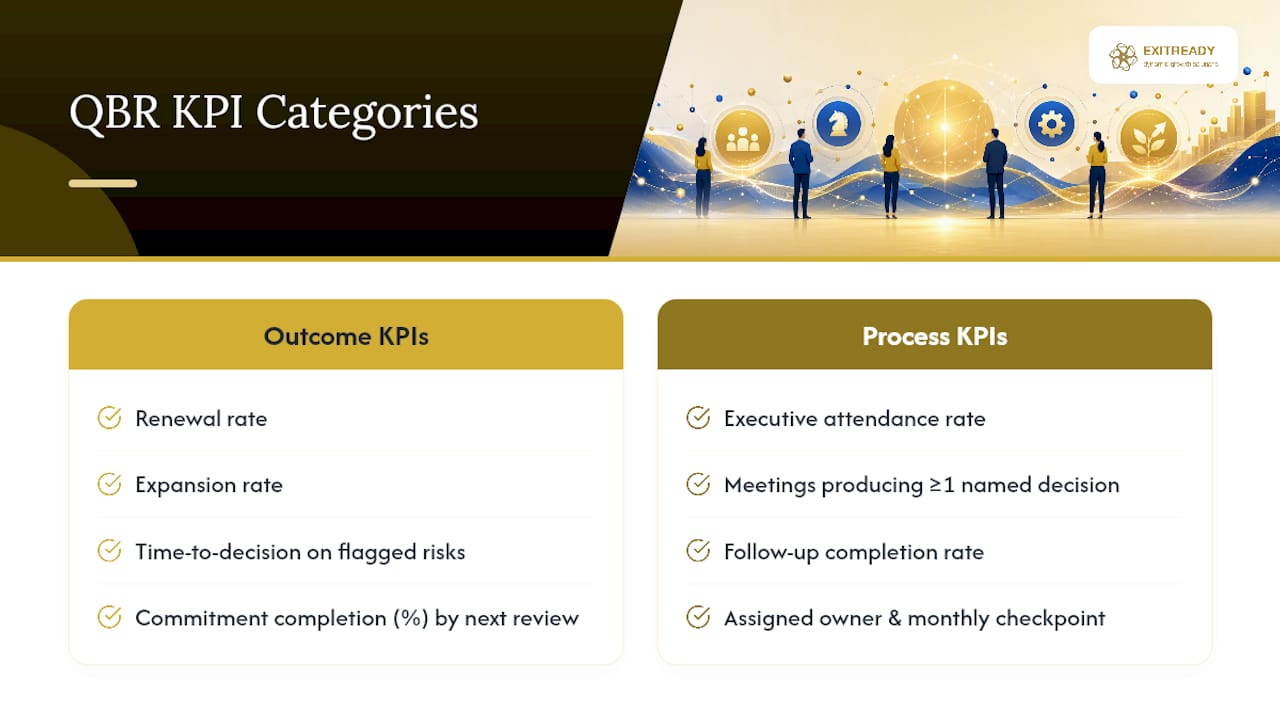
Outcome KPIs measure whether the business actually moved: renewal rate, expansion rate, time-to-decision on flagged risks, and the percentage of quarterly commitments actually completed by the next review. Process KPIs measure whether the meeting itself is functioning: executive attendance rate, the percentage of meetings that produce at least one named decision, and follow-up completion rate on action items.
Follow-up needs an owner and a cadence, not good intentions. Assign one person to track commitments and report progress at a monthly checkpoint between QBRs. EntrepreneurBytes recommends distributing a short summary document within 48 hours of the meeting, which prevents the QBR from becoming a one-off event nobody references again.
Companies running formal quarterly reviews report growth roughly 30% faster than peers skipping the practice, which gives you a rough benchmark for the ROI conversation.
Estimating QBR ROI doesn’t need to be complicated. Weigh the hours invested by attendees against the cost of the churn or missed expansion those decisions likely prevented. If a QBR flags a churn risk two quarters before renewal instead of two weeks before, the hours spent preparing the review are trivial next to the revenue saved.
How QBRs Fit Into a Business Operating System and Drive Transformation
A single great QBR is a good meeting. A quarterly cadence of great QBRs, connected to a documented operating rhythm, is what actually compounds into higher valuation and operational independence.
The loop looks like this: QBR surfaces the decision, an operating system like AOS turns that decision into a documented playbook and an owned process, and the next quarter’s QBR measures whether that playbook actually worked. McKinsey’s research on QBR ecosystems points to clear ownership and alignment between budgeting logic and delivery teams as the real determinant of whether reviews create lasting value or just repeat themselves every 90 days.
QBR discipline is what separates a business that reacts to its numbers from one that runs on a repeatable operating rhythm, where documented playbooks and named owners replace founder-dependent decision-making, one quarter at a time.
That’s the difference between a business that’s interesting to a buyer and one that’s still dependent on the owner walking into every room. A structured approach to business transformation treats the QBR as one recurring input into a larger system built for eventual exit or long-term scale.
Advisor’s Quick Guide: Three Tips to Make Your Next QBR Strategic
The week before a QBR, I chase down one thing: the single metric most likely to derail the meeting into a debate instead of a decision, and I get alignment on it beforehand in a five-minute call.
To force decisions in the room, I ask “what changes because of this number” before we’re allowed to move to the next slide. If nothing changes, the slide didn’t need to be there.
Afterward, I track commitments the same way I’d track a sales pipeline: named owner, date, and a one-line status I update at the monthly checkpoint, not just at the next QBR.
Five things to do in the next seven days: name a QBR owner, pick the date, request the pre-read data, draft your decisions-required slide, and confirm your executive sponsor is actually attending.
How Dynamic Growth Solutions Helps You Run QBRs That Actually Drive Growth
Most owners running their own QBRs hit the same wall: the meeting produces good conversation but no repeatable system behind it, so the next quarter starts from scratch. Dynamicgrowthsolutions builds that system directly into your operations through AOS, replacing ad hoc quarterly meetings with a documented cadence, assigned ownership, and playbooks that survive turnover on your leadership team.
The assessment process identifies exactly where your current review cadence breaks down, whether that’s unclear ownership, disconnected data, or a habit of reviewing the past without committing to the next 90 days. From there, Dynamicgrowthsolutions’ business operating system installs the structure that turns QBRs into a compounding advantage rather than a quarterly obligation, one that also strengthens your position when it’s time to talk valuation or exit.
Start with a business transformation assessment to see where your review process stands today and what a repeatable AOS-driven cadence could look like for your business.
Sources
- How to Run a Quarterly Business Review (QBR) – KPI Tree
- The Essential Guide to Quarterly Business Reviews (QBRs)
- Profit
- Quarterly Business Review Checklist: End-of-Quarter Audit | EntrepreneurBytes