

Automation frees business owners by removing repetitive work and cognitive load from their daily hours, but only when it runs on top of a documented process. The mechanism is simple: automation converts recurring work into background systems that operate without the owner’s attention. That only works in one order. You document the process first, then delegate ownership of it to a person, then automate what’s left. Skip a step and you’ve just built a faster version of the bottleneck you already had.
A few things worth setting straight before going further:
- Tools alone don’t create freedom. A calendar app or a CRM automation sitting on top of chaos just automates the chaos.
- Systems and measurement create freedom. If you can’t measure how many hours an owner spends on a task, you can’t prove automation removed it.
- The role of automation in owner freedom depends entirely on what it’s automating: a documented, delegated process, or a decision that still lives in your head.
Key Takeaways
Owner freedom comes from documenting a process, delegating its ownership, and only then automating it, in that exact order.
| Point | Details |
|---|---|
| Sequence matters most | Document the process, delegate ownership, then automate. Reversing this order recreates the bottleneck faster. |
| Freedom buffer is real | Automation saves refocusing time, not just task time, which is why hours saved understate the actual benefit. |
| Watch the owner-operator trap | Automating steps while keeping approvals with the owner leaves the dependency fully intact. |
| Measure owner availability | Track hours the business runs without owner decisions, not just total hours worked. |
| Dynamicgrowthsolutions runs the sprint | AOS structures the 90-day audit, documentation, and automation sequence, with owner-hours and error reduction as proof points. |
Table of Contents
- Why Automation Actually Buys Back Owner Time
- What Should You Automate First?
- The Owner-Operator Trap: When Automation Backfires
- What Does a 90-Day Owner Freedom Sprint Look Like?
- How Do You Measure Whether Automation Actually Freed You?
- What Does the Research Actually Say About Automation and Freedom?
- What Owners Consistently Get Wrong About Automation
- How Dynamicgrowthsolutions Turns the Roadmap Into a Result
- Sources
Why Automation Actually Buys Back Owner Time
The freedom automation delivers isn’t just the minutes a task used to take. It’s the recovery time around it. Every time an owner gets pulled into an approval, a customer escalation, or a scheduling conflict, they lose the task they were doing and the mental runway to get back into it. Researchers call this refocusing cost, and it’s often larger than the interruption itself. Automation that removes the interruption also removes that refocusing tax, which is what creates what one industry analysis calls a genuine freedom buffer rather than a marginal efficiency gain.
This matters because owner attention is a finite resource, not an infinite one. Every unstructured decision an owner makes during the day (approve this invoice, answer this vendor email, decide this schedule conflict) draws on the same limited pool of deliberate thinking. Automating the routine decisions leaves that pool for the ones that actually need a founder’s judgment.
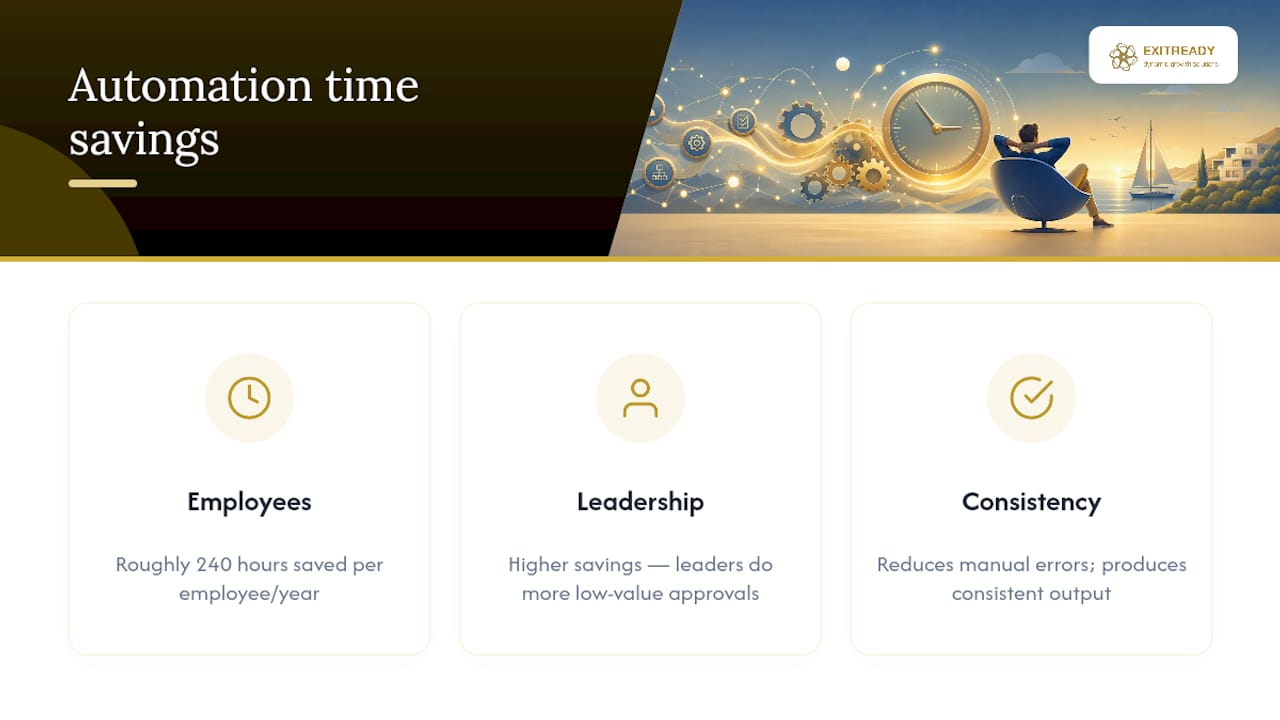
The operational payoff shows up in consistency, not just hours. Business process automation reduces manual errors and produces the same output every time, which means fewer fires for the owner to put out personally. Industry estimates suggest employees can save roughly 240 hours a year through automation, with leadership-level savings running even higher, since leaders tend to carry more of the low-value approval work.
Pro Tip: Track “interruptions per day” for two weeks before automating anything. It’s a better diagnostic than a time log, because it shows you exactly where your attention is getting hijacked, not just where your hours go.
What Should You Automate First?
Not every process deserves automation on day one. The highest-leverage targets share three traits: they happen often, they currently require the owner’s direct involvement, and getting them wrong has real cost. Rank candidates against those three filters before touching a single tool.
- Finance operations. Automated cashflow transfers, recurring payroll runs, and invoice matching remove daily approval bottlenecks that otherwise sit on an owner’s desk.
- Sales and lead follow-up. Rule-based sequences that respond to inbound leads within minutes outperform manual follow-up, and they don’t wait for the owner to check email.
- Customer onboarding and fulfillment. A documented onboarding sequence, once automated, delivers the same experience to client one hundred as it did to client one.
- HR onboarding and scheduling. New-hire paperwork, benefits enrollment, and shift scheduling are high-frequency, low-judgment tasks perfectly suited to automation.
- Routine reporting and alerts. Dashboards that flag anomalies (a missed SLA, a cash shortfall) replace the owner’s habit of checking everything manually.
Different domains call for different automation types:
- Rule-based workflows handle simple if-this-then-that logic, like auto-assigning a support ticket by category.
- BPA and BPM platforms manage multi-step processes across departments, such as onboarding a new client from contract to first delivery.
- RPA (robotic process automation) replicates manual clicks in legacy software when no clean integration exists.
- AI-assisted decision points work best where the decision has a pattern but still benefits from a human check, like flagging a contract for review instead of auto-signing it.
Prioritize by frequency and revenue impact first. A task you touch daily and that affects revenue outranks a monthly task that’s merely annoying, even if the monthly task feels more urgent when it happens.
The Owner-Operator Trap: When Automation Backfires
Here’s where most automation efforts quietly fail: the owner automates the steps of a process but keeps the approval sitting on their own desk. The task runs faster, but it still can’t finish without the owner’s sign-off. That’s the owner-operator trap, and it’s one of the most common reasons automation projects stall out on hours saved without ever improving actual owner independence.

A related mistake is buying the tool before writing the process down. Software implemented on top of an undocumented workflow just automates whatever inconsistency was already there, faster.
Some pitfalls to watch for directly:
- Automating a task that genuinely needs human judgment (a nuanced customer complaint, a pricing exception) and hoping the system handles the edge cases.
- Building an automation with no documented decision rule behind it, so only the owner knows when to override it.
- Treating “automated” as finished, without testing whether the process survives a week of the owner being completely unavailable.
Pro Tip: Run a “no-owner” test before calling any automation done. Have the process execute for a full cycle with the owner unreachable. Whatever breaks tells you exactly where the real dependency still lives.
What Does a 90-Day Owner Freedom Sprint Look Like?
A focused sprint on the highest-leverage systems, rather than a slow rollout across the entire business, tends to produce the clearest proof that a process runs without the owner. Twelve weeks is enough time to prove it, not just plan it.
- Weeks 1 to 2: dependency audit. List every task that would stall if the owner disappeared for 30 days. Rank each by frequency and business risk.
- Weeks 3 to 6: document the top three systems. Write the SOPs, decision trees, and quality standards for the three highest-risk dependencies identified in the audit.
- Weeks 7 to 10: delegate and dry-run. Assign real ownership to a team member, not just the task. Run the process manually with them in charge while you build the automation scripts alongside it.
- Weeks 11 to 12: deploy and verify. Turn on the automation, track the agreed metrics, and adjust based on what the dry-run exposed.
A few non-negotiables for the sprint to count as real progress:
- Every system must pass a “no-owner” acceptance test before you call it automated.
- Document decision logic in writing, not just in the automation’s configuration screen.
- Pick exactly three systems. More than that and the sprint turns into a backlog nobody finishes.
This sequencing (document, delegate, then automate) mirrors what detailed examples of systematized processes consistently show: automation sticks when it’s built on a process someone else already runs successfully by hand.
How Do You Measure Whether Automation Actually Freed You?
The clearest signal isn’t hours saved, though that matters. It’s owner availability: how many hours a week the business runs decisions without needing you in the room. Track that number specifically, separate from total hours worked, because a busy owner and a free owner can log the same hours doing very different things.
Operational metrics worth watching weekly:
- Owner hours spent on approvals or exceptions versus strategic work.
- Response time on customer inquiries before and after automation.
- Error rates on the automated process compared to its manual predecessor.
- SLA adherence across the automated workflow.
Business-level metrics tell the valuation story. Revenue predictability, customer churn, and margin stability all improve when fewer functions depend on one person’s judgment, and buyers notice. Fewer founder-dependent functions lower the perceived risk in a sale, which tends to support stronger exit valuation multiples. Document the before-and-after numbers now. A business operating system that tracks these metrics natively gives you a running record you can hand a buyer later instead of reconstructing it under deadline pressure.
What Does the Research Actually Say About Automation and Freedom?
Academic work on this question is more cautious than the marketing copy around automation tools. A frequently cited analysis on automation and work argues the technology genuinely can expand leisure and improve the quality of work, but only under the right conditions.
Automation’s capacity to “lighten work” is real, but it is not automatic. Whether the time it frees actually returns to workers and owners, rather than simply raising output expectations, depends on how ownership and governance of that automation are structured.
That caveat lines up with what shows up in practice. A business process automation implementation reduces error rates and frees staff for higher-value work, but only in businesses that already had consistent workflows to automate. The client-facing evidence follows the same pattern:
- Case studies built around a 90-day sprint consistently show measurable reductions in owner involvement in day-to-day operations.
- Documented playbooks and decision logic, developed under a framework like Dynamicgrowthsolutions’s AOS, appear repeatedly as the precondition for automation actually holding up under load.
- Every source agrees on one caveat: automation without governance just moves the bottleneck, it doesn’t remove it.
What Owners Consistently Get Wrong About Automation
The mistake I see most often isn’t technical. It’s sequencing. Owners buy a platform, plug it into whatever mess already exists, and expect the mess to sort itself out because software is involved. It never does. The principle worth repeating until it’s boring: systems before tools, and measure owner independence, not just efficiency.
The clearest illustration is the owner who automates invoicing but still personally approves every invoice over a certain amount. The bottleneck didn’t move. It just got a faster interface. The businesses that actually escape founder dependency are the ones that write the approval rule down, hand it to someone else, and only then build the automation around it. That order is the entire difference between a tool and a system a look at building a business that runs without you makes clear from the opposite direction.
How Dynamicgrowthsolutions Turns the Roadmap Into a Result
Dynamicgrowthsolutions runs the 90-day sprint described above as a structured engagement, not a suggestion you have to piece together alone. AOS, the firm’s proprietary operating system, exists specifically to sequence the document-delegate-automate process correctly instead of letting an owner skip straight to buying software.

The engagement starts with an assessment that identifies your three highest-risk owner dependencies, the same audit outlined in the sprint above, then builds the documented SOPs and decision logic those systems need before any automation touches them. Partner integrations, including AI workflow patterns like the ones detailed in Collett Systems’ work with managed service clients, show how far a documented process can go once automation actually sits on solid ground. Clients track owner-hours freed and operational error reduction as concrete proof points, the kind of evidence that also supports a stronger position at exit. If you’re ready to see where your business creates the most founder dependency, learn what a business operating system does for owners and book a strategy call to map your own 90-day sprint.
Sources
- The Real ROI of Automation: Why It’s Not About Efficiency, It’s About Freedom
- Business automation explanations and benefits — IBM
- What is business automation? — U.S. Chamber of Commerce
- The Owner-Operator Trap: You Are the Bottleneck