
You can stop running day-to-day operations by doing three things in sequence: audit where your time actually goes, delegate the top recurring tasks to capable people with clear authority, then run a short absence test to expose what still depends on you. Many owners recover significant hours per week within the first months of this process. Full operational independence — where the business runs without your daily input — typically takes several months depending on team maturity and how willing you are to let go. The framework Dynamicgrowthsolutions uses for this is called AOS (Accelerated Operating System), and it maps directly to the steps in this guide: time audit, documented SOPs, leadership handoff, and a validated absence test. Start the 2-week time audit today and you will have your first delegation targets identified before the week is out.
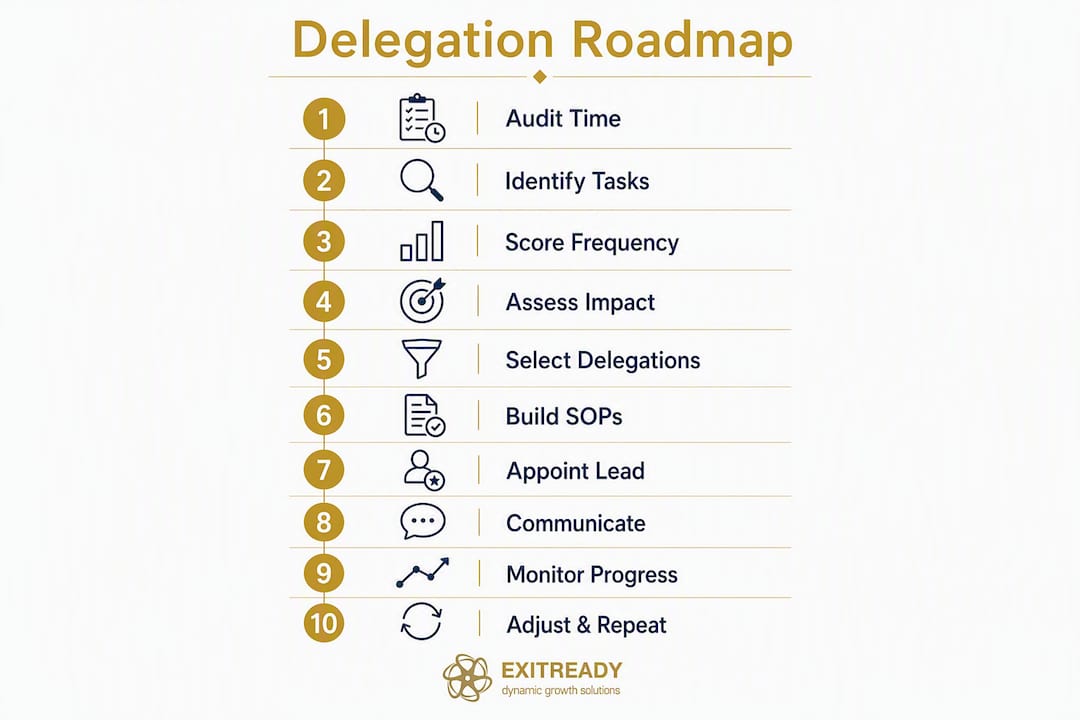
Table of Contents
- What does a 10-step checklist to step back from management look like?
- How do you run a time audit and decide what to delegate?
- How do you build SOPs and playbooks that actually get used?
- How do you build a leadership team that runs things without you?
- How do you hand off client relationships without losing revenue?
- What governance structure lets you lead from a distance?
- What does a realistic timeline and cost look like?
- What pitfalls and psychological barriers should you watch for?
- How do you know you’re ready to step away?
- Key Takeaways
- The thing most owners get wrong about stepping back
- How Dynamicgrowthsolutions AOS accelerates your path to operational independence
- Useful sources and tools for each stage of owner extraction
What does a 10-step checklist to step back from management look like?
Use this list as your operating sequence. The first three items can start within 24 hours.
First 24 hours:
- Start a time-tracking log (use Toggl Track, Clockify, or a simple spreadsheet) and record every task you touch.
- Write down the three tasks you handled today that someone else could theoretically do.
- Identify one person on your team who has capacity and expressed interest in more responsibility.
First week:
- Continue the time log daily; do not change your behavior yet, just capture it.
- Film one recurring process using Loom while you do it — pick something you explain to people more than twice a week.
- Draft a one-page decision boundary for your most capable team member: what they can decide alone, what needs your sign-off.
First 30 days:
- Categorize every logged task into four buckets (detailed in the next section).
- Assign ownership for your top three delegate targets with written outcomes, not just task descriptions.
- Schedule a 3–5 business day “vanish test” — a planned offline period to stress-test your systems.
- Identify which client relationships only you currently own and begin the handoff process.
How do you run a time audit and decide what to delegate?
A 2-week time audit is the most reliable way to find your first extraction targets. The goal is not to optimize your schedule — it is to see, in raw data, where your hours actually go versus where you think they go. Those two things are almost never the same.

How to run it: Log every task in real time, not at the end of the day. Use Toggl Track or Clockify for automatic tracking, or a Google Sheet with columns for task name, duration, category, and a quick note on whether it required your specific judgment. Do this for 10 business days without changing your behavior.
After two weeks, sort your log by frequency and time spent. Then assign each task to one of four buckets:
| Bucket | Definition | Example tasks |
|---|---|---|
| Owner-only | Requires your unique authority, relationships, or judgment | Final contract approval, investor calls, culture-setting decisions |
| Delegate | Someone else can own this with training and clear outcomes | Weekly reporting, vendor coordination, onboarding new hires |
| Automate | Repetitive, rule-based, no judgment needed | Invoice reminders, scheduling, status update emails |
| Stop | Low value, no clear owner, nobody would miss it | Redundant approval steps, reports nobody reads |
Scoring rubric: For each task, score it on three dimensions: frequency (how often it recurs), revenue impact (does it directly affect a client or revenue outcome?), and skill required (does it need your specific expertise?). High-frequency, low-skill tasks are your first wave of delegation — they give you time back fast and carry low risk if the handoff is imperfect.
Pro Tip: Start delegations with tasks that recur at least three times per week and require no specialized judgment. These are your fastest wins and they build your team’s confidence before you hand off anything higher-stakes.
The delegation decision matrix maps tasks on two axes: skill required versus business impact. Tasks that are low-skill and low-impact should be eliminated or automated first. Tasks that are high-frequency and medium-impact are your primary delegation targets. Keep only what genuinely requires your authority or relationships.
How do you build SOPs and playbooks that actually get used?
The knowledge that lives in your head is the single biggest bottleneck to stepping back from management. Until it is written down or filmed, every task routes back to you by default.
Film first, write second. For any physical, visual, or multi-step process, record yourself doing it with Loom or even a phone camera. A short screencast plus an AI tool to structure the transcript into steps is significantly faster than writing from scratch and produces SOPs teams actually follow. Reserve written SOPs for decision-making processes and judgment calls where context matters more than sequence.
SOP template structure:
- Purpose: What this process achieves and why it exists.
- Inputs: What information, tools, or access is needed before starting.
- Steps: Numbered sequence with screenshots or video timestamps where relevant.
- Acceptance criteria: What “done” looks like — specific, measurable.
- Escalation rules: What triggers a call to the owner versus a team decision.
- Sign-off: Who approves the output and how.
Where to store them: Google Workspace works for small teams already in that ecosystem. Notion is better for mid-market teams that need linked databases and cross-referencing. Confluence suits companies with engineering or product teams that need version control. Loom handles the video library. Pick one platform and commit — a fragmented SOP library is nearly as bad as no library at all.
Which SOPs to build first: Focus on “leash” processes — the ones where you are the single point of failure. If the task stops or degrades when you are unavailable, it belongs in your first documentation sprint.
| Priority | Process type | Estimated time to document |
|---|---|---|
| 1 | Client onboarding | 2–4 hours |
| 2 | Weekly reporting and KPI review | 1–2 hours |
| 3 | Vendor payment and approval | 30–60 minutes |
| 4 | Hiring and interview process | 2–3 hours |
| 5 | Customer complaint escalation | 1 hour |
A realistic first sprint is five SOPs in two weeks. That is enough to cover the highest-risk handoffs and give your team a working playbook before you run your first absence test.
How do you build a leadership team that runs things without you?
Appointing a second-in-command is the structural move that makes everything else stick. Without someone who owns outcomes in your absence, even the best SOPs eventually route back to you.
Decision boundaries template: Define three tiers of authority for your lead. Tier 1 is full autonomy — they decide and act without informing you. Tier 2 is inform-only — they decide, then send you a brief note. Tier 3 is escalate — they bring it to you before acting. The most common mistake is making Tier 3 too broad. If your lead needs to check with you on more than two or three categories of decision, you have not actually handed off authority.
30/60/90-day training plan for a new lead:
- Days 1–30: Shadow every owner-facing process; co-own two client relationships; review all active SOPs and flag gaps.
- Days 31–60: Lead two client relationships independently; own weekly team reporting; handle all Tier 1 and Tier 2 decisions without owner input.
- Days 61–90: Run the weekly operations meeting solo; manage one vendor negotiation; complete a 3-day solo coverage test while the owner is offline.
Promote vs. hire checklist: Promote an internal operator when they already know your clients, culture, and processes — the learning curve is shorter and team trust is higher. Hire externally when the role requires skills your team genuinely does not have (fractional COO, for example) or when promoting would create a gap in a critical function. The delegation framework is clear on this: define the outcome you need, then decide who is best positioned to own it.
Midpoint check-in plan: Schedule one structured check-in at the midpoint of any new delegation, not a daily check-in and not silence until the deadline. This single touchpoint prevents both micromanagement and the “dump and run” failure where the team member gets stuck and has no path forward.
Pro Tip: Define “done” by outcome, not by process steps. Tell your lead what a successful week looks like in measurable terms — client satisfaction score, delivery SLA met, no unresolved escalations — and let them own the how.
How do you hand off client relationships without losing revenue?
Client relationships are the last thing most owners let go of, and often the most important to transfer carefully. The risk is real: a clumsy handoff can trigger churn. A phased approach manages that risk.
Client tiering matrix: Sort your clients into three tiers. Tier A clients (highest revenue, longest tenure, most relationship-sensitive) stay partially owner-connected for the longest. Tier B clients get a co-managed handoff over 60 days. Tier C clients (transactional, low-touch) can be transferred immediately with a brief introduction email.
Phased handoff timeline:
- Observe (weeks 1–2): Your lead shadows all client calls and reviews all correspondence. No ownership transfer yet.
- Co-own (weeks 3–6): Your lead leads calls with you present. You introduce them explicitly as the primary point of contact going forward.
- Lead (weeks 7–10): Your lead runs the relationship independently. You are copied on communications but do not respond unless escalated.
- Monitor (week 11 onward): You review a monthly summary. The relationship is fully transferred.
Suggested handoff email language: Keep it brief and confident. Something like: “I’m writing to introduce [Name], who will be your primary contact going forward. [Name] has been working alongside me on your account for the past [X weeks] and is fully up to speed. I remain available for strategic conversations, and [Name] will handle day-to-day coordination.”
Communication best practices: Never frame the handoff as the owner stepping away. Frame it as the client gaining a dedicated resource. Clients respond to the quality of the new contact, not the fact of the transition — so invest in your lead’s preparation before the introduction, not after.
What governance structure lets you lead from a distance?
Stepping back from management does not mean going dark. It means shifting from daily approvals to weekly outcome reviews. The governance layer is what makes that shift sustainable.
Weekly KPI dashboard fields to track:
- Revenue mix by product or service line (flags concentration risk early)
- Customer churn rate or NPS movement
- Delivery SLA compliance rate
- Cash runway (weeks of operating expenses covered)
- Open escalations older than 48 hours
One-page owner report: Your lead sends this every Monday. It covers: top three wins from last week, top three priorities for this week, one risk or blocker that needs owner awareness, and one metric that moved outside its normal range. That is it. If the report runs longer than one page, it is doing too much.
Escalation triggers checklist — “call me” events:
- A client with more than 15% of revenue is at risk of churning.
- A legal, compliance, or regulatory issue arises.
- A team member in a key role resigns unexpectedly.
- Cash position drops below a defined threshold.
- A vendor failure threatens a client deliverable.
Everything else is a team decision. Documenting these triggers explicitly removes the ambiguity that causes your team to over-escalate, which is the primary reason owners get pulled back into daily operations even after a successful initial handoff. For more on removing approval bottlenecks, the owner bottleneck guide covers workflow redesign in detail.
What does a realistic timeline and cost look like?
Owner extraction is not free, and it is not instant. Here is what the roadmap looks like in practice, with ballpark U.S. cost ranges.
| Phase | Timeframe | Key activities | Expected outcome |
|---|---|---|---|
| Foundation | Days 0–30 | Time audit, task categorization, first 5 SOPs, identify lead candidate | 5–10 hours/week recovered |
| Delegation sprint | Days 31–90 | Delegate top 6 tasks, train lead, run vanish test | 10–20 hours/week recovered; first absence test passed |
| Leadership transfer | Months 3–6 | Lead owns operations meeting, client handoffs complete, KPI dashboard live | Owner down to weekly reviews |
| Full independence | Several months | Owner in strategic role only; team self-manages; exit-readiness certification possible | Business runs without daily owner input |
Ballpark U.S. cost ranges:
- Virtual assistant (20 hrs/week): $1,500–$3,000/month
- Operations lead (full-time, mid-market): $70,000–$110,000/year
- Fractional COO: $5,000–$15,000/month depending on scope
- SOP platform (Notion, Confluence): $0–$800/year for most teams
- Collaboration and automation tools (Asana, Slack, Zapier): $200–$600/month
ROI calculation: Estimate your effective hourly value as an owner (annual revenue you influence divided by hours worked). If you recover 15 hours per week at $500/hour, that is $390,000 in annual capacity freed up. A $90,000 operations lead that frees 15 hours per week pays for itself many times over — and that math does not include the exit valuation premium that comes with an owner-independent business.
Budgeting tip: Spend first on the hire or tool that recovers the most owner hours per dollar. A VA handling scheduling and email triage often delivers the fastest payback in the first 30 days.
What pitfalls and psychological barriers should you watch for?
The practical steps are straightforward. The harder part is what happens in your own head — and in your team’s behavior — when you start letting go.
Red flags that signal backsliding:
- You are still the final approver on decisions your lead should own.
- Clients call you directly because they know you will respond faster than your team.
- You check task status daily instead of reviewing weekly outcomes.
- No one on your team knows the answer to a client question without asking you first.
Mitigation actions:
- Set explicit decision boundaries in writing and share them with the full team, not just your lead.
- Update your email signature and voicemail to redirect routine inquiries to your lead.
- Apply the 80% rule: if your team member can do it 80% as well as you, hand it off. Perfection is the enemy of extraction.
- Use midpoint check-ins rather than daily status requests to stay informed without hovering.
Psychological barriers: Most owners who struggle to step back from management are not struggling with process — they are struggling with identity. When your value to the business has been defined by your daily presence, removing yourself feels like becoming irrelevant. The reframe that works: your value is highest when you are working on the business, not in it. An owner who is indispensable to daily operations is actually a liability on a balance sheet — it suppresses valuation and makes the business harder to sell or scale.
Short escalation playbook for early failures: When something goes wrong after a handoff (and something will), resist the reflex to take it back. Instead: (1) identify the specific gap (missing SOP, unclear authority, wrong person), (2) fix the system, not the symptom, (3) document the fix as a new or updated SOP, and (4) let your lead own the recovery with your coaching, not your hands.
Pro Tip: The first time your team solves a problem without you, resist the urge to review every detail of how they did it. Review the outcome. If the outcome was acceptable, the process was good enough.
How do you know you’re ready to step away?
Readiness is not a feeling — it is a set of measurable conditions. Check these before you announce any extended absence.
Readiness checklist:
- At least 80% of your core processes have a published SOP.
- Your top six recurring tasks have been delegated with written outcome definitions.
- Your lead has covered for you successfully for at least one full week.
- Every Tier A client has been introduced to your lead and has had at least two interactions with them.
- Your KPI dashboard is live and your lead reviews it weekly without prompting.
- Fewer than 5% of team escalations in the past 30 days required your direct decision.
The vanish test: Announce a 3–5 business day offline period to your team. Set clear rules: what constitutes a genuine emergency (use your escalation triggers list), who is the decision-maker in your absence, and how you will debrief afterward. Do not check in. The problems that surface during this test are your next documentation and delegation priorities — they are not failures, they are a diagnostic.
Behavioral signals that confirm readiness:
- Your team stops asking “what would [owner] do?” and starts asking “what does the SOP say?”
- Client satisfaction scores hold steady or improve during your absence.
- Your lead runs the weekly operations meeting without an agenda from you.
- You return from the vanish test to find decisions made, not a pile of deferred problems.
For a structured benchmark of what owner-independent operations look like at the mid-market level, the readiness criteria above align with the standards Dynamicgrowthsolutions uses in its AOS certification process.
Key Takeaways
Successfully removing yourself from daily operations requires a sequenced approach: audit your time, delegate with clear authority, document the knowledge in your head, and validate everything with a short absence test before stepping back further.
| Point | Details |
|---|---|
| Start with the time audit | A 2-week time log reveals your real delegation targets; high-frequency, low-skill tasks go first. |
| Delegate outcomes, not tasks | Hand over the result definition and the authority to decide, not just a to-do item. |
| Document “leash” processes first | Build SOPs for the workflows where you are the single point of failure before anything else. |
| Full independence takes several months | The first 90 days recover 10–20 hours/week; complete extraction depends on team maturity. |
| Dynamicgrowthsolutions AOS framework | The AOS program maps assessment, SOPs, leadership coaching, and exit readiness into one structured path. |
The thing most owners get wrong about stepping back
The conventional wisdom says the hardest part of owner extraction is building the systems. It is not. The hardest part is tolerating the gap between how you would do something and how your team does it.
Every owner I have seen struggle with this hits the same wall around week six or eight. The SOPs are written. The lead is trained. The KPIs are on a dashboard. And then the owner starts “just checking in” on things they delegated three weeks ago, quietly taking back approvals, answering client emails that should go to the lead. The systems did not fail. The owner’s tolerance for imperfection did.
The research on delegation and authority is consistent: psychological empowerment in a team grows when decision boundaries are clear and outcomes are reviewed, not when process steps are monitored. The moment you start reviewing how your team does something instead of what they produced, you have re-inserted yourself as the bottleneck.
Stepping back is not a one-time event. It is a practice. The owners who get it right are not the ones with the best SOPs — they are the ones who decided, at some point, that a business that runs without them is worth more than one that needs them. That shift in perspective is what makes the practical steps actually stick. And it is what separates an owner who is exit-ready from one who is permanently trapped in their own company.
How Dynamicgrowthsolutions AOS accelerates your path to operational independence
Most owners who try to extract themselves from daily operations do it piecemeal: a VA here, a Notion workspace there, a promoted manager who never quite gets full authority. The result is partial independence at best and a reversion to owner-dependence within six months.

Dynamicgrowthsolutions built the AOS (Accelerated Operating System) specifically to close that gap. The program starts with a structured operational assessment that maps exactly where owner dependency lives in your business — the same diagnostic logic as the time audit in this guide, but applied by advisors who have done it across dozens of mid-market companies. From there, AOS moves through documented playbooks, leadership coaching, and a governance layer that gives you weekly visibility without daily involvement. The endpoint is an owner-independent business that is certifiably exit-ready, with documented systems and a leadership team that buyers and investors can evaluate independently of you.
Owners who complete the AOS program typically reclaim significant weekly hours and see measurable improvements in business valuation. If you are ready to move from the audit phase to a structured extraction plan, take the Growth Readiness Score Card to see exactly where you stand today.
Useful sources and tools for each stage of owner extraction
These resources map to the major steps in this guide. Consult them in the order that matches your current stage.
For owners with no team yet (starting from scratch):
- The Owner Extraction Method — Move at Pace. The clearest explanation of the 90-day first-extraction framework and how to categorize tasks for delegation. Start here.
- 5 Steps to Make Your Business Run Without You in 90 Days — Forbes. Covers the vanish test methodology and staged absence planning in practical terms.
For owners building their first SOP library:
- How to Remove Yourself From Day-to-Day Operations with SOPs — SOPX. Film-first SOP capture, prioritization logic, and tool recommendations. Best resource for the documentation sprint.
For owners delegating to a team for the first time:
- How to Delegate Tasks Effectively — Goals & Progress. Covers decision boundaries, midpoint check-ins, and the psychological shift from doing to leading.
- The Delegation Decision Matrix — BeyondTime.ai. A practical quadrant tool for scoring tasks by skill required versus business impact.
- How to Delegate Tasks as a Manager — Bunch. Strong on the mindset shift from task assignment to distributed ownership; useful for owners promoting internal leads.
For mid-market owners preparing for exit:
- Common Signs of Owner-Reliant Businesses — Dynamicgrowthsolutions. Identifies the specific indicators that suppress valuation and what to fix first.
- Business Transformation Best Practices for Executives — Dynamicgrowthsolutions. Practical framework for owners ready to engage structured consulting support for the extraction process.