
Small and mid-size businesses that adopt these five Fortune 500 processes will get enterprise-level reliability without the overhead: (1) leadership and governance, (2) documented systems and SOPs, (3) performance management with KPIs and cadence, (4) culture and change management, and (5) a guarded technology and data command center. To implement Fortune 500 processes in an SMB, start with governance to clarify who owns what, then document your top five repeatable plays, pick three to five outcome metrics, run a 30-day culture pilot, and build one integrated tech stack before you automate anything.
Your 7-day starter checklist:
- Day 1: Name a single transformation owner and block 30% of their calendar.
- Day 2: Write a one-page vision and decision-rights map (who decides what, alone).
- Day 3: List your five highest-frequency, most error-prone processes for SOP documentation.
- Day 4: Choose three to five KPIs, one per function, with a named owner for each.
- Day 5: Audit your current tech stack for redundant tools and data silos.
- Day 6: Schedule a weekly 30-minute ops huddle starting next Monday.
- Day 7: Book a 90-minute kickoff with your leadership team to align on the 30/90/180 plan.
Key Takeaways
Implementing Fortune 500 processes in an SMB requires five disciplines in sequence: governance first, then SOPs, then performance management, then culture, then a guarded tech stack, with a single named owner driving the program from day one.
| Point | Details |
|---|---|
| Governance before everything | Name one transformation owner with 30% protected time before any other step. |
| Map before you automate | SMBs that map and validate processes first see 3–5x better ROI on automation investments. |
| Fewer metrics, named owners | Pick three to five KPIs per function; every metric needs one accountable person, not a team. |
| 30/90/180 is the right shape | Platform-powered mid-market transformations typically run 16–24 weeks; plan milestones at each horizon. |
| Dynamicgrowthsolutions AOS | AOS delivers assessment, playbooks, training, and fractional executive support for mid-market firms building toward scale or exit. |
Table of Contents
- How do you implement Fortune 500 processes in an SMB without bureaucracy?
- Why SOPs are your best risk-transfer mechanism
- What KPIs and meeting cadence actually move the needle for SMBs
- How do you make new systems stick without slowing everything down?
- How should you design your tech stack and data governance for SMB scale?
- What does a realistic 30/90/180-day implementation roadmap look like?
- What mistakes do SMBs most often make when adopting enterprise processes?
- How AOS helped a mid-market client adopt these processes: a real example
- Why discipline is actually a freedom multiplier for owners
- What AOS delivers for mid-market owners ready to scale
- Sources
How do you implement Fortune 500 processes in an SMB without bureaucracy?
Governance gives leverage. When decision rights are unclear, every question escalates to the owner, and the owner becomes the bottleneck. Fixing that one thing frees more execution capacity than any software purchase.
The minimum viable governance model for an SMB has three components: a vision/mission one-pager, a decision-rights map, and a single transformation owner with protected time. The one-pager does not need to be a strategy deck. One page, one paragraph on where you are going, one paragraph on what you will not do. Done.
Decision rights are where most owners skip a step. A lightweight RACI (Responsible, Accountable, Consulted, Informed) applied to your top ten recurring decisions eliminates the daily “should I bother the owner?” loop. Here is a minimal example for a mid-market transformation:
| Decision | Owner (R/A) | COO © | Head of Ops ® | Finance (I) |
|---|---|---|---|---|
| Process prioritization | Transformation Owner | Consulted | Responsible | Informed |
| SOP approval | Head of Ops | Informed | Accountable | Informed |
| Tech stack changes | COO | Accountable | Consulted | Consulted |
| Budget sign-off | Owner | Accountable | Informed | Responsible |
The transformation owner role is the single most important structural decision you will make. This person runs the program, owns the calendar, and reports directly to the CEO or owner. Without that role filled and protected, every other process improvement stalls within 60 days.
Pro Tip: Committees kill SMB transformations. A governance committee that meets monthly to “review progress” is a delay machine. One owner, one weekly check-in with the CEO, one shared dashboard. That is the entire governance structure you need at this scale.
Why SOPs are your best risk-transfer mechanism
SOPs are not bureaucracy. They are the answer to the question: “What happens when your best person leaves?” Document what your top performers actually do today, not what the theoretical best practice says they should do. That gap is where most SOP projects fail.
Building an SOP from scratch, step by step:
- Map the process. Sit with the person who does it best. Record or shadow them for one full cycle. Capture every step, every decision point, every exception they handle without thinking.
- Draft the SOP. Use this template structure: Role, Trigger, Inputs, Steps (numbered), Exceptions, Acceptance Criteria. Keep it under two pages.
- Validate with front-line staff. Have two other people run the process using only the SOP. Where they get stuck, the SOP is incomplete.
- Pilot for two weeks. Run the documented version in parallel with the old way. Track error rates and time.
- Freeze and version-control. Lock the approved version. Any change requires a named approver and a version number.
- Automate. Only after steps 1 through 5 are complete. SMBs that map and clean workflows before automation see materially higher ROI and fewer implementation failures — the research consistently shows a 3–5x better return when mapping precedes automation.
For hosting, a shared Google Drive or SharePoint folder with a version-naming convention (SOP_InvoiceProcessing_v2.1) works for teams under 50. A lightweight wiki like Notion or Confluence adds search and linking for teams of 50 to 250. Dedicated SOP tools add workflow routing and compliance tracking for larger or regulated environments. Start with what your team will actually open. The fanciest platform with zero adoption is worse than a Google Doc everyone reads.
The highest-priority SOPs to write first are the ones tied to high-frequency, repetitive workflows: employee onboarding, invoice handling, purchase approvals, and order-to-fulfillment. These are where errors compound and where automation pays off fastest once the process is clean. For concrete examples of what scaled playbooks look like in practice, the systematized business process examples from Dynamicgrowthsolutions show how mid-market firms have structured these plays.

What KPIs and meeting cadence actually move the needle for SMBs
Fewer metrics beat more metrics, every time. A dashboard with 40 KPIs is a dashboard nobody reads. Pick metrics that are outcome-focused, tied to a named owner, and split between leading indicators (what predicts the result) and lagging indicators (what confirms it).
KPI selection checklist — a metric earns its place only if it passes all four:
- It is actionable: the owner can change it within 30 days with a specific intervention.
- It has a named owner: one person, not a team, is accountable for the number.
- It is measurable without manual effort: if someone has to build a spreadsheet each week to produce it, it will not survive.
- It balances leading and lagging: at least one leading indicator per function, not just revenue and margin.
Optimization frameworks consistently point to four core process metrics as the most reliable signal set: cycle time, rework rate, throughput, and cost per transaction. Those four, applied to your highest-volume process, will tell you more than a 20-metric dashboard.
Example KPIs by function (ranges, not absolutes):
| Function | Leading KPI | Lagging KPI | Suggested Target Range |
|---|---|---|---|
| Sales | Pipeline coverage ratio | Revenue vs. plan | 3x–4x pipeline to quota |
| Operations | On-time start rate | Cycle time per unit | Reduce cycle time 10–20% in 90 days |
| Finance | Invoice aging >30 days | Cash conversion cycle | Aging <15% of AR |
| Customer support | First-response time | Resolution rate | Response <4 hours |
Meeting cadence template:
- Weekly ops huddle (30 minutes, ops leads only): review the prior week’s KPIs, flag blockers, assign owners to open items. No strategy, no status theater.
- Monthly business review (90 minutes, full leadership team): KPI trends, variance analysis, one process improvement decision.
- Quarterly planning session (half day, owner plus leadership): OKR review, next-quarter priorities, resource decisions.
The weekly huddle is the one most SMBs skip. It is also the one that prevents the most firefighting.
How do you make new systems stick without slowing everything down?
Change is mostly a cultural problem, not a technical one. The SOP can be perfect and still fail if the team sees it as the owner’s project rather than their own. Small, iterative pilots with visible wins are how you shift that perception.
Change management checklist for SMBs:
- Owner sponsorship, visible and consistent. The transformation owner attends the first training session for every new process. Not to present. To show up.
- Communications cadence. A brief weekly update (one paragraph, one metric, one win) sent to the whole company. Silence breeds rumor.
- Role-based micro-training. Each SOP gets a 10-minute video or walkthrough built for the specific role that uses it, not a company-wide all-hands.
- Leader-led demos. Managers run the first live demo of each new process with their team. Not HR. Not the transformation owner.
- Rapid refresh sessions. 20-minute monthly refreshers for the first quarter after launch. Attendance tracked.
- Feedback loop. A simple form or Slack channel where anyone can flag a broken step in an SOP. Reviewed weekly. Fixes published within 48 hours.
Pro Tip: Designate one “process champion” per department — someone who is not a manager but is respected by peers. Champions field questions, surface friction early, and become the informal trainers. This structure consistently outperforms top-down mandates in SMB environments because it distributes ownership without adding headcount.
The certification piece matters more than most owners expect. When a role-holder can demonstrate they have completed training and passed a basic competency check, the SOP becomes a credential, not a chore. That shift in framing changes adoption rates. Fractional executive networks are a practical way to inject this kind of change-management experience without the cost of a full-time Chief People Officer.
How should you design your tech stack and data governance for SMB scale?
The command center is the control plane that keeps automation reliable. Without it, you end up with five tools that each hold a different version of the truth, and your team spends more time reconciling data than acting on it.
Recommended stack patterns by category:
- Single source of record (CRM/ERP): One system owns the customer and transaction record. Everything else reads from it; nothing else writes to it without a defined integration.
- Workflow engine: A lightweight process automation layer (forms, approvals, notifications) that sits between your record system and your team’s daily tools.
- Analytics/BI layer: A reporting tool that pulls from the single source of record and produces the KPI dashboard the leadership team reviews weekly.
- Identity and access pattern: Role-based access control, reviewed quarterly. Who can see what, who can change what, and an audit trail for both.
SMB manufacturing and service firms are increasingly borrowing enterprise ERP and integration patterns to close capability gaps, and the cost of entry-level integrated stacks has dropped significantly in the past five years.
Data governance checklist:
- Named data owner for each core data object (customer, product, transaction, employee).
- Agreed definitions in writing: what counts as a “closed deal,” what counts as “on time.”
- Access control reviewed quarterly, not just at onboarding.
- Audit trail for any automated write or delete operation.
- Monthly data quality check: spot-check 50 records per core object for completeness and accuracy.
Integration pattern comparison:
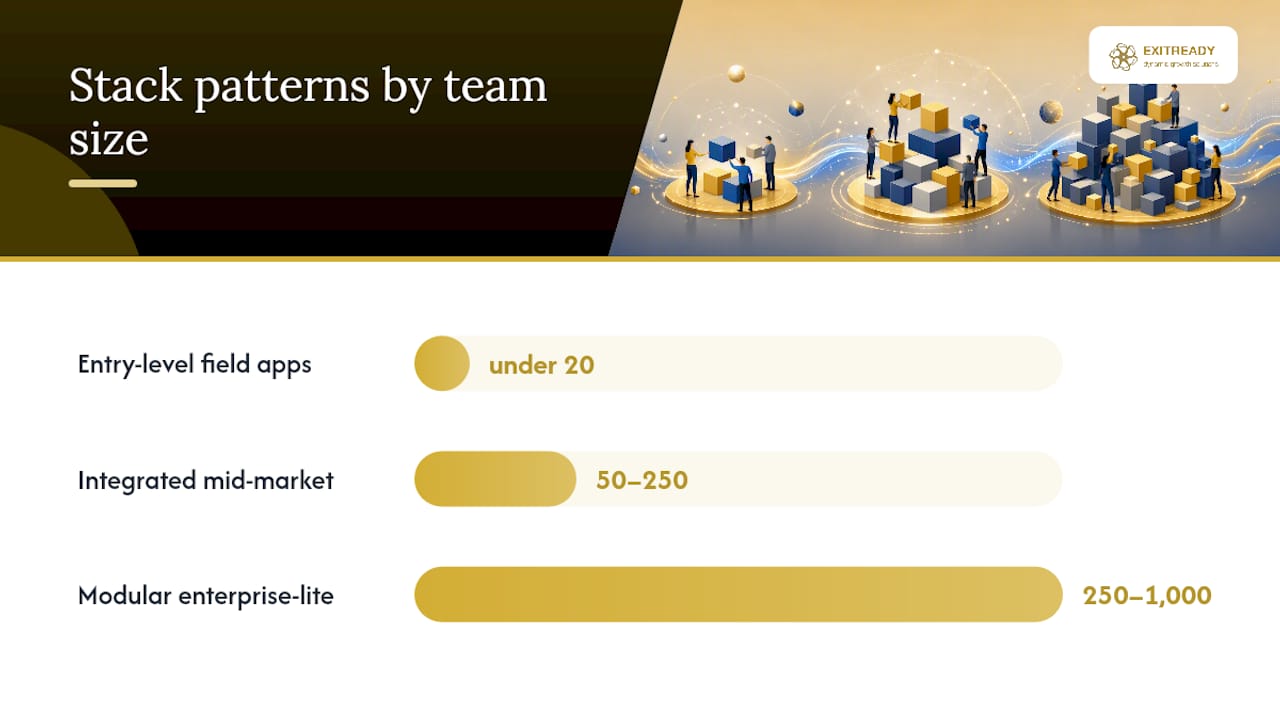
| Pattern | Best for | Key trade-off |
|---|---|---|
| Entry-level field apps (standalone) | Teams under 20, single-process focus | Low cost, high fragmentation risk |
| Integrated mid-market stack (CRM + ERP + BI) | Teams of 50–250, multi-process | Higher setup cost, lower reconciliation overhead |
| Modular enterprise-lite (API-connected best-of-breed) | Teams of 250–1,000, complex workflows | Maximum flexibility, requires integration governance |
Pro Tip: Major firms like S&P Global run large-scale AI training programs emphasizing benchmarking and validation of AI outputs before broad deployment. Apply the same principle at SMB scale: require explainability for any automated decision, log every automated output, keep a human in the loop for edge cases, and define one validation metric per automated workflow before you go live. Automation without that guardrail creates chaos faster than manual processes ever did.
What does a realistic 30/90/180-day implementation roadmap look like?
That is the entire operating model. Platform-powered transformation programs for mid-market firms typically follow a 16–24 week shape, which maps directly onto the 90/180-day horizons below.
30/90/180-day checklists:
Days 1–30 (Scoping and foundation):
- Appoint transformation owner; block 30% calendar time.
- Complete a process inventory: list all recurring processes, score by frequency and error rate.
- Select three to five priority processes for the first wave.
- Draft governance one-pager and decision-rights map.
- Baseline current KPIs for each selected process.
Days 31–90 (Pilots and validation):
- Write and validate SOPs for the top three processes.
- Run two-week pilots with front-line staff; track error rates and cycle time.
- Stand up the weekly ops huddle and monthly review cadence.
- Deploy the single source of record for the first process.
- Complete role-based training for pilot participants.
Days 91–180 (Scale and govern):
- Freeze and version-control all validated SOPs.
- Automate the two highest-volume, cleanest processes.
- Expand KPI dashboard to cover all five priority processes.
- Conduct first quarterly planning session using the new cadence.
- Run a post-implementation review: cycle time, rework rate, owner hours freed.
Milestone table:
| Horizon | Key Deliverable | Acceptance Criteria |
|---|---|---|
| 30 days | Process inventory + governance one-pager | Owner named, top 5 processes scored, baseline KPIs set |
| 90 days | SOPs piloted, cadence running, single source live | Pilot error rate down, weekly huddle held 4+ times |
| 180 days | Automation live, KPI dashboard complete, quarterly review done | Cycle time reduced, owner hours freed, rework rate tracked |
Cost bands by company size:
For teams under 50 employees, the program typically covers two to three processes. The owner often runs it personally, with minimal external support. Tooling costs are low; the primary investment is internal labor. Under-50 programs compress to shorter timelines and smaller budgets, often completing a first wave in 60 to 90 days.
For teams of 50 to 250, a part-time transformation owner plus one or two fractional advisors is the typical model. Tooling costs rise with the integrated stack. The business scalability checklist from Dynamicgrowthsolutions provides a practical readiness framework for this size range.
For teams of 250 to 1,000, a dedicated transformation owner, a fractional COO or CTO, and a structured program with formal milestones and sign-offs is the norm. ROI calculation at this scale should compare the fully loaded manual cost of each process (hours per week multiplied by loaded rate, multiplied by 52) against ongoing automation costs, including error-reduction and revenue effects.
RACI for major milestones:
| Milestone | Transformation Owner | CEO/Owner | Head of Ops | Finance |
|---|---|---|---|---|
| Process selection | Responsible | Accountable | Consulted | Informed |
| SOP sign-off | Responsible | Informed | Accountable | Informed |
| Tech stack decision | Consulted | Accountable | Responsible | Consulted |
| 90-day review sign-off | Responsible | Accountable | Consulted | Consulted |
For a structured Fortune 500 methodology adapted to a 90-day SMB plan, Dynamicgrowthsolutions has published a practical framework that maps directly to this roadmap.
What mistakes do SMBs most often make when adopting enterprise processes?
The most common failures are sequencing errors, underpowered sponsorship, and tool proliferation. Automating a broken process does not fix it. It makes the broken version run faster.
Common mistakes and how to avoid them:
- Automating before mapping. Avoidance: complete the map-validate-pilot sequence before any automation vendor gets involved.
- Picking the wrong first process. Avoidance: score processes by frequency and error rate, not by what is most visible or most annoying to the owner.
- No named owner. Avoidance: if no one person is accountable for the program, the program does not exist. Name the owner before the kickoff meeting.
- Metrics without owners. Avoidance: every KPI on the dashboard must have one person’s name next to it. Shared ownership is no ownership.
- Tool proliferation. Avoidance: a new tool requires retiring an old one. One-in, one-out is a workable rule for teams under 250.
- Committee governance. Avoidance: replace the governance committee with a single owner and a weekly 15-minute check-in with the CEO.
- Training once, never again. Avoidance: schedule quarterly refreshers for the first year. Staff turnover means your SOP knowledge base degrades faster than you think.
Pre-launch health check:
Before you kick off any process improvement wave, confirm: a named owner with protected time, a baseline metric for each target process, a pilot plan with a defined end date, and a communication plan for the team. Missing any one of these is a reliable predictor of stall. For documentation and audit-readiness practices that support this kind of pre-launch discipline, the audit-proof documentation guide from TrueMeasure Accounting is a practical reference.
How AOS helped a mid-market client adopt these processes: a real example
AOS delivered measurable throughput improvement, reduced owner workload, and improved valuation readiness for a mid-market client that came in with no documented processes, owner-dependent decision-making, and a tech stack of seven disconnected tools.
Baseline: A 75-person professional services firm. The owner was involved in every client delivery decision. Invoice processing took an average of 11 days. New employee onboarding had no documented steps and took three to four weeks to reach productivity. There was no weekly ops cadence and no shared KPI dashboard.
Intervention: Dynamicgrowthsolutions ran an AOS engagement covering governance, SOPs, and performance management over a 20-week period. The program included an operational assessment, playbook development for the five highest-frequency processes, role-based training, and a fractional COO engagement for the first 90 days.
What changed:
- Invoice processing cycle time dropped from 11 days to under 3 days after the SOP was documented, validated, and the approval workflow was automated.
- New hire time-to-productivity fell from three to four weeks to under ten days after the onboarding playbook was built and role-based training was standardized.
- The owner reclaimed approximately 12 hours per week by transferring decision rights for operational issues to the Head of Ops using the RACI framework.
- The weekly ops huddle and monthly review cadence were running consistently by week eight.
- Valuation readiness improved materially: documented systems, a clean KPI dashboard, and reduced owner dependency are among the factors buyers and advisors assess when pricing a business.
Lessons for other owners:
- The governance step is the one most owners want to skip. It is also the one that makes every other step faster.
- SOPs written by the people who do the work get adopted. SOPs written by consultants in isolation do not.
- The weekly cadence is the accountability engine. Without it, improvements revert within 60 days.
- Fractional executives accelerate the program without the cost of full-time C-suite hires, particularly for the first 90 days when the transformation owner needs experienced support.
Why discipline is actually a freedom multiplier for owners
Most owners resist process documentation because it feels like adding constraints. The opposite is true. Discipline is what buys freedom.
When decision rights are clear and SOPs exist, the owner stops being the answer to every question. That is not a small thing. Owners who have run a full 30/90/180 implementation consistently report the same experience: the first 30 days feel like more work, and by day 90, they have their calendar back.
The exit-readiness angle is underappreciated. A business that runs on documented systems, with a named owner for every process and a KPI dashboard the buyer can read, commands a higher multiple than a business that runs on the owner’s institutional knowledge. That is not a soft claim. Buyers price owner dependency as risk, and they discount for it.
The real trade-off is not discipline versus speed. It is short-term friction versus long-term optionality. Owners who build systems early have more choices: they can scale, they can step back, they can sell at a premium, or they can simply stop firefighting. Owners who skip the systems work keep all the risk and none of the options.
One concrete daily benefit: when a transformation owner runs the weekly ops huddle and the KPI dashboard is live, the CEO’s Monday morning shifts from “what is on fire?” to “what do the numbers say?” That is a different job. Most owners did not start their business to be the person who puts out fires. The systems work is how you stop being that person.
What AOS delivers for mid-market owners ready to scale
Mid-market owners who have read this far know what needs to happen. The harder question is whether to build the program internally or bring in a partner who has done it before.
Dynamicgrowthsolutions built the AOS (Accelerated Operating System) specifically to adapt Fortune 500 methods for mid-market firms, without the cost or complexity of an enterprise consulting engagement. The program covers operational assessment, playbook development, delegation systems, role-based training, fractional executive support, and exit-readiness certification. It is designed for companies with 3 to 250-plus employees that want documented systems, a clean KPI dashboard, and an owner who is not the bottleneck.
What makes AOS different from a generic consulting retainer is the structure: a defined program with milestones, a certification outcome, and access to a network of buyers and advisors for owners who are building toward an exit. The business transformation best practices page covers the full program scope for owners ready to discuss a consulting engagement. If you want to understand how the operating system itself is structured before committing, the AOS overview for owners is the right starting point. To apply for the program directly, the AOS Entrepreneur Application takes less than ten minutes and starts the scoping conversation.
Sources
The following sources informed the frameworks and recommendations in this article:
- Business Process Automation: 7 Proven Ways SMBs Win in 2026
- Business Process Optimization for SMB Growth in 2026 | Up North Media
- Small Business Process Automation ? | Top 7 Focus Areas in SMB