
A qualified buyer in the mid-market is defined as a party with verified financial capacity, a clear acquisition mandate, and a realistic timeline to close. Finding qualified buyers in the mid-market is not a passive activity. It requires financial preparation, a mapped buyer universe, and a disciplined outreach process running simultaneously. Buyer demand concentrates heavily in the $1M–$3M EBITDA range, with new buyers on the Axial platform growing 36% year over year in 2025. That growth signals real competition for well-prepared sellers, but only if your business is positioned to attract serious acquirers.
How to find qualified buyers mid-market: start with preparation
The single most effective filter for unqualified buyers is a clean, organized set of financials. Buyers who see inconsistent or incomplete records disengage fast. Sellers who invest in financial readiness attract more sophisticated, competitive buyers and spend less time in drawn-out due diligence.
Three years of audited or reviewed financial statements is the baseline. For businesses generating above $2M in annual revenue, a Quality of Earnings (QoE) report adds a layer of credibility that institutional buyers expect. A QoE report is a third-party analysis of your revenue and earnings quality. It confirms that your reported EBITDA is real, recurring, and defensible.

Operational independence matters just as much as the numbers. Buyers pay a premium for businesses that run without the owner in the room. If your company depends on you for key client relationships, vendor negotiations, or daily decisions, that dependency is a valuation discount. Documented processes, a capable management team, and clear reporting structures all signal that the business can survive a transition. Dynamicgrowthsolutions specializes in building exactly this kind of exit-ready operational structure for mid-market owners.
Pro Tip: Pair your financial package with a one-page operational summary showing management depth, customer concentration, and recurring revenue percentage. Buyers use this to pre-qualify deals before requesting full financials.
Getting your books in order also means resolving any outstanding legal issues, cleaning up your cap table, and addressing customer concentration risks before going to market. Sellers who handle these issues proactively avoid the most common deal-killing surprises. Professional accounting and bookkeeping services can help you organize multi-year records into the format institutional buyers expect.
Which buyer types should you target?
Private Equity firms represent 55.3% of active buyers in the lower middle market as of Q2 2026. That makes them the dominant force in mid-market acquisitions. Understanding each buyer type helps you target the right audience and avoid wasting time on parties who are structurally misaligned with your business.
The five main buyer categories in the mid-market are:
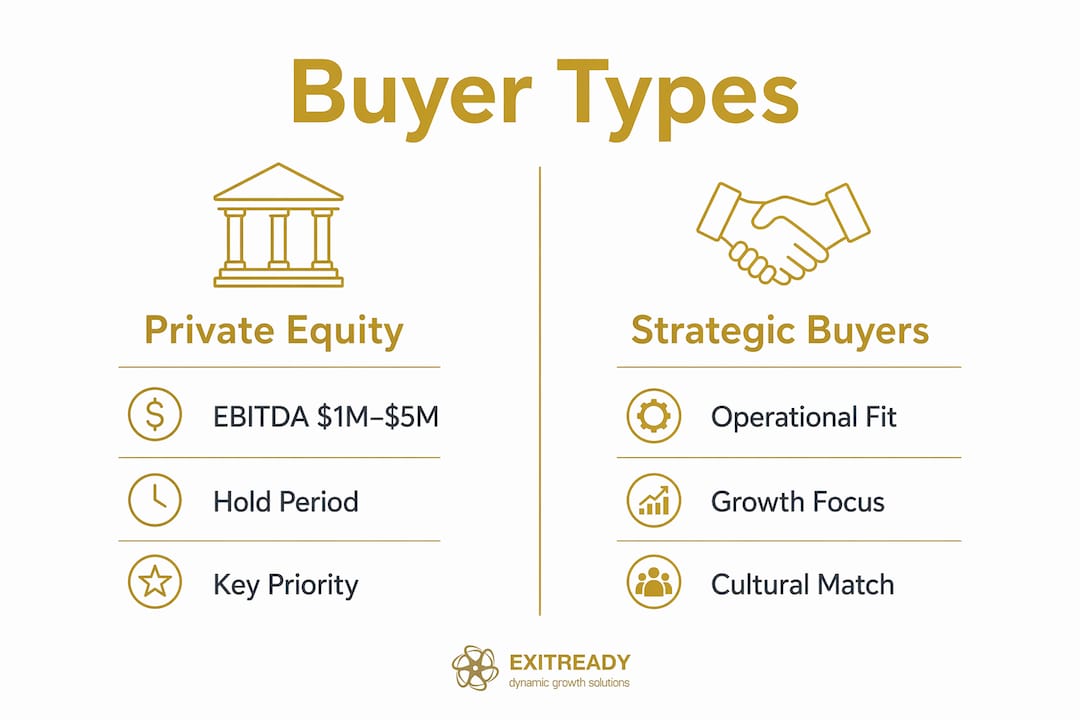
- Private Equity firms: Acquire businesses with strong cash flow and defensible market positions. They provide capital and operational expertise for growth and typically target $1M–$5M EBITDA. They plan to exit again in 4–7 years.
- Search Funds: Individual operators backed by investors who seek one acquisition to run long-term. They represent 25% of active buyers in the lower middle market and favor owner-operated businesses with clear growth potential.
- Family Offices: Invest capital on behalf of wealthy families. They prefer stable, cash-generating businesses and often hold indefinitely, which appeals to sellers who care about legacy.
- Independent Sponsors: Deal-by-deal buyers who raise equity after identifying a target. They move slower than PE firms but can be flexible on deal structure and seller involvement post-close.
- Strategic Buyers: Existing companies acquiring for synergies, market share, or capabilities. They often pay the highest multiples because the acquisition fits directly into their existing operations.
| Buyer type | Typical EBITDA target | Hold period | Key priority |
|---|---|---|---|
| Private Equity | $1M–$5M | 4–7 years | Cash flow, growth potential |
| Search Fund | $500K–$2M | Long-term | Operational takeover |
| Family Office | $1M–$3M | Indefinite | Stability, legacy |
| Independent Sponsor | $1M–$4M | Varies | Deal flexibility |
| Strategic Buyer | Any | Permanent | Synergies, market position |
Cultural and operational fit matters beyond the numbers. A buyer who plans to gut your management team or relocate operations will face resistance from employees and customers. Sellers who screen for post-close intentions early avoid painful surprises during integration. A detailed guide on mid-market buyer archetypes can help you match your business profile to the right buyer category before outreach begins.
What outreach strategies actually work for mid-market deals?
Most mid-market buyers are reached through targeted direct outreach or specialized intermediary networks. Public online marketplaces serve smaller, local deals. Listing a $5M EBITDA business on a general business-for-sale platform is the equivalent of posting a luxury property on Craigslist. The audience is wrong, and confidentiality is nearly impossible to maintain.
The most effective outreach methods for mid-market deals are:
- M&A advisors and investment bankers: They maintain proprietary buyer databases and can run a confidential process that reaches hundreds of qualified parties without exposing your identity prematurely. Their networks are the fastest path to institutional buyers.
- Industry trade groups and professional associations: Buyers actively monitor these communities for acquisition targets. Presenting at industry conferences or publishing in trade publications puts your business in front of strategic buyers who already understand your market.
- Peer networks and CEO roundtables: Other business owners often know buyers or have been approached themselves. A warm introduction from a trusted peer carries more weight than a cold outreach from an advisor.
- Direct outreach to known acquirers: If you know which PE firms or strategics are active in your sector, a targeted letter of introduction through your advisor can open a conversation without triggering a full auction process.
Maintaining competitive tension is the most underrated tactic in mid-market sales. When a buyer knows other parties are evaluating the same business, they move faster and negotiate less aggressively. Running a structured process with multiple simultaneous conversations is how sellers extract full value. The role of experienced advisors in exit transactions is precisely to manage this tension on your behalf.
Pro Tip: Before sharing a confidential information memorandum, require every buyer to sign an NDA and provide proof of funds, a lender pre-qualification letter, or a credible equity commitment. Verifiable financial capacity is the minimum threshold for access to sensitive business data.
Common pitfalls when qualifying mid-market buyers
The most expensive mistake sellers make is treating interest as qualification. A buyer who attends a management presentation, asks detailed questions, and requests financial models is not necessarily a qualified buyer. Without verified financial capacity, they are a distraction.
Buyers often reject businesses for non-financial reasons like owner dependency and poor cultural fit, and they rarely communicate these reasons directly to the seller. The deal simply goes quiet, and the seller never knows why.
This pattern is more common than most owners realize. A buyer may love your financials and still walk away because the business is too dependent on the owner, the management team lacks depth, or the company culture feels misaligned with their operating model. Serious buyers evaluate operational independence and cultural fit as carefully as revenue and margins.
Other common pitfalls include:
- Misaligned timelines: A buyer who wants to close in 18 months while you need to exit in 6 months is not a match, regardless of their financial capacity.
- Ignoring post-close intentions: Buyers who plan to replace management, relocate the business, or pivot the product line create integration risk that affects price and terms.
- Relying solely on passive listings: Waiting for inbound interest from marketplace listings produces low-quality leads and eliminates confidentiality.
- Skipping reference checks: Calling a buyer’s previous acquisition targets reveals how they behave post-close, which is information no pitch deck will provide.
A Mutual Action Plan (MAP) addresses many of these issues by mapping every step of the process with clear owner responsibilities and deadlines. Structured mutual action planning improves win rates by 26% by preventing last-minute surprises and keeping both parties aligned on timeline and deliverables.
Key Takeaways
Finding qualified mid-market buyers requires simultaneous preparation, targeted buyer outreach, and disciplined process management to attract serious acquirers and close at full value.
| Point | Details |
|---|---|
| Financial preparation is the first filter | Three years of clean financials and a QoE report above $2M revenue screen out unqualified parties early. |
| Know your buyer type before outreach | Private Equity leads at 55.3% of active buyers; match your EBITDA and goals to the right buyer category. |
| Advisors outperform marketplaces | Mid-market deals close through intermediary networks and direct outreach, not public listing platforms. |
| Non-financial factors kill deals silently | Owner dependency and cultural misalignment cause buyers to walk without explanation. |
| Structured process creates competitive tension | Running multiple simultaneous buyer conversations produces better terms and faster closes. |
What I’ve learned about finding the right mid-market buyer
The owners who get the best outcomes are not always the ones with the best businesses. They are the ones who treat the sale as a process, not an event. I have seen sellers with strong financials lose deals because they engaged one buyer at a time, gave away leverage, and had no fallback when that buyer retooled their offer at the last minute.
The preparation phase is where most owners underinvest. They clean up the financials but leave the operational story untold. Buyers are buying a future, not a history. They want to see a management team that can execute without the founder, a customer base that is not concentrated in two accounts, and a documented playbook that makes the business transferable. A business exit readiness assessment surfaces these gaps before a buyer does.
The buyer universe construction step surprises most owners. They assume the right buyer will find them. The reality is that the right buyer is probably running a focused acquisition mandate and will never see your business unless someone puts it in front of them directly. Building that list, prioritizing by fit, and reaching out through warm channels is work that takes months, not days.
The uncomfortable truth is that most sellers wait too long to start. By the time they are ready to exit, they are also tired, which makes them susceptible to the first credible offer. Starting the preparation process 18–24 months before your target exit date gives you the time to fix what buyers will find, build competitive tension, and negotiate from strength.
— Andre
Dynamicgrowthsolutions: your path to qualified buyer access
Mid-market owners who work with Dynamicgrowthsolutions enter the market with a documented operational structure, clean financials, and a clear buyer targeting strategy already in place.

Dynamicgrowthsolutions’ AOS (Accelerated Operating System) reduces owner dependency, builds management depth, and positions your business for a premium exit. The firm’s network includes buyers, advisors, and fractional executives who specialize in mid-market transactions. Whether you are 6 months or 2 years from a planned exit, the right time to build your exit-ready business is before a buyer asks the questions you are not prepared to answer. Reach out to Dynamicgrowthsolutions to start with a readiness assessment tailored to your business size and exit goals.
FAQ
What is a qualified buyer in the mid-market?
A qualified buyer is a party with verified financial capacity, a clear acquisition mandate, and a realistic timeline to close. Proof of funds, lender pre-qualification, or a credible equity commitment are the minimum requirements before sharing sensitive business information.
How do mid-market sellers find buyers without going public?
Most mid-market deals are sourced through M&A advisors, investment bankers, and intermediary networks that reach buyers confidentially. Public marketplaces are not effective for deals above $1M in EBITDA.
What EBITDA range attracts the most mid-market buyers?
Buyer demand concentrates in the $1M–$3M EBITDA range, where more than 90% of active mandates focus. Private Equity firms represent 55.3% of active buyers in this segment as of Q2 2026.
Why do buyers pass on financially strong businesses?
Buyers reject businesses for non-financial reasons including owner dependency, poor cultural fit, and weak management depth. These factors are rarely communicated directly, which is why operational preparation matters as much as financial preparation.
How long does it take to attract qualified mid-market buyers?
Building a qualified buyer pipeline typically takes 6–12 months when combined with proper preparation. Owners who start 18–24 months before their target exit date have the most negotiating leverage and the best outcomes.