
A business growth plateau is defined as the point where revenue, pipeline, and profit metrics flatline despite continued operational activity. Mid-market owners hit this wall not because they lack ambition, but because the systems driving growth stop scaling before the business does. To break through a business growth plateau, you need targeted diagnosis, rebuilt unit economics, and a time-boxed execution plan, not another marketing campaign or retention tweak. This guide gives you the exact framework to identify your real constraint, reset your operations, and accelerate company growth with measurable results.
Thank you for reading this post, don't forget to subscribe!How do you diagnose a business growth plateau?
The first mistake most owners make is measuring the wrong things. Organic traffic rising while MQL volume flatlines is a classic funnel break signal, visible 60–90 days before it shows up in revenue. By the time your board asks why pipeline is thin, the problem started three months ago in your qualification criteria or ICP targeting.
The right diagnostic focuses on cash-adjacent metrics, not vanity numbers. Mapping funnel throughput from attention to cash, with segmentation at each stage, reveals the weakest link in your system. Segmentation matters here because averages mask problems. A 40% conversion rate across all leads can hide a 10% rate on your highest-value segment.

Dashboards that show healthy activation and stable customer acquisition cost can still sit on top of flat revenue. That happens when the constraint lives in process handoffs or ownership gaps, not in the metrics you track daily. System throughput is what matters, not local health indicators.
Here is a four-step diagnostic sequence you can run right now:
- Pull qualified pipeline data for the last 90 days. Separate leads by source, segment, and deal size. Look for where conversion drops sharply.
- Map your funnel stage by stage from first touch to cash collected. Identify the single stage with the lowest throughput rate.
- Check decision flow ownership. Ask who is accountable for each handoff. If the answer is “everyone,” the answer is no one.
- Form one falsifiable bet. State clearly: “If we fix X, qualified pipeline will increase by Y within 30–90 days.” This forces precision and creates a testable hypothesis.
Pro Tip: Never run more than one constraint test at a time. Testing two fixes simultaneously makes it impossible to know which one moved the needle.
Why do acquisition economics matter more than retention?
Retention gets most of the attention in growth conversations. The problem is that retention investments pay off only after your first-sale unit economics are solid. CAC is now a structural input cost in 2026, permanently elevated by privacy changes, platform constraints, and weakening cohort quality. You cannot retain your way out of a broken acquisition model.
The payback period is the metric that connects acquisition cost to cash flow capacity. Payback has surpassed 24 months for many mid-market companies. That means you are funding 24 months of operations before a customer becomes profitable. At that rate, growth consumes cash faster than revenue replaces it.
“Retention is a high-ROI investment only after first-sale economics are healthy. Investing in retention before fixing acquisition is like painting a house with a cracked foundation.” — Dynamicgrowthsolutions advisory framework
Here is what broken acquisition economics looks like in practice:
- Rising CAC with flat or declining close rates. You are spending more to win customers who convert less reliably.
- Cohort quality declining over time. Early customers outperform recent ones on LTV, churn, and expansion revenue.
- Payback extending quarter over quarter. Cash flow tightens even as revenue grows, limiting your ability to reinvest.
- Retention metrics look strong but revenue stalls. Existing customers stay, but new customer economics cannot fund the next growth layer.
The fix is to rebuild unit economics before scaling spend. That means auditing your common bottlenecks in business growth at the acquisition layer first, then layering retention programs on top of a repaired foundation.
What does a 30-to-90 day audit and rebuild cycle look like?
A time-boxed reset is the fastest proven path through most growth stalls. The structure is a 30-day diagnostic audit followed by a 60-day rebuild and test sequence. This approach forces focus and creates accountability that open-ended improvement projects never deliver.
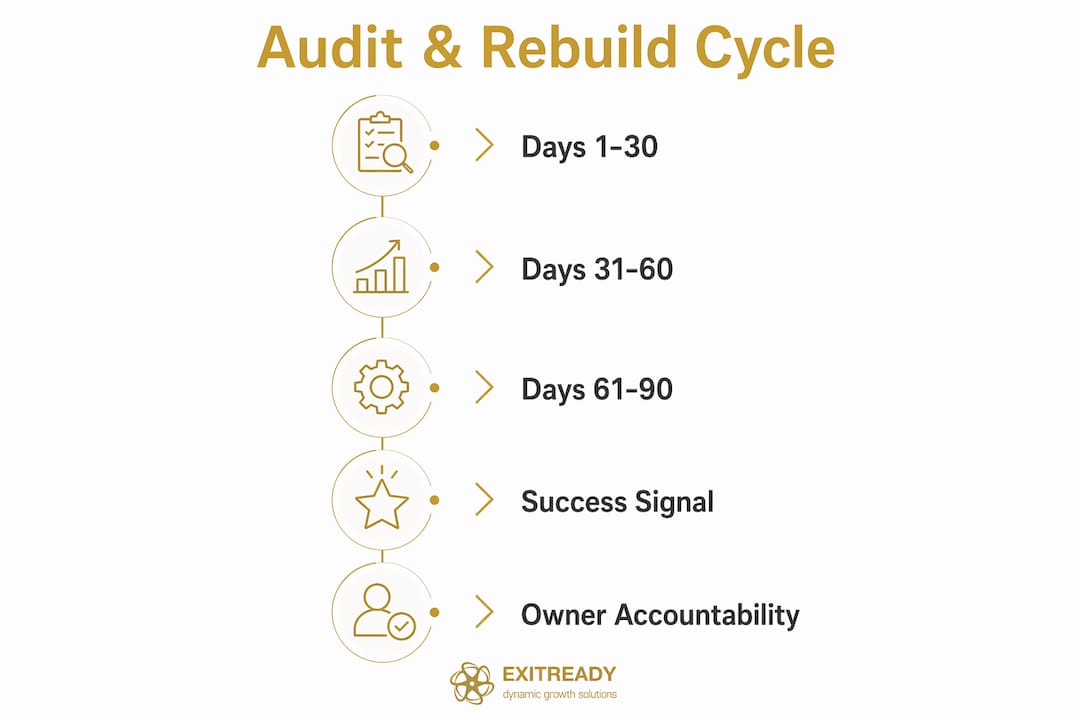
Here is the full cycle broken into three phases:
- Days 1–30: Diagnostic audit. Pull sales data, churn reports, delivery speed metrics, and decision flow maps. Identify the single biggest constraint. Do not try to fix anything yet. Document what you find with specificity.
- Days 31–60: Rebuild phase. Assign clear ownership to each funnel stage. Reset targets based on what the audit revealed. Improve the one system most directly connected to your identified constraint.
- Days 61–90: Test and measure. Run your falsifiable bet. Track leading indicators weekly. At day 90, decide whether to double down, pivot, or move to the next constraint.
| Phase | Focus | Success Signal |
|---|---|---|
| Days 1–30 | Audit sales, churn, decisions | Single constraint identified |
| Days 31–60 | Rebuild ownership and systems | Clear accountability assigned |
| Days 61–90 | Test and measure one fix | Leading indicators move in 30 days |
This cycle works because it separates diagnosis from execution. Most owners skip the audit and jump to fixes, which means they solve the wrong problem faster. The rebuild your business for scalable growth approach at Dynamicgrowthsolutions is built around exactly this cadence.
Pro Tip: Assign one named person to govern the 90-day cycle. Without a single accountable owner tracking weekly progress, the cycle drifts into another forgotten initiative.
How do decision rights affect growth after a plateau?
Organizational structure is where most growth gains get lost after the initial breakthrough. Scaling decision-making requires structured empowerment as informal founder control fragments across operational complexity. The founder who once made every call becomes a bottleneck when the business has 50 people and five revenue streams.
Misaligned ownership of decision rights slows growth by creating disconnected efforts across teams. Marketing optimizes for MQLs. Sales optimizes for close rate. Operations optimizes for delivery speed. No one owns the end-to-end system. The result is each team hitting its local target while the overall funnel underperforms.
The solution requires two structural moves. First, name a single accountable owner for the end-to-end funnel, from first touch to cash collected and renewal. Second, build what HBR calls “bridgers”, people who collaborate across departmental boundaries and translate priorities between teams. Breakthrough innovation scales only when cross-boundary collaboration works. Without bridgers, growth stalls even when the strategy is sound.
Here is how misaligned versus aligned ownership plays out in practice:
| Scenario | Misaligned Ownership | Aligned Ownership |
|---|---|---|
| Lead handoff | Marketing drops MQLs, sales ignores them | One owner defines MQL criteria with both teams |
| Churn response | CS escalates, no one acts | Named owner triggers retention protocol within 48 hours |
| Revenue reporting | Three dashboards, three numbers | One system of record, one weekly review |
The how to scale a mid-market business systematically framework at Dynamicgrowthsolutions addresses this directly by building documented playbooks that replace founder dependency with structured team ownership.
What are the safest ways to scale after breaking through?
Breaking out of slow growth is one challenge. Staying out is another. Most businesses that break through a plateau hit a second one within 18 months because they scale activity before they scale systems. The strategies for business expansion that work long-term share one characteristic: they move the actual constraint, not the metrics around it.
Here is what safe scaling looks like in practice:
- Move the constraint, not the activity. If your constraint is sales capacity, hiring more marketers generates more unworked leads. Fix the constraint directly.
- Shift performance marketing from volume to system redesign. At scale, the job of marketing is not to drive more traffic. It is to improve the quality and fit of what enters the funnel.
- Build cash flow cadence into your financial review. Strategic finance and cash flow forecasting gives you the visibility to know when you can reinvest and when you need to hold. Growth without cash visibility is guesswork.
- Expand into new markets only after your core system is proven. A broken funnel in your primary market becomes a more expensive broken funnel in a new one.
- Use growth signals, not gut feel, to time expansion. The signal to expand is three consecutive quarters of improving unit economics in your current market, not a competitor entering your space.
The owners who sustain growth after overcoming business barriers are the ones who treat their business as a system, not a collection of departments. Every change gets evaluated by one question: does this move the constraint?
What i’ve learned from watching owners hit the same wall twice
The most common pattern I see is owners who diagnose the symptom and treat it as the cause. Revenue is flat, so they hire a new VP of Sales. Pipeline is thin, so they increase ad spend. Churn is rising, so they build a customer success team. None of these moves are wrong in isolation. All of them are wrong when the underlying constraint is something else entirely.
The owners who break through and stay through share one habit: they name a single constraint, test one fix, and measure it with leading indicators before scaling anything. They do not wait for quarterly results to tell them if it worked. They pick a 30-day signal and watch it weekly.
The uncomfortable truth about overcoming growth stagnation is that it usually requires looking at financial data most owners avoid. Payback periods, cohort LTV decay, and CAC trends by channel are not exciting metrics. They are the metrics that tell you whether your growth is real or borrowed. I have seen businesses with impressive revenue growth that were quietly destroying cash because no one was tracking payback. That is not growth. That is a delayed crisis.
Short-term discipline in 30–90 day sequences beats sporadic initiatives every time. The discipline is not about working harder. It is about refusing to move to the next problem before the current one is solved and measured.
Key takeaways
Breaking through a business growth plateau requires constraint-based diagnosis, rebuilt unit economics, and structured ownership, not more activity across the same broken system.
| Point | Details |
|---|---|
| Diagnose before you fix | Map funnel throughput with cash-adjacent metrics before changing any system or team. |
| Rebuild acquisition economics first | Fix CAC and payback period before investing in retention programs or new market expansion. |
| Use a 30–90 day cycle | Run a structured audit, rebuild, and test sequence with one named owner and one falsifiable bet. |
| Align decision rights | Assign end-to-end funnel ownership to one accountable person and build cross-functional bridgers. |
| Scale systems, not activity | Expand only after your core unit economics show three consecutive quarters of improvement. |
How Dynamicgrowthsolutions helps you scale past the plateau
Knowing the framework is step one. Building the system that runs it without you is step two.

Dynamicgrowthsolutions works with mid-market owners to implement the AOS (Accelerated Operating System), a documented operating framework that replaces founder dependency with self-sustaining team ownership. The AOS covers constraint diagnosis, decision rights architecture, and the financial cadence tools you need to increase revenue growth without burning cash. Start with the business operating system for owners overview to see how the system maps to your current stage. Then use the mid-market scalability checklist to identify exactly where your growth is leaking before your next planning cycle.
FAQ
What is a business growth plateau?
A business growth plateau is a period where revenue, profit, and pipeline metrics stop growing despite continued operational effort. It signals that the current system has reached its capacity and requires structural change, not just more activity.
How long does it take to break out of slow growth?
A focused 30–90 day audit and rebuild cycle is the fastest proven path through most growth stalls. Results depend on how quickly you identify and test the primary constraint.
Should i fix retention or acquisition first?
Fix acquisition economics first. Retention investments pay off only after your first-sale unit economics, including CAC and payback period, are solid.
Why do dashboards show growth but revenue stays flat?
Dashboards measure local health metrics, not system throughput. Rising activation with flat revenue typically indicates a hidden constraint in process handoffs or ownership gaps downstream.
What is the single biggest cause of stalled growth in mid-market companies?
Misaligned decision rights and fragmented funnel ownership are the most common structural causes. Naming one accountable owner for the end-to-end system is the highest-leverage fix most mid-market businesses can make immediately.