
The safest way to delegate critical business functions is constrained, auditable, and time-bound authority, never shared logins or open-ended access. You give a named person a specific task, a start and end date, a documented process to follow, and a record of what they did with it. That structure, not the person’s job title or how much you trust them, is what keeps a delegated function from becoming a liability.
Here’s a five-step checklist you can start applying this week:
- Identify the two or three functions where a single point of failure would hurt revenue, compliance, or customer continuity most.
- Scope each delegated task narrowly. Delegate the action, not the entire role.
- Constrain access with time limits, vaulted credentials, and no shared passwords.
- Operationalize with a written SOP, a handover checklist, and a sign-off before anyone touches the live process.
- Verify on a set schedule. Quarterly access attestation at minimum, plus a review any time roles change.
Delegation fails owners not because they picked the wrong person, but because they never built a way to check the work, revoke the access, or prove what happened if something went wrong.
Get that infrastructure right, and delegation stops being a risk you tolerate and starts being the mechanism that makes your business run without you standing over it. That’s also, not coincidentally, exactly what a buyer or investor wants to see during due diligence.
Key Takeaways
Safe delegation depends on constrained, time-bound, and auditable authority backed by documented SOPs and a fixed review cadence, not on trust alone.
| Point | Details |
|---|---|
| Rank before you delegate | Score each function by impact and likelihood of failure before choosing what to hand off. |
| Constrain every grant | Give scoped, time-limited access instead of shared logins or broad role permissions. |
| Document the handover | Require a written SOP, a runbook, and formal sign-off before a delegate takes ownership. |
| Review on a fixed schedule | Run quarterly access attestations plus reviews triggered by role changes or incidents. |
| Build it into a system | Dynamicgrowthsolutions’ AOS packages these controls into ready-made delegation playbooks and audit trails for mid-market owners. |
Table of Contents
- How to Delegate Critical Business Functions Safely: Start by Ranking Them
- Deciding What to Delegate and What to Keep for Yourself
- Building the Controls: Constrained Delegation and Least Privilege
- Turning the Plan Into a Working Playbook
- Keeping Delegated Work Safe Over Time
- Outsourcing vs. Keeping Delegation In-House
- What Delegation Actually Costs and How Long It Takes
- The Failure Patterns That Show Up Again and Again
- What Research and Platform Standards Say About Safe Delegation
- Why I Think Most Owners Get Delegation Backward
- Turn This Framework Into a Working System With AOS
- Sources
How to Delegate Critical Business Functions Safely: Start by Ranking Them
Not every task in your business qualifies as “critical.” A critical business function is one that, if it stopped or failed today, would materially damage revenue, break a compliance obligation, or leave a customer stranded. That’s a much narrower list than most owners think, and getting the list right is the entire foundation of delegating critical operations without creating new exposure.
Six categories cover most mid-market businesses:
- Sales: pipeline management, pricing authority, contract approval thresholds.
- Operations and production: scheduling, quality control, supplier coordination.
- Finance and accounting: payables, receivables, payroll, banking access.
- Customer service: escalation handling, refund authority, account access.
- IT: system administration, credential management, data backups.
- HR: hiring authority, termination process, benefits administration.
The fastest way to prioritize among these is a simple criticality matrix: plot each function by business impact (revenue exposure, SLA penalties, regulatory risk) against likelihood of something going wrong (how often it’s touched, how many hands are on it, how error-prone the current process is). Functions that land high on both axes go first. A payroll error that hits every employee twice a month sits in a very different risk tier than an occasional vendor negotiation.
| Function | Impact if it fails | Likelihood of failure | Delegation priority |
|---|---|---|---|
| Payroll processing | High (legal, morale) | Medium (manual steps) | Immediate, high-control |
| Customer refund approval | Medium (revenue leakage) | Medium (frequent) | Near-term, scoped limits |
| Vendor contract renewal | Medium (cost exposure) | Low (infrequent) | Staged, owner-reviewed |
| Social media posting | Low (brand only) | High (frequent) | Early candidate, low risk |
A quick process map helps surface hidden single points of failure: list each critical process, name who currently owns it, and flag anywhere only one person knows how it works. If your controller is the only one who can run payroll, that’s not a strength. It’s an unaddressed risk sitting in plain sight.
Deciding What to Delegate and What to Keep for Yourself
Once you know which functions matter most, the next question is which pieces of each one are actually safe to hand off. A useful framework weighs four factors: impact if something goes wrong, sensitivity of the data or regulatory exposure involved, how frequently the task recurs, and how reversible a mistake would be.
- Score impact from low to severe, tied to a dollar figure or customer count wherever you can attach one.
- Flag sensitivity separately. Payroll data, health records, and financial account access carry regulatory weight that a social media calendar doesn’t.
- Note frequency. High-frequency tasks compound small errors fast; low-frequency tasks are easier to supervise closely.
- Assess reversibility. A bad email send is fixable. A signed contract or a wire transfer often is not.
Some things should stay with you or a tightly controlled inner circle regardless of how confident you feel in your team. Final approval on strategic pivots, signature authority on contracts above a set dollar threshold, and certain regulatory filings (tax elections, licensing renewals, SEC disclosures if you’re publicly traded) belong in that category. The rationale isn’t distrust. It’s that reversing a mistake in these areas is expensive, slow, or legally impossible, so the cost of a delegation error there outweighs almost any time saved.
A RACI matrix (Responsible, Accountable, Consulted, Informed) keeps this from becoming guesswork. For each critical task, name exactly one person as Accountable, even when several are Responsible for the doing. Ambiguity about who owns the outcome is where delegated functions quietly fall apart.
- Responsible: who does the work.
- Accountable: who answers for the result. One name only.
- Consulted: who needs input before a decision.
- Informed: who needs to know after the fact.
Pro Tip: Stage your delegation from low-risk to high-risk tasks in that order, not the reverse. Start with something reversible and low-stakes, like report generation, before handing over anything touching cash or customer data. You build trust in the system before you test it under real pressure.
Building the Controls: Constrained Delegation and Least Privilege
Constrained delegation means giving someone the narrowest possible slice of authority needed to complete a specific task, not a role that happens to include that task among a dozen other things. The distinction matters more than most owners realize. A bookkeeper who needs to reconcile bank statements doesn’t need wire transfer authority. A customer service rep who needs to issue refunds under $50 doesn’t need access to full account histories going back years. Industry guidance on constrained delegation treats this as the baseline standard: restricted, task-specific authority with a built-in expiration, not indefinite access granted once and forgotten.
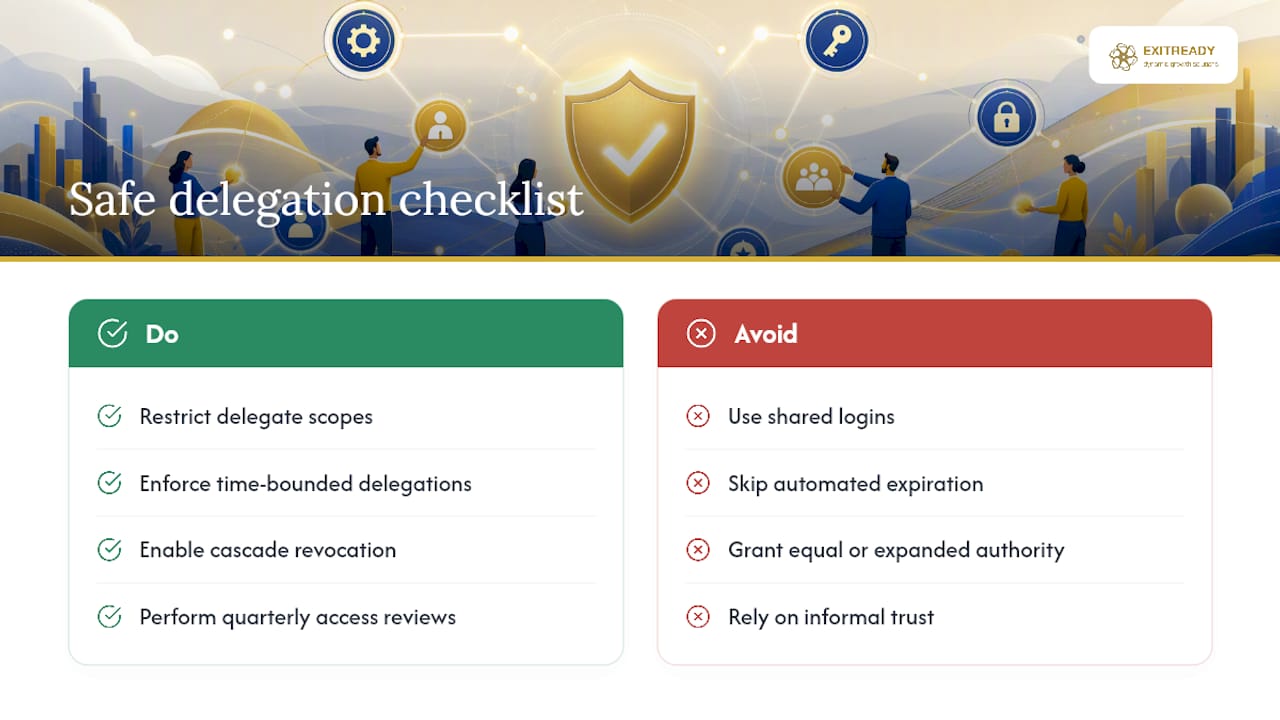
Least privilege is the same idea applied continuously. Every delegated permission should default to the smallest scope that gets the job done, and it should never quietly expand over time. Here’s what enforcing that looks like in practice:
- Set time-limited assignments with automatic expiration, so a vacation cover doesn’t outlive the vacation.
- Use scoped action interfaces, like a specific task form or approval workflow, rather than handing someone raw system access.
- Store credentials in a password vault. Nobody should ever type a shared login into a spreadsheet or a sticky note.
- Keep audit trails on every delegated action: who did what, when, and what changed as a result.
Azure’s role-based access control system is a useful real-world reference point even if you’re not running Azure infrastructure. It lets administrators attach conditions to role assignments so a delegate can only assign permissions within a fenced boundary, never expanding their own reach. The principle translates directly to a non-technical business: build your delegation templates (vacation cover, project handover, supervised onboarding) with the same fenced logic. Specify scope, start and end dates, and what’s explicitly off-limits, every time.
Pro Tip: Before delegating any task involving system access, ask “can this person’s access expand without anyone noticing?” If the answer is yes, you don’t have constrained delegation. You have a permission that’s waiting to become a problem.
Turning the Plan Into a Working Playbook
A control framework only works if the people using it can follow it without calling you every ten minutes. That’s what SOPs and handover playbooks are for, and they’re the single most underrated part of managing delegated responsibilities.
A working handover checklist covers activation steps, a runbook for the actual process, what output is expected and by when, and a formal acceptance sign-off before the delegate takes over live responsibility. Skipping that sign-off step is one of the more common ways delegation goes sideways. Nobody’s actually confirmed the delegate understands the process well enough to be accountable for it.
Training should follow a competency curve, not a single onboarding session:
- First 30 days: shadow the current owner, run the process under supervision, document any gaps in the existing SOP.
- Next 30 days: run the process independently with a review checkpoint after every cycle.
- Final 30 days: full independent ownership, with the original owner stepping back to a spot-check role.
Every SOP needs a single source of truth. A shared drive folder that three people edit differently is not documentation, it’s chaos with a filename. Harvard Business School’s guidance on effective delegation points to the same core discipline: define the outcome clearly, match the task to the right person’s skill level, give them the authority and resources to actually execute, and track progress against the plan rather than assuming it’s fine. Delegation templates for common scenarios, such as vacation cover or a formal project handover, should specify exact scope, dates, and constraints so nobody’s improvising the boundaries mid-task.
Keeping Delegated Work Safe Over Time
Delegation isn’t a project with a finish line. It’s an ongoing system that needs the same maintenance as any other piece of business infrastructure, and the businesses that skip this step are the ones where a delegated function quietly turns into a blind spot.
Track a small set of metrics consistently:
- SLA adherence on delegated tasks (are refunds processed within the promised window?).
- Error rate per delegated function, tracked over time, not just at launch.
- Number of active delegations at any given moment, so nothing gets lost.
- Access attestation completion rate, meaning how many delegates have had their access formally re-confirmed.
A recommended review rhythm combines a fixed schedule with event-driven triggers:
| Review type | Frequency | What it confirms |
|---|---|---|
| Access attestation | Quarterly | Who still has access and whether they still need it |
| SOP accuracy check | Quarterly | Whether the documented process matches actual practice |
| Event-driven review | After role changes, incidents, or new hires | Whether access changed appropriately |
| Full delegation audit | Annually | Complete evidence trail for compliance or exit prep |
An audit should be able to prove three things without a scramble: who acted, what changed, and exactly when. If you can’t answer those three questions from your existing records, your delegation system has a gap regardless of how well it’s performed so far. Store that evidence somewhere durable, not scattered across email threads and memory. This becomes directly relevant if you’re ever preparing for a business exit readiness assessment, where buyers and their advisors will ask exactly these questions about every function you don’t personally run.
- Confirm who currently holds access to each delegated function.
- Cross-check that access against actual job responsibilities.
- Flag and revoke anything that no longer matches.
- Log the review date and outcome for future reference.
Outsourcing vs. Keeping Delegation In-House
Some critical functions are better handled by an outside provider than by stretching internal staff thin. Accounting, IT management, and customer support are the classic candidates, and the U.S. Small Business Administration specifically names these along with manufacturing and research as functions that commonly move outside the business without sacrificing quality, provided the vendor relationship is built correctly from the start.
The vetting process matters as much as the decision to outsource at all. Before signing with any vendor handling a critical function, check for:
- SOC 2 or ISO certification appropriate to their service type.
- References from clients with a similar business size and risk profile.
- Adequate cyber insurance coverage, verified, not just claimed.
- A documented security posture, including how they handle credentials and access.
Your contract needs specific clauses, not boilerplate. Require clear data handling rules, least-privilege access commitments, restrictions on further subcontracting without your approval, a defined breach notification timeline (48 hours is a common standard, though your industry may demand faster), and an explicit right to audit their compliance with the agreement.
- Run a small pilot with the vendor on a lower-stakes piece of the function first.
- Verify their SOP matches your documented process, not just their sales pitch.
- Check performance against agreed KPIs after 30 and 90 days.
- Expand scope only after two consecutive clean review cycles.
Outsourcing accounting typically trades internal headcount cost for a monthly retainer and faster access to specialized expertise, but it also means your financial controls now depend on someone else’s internal security. IT managed services work similarly. Virtual assistants and customer support outsourcing tend to carry lower sensitivity but higher volume, so the controls that matter most there are training consistency and quality benchmarks rather than data security alone. If you want outside leadership support rather than a task-level vendor, a fractional executive or an experienced consulting partner focused on leadership development can bridge the gap while you build internal capability.
What Delegation Actually Costs and How Long It Takes
Owners consistently underestimate the timeline and overestimate the cost of doing this properly, largely because they picture delegation as a single event rather than a staged rollout.
A realistic program runs in three phases. A pilot phase of four to six weeks covers one or two low-risk functions, with tight supervision and daily or weekly check-ins. An expansion phase of two to three months layers in additional functions once the pilot’s controls have proven out, typically with a lighter review cadence. An audit phase, ongoing from that point forward, confirms the system holds up under the quarterly review rhythm described earlier.
The main cost drivers aren’t what most owners expect:
- Tooling: a password vault, an access management system, or workflow software to enforce scoped permissions.
- Training time: the 30/60/90 competency curve isn’t free, even when it’s internal staff learning a new responsibility.
- Vendor fees: if any portion of the delegation is outsourced, factor in setup costs beyond the ongoing retainer.
- Internal change management: the hours you and your leadership team spend documenting SOPs and running review meetings.
- Audit or consulting support: bringing in outside expertise to validate the control framework before it’s tested by a real incident.
Pro Tip: Budget your first delegation pilot around a 30/60/90 structure and measure ROI in hours regained for you or your leadership team, not just dollars spent. If delegating one function frees up ten hours a month of owner time, that’s the number that tells you whether the program is working, not the invoice from your bookkeeping vendor.
The Failure Patterns That Show Up Again and Again
Most delegation failures trace back to a small handful of repeat offenders, and they’re worth knowing by name so you catch them before they cause damage.
Watch for these red flags, roughly in order of how often they cause real harm:
- Stale delegations: access nobody remembers granting, tied to a role that changed or a person who left.
- Shared credentials: the single fastest way to lose any ability to audit who did what.
- Missing audit trails: if you can’t reconstruct an action after the fact, you don’t have a control, you have a hope.
- Privilege creep: small permission additions over time that nobody re-evaluates as a whole.
- Surprise sub-delegation: a delegate quietly handing their access to someone else without approval.
The failure modes get concrete fast. An overprovisioned virtual assistant given broad email access to “help with scheduling” can become an accidental backdoor into sensitive client correspondence nobody meant to expose. A manager who changes roles internally but keeps the system access from their old position is a walking privilege-creep case study, and it happens in nearly every mid-market company that doesn’t run structured access reviews.
When a delegated process does fail or access gets misused, speed and clarity matter more than perfection:
- Contain: revoke the access or authority in question immediately, without waiting for a full investigation.
- Investigate: pull the audit trail to establish exactly what happened and when.
- Communicate: notify affected stakeholders, customers, or regulators according to whatever timeline your contracts or compliance obligations require.
- Remediate: fix the underlying gap in the delegation model, not just the immediate symptom.
- Document: record the incident and the fix for your next audit cycle.
What Research and Platform Standards Say About Safe Delegation
The push toward constrained, auditable delegation isn’t a mid-market invention. It’s become the default architecture across enterprise identity and access management, and the reasoning behind it applies just as directly to a 40-person business as it does to a Fortune 500 IT department.
The core principle showing up across platform documentation and governance frameworks is monotonic scope narrowing: every delegate down a chain receives a strict subset of the authority above them, never an equal or expanded version of it. Microsoft’s agent governance guidance frames this using delegation depth limits and cascade revocation, meaning if you revoke the person at the top of a delegation chain, everyone downstream loses access automatically rather than retaining orphaned permissions.
That same governance model applies to how authorization platforms structure delegation relationships generally. Keymate’s delegation model documentation describes delegation as an explicit, auditable relationship with a defined scope, a validity period, specific constraints, and an evaluation-time check that automatically blocks expired or revoked delegations from authorizing anything further. That last detail matters: the enforcement happens at the moment of use, not just at the moment of granting access, which closes the gap where a revoked delegate could still act on outdated permissions.
Automated expiration is the detail owners most often skip when they build delegation manually. Without it, delegated access accumulates over years until nobody can say with confidence who has access to what or why. A quarterly review cadence combined with automatic time-bounding, as governance frameworks recommend, is what prevents that slow accumulation from becoming an audit nightmare or, worse, a security incident.
For mid-market owners thinking ahead to a sale, this isn’t abstract. A buyer’s due diligence team will ask who has access to what, how that access is documented, and how you’d prove it if challenged. A business running on constrained, time-bound, auditable delegation walks into that conversation with answers ready. One built on shared logins and informal trust walks in with a liability.
Why I Think Most Owners Get Delegation Backward
Most delegation advice tells owners to focus on finding the right person. Hire well, trust your team, let go of control. That’s not wrong, exactly, but it skips the part that actually determines whether delegation succeeds: the system the person operates inside, not the person themselves.
I’ve watched the same pattern play out across mid-market businesses building toward an exit or a major transformation: an owner delegates a function to someone genuinely capable, skips the documentation and the access controls because “they know what they’re doing,” and then discovers eighteen months later that nobody, including the delegate, can explain exactly how the process runs or who else has quietly gotten access to it along the way. The person wasn’t the problem. The absence of a scoped, auditable structure around them was.
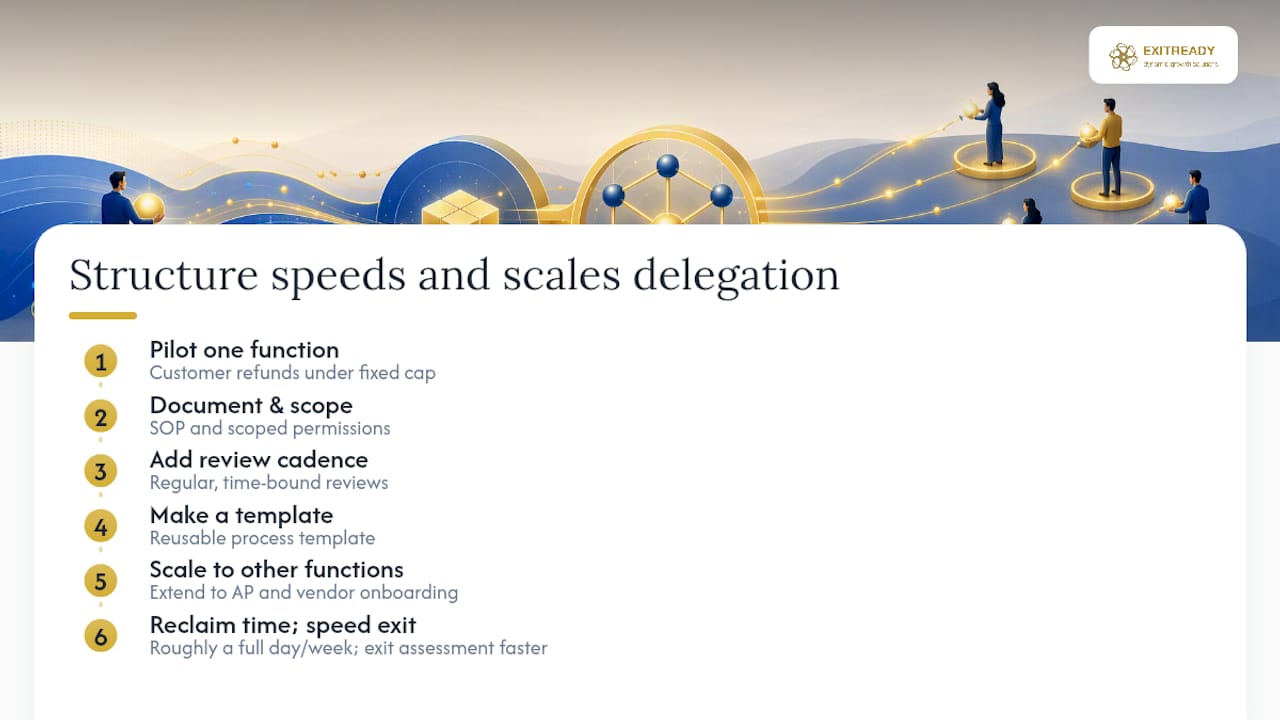
Here’s the part that surprises owners the most: building that structure doesn’t slow delegation down, it speeds it up. Once you have a documented SOP, a scoped permission set, and a review cadence in place for one function, replicating that pattern for the next function takes a fraction of the time. One mid-market client I’ve seen work through this staged approach started with a single low-risk pilot, customer refund approvals under a fixed dollar threshold, fully documented and time-bound. Within two quarters, the same template extended to accounts payable and vendor onboarding, and the owner recovered roughly a full day a week that used to go to answering questions his team should have been able to answer themselves. That time didn’t just go back into growth work. It went into the kind of audit-ready documentation that made his eventual exit readiness assessment go faster than he expected.
The uncomfortable truth is that owner-dependency and weak delegation controls are usually the same problem wearing different clothes. You can’t build operational independence on trust alone, and you can’t build it on rigid control alone either. It takes both: real authority handed off, inside a structure narrow and documented enough that handing it off doesn’t feel like a gamble.
Turn This Framework Into a Working System With AOS
Everything covered here, the criticality matrix, the RACI templates, the constrained access controls, the review cadence, is exactly what Dynamicgrowthsolutions builds into the Accelerated Operating System (AOS) so you’re not assembling it from scratch on your own. Where most owners spend months piecing together SOPs, access templates, and audit logs in isolation, AOS gives you delegation playbooks and audit-ready documentation already structured around the same auditable, time-bound principles this article walks through, backed by a review cadence built into the program rather than left to memory.

The practical starting point is a Business Operating System assessment that maps your current critical functions against the same impact-and-likelihood framework covered above, then shows you exactly where owner dependency is highest and where a staged delegation pilot would return the most time. From there, Dynamicgrowthsolutions works alongside your leadership team to build the SOPs, the access controls, and the documented evidence trail that make delegated functions defensible, whether you’re preparing for a growth phase or an eventual exit. If you’re ready to see where your business stands, start with the transformation program overview and request an assessment this week.
Sources
- Constrained delegation and safe delegation patterns — Cayosoft
- Delegate role assignments overview — Microsoft Learn (Azure RBAC)
- Delegation chains and monotonic scope narrowing — Microsoft Agent Governance Toolkit (GitHub)
- Delegation model — Keymate Documentation
Use these alongside your own SOP library and audit records when you’re building out a delegation checklist or preparing documentation for a compliance review or exit process.