

A service delivery SLA is a formal agreement that sets measurable commitments and shared responsibilities for a delivered service. It defines what “good” looks like in numbers, not adjectives. An SLO is the specific target inside that agreement (say, 99.9% uptime), and an SLI is the measured value that tells you whether you hit it. The real value of an SLA isn’t the penalty clause. It’s the transparency that stops disputes before they start.
TL;DR:
- Most organizations select a single SLA template for all relationships, increasing the risk of ambiguity and misalignment in expectations.
- Accurate SLA measurement depends on clearly defined scope, measurement windows, exclusions, and precise KPIs written into the contract.
- Combining real-time telemetry with periodic reports and explicit measurement ownership reduces disputes and improves proof of breaches.
- Effective remedies require tiered service credits, clear escalation processes, and narrowly drafted exclusion clauses to maintain enforceability.
- Embedding SLA governance into operational playbooks ensures performance standards persist through staff changes and support long-term operational independence.
Table of Contents
- Types of Service Delivery SLAs You’ll Actually Use
- The Core Components Every SLA Needs on Paper
- How to Measure What the SLA Actually Promises
- Monitoring, Reporting, and Proving a Breach Happened
- Making SLA Remedies Actually Enforceable
- A Practical Checklist for Drafting Your SLA
- Best Practices and the Pitfalls That Sink Good SLAs
- Examples of SLA Failures and What They Teach
- Why SLAs Shape Customer Trust More Than Anyone Admits
- How SLA Discipline Builds Operational Independence
- Turn SLA Discipline Into an Operating System
- Where to Verify the Standards Behind This Guide
- Sources
- FAQ
Types of Service Delivery SLAs You’ll Actually Use
Most organizations default to one SLA template and stretch it over every relationship, which is how ambiguity creeps in. Three standard categories cover almost every real scenario, and picking the wrong one is a common source of friction later.
- Customer-level SLAs apply to a single client relationship, covering every service that client receives under one negotiated agreement. Common in enterprise B2B contracts where one account manager owns the whole relationship.
- Service-level SLAs apply to one specific service across all customers who use it. A cloud hosting provider might run one uptime SLA for every tenant on a shared platform.
- Multilevel SLAs stack corporate, customer, and service tiers so a large organization can set baseline standards while still customizing terms for individual accounts or business units.
Internal SLAs deserve separate attention because they don’t involve a paying customer at all. They set expectations, timelines, and responsibilities between internal teams, like IT promising a four hour response to a finance ticket. The upside is flexibility. The downside is enforcement: without external contract pressure, internal SLAs often quietly erode unless leadership actually reviews compliance. External SLAs carry legal and financial weight, which forces discipline internal ones rarely get without a push.
The Core Components Every SLA Needs on Paper
A vague SLA is worse than no SLA, because it creates a false sense of protection. Every service delivery agreement needs the same structural backbone regardless of industry.
- Scope and service description. State exactly what’s covered and, just as important, what’s excluded. A logistics SLA covering “delivery time” needs to specify whether that clock starts at order confirmation or at warehouse dispatch.
- Roles, responsibilities, and escalation contacts. Name who owns the metric, who gets notified on a miss, and who has authority to invoke remedies.
- SLOs and SLIs with precise definitions. “99% availability” means nothing without a measurement window, a formula, and a stated exclusion list for planned maintenance.
- Exclusions and measurement windows. Force majeure events, scheduled downtime, and third-party outages typically sit outside the calculation. Say so explicitly.
- Reporting cadence and change control. Define how often performance gets reported and what process amends the agreement when business needs shift.
Skipping any one of these turns the SLA into a document nobody can actually enforce, because well-defined SLAs force organizations to examine their own processes and tooling long before a dispute ever reaches escalation.
How to Measure What the SLA Actually Promises
Here’s where most SLAs quietly fall apart: the percentage on the cover page rarely matches what actually gets counted. A vendor advertising a very high availability percentage often termed ‘five nines’ sounds airtight, but that number is meaningless without knowing the measurement window and what counts as an outage. A five-minute outage measured over a month looks disastrous. The same five minutes measured over a year barely registers.
Two measurement philosophies produce very different real-world outcomes:
- Time-based measurement tracks the percentage of a period a service was available, regardless of how many requests hit it. Good for infrastructure and hosting SLAs.
- Request-based measurement tracks the percentage of individual requests that succeeded within threshold. Better for APIs and transaction-heavy services where volume spikes matter more than clock time.
Configuration choices reshape what even counts as a breach. SLA applicability often hinges on aggregation scope and retry behavior, meaning a provider’s SLA might only apply if you deployed across multiple availability zones or if your client retried a failed call within a defined window. Skip those conditions and the “guarantee” simply doesn’t apply to your setup. This is precisely why reading the fine print on exclusions and aggregation rules matters more than comparing headline percentages between competing vendors.
Practical KPIs worth defining explicitly include first response time, resolution time, order-to-delivery cycle time, and error/defect rate. Whichever you choose, write the exact formula into the contract, not just the target.
Monitoring, Reporting, and Proving a Breach Happened
Detecting an SLA miss and proving it are two different jobs, and companies that only build for the first one struggle when a dispute actually lands. The strongest setups run two parallel tracks: real-time dashboards for operational visibility, and periodic (monthly or quarterly) formal reports for contractual record-keeping.
- Real-time telemetry catches problems as they happen, so ops teams can react before a breach compounds.
- Periodic reports create the paper trail both parties reference when a credit claim gets disputed.
- Someone on each side needs explicit ownership of measurement, not a shared assumption that “IT handles it.”
- Incident logs, timestamps, and root-cause notes should get captured the moment an issue is detected, not reconstructed weeks later from memory.
- Claims typically carry a submission deadline. Missing it can forfeit an otherwise valid credit.
Pro Tip: Store the exact query or formula used to calculate uptime, whether it’s a SQL script or an API call, in a shared annex both parties can access. That single step eliminates most measurement disputes, because neither side has to trust the other’s math.
Automation earns its keep here. Machine-readable telemetry feeding directly into a compliance dashboard removes the manual reconciliation that turns a five-minute check into a two-day argument. A framework like the Growth Readiness Score Card can help operators see where their current metrics tracking has gaps before those gaps become disputed claims.
Making SLA Remedies Actually Enforceable
Most service credit clauses look reasonable on paper and fail the first time they’re tested. The fix is precision, not stricter penalties.
- Service credits should scale with severity. A tiered structure (small credit at 99.5%, larger credit below 99%) holds up better than a single all-or-nothing threshold.
- Earn-back provisions let a provider recover standing after a period of clean performance, which keeps long-term relationships from souring over one bad month.
- Escalation ladders define exactly what happens after the second or third consecutive miss: a formal review, an executive call, then a termination trigger.
- Termination rights need a clear, objective breach count, not a subjective “material failure” standard that invites argument.
- Exclusions must be written narrowly and specifically. Broad exclusion language is what turns a legitimate credit claim into a legal fight.
A Practical Checklist for Drafting Your SLA
Building an SLA from scratch goes faster with a sequence, not a blank page.
- Run a stakeholder workshop. Get operations, legal, and the customer-facing team in one room to agree on risk tolerance before anyone drafts language.
- Choose metrics and define measurement. Pick two or three KPIs that actually reflect the customer experience, not just what’s easiest to log.
- Select monitoring tools. Match tooling to the metric. Not every service needs a full observability stack.
- Set reporting cadence and escalation path. Decide who sees what report, how often, and what triggers a formal review.
- Draft governance annexes for multi-provider chains. If more than one vendor touches the service, spell out coordination rules now, not after the first finger-pointing incident.
- Run acceptance testing before go-live. Confirm the measurement formula produces the number both sides expect, using real data.
- Schedule a review date. Treat the SLA as a living document, not a one-time contract, since business requirements and technical baselines shift faster than most agreements get updated.
Pro Tip: Reference ETSI’s guidance on measurable QoS indicators when you’re stuck on how granular a metric should be. Industry templates favor simple, verifiable indicators over complex composite scores precisely because complexity is what breaks down under dispute.
Best Practices and the Pitfalls That Sink Good SLAs
A few habits separate SLAs that hold up from ones that collapse under real-world pressure.
- Read the definitions section before you read the percentage. That’s where the actual coverage lives.
- Confirm the measurement method matches your usage pattern, not the vendor’s default configuration.
- Hold providers accountable only for metrics they genuinely control. Penalizing a vendor for an upstream carrier’s outage without a back-to-back clause just breeds resentment and non-payment disputes.
- Automate evidence collection wherever possible. Manual log-pulling under deadline pressure is how errors creep into claims.
- Build in a scheduled review, quarterly or semiannual, so the agreement evolves with the business instead of becoming outdated the moment conditions change.
Examples of SLA Failures and What They Teach
The most common SLA failure isn’t a missed target. It’s a target nobody defined precisely enough to enforce. A logistics provider promising “next-day delivery” without specifying a cutoff time for order placement will inevitably clash with a customer who orders at 4:59 PM and expects the clock to start immediately. Both sides read the same sentence and walked away with opposite expectations.
Cloud and IT services show a related pattern: a customer discovers, only after an outage, that the provider’s uptime guarantee excluded a category of failure they assumed was covered. This is exactly why SLA applicability rules around retries, redundancy configuration, and aggregation windows need reading before signature, not after an incident.
A third recurring failure sits in multi-provider chains. When three vendors touch one delivery process and something breaks, each one points to the next, and the customer gets nothing resolved for weeks. The lesson every one of these failures teaches is the same: ambiguity is the actual root cause, almost never bad faith. Tighter definitions, explicit exclusions, and a named accountable party at each handoff point prevent nearly all of them.
Why SLAs Shape Customer Trust More Than Anyone Admits
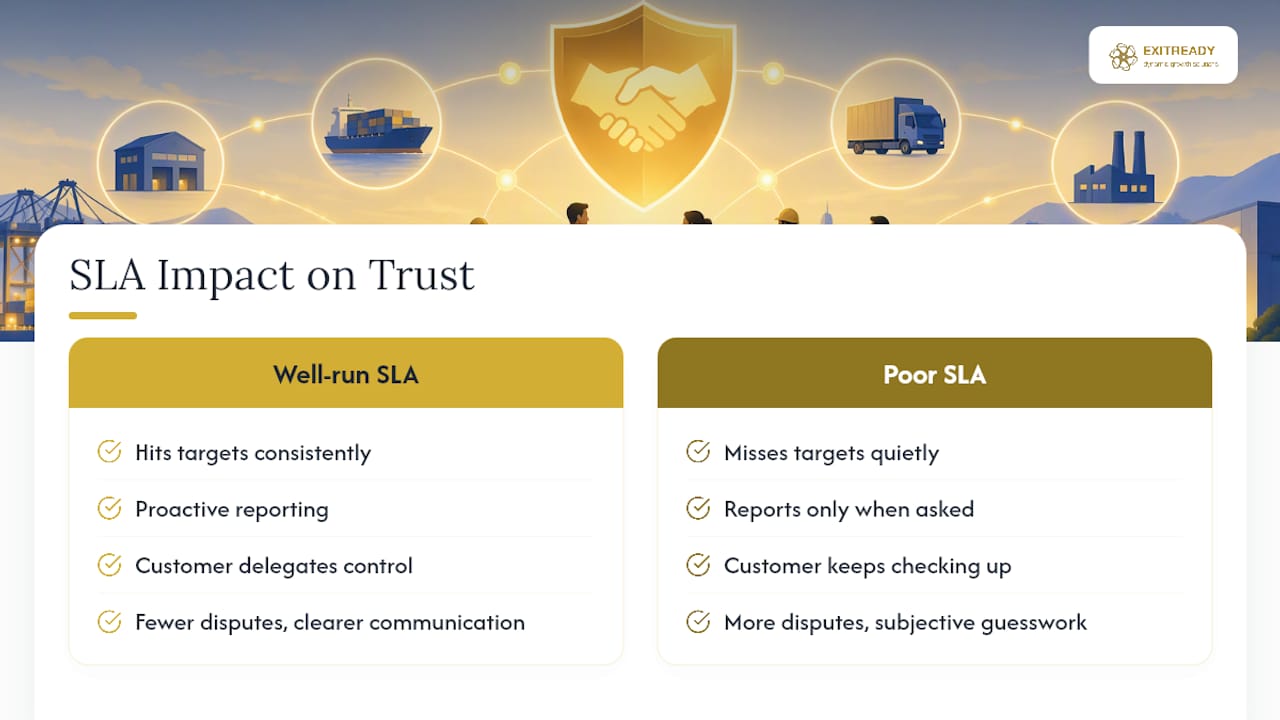
A well-run SLA does something subtler than avoid penalties: it changes how the customer relationship feels day to day. When a provider hits its numbers consistently and reports on them proactively, customers stop checking up and start delegating. That shift, from oversight to trust, is worth more to a long-term contract than any single service credit.
The opposite is just as visible. A provider that misses targets quietly, or only reports performance when asked, trains the customer to distrust every future claim, even the accurate ones. SLAs that are well-written and consistently honored reduce disputes and improve communication precisely because they remove the guesswork from an otherwise subjective relationship. Renewal conversations get shorter. Escalations get rarer. And when something does go wrong, a track record of transparent reporting means the customer assumes good faith instead of pattern of failure.
How SLA Discipline Builds Operational Independence
Documented SLAs do more than manage vendors. They force a business to define what “good service” means without relying on the owner’s judgment call. That standardization is exactly what reduces owner dependency and makes operations transferable to a team, or attractive to a buyer.
SLA governance maps directly onto the playbooks that make a company exit-ready: clear metrics, named accountability, and a review cadence that runs without founder involvement. Buyers pay more for businesses that already prove they run this way.
— Andre
Turn SLA Discipline Into an Operating System
Most mid-market companies have an SLA on file somewhere. Few have one that’s actually monitored, enforced, and tied to how the whole business runs. That gap is where Dynamicgrowthsolutions works differently: instead of handing you a template, we build SLA governance directly into your documented operating playbooks so performance standards survive staff turnover and don’t depend on you personally chasing metrics.

The Enterprise Assessment maps where your current service metrics and accountability structures have gaps, using the same AOS framework behind our broader value creation work. From there, a Growth Sprint or Performance Sprint turns those findings into an operational playbook your team can run without you in the room. If you’re managing multiple vendors or business units and need SLA governance that actually holds up under review, book a diagnostic conversation and see where your current setup stands before your next contract renewal or business review.
Where to Verify the Standards Behind This Guide
For deeper technical grounding, review the ISO/IEC 19086-1 cloud SLA framework, Microsoft’s Azure reliability documentation on SLA applicability, and the FACIS SLA Governance Framework Playbook for multi-provider governance models. Facilities and contractor-heavy operations may also find this guide to managing cleaning contractors useful for applying these principles outside IT.
Sources
- Keeping your word on support SLAs — Zendesk blog
- Service level agreements | Microsoft Learn
- ISO/IEC 19086-1:2016 — Service level agreement (SLA) framework
FAQ
What Is an SLA in Delivery?
An SLA in delivery is a formal agreement defining the measurable commitments a provider makes about how a service gets delivered, including timelines, quality standards, and what happens when those commitments aren’t met. It typically covers scope, metrics, responsibilities, and remedies like service credits for non-compliance.
What Are the Three Types of SLAs?
The three standard types are customer-level (covering all services for one client), service-level (covering one service across all customers), and multilevel SLAs that combine both into tiered agreements. Each fits a different contractual structure depending on how many clients and services a provider manages.
What Does a 3-Day SLA Mean?
A 3-day SLA typically means a provider commits to completing a specific action, like resolving a support ticket or fulfilling an order, within three business or calendar days of the trigger event. The exact meaning depends entirely on how the agreement defines the starting clock and whether weekends or holidays count.
What Does SLA Stand For in ServiceNow?
In ServiceNow, SLA stands for Service Level Agreement, referring to the platform’s built-in tracking of response and resolution timers against defined targets for IT service management workflows. The system flags breaches automatically once a ticket exceeds its configured SLA definition.
How Do I Know if My Current SLAs Are Actually Effective?
Effective SLAs get monitored continuously, reported on consistently, and reviewed on a set schedule rather than left untouched after signing. A diagnostic like Dynamicgrowthsolutions’ Growth Readiness Score Card can help surface whether your current metrics and governance structure would hold up under real scrutiny.