
A management system audit is a structured review of the operating system running your business — your documented processes, delegation structure, KPIs, and financial controls — designed to find where value is trapped in founder-dependent work. If you’re planning to scale or sell within the next few years, the right move is to run a readiness survey or book a focused five-day audit within the next 90 days, not wait for a buyer or a crisis to force the question.
TL;DR:
- A management system audit should prioritize high-impact revenue processes, such as fulfillment or onboarding, rather than trying to review every department at once.
- Conducting a five-day focused audit is suitable when quick insights are needed, while a 30 to 90-day comprehensive review suits companies rebuilding management depth or preparing for sale.
- The audit process involves securing executive sponsorship, collecting evidence, mapping workflows, and assigning specific owners with deadlines for each identified issue.
- Deliverables include a concise findings summary, impact quantification, process maps, and a clear 90-day action plan with accountable owners.
- Post-audit follow-up is crucial, requiring regular progress reviews and re-scoring to ensure corrective actions translate into real operational improvements.
Table of Contents
- What Does a Management System Audit Actually Review?
- Why Run This Audit Now Instead of Later?
- Fast Diagnostic or Full Audit: Which Timeline Fits?
- How Do You Run a Management System Audit Step by Step?
- What Should the Audit Deliver, and What Do the Numbers Mean?
- Should You Run the Audit Internally or Bring in a Consultant?
- What Happens After the Audit Ends?
- What Pitfalls Derail a Management System Audit?
- Author perspective: make audits a rhythm, not an event
- Dynamic Growth Solutions: Your Next Move on Readiness
- Selected Further Reading and Primary Sources
- Sources
- FAQ
What Does a Management System Audit Actually Review?
An audit worth commissioning looks at four domains, and most owners are surprised by which one turns up the worst news.
- Documented SOPs versus reality. Almost every mid-market company has some written procedures. Far far fewer have procedures that match what actually happens on the floor or in the CRM. Auditors flag this “reality gap” first because it’s the fastest predictor of chaos during a leadership transition.
- Delegation and management depth. This is where single-point-of-failure risk lives. If three key decisions a week require your signature, that’s not a management style, it’s a valuation discount waiting to be discovered by a buyer’s diligence team.
- KPI quality and financial reporting. Vanity metrics get replaced with numbers a lender or acquirer would actually trust: gross margin by service line, customer concentration, cash conversion cycle.
- Technology, vendor contracts, and baseline compliance. Auditors check whether your data lives in systems your team can access without you, and whether vendor agreements would survive a change of ownership.
Documented systems and accountability structures are the backbone auditors are actually testing, not just paperwork for paperwork’s sake.
Why Run This Audit Now Instead of Later?
Buyers evaluate operations across five categories. Process documentation, organizational depth, technology, financial controls, and compliance often shape their confidence more than the revenue line does, according to Icon Business Advisors. Weak scores in any of those areas give a buyer leverage to cut price or slow the deal down. That’s the valuation case. The operational case is just as real: companies with documented, delegated systems see fewer 2 a.m. fire drills, faster onboarding for new hires, and delivery that does not wobble every time you take a week off.
Timing matters here. If you’re three years or more from an exit, treat this as a rebuild. If you’re inside 12 months, a fast diagnostic sprint is the better use of time and money.
Statistic callout: Growing companies commonly lose 15 to 30 percent of operational capacity to untracked inefficiencies. A management system audit exists specifically to find that lost capacity and put a number next to it.
Fast Diagnostic or Full Audit: Which Timeline Fits?
Scope should match your timeline and your appetite for disruption, not the other way around.
- The five-day focused audit covers 3 to 5 revenue-critical processes. A structured five-day format runs kickoff and scoping on day one, mapping and interviews on days two and three, analysis on day four, and a delivered 90-day action plan with named owners on day five. This is the right call when you need answers fast or want a low-risk pilot before committing to more.
- The 30 to 90 day comprehensive audit maps every core workflow, not just the loudest ones, and includes remediation planning and change management support. This is the format for owners rebuilding management depth or preparing for a sale more than a year out.
- Deliverables scale with scope. A five-day audit typically produces a scorecard and a prioritized 90-day plan. A comprehensive audit adds full process maps, an ownership matrix, and gap-to-dollars quantification across every function, not just the ones you already suspected were broken.
Start scoping with whatever workflow touches revenue most directly. Fixing a broken fulfillment process matters more, dollar for dollar, than polishing an HR manual nobody reads.
How Do You Run a Management System Audit Step by Step?
Whether you commission this externally or attempt it internally first, the sequence doesn’t change.
- Secure executive sponsorship. Someone with authority to approve changes needs to own this before day one, along with a defined timeline and success metrics.
- Pick 3 to 5 priority processes. Order fulfillment, client onboarding, and accounts receivable are common starting points. Name the stakeholders for each before you start interviewing anyone.
- Collect the evidence. Pull existing SOPs, the org chart, KPI dashboards, vendor contracts, and financial statements before a single interview happens.
- Map the actual workflow. Interview the people doing the work, not just their managers, and quantify what you find: hours lost, error rates, lead time between steps.
- Build the 90-day roadmap. Every fix gets a named owner and a due date. A plan with no owner is a wish list, not a roadmap.
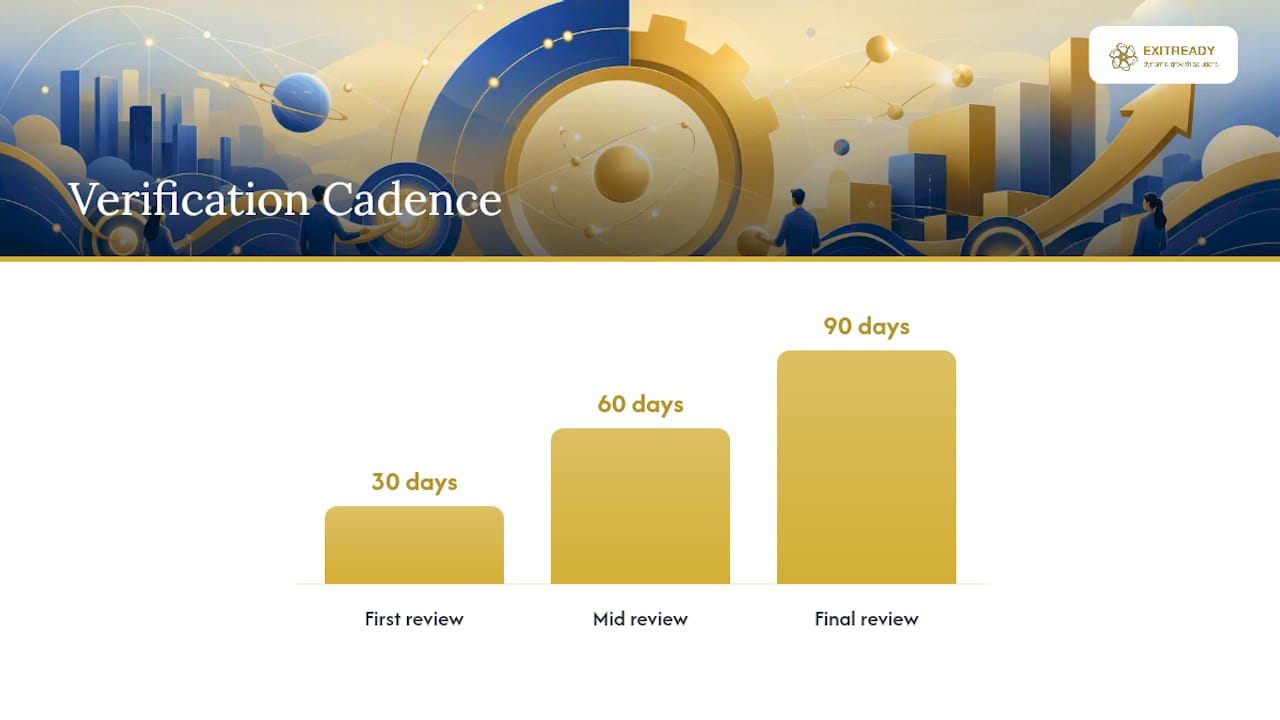
- Set a verification cadence. Review progress at 30, 60, and 90 days against the success criteria you defined in step one.
Readiness surveys work best when findings convert into sequenced, owner-assigned action steps with dependencies and dates attached, not a static report that sits in a shared drive.
Pro Tip: Interview the person actually doing the task, not the manager who thinks they know how it’s done. The gap between the two is usually where the real inefficiency hides.
What Should the Audit Deliver, and What Do the Numbers Mean?
A credible audit hands you more than a narrative report. Expect:
- An executive findings summary that fits on one slide, not twenty.
- A quantified impact table showing hours, dollars, or error rates tied to each gap.
- A prioritized 90-day plan with named owners and dates.
- Process maps for the workflows reviewed.
- An ownership matrix showing who’s accountable for what going forward.
Gap-to-dollars figures come from weighted scoring across diligence categories, mapped to estimated valuation impact. Weighted readiness assessments that score above 8 out of 10 are often considered close to sale-ready, though the exact multiple impact depends heavily on your industry and deal structure, so treat any dollar estimate as directional rather than a guarantee. Post-audit, track cycle time, SLA adherence, error rate, and owner hours reclaimed. Reclaiming hours is the metric owners underrate most; it’s the one that tells you delegation is actually working.
Should You Run the Audit Internally or Bring in a Consultant?
Internal audits build institutional capacity and cost less upfront, and they make sense when you have someone credible enough to challenge existing habits without political fallout. External audits earn faster buy-in from a future buyer, who will trust a third-party assessment more than a self-graded report, and they move faster because outside eyes don’t inherit your blind spots.
If you’re evaluating an external provider, ask pointed questions:
- Can they show a sample deliverable, not just a sales deck?
- Who owns implementation after the findings land, them or your team?
- Do they commit to specific KPI targets, or just “improvement”?
- Can they name references from businesses your size?
Vague deliverables and no named owners in the proposal are the two biggest red flags. A certification tied to a documented operating system, the kind buyers can verify rather than take on faith, signals readiness in a way a generic consulting engagement doesn’t.
What Happens After the Audit Ends?
The audit report is the easy part. Most corrective-action plans fail not because the findings were wrong, but because nobody built a mechanism to check whether the fixes actually happened.
Assign every finding a single accountable owner, not a department. “Operations” doesn’t fix anything; a named person with a due date does. Build a short recurring check-in, weekly for the first month, then biweekly, where owners report status against the 90-day plan rather than waiting for a big reveal at the end.
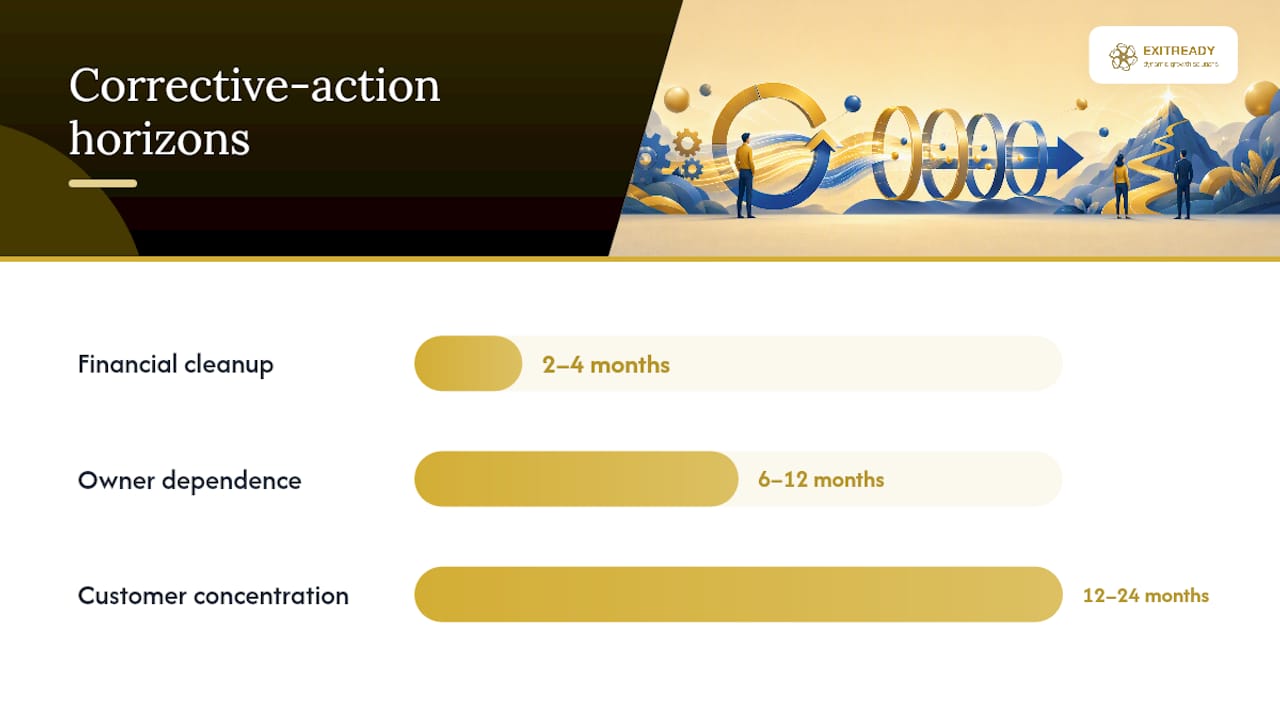
Timelines vary by category, and this matters for setting expectations with your team. Financial cleanup issues can often be resolved in 60 to 120 days with focused CFO support. Reducing owner dependence typically takes 6 to 12 months, because it requires actual skill transfer, not just a memo reassigning tasks. Cutting customer concentration risk can take 12 to 24 months, since it depends on new business development, not internal process changes.
Re-score the same categories at 90 days using the same criteria from the original audit. If a finding hasn’t moved, ask why before adding new initiatives on top of unresolved ones. A prioritized 90-day plan only builds buyer confidence when the follow-through is visible, not just documented.
What Pitfalls Derail a Management System Audit?
The most common failure isn’t a bad audit. It’s a good audit that nobody acts on.
Scope creep kills momentum. Trying to map every process in the company during a first pass produces a report so broad nobody can act on any single finding. Stick to the 3 to 5 processes that touch revenue most directly, and expand from there once you’ve proven the model works.
No executive sponsor means no teeth. If the person commissioning the audit can’t approve the fixes it recommends, the findings become a discussion topic instead of a mandate. Get sponsorship locked before day one.
Interviewing managers instead of operators. Managers describe the process as designed. Operators describe the process as it actually runs, including every workaround they’ve built because the official process doesn’t work. Skip the operators and you audit a fiction.
Treating the report as the finish line. A binder of findings that never gets a follow-up cadence is worse than no audit at all, because it creates a false sense that the problem has been addressed. Build the 30/60/90-day review into the plan from the start, not as an afterthought.
Underestimating delegation timelines. Owners often expect management depth to build in weeks. It takes months, sometimes closer to a year, because it involves training successors and letting them make mistakes without stepping back in.
Author perspective: make audits a rhythm, not an event
The biggest mistake I see is treating a management system audit as a one-time inspection before a sale. Treat it instead as a quarterly readiness sprint, the same rigor you’d apply to a financial close. Each cycle should feed directly into a playbook that transfers what’s in your head into something a hire could execute. Companies that build exit readiness into daily operations rather than as a pre-sale scramble tend to move faster when a real opportunity, or a real crisis, shows up. Optionality is the actual prize here, not just a higher number on a term sheet.
— Andre
Dynamic Growth Solutions: Your Next Move on Readiness
An AOS assessment can help mid-market owners who suspect their business runs on their own memory more than on documented systems. The assessment typically starts with an owner readiness survey and scoring process that pinpoints where dependency, weak KPIs, or undocumented workflows may be capping valuation. From there, clients receive a prioritized 90-day action plan, access to a network of fractional executives who can help execute fixes, and a buyer network for owners planning an eventual exit. Certification through the Accelerated Operating System gives buyers and lenders a verifiable signal that your operations, not just your revenue, are ready. If you want a clear picture of where your business actually stands, book an exit readiness assessment and get your 90-day plan in hand before your next board meeting.
Selected Further Reading and Primary Sources
- The Owner Readiness Survey walks through how to convert diagnostic findings into a sequenced action worksheet with owners and dates attached.
- Icon Business Advisors’ operational readiness guide breaks down the five diligence categories buyers actually weigh before a sale.
- The five-day operations audit framework is a practical template for scoping a fast diagnostic sprint.
- Hello Exit’s readiness assessment tool explains how weighted scoring translates operational gaps into estimated valuation impact.
- Exit Readiness as an Operating System makes the case for continuous readiness over one-time audits.
- Business Scalability Checklist for Mid-Market Growth offers a practical next step for prioritizing post-audit work.
Sources
- Owner Readiness Survey for Exit Planning Success
- Operational Readiness for a Business Sale: How to Prepare Your Operations Before Going to Market – Icon Business Advisors
- How to Run an Operations Audit in 5 Days | APFX
- Exit Readiness Assessment | Hello Exit
FAQ
What Is a Management System Audit?
It’s an operational review of your business operating system, examining documented processes, delegation, KPIs, and financial controls to find where value is trapped in founder-dependent work.
How Long Does a Management System Audit Take?
A focused audit covering 3 to 5 core processes typically runs five days; a comprehensive audit mapping every function takes 30 to 90 days.
What Deliverables Should I Expect From the Audit?
Expect an executive findings summary, a quantified impact table, a prioritized 90-day action plan with named owners, process maps, and an ownership matrix.
How Soon Before an Exit Should I Run This Audit?
Start three years or more out if you’re addressing deep gaps like owner dependency; a 90-day sprint works for shorter timelines focused on quick fixes.
Can Dynamic Growth Solutions Run This Audit for My Company?
Yes. Dynamicgrowthsolutions offers an AOS assessment and certification that includes an owner readiness survey, a quantified gap analysis, and a prioritized 90-day plan.
What’s the Biggest Mistake Owners Make After an Audit?
Treating the findings report as the finish line instead of building a 30/60/90-day follow-up cadence to verify that corrective actions actually happened.