
Commission sell-side due diligence, a seller-paid quality of earnings report plus a legal and tax sweep, 3 to 6 months before you go to market. It defends your EBITDA number, cuts the odds a buyer retrades you after signing a letter of intent, and shortens the path to close. Owners who skip this step hand buyers the leverage to renegotiate price on their own terms, usually right when you have the least room to say no.
TL;DR:
- Conduct sell-side due diligence at least 3 to 6 months before market launch to ensure financials are verified and operational gaps are addressed.
- A quality of earnings report that is re-performable by buyers’ accountants shifts negotiation focus from numbers to valuation, reducing post-LOI surprises.
- Prioritize preparing your data room with organized, version-controlled documents across five key categories to streamline buyer review and avoid delays.
- Hire advisors in the correct sequence—start with a sell-side assessment, then legal, tax, and valuation experts—to maximize leverage and avoid wasted effort.
- Early readiness work, including documented processes and pre-verified add-backs, significantly reduces the risk of deal retrades and accelerates closing timelines.
Table of Contents
- What Sell-Side Due Diligence Actually Covers
- What Do Buyers Look At First?
- How Long Does It Take and What Does It Cost?
- What Belongs in Your Data Room?
- Who Should You Hire, and in What Order?
- Why Do Deals Get Retraded After the LOI?
- How Dynamicgrowthsolutions Fits Into Readiness Work
- Why Early Prep Is the Real Lever Owners Underestimate
- Ready to Build Your Exit-Ready Operation?
- Sources
What Sell-Side Due Diligence Actually Covers
Sell-side due diligence is a seller-commissioned review, built around a quality of earnings (QoE) report, that gets run before you ever talk to a buyer. A QoE goes deeper than a standard audit. It reconstructs adjusted EBITDA, tests every add-back for legitimacy, and traces working capital and revenue recognition across multiple periods, not just the year-end snapshot.
The effect on negotiations is immediate. A QoE that a buyer’s own accountants can re-perform and match shifts the conversation from “is this number real” to “what is this business worth”, which is exactly the argument you want to be having.
Sellers who do this work up front typically see:
- Fewer post-LOI surprises that give buyers an excuse to cut-price
- Stronger anchoring on the original offer, since the numbers survive scrutiny
- Faster closings, because confirmatory diligence has less to uncover
- Better positioning during sell side advisory conversations, since your advisor is negotiating from strength, not defending gaps
What Do Buyers Look At First?
Buyers work through diligence in a fairly predictable order, and knowing that order tells you where to spend your prep time first.
- Financial and QoE review. This is where deals live or die. Buyers scrutinize add-backs line by line, rebuild working capital trends, and often ask for month-by-month EBITDA reconstructions going back two or three years. If your books can’t support the story your broker told, the price moves.
- Commercial and customer concentration. Expect a full breakdown of revenue by customer, contract terms, renewal dates, and how much runway is left on your biggest accounts. A buyer who discovers your top three customers carry no long-term contracts will price that risk into the offer.
- Operational review. This covers documented processes, tracked KPIs, and how dependent the business is on you personally. A company that runs on the owner’s memory instead of written playbooks reads as risk, not resilience.
- Legal and tax. Change-of-control clauses buried in supplier or lease agreements can force you to get consents before closing. Add pending audits, unresolved tax positions, or unfiled state registrations, and you’ve built a delay into your own timeline.
- Technology, cyber, and HR. IP assignment agreements, employee contracts, and benefit plan documentation round out the list. Missing IP assignments from a former contractor is a common, entirely avoidable, deal killer.
How Long Does It Take and What Does It Cost?
Start the due diligence process 3 to 6 months before you plan to launch a sale process. If you have real readiness gaps, meaning messy books, missing contracts, or undocumented operations, push that window to 6 to 12 months.
Pro Tip: Do not compress QoE timelines to hit an arbitrary launch date. A rushed QoE gets picked apart by the buyer’s accountants, and that’s a worse outcome than delaying launch by a month.
QoE fieldwork usually runs 4 to 8 weeks, plus another 2 to 3 weeks for owner review and revisions. Data room construction typically takes 6 to 10 weeks on its own, and well-prepared sellers can shorten buyer confirmatory diligence enough to accelerate closing by roughly 30 to 45 days.
Cost varies with deal size, but treat QoE and legal/tax fees as an investment, not overhead. Lower middle market sellers routinely recoup the fee many times over by avoiding a single retrade, since retrades in this segment often represent a modest percentage of deal value when discovered post-LOI.
What Belongs in Your Data Room?
A data room organized by buyer workstream, not by whatever folder structure happened to exist in your file server, prevents duplicate requests and speeds up the first review cycle. Structure it around five main folders: Financial, Legal, Commercial, Operational, and HR/Technology.
Inside Financial, buyers expect a trailing twelve-month revenue waterfall, monthly accounts receivable, accounts payable, and inventory series, and a clean bridge from reported to adjusted EBITDA. Commercial needs revenue broken out by customer with contract durations attached. Legal and HR require material contracts indexed by counterparty, IP assignment agreements, employee agreements, and any consents required for change-of-control provisions.
- Financial: revenue waterfall, working capital series, EBITDA bridge, tax filings
- Legal: material contracts, leases, corporate formation documents, litigation history
- Commercial: customer list with concentration data, pricing agreements, pipeline
- HR/Tech: employment agreements, IP assignments, benefit plans, cybersecurity policies
Pro Tip: Version-control every document you upload and set granular permissions by buyer. A room that mirrors how buyers actually diligence a deal reads as competence before they’ve asked a single question.
Room builds of this scope commonly involve 400 to 500 documents. A platform built for acquisition documentation keeps that volume organized instead of overwhelming.
Who Should You Hire, and in What Order?
Not every advisor plays the same role, and hiring them out of sequence wastes both time and leverage. Evaluate any QoE firm, sell-side advisor, tax adviser, or transaction counsel on four things: mandate fit for your industry and deal size, fee incentives that reward preparation rather than just distribution, willingness to actually own parts of the process instead of just reviewing your work, and whether they fund or discount readiness work relative to the eventual success fee.
The roles break down cleanly:
- QoE provider: builds and defends the adjusted EBITDA number
- Sell-side M&A advisor: runs the process, manages buyer outreach, negotiates terms
- Transaction counsel: drafts and negotiates the purchase agreement and disclosure schedules
- Tax adviser: structures the deal and flags exposure before buyers find it
Advisor incentive alignment determines whether your process is preparation-led or just a rush to distribution. Ask directly who does the prep work and how they get paid for it. The right sequence runs readiness assessment first, QoE and legal/tax remediation in parallel next, then data room construction, then staged buyer outreach.
Why Do Deals Get Retraded After the LOI?
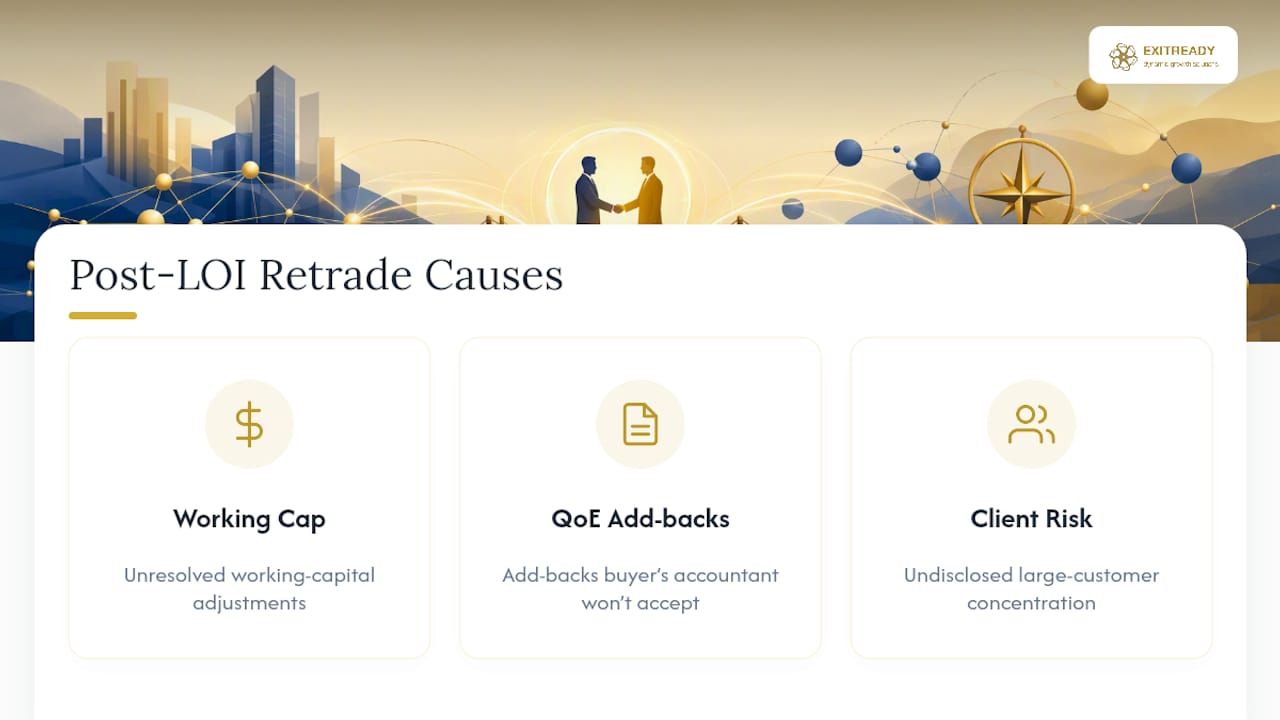
Three issues account for most post-LOI retrades: unresolved working capital adjustments, QoE add-backs a buyer’s accountant won’t accept, and customer concentration nobody flagged early. Each one is preventable with earlier prep, not damage control after the fact.
The other frequent mistake is dumping raw, unorganized data into the room instead of curating it. Over-sharing invites buyers to dig deeper than they otherwise would, which expands scope and slows everything down.
Pro Tip: Document support for every add-back before a buyer asks for it, pre-draft your disclosure schedules, and start consent conversations with landlords or key suppliers the same month you begin QoE work, not after you sign an LOI.
How Dynamicgrowthsolutions Fits Into Readiness Work
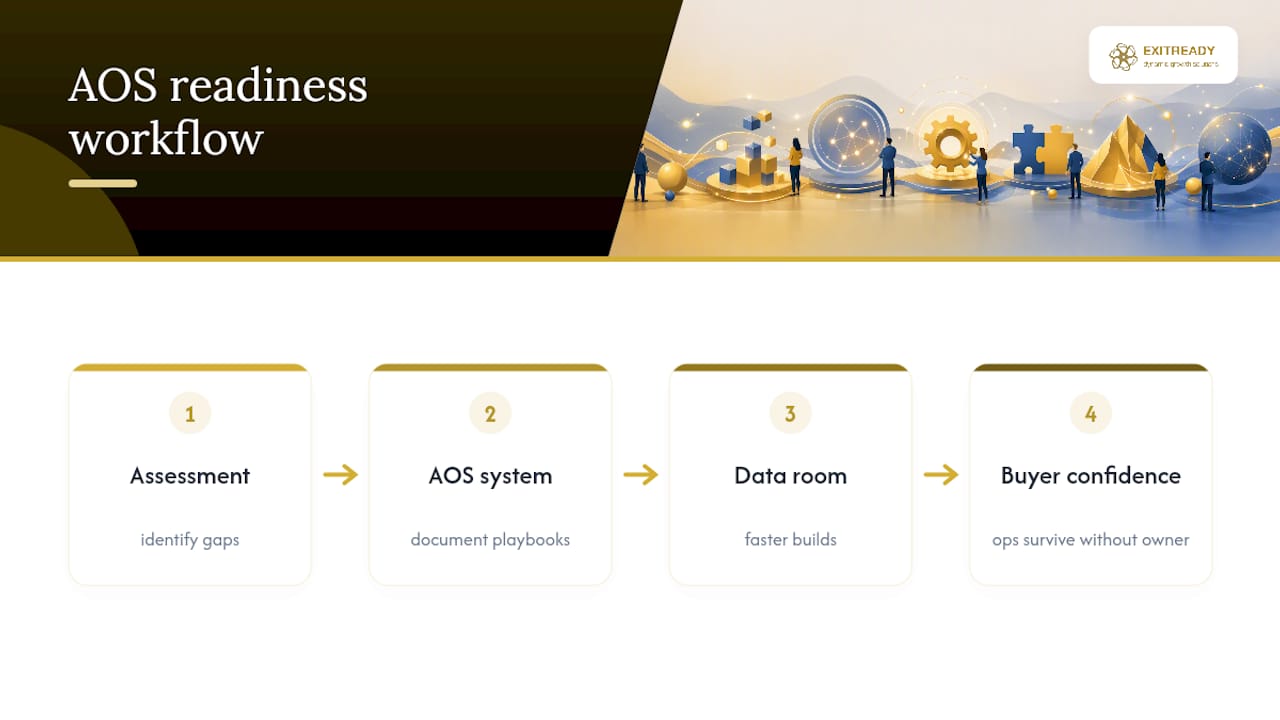
Most of the delay in getting sale ready traces back to one thing: nothing is written down. The AOS operating system is designed to replace owner memory with documented playbooks, which helps shorten data room builds and gives buyers confidence your operations survive without you. Owners can start with a business exit readiness assessment to identify gaps before committing to a full QoE engagement.
Why Early Prep Is the Real Lever Owners Underestimate
Most owners treat due diligence as a hurdle to clear after the offer arrives. That’s backward. The prep work itself is what sets the price a buyer is willing to defend, not just the number your broker puts on a teaser. Run a readiness assessment or commission a sell-side QoE before you launch, not after a buyer starts asking questions you can’t answer cleanly.
— Andre
Ready to Build Your Exit-Ready Operation?
Getting sale ready is less about finding the right buyer and more about building a business that doesn’t fall apart under scrutiny. This consulting approach assists mid-market owners in installing documented systems, reducing owner dependency, and preparing companies for the kind of diligence process that defends value instead of eroding it. Explore Dynamicgrowthsolutions’ business transformation programs to see how a structured operating system turns readiness gaps into a stronger negotiating position before you ever open a data room.
Sources
- Sell-side due diligence in 2026: how to stop buyers retrading the price
- Sell-Side Due Diligence (2026): What Buyers Dig Into First | CT Acquisitions