
A working capital adjustment is the mechanism that compares the net working capital actually delivered at closing against a pre-negotiated target, called the peg, and moves the purchase price dollar-for-dollar to cover the difference. If closing working capital comes in above the peg, the buyer pays more. If it falls short, the seller receives less. Most deals settle this in two steps: an estimate at closing, then a final true-up 60 to 90 days later.
TL;DR:
- A common peg for working capital is a trailing twelve-month average, which should be broken down by month to identify anomalies that could distort the target.
- Most deals include a two-step adjustment process: an estimate at closing and a true-up within 60 to 90 days, with discrepancies settled dollar-for-dollar without partial credits.
- Inventory write-downs and account receivable reserves are frequent sources of post-close disputes, especially if thresholds or methodologies are not pre-agreed.
- Proper normalization, explicit policies, and testing of the calculation against historical data well before closing reduce the risk of settlement friction and lost proceeds.
- Building transparent, detailed policies and forecasts at least 12 to 18 months before a sale helps sellers retain leverage and avoid last-minute surprises during diligence.
Table of Contents
- How the Working Capital Adjustment Mechanism Actually Works
- Setting the Peg: How Buyers and Sellers Agree on a Target
- A Worked Example: How the Purchase Price Math Actually Flows
- Where Working Capital Disputes Actually Start
- The Post-Closing Timeline: From Estimate to Final Payment
- A Pre-Close Checklist for Sellers and Buyers
- How the Adjustment Shapes Behavior on Both Sides of the Table
- Industry Benchmarks Change What “Normal” Working Capital Looks Like
- Tax Considerations That Come With the True-Up Payment
- What Real Working Capital Clauses Look Like in Practice
- Forecasting Working Capital Before You Ever List the Business
- Why Working Capital Readiness Is Really Exit Readiness
- Preparing Your Business’s Working Capital Before You Sell
- Sources
How the Working Capital Adjustment Mechanism Actually Works
Net working capital is current assets minus current liabilities, usually limited to the operating items a business needs to run day to day: accounts receivable, inventory, prepaid expenses, accounts payable, and accrued liabilities. Cash, debt, and debt-like items sit outside this calculation entirely, which surprises first-time sellers who assume every balance sheet line is fair game.
The reason for that split is simple. Cash and debt get settled through separate purchase price mechanics (the equity-to-enterprise-value bridge), while working capital adjustment clauses exist purely to make sure the business changes hands with enough operating fuel to keep running without an immediate cash injection from the new owner. A buyer who acquires a company that’s been drained of receivables and stuffed with unpaid vendor bills just before close is effectively getting less than they paid for.
The mechanics run in two phases:
- Estimated adjustment at close. The seller (sometimes jointly with the buyer) prepares an estimated closing balance sheet a few days before the transaction closes. Whatever the estimated NWC is relative to the peg adjusts the wire amount that actually changes hands on closing day.
- Final true-up. Once the dust settles, actual closing books get finalized, typically 60 to 90 days after close, and the parties true up the difference between the estimate and the final number.
This two-step structure exists because nobody can close the books to the penny on closing day itself. The dollar-for-dollar mechanism means there’s no proration or partial credit. A $200,000 shortfall against peg is a $200,000 reduction in proceeds, full stop.
Setting the Peg: How Buyers and Sellers Agree on a Target
The peg is the number everything else measures against, and getting it wrong is more damaging than most sellers realize, since a peg set too high effectively claws back sale proceeds before the deal even closes.
The most common approach is a trailing twelve-month average of monthly working capital balances. It smooths out seasonality, so a landscaping company that closes in March (its leanest cash month) isn’t unfairly penalized against a target built from July numbers. Alternatives include a fixed dollar peg negotiated off a single balance sheet date, or a percentage-of-revenue formula for businesses with volatile but predictable seasonal cycles.
Before the peg gets locked in, both sides normalize the historical data:
- Strip out one-time items like a lawsuit settlement or an unusual bulk inventory purchase.
- Align accounting policies (if the seller has been booking bad debt reserves inconsistently, that gets fixed before the average is calculated).
- Document every adjustment with backup support, since normalization is where most peg disputes originate.
Caps, collars, and baskets often get layered on top to prevent either side from chasing every small dollar. A collar might say no adjustment applies within plus or minus 2% of the peg, which keeps the parties from litigating rounding errors.
Pro Tip: Push to see the trailing 12-month data broken out by month, not just the average. A single unusually strong or weak month can distort the whole peg, and you won’t catch it without looking at the underlying trend.
A Worked Example: How the Purchase Price Math Actually Flows
Here’s how the numbers move through a typical deal:
- Set the peg. Trailing 12-month average NWC comes out to $2,000,000.
- Estimate at close. The seller’s estimated closing balance sheet shows NWC of $2,150,000, which is $150,000 above peg. The buyer pays an extra $150,000 at closing, on top of the base purchase price.
- Finalize the numbers. Several weeks later, the final closing balance sheet comes in at about $2,090,000, or $90,000 above peg, not $150,000.
- True up the difference. Since the buyer already paid $150,000 extra at close but the final number only supports $90,000, the seller owes the buyer $60,000 back.
Roughly 96% of private-target M&A deals include a working capital adjustment provision, which tells you this isn’t a niche negotiating point. It’s standard deal architecture in almost every private transaction.
True-up payments typically settle through direct wire transfer, sometimes with a modest interest charge on the deferred amount, and buyers often use a portion of escrow specifically earmarked for working capital shortfalls rather than the general indemnity escrow.
Where Working Capital Disputes Actually Start
Four categories generate most of the friction between buyers and sellers post-close. Inventory write-downs consistently account for the largest share of disputed dollars](https://ctacquisitions.com/net-working-capital-adjustment/) in deal samples reviewed by advisory firms.
Inventory obsolescence is the classic flashpoint. A buyer’s post-close team looks at slow-moving stock and wants to write it down; the seller argues the inventory is perfectly sellable and was valued correctly under historical methods. Deals that pre-agree obsolescence thresholds, often tiered by months of supply (18, 24, or 36 months), avoid this fight almost entirely because the reserve calculation becomes mechanical instead of a judgment call.
Accounts receivable reserves cause similar friction. Buyers want aggressive reserves against anything unpaid past 90 days; sellers point to a collections history that says most of it will come in. Specifying the exact reserve methodology in the working capital exhibit, rather than leaving it to “GAAP” in the abstract, removes the ambiguity.
Accrued liabilities like unpaid bonuses, accrued vacation, and warranty reserves get missed or mis-negotiated constantly. If a discretionary bonus wasn’t paid before close, is it accrued at 100% or prorated? The purchase agreement needs to say so explicitly, line by line.
- Bonus accruals: specify proration method and payout trigger.
- Vacation/PTO: state whether accrued balances transfer at full liability value.
- Warranty reserves: define the historical loss-rate methodology used to calculate them.
Accounting policy mismatches underlie most of the above. The safest drafting fix is requiring the closing balance sheet to be prepared using the seller’s historical accounting policies, with explicit, enumerated exceptions for anything both parties agree should change. That single sentence in the purchase agreement prevents a buyer’s post-close accounting team from quietly applying more conservative policies that shrink the seller’s payout.
Pro Tip: Ask for the working capital exhibit to include a fully worked sample calculation using real historical numbers, not just a description of methodology. If the seller’s team can’t produce one before signing, that’s a sign the peg wasn’t rigorously tested.
The Post-Closing Timeline: From Estimate to Final Payment
The standard sequence runs on a predictable clock, and most deals hit each milestone within a narrow band:
- Estimated adjustment applied at closing (day zero).
- Final closing balance sheet delivered, median around 75 days post-close, typically within a 60 to 90 day window set by the purchase agreement.
- Seller review and objection period, commonly 30 days.
- Negotiation period between the parties to resolve disagreements directly.
- If unresolved, referral to an independent accounting firm for binding determination.
Most disputes actually resolve before reaching that independent accountant step, largely because the cost and delay of arbitration push both sides toward compromise. Escrow accounts, when used, hold back a portion of proceeds specifically to cover potential working capital shortfalls, and interest sometimes accrues on amounts owed past the final determination date.
The single biggest lever for shortening this timeline is pre-naming the independent accountant in the purchase agreement rather than fighting over firm selection after a dispute has already started.
A Pre-Close Checklist for Sellers and Buyers
Getting the working capital adjustment right starts weeks before the closing date, not the week of it.
For sellers:
- Prepare the estimated closing balance sheet using the same format and policies as the working capital exhibit, not a rough approximation.
- Accelerate collections in the final weeks before close, but avoid anything that looks like manipulation of the peg calculation itself.
- Clean up inventory (write off genuinely obsolete stock ahead of time so it isn’t a surprise fight after close).
- Document any one-time items affecting the trailing average with clear support, invoices, and explanations.
For buyers:
- Push for explicit line-item rules in the working capital exhibit rather than a general reference to GAAP.
- Pre-name the independent accounting firm and define the scope of what they can and can’t rule on.
- Negotiate a collar or cap so small timing differences don’t trigger disputes over immaterial amounts.
Joint priorities: both sides benefit from testing the calculation methodology during diligence with real historical numbers, not waiting until closing to discover the formula produces a number nobody expected. Sellers who model their cash flow cadence well before a sale process starts tend to walk into peg negotiations with far more leverage.
Pro Tip: Run the peg formula against your last three years of monthly data before you ever sign a letter of intent. If the number surprises you, it will surprise the buyer too, and that’s exactly the moment you want to control, not react to.
How the Adjustment Shapes Behavior on Both Sides of the Table
Working capital adjustments change how sellers run the business in the months before close, and not always for the better. A seller who understands the peg mechanism has an incentive to keep working capital right at (or artificially near) the target, which can mean delaying vendor payments, slow-walking collections, or trimming inventory purchases in ways that wouldn’t happen in normal operations.
Buyers, for their part, have the opposite incentive after signing but before closing: some push for aggressive normalization adjustments or reserve increases specifically because it lowers the effective purchase price through the true-up rather than through open renegotiation of the headline number.
Neither behavior is inherently dishonest, but both distort the deal if the peg and methodology aren’t tightly defined. This is exactly why a detailed working capital exhibit that locks down line items and calculation rules matters more than the headline purchase price multiple in many transactions. When the rules are ambiguous, the party with more sophisticated deal counsel or a better forensic accounting team tends to win the true-up fight, regardless of what actually happened operationally. Sellers who treat working capital management as a last-minute exercise, rather than an ongoing discipline, consistently leave money on the table at the settlement stage.
Industry Benchmarks Change What “Normal” Working Capital Looks Like
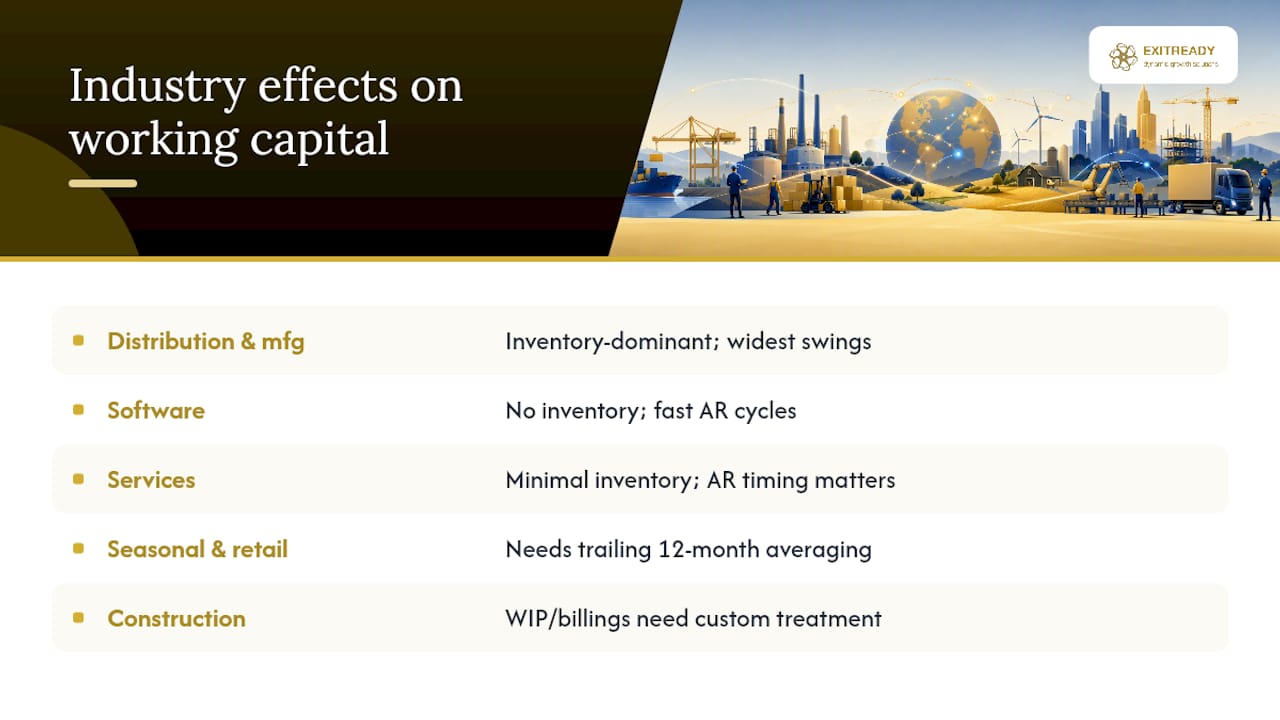
A software company with no inventory and fast-paying enterprise customers has a fundamentally different working capital profile than a distributor carrying six months of stock or a manufacturer with long production cycles and slow-paying customers. Benchmarks vary enormously by sector, and applying a generic peg formula across industries produces distorted results.
Distribution and manufacturing businesses typically show the widest swings in working capital adjustment because inventory dominates the current asset side and its valuation is the most subjective line on the balance sheet. Service businesses with minimal inventory tend to see smaller, more predictable adjustments driven mostly by accounts receivable timing.
Seasonal businesses, landscaping, retail, agriculture, and hospitality, need the trailing 12-month averaging approach far more than steady-state businesses do, since a single point-in-time peg would badly misrepresent normal operations depending on when in the year the deal closes. Construction and project-based businesses often need custom treatment for work-in-progress and billings-in-excess accounts that don’t map cleanly onto a standard NWC formula at all.
The practical takeaway: don’t import a peg methodology from a different industry’s playbook. What counts as a “normal” collection cycle or inventory turn in one sector can look alarming in another, and buyers with cross-industry experience will sometimes anchor on the wrong benchmark unless the seller pushes back with sector-specific data.
Tax Considerations That Come With the True-Up Payment
A working capital true-up payment isn’t a separate taxable event on its own; it’s generally treated as an adjustment to the purchase price itself, which means it flows into the same tax treatment as the original transaction, whether that’s an asset deal or a stock deal.
For sellers, that typically means a true-up payment received after closing adjusts the amount realized on the sale, which can affect capital gains calculations in the year the payment is finalized rather than the year of closing if the true-up crosses a tax year boundary. For buyers, an upward adjustment to the purchase price can affect the allocation of purchase price among asset classes in an asset deal, which in turn affects depreciation and amortization schedules going forward.
The timing mismatch is where things get complicated. If a deal closes in December and the final true-up isn’t determined until March, the payment may need to be addressed in an amended purchase price allocation or accounted for in the following tax year’s returns. This is a genuine reason to loop in tax counsel or a qualified accountant before finalizing the true-up mechanics in the purchase agreement, not after a dispute arises. The specific treatment depends heavily on deal structure and jurisdiction, so generic assumptions about “it’s just a price adjustment” can create real filing headaches if nobody planned for the timing gap in advance.
What Real Working Capital Clauses Look Like in Practice
Purchase agreements rarely use the plain phrase “working capital adjustment” as a standalone clause. Instead, the mechanism usually lives across three linked provisions: a definitions section that spells out exactly which balance sheet line items count as current assets and current liabilities for this deal, a working capital exhibit (often an appendix or schedule) that shows the peg calculation with sample numbers, and an adjustment mechanics section that walks through the estimated and final true-up process step by step.
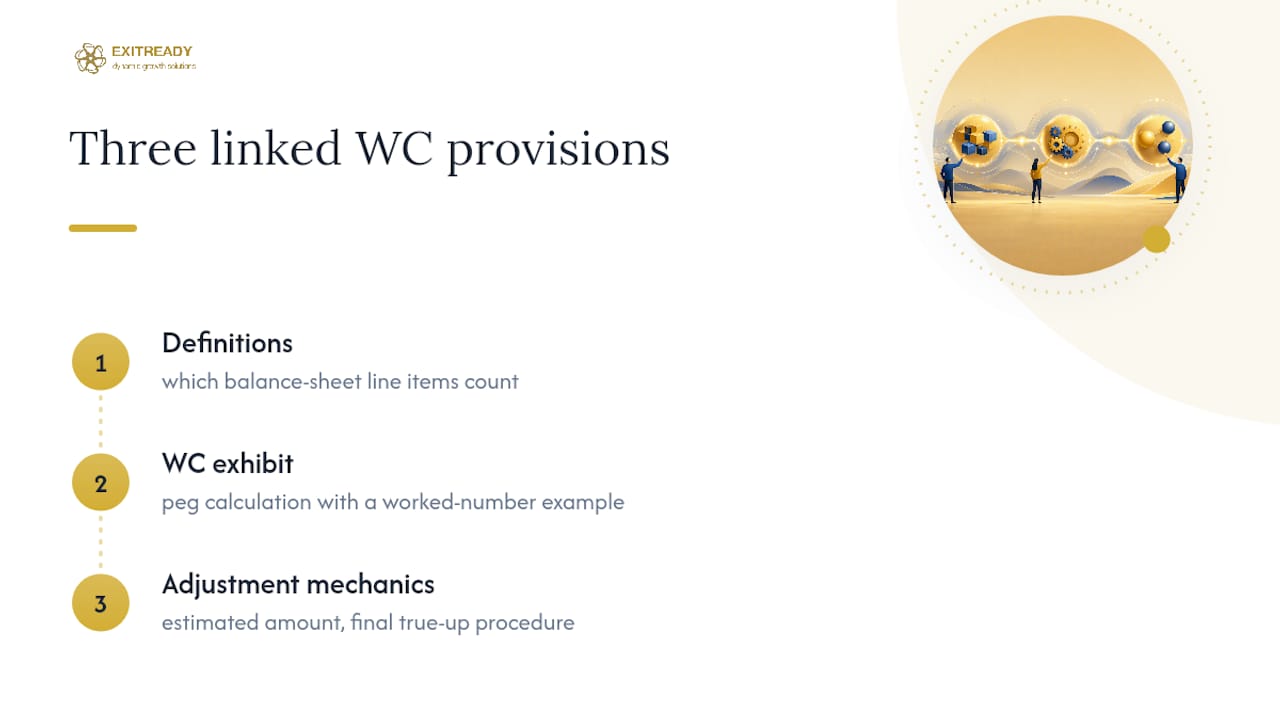
A well-drafted exhibit typically includes a literal worked example, using the actual trailing-period numbers, showing exactly how the peg was calculated and what a hypothetical final balance sheet adjustment would look like in dollars. That’s not boilerplate. It’s the single clearest signal that both sides tested the methodology before signing rather than leaving the formula to be interpreted after a dispute erupts.
The strongest clauses also name the specific accounting firm or firm type eligible for the independent determination role, define what “GAAP consistently applied” means relative to the seller’s specific historical practices, and set explicit dollar thresholds for baskets and collars rather than vague language like “immaterial amounts.” Weaker agreements leave these terms generic, which is precisely what pushes disputes toward the expensive independent accountant stage instead of a quick negotiated resolution.
Forecasting Working Capital Before You Ever List the Business
The best time to understand your working capital adjustment exposure is 12 to 18 months before you go to market, not during diligence when a buyer’s team is already scrutinizing every account.
Start by building a rolling 24-month monthly working capital history, broken into its component accounts (receivables, inventory, payables, accruals) rather than one aggregate number. That level of detail lets you spot the seasonal pattern a trailing-average peg will eventually be built on, and it lets you catch accounting policy inconsistencies while there’s still time to fix them cleanly instead of disclosing them as exceptions.
Model at least two peg scenarios, trailing 12-month average and a fixed-date alternative, against your actual historical numbers to see which produces a fairer target for your business’s specific seasonality. Businesses with volatile working capital swings, driven by a few large customers, long production cycles, or seasonal demand, benefit the most from this exercise, since a poorly chosen peg methodology can quietly cost six or seven figures at closing.
Sound cash flow forecasting discipline built well before a sale process also gives you leverage in the room. A seller who can produce clean, defensible monthly data going back two years negotiates from a position buyers respect, because it signals the post-close numbers won’t hold surprises. Working capital drivers like receivables and payables timing also shape day-to-day operating flexibility long before a sale is even on the table, which is exactly why this discipline pays off whether or not you sell within the next year.
Why Working Capital Readiness Is Really Exit Readiness
Sellers who treat working capital as a closing-week problem almost always leave money on the table, and often endure months of post-close friction that erodes goodwill with the buyer’s team right when it matters most. The businesses that walk away clean are the ones with documented accounting policies, clean forecasting habits, and a peg that was stress-tested long before a term sheet existed. Certainty at closing isn’t luck. It’s the byproduct of systems built years, not weeks, in advance.
— Andre
Preparing Your Business’s Working Capital Before You Sell
Most sellers only discover their working capital exposure the week a buyer’s diligence team starts asking hard questions, which is the most expensive time to learn it. Working capital readiness should be built into operational assessments well before a business goes to market, so the peg conversation happens on your terms instead of the buyer’s.

A typical engagement starts with an operational assessment that flags where your working capital patterns will attract buyer scrutiny, then moves into a documented playbook covering accounting policy consistency, cash forecasting cadence, and normalization support that can be provided to a buyer. From there, implementation and exit-readiness certification may provide documentation helpful for negotiations. If you’re planning a sale in the next one to three years, start with the business transformation best practices overview to see how the assessment process works and what a readiness engagement typically covers.
Sources
- Key takeaways from SRS Acquiom’s 2024 M&A deal terms study
- Navigating working capital in M&A transactions — Kroll
- Net working capital adjustment: peg calculation, true-up process, and dispute avoidance