

Use a focused, catchball-enabled cascade: three to five breakthrough objectives, outcome-based roadmaps, and monthly review cadence. That combination borrows Hoshin Kanri’s vertical discipline and pairs it with OKR-style short cycles for team-level speed. It works because most strategy failure is not a bad plan. It is a plan nobody translated into weekly work.
Roughly 67% of well-formulated strategies fail because of poor execution, and the biggest single cause is what researchers call the laddering gap, where daily tasks never connect back to the top-level goals. Fixing that requires genuine two-way negotiation between levels, not a memo from the executive floor.
Your next step: run a 90-day alignment sprint.
- Pick 3 to 5 breakthrough objectives, not fifteen.
- Name an owner for each one by name, not by department.
- Schedule the first monthly review before you leave the room.
Key Takeaways
A focused, catchball-enabled cascade combining Hoshin Kanri’s vertical alignment with OKR-style cadence resolves the laddering gap responsible for most strategy failures.
| Point | Details |
|---|---|
| Fix the laddering gap first | Confirm every level can name the top 3 to 5 objectives before adding new tools or software. |
| Never skip catchball | Budget close to a full fiscal quarter for genuine negotiation, not a rubber-stamp announcement. |
| Match framework to need | Use Hoshin Kanri for vertical alignment, OKRs for team speed, and CADAP when capability gaps run deeper than planning. |
| Track leading indicators only | Replace activity reports with one outcome metric per initiative and require A3 reports on misses. |
| Get a structured operating system | Dynamicgrowthsolutions’ AOS maps directly to each framework step through assessment, roadmap, and governance setup. |
Table of Contents
- Why Strategy Execution Fails Before It Even Starts
- A Compact, Practical 5-Step Strategy Execution Framework
- How Do Hoshin Kanri, OKRs, and Balanced Scorecard Compare?
- Which Tools and Artifacts Make Execution Visible?
- Who Should Own Governance and Review Cadence?
- Common Execution Pitfalls and How to Fix Them
- Your 90-Day Starter Plan for Locking Alignment
- How Dynamicgrowthsolutions Helps You Operationalize This Framework
- Frequently Asked Questions
- Sources
Why Strategy Execution Fails Before It Even Starts
Most failures trace back to five recurring patterns, as explained in the executive guide on why new tools fail to change operations. The laddering gap tops the list: a plant supervisor’s daily priorities have no visible link to the CEO’s growth targets, so the strategy exists on a slide deck and nowhere else. Weak catchball is a close second. Leadership announces objectives instead of negotiating them, so front-line teams commit to numbers they never believed were realistic.
The rest compound from there:
- Too many priorities. Twelve “top priorities” means zero real ones.
- Poor governance cadence. Reviews happen quarterly, if at all, so problems surface months too late.
- Missing capabilities. The plan assumes skills or headcount the organization doesn’t have.
- Metrics that track activity, not outcomes. Reports show hours logged instead of results moved.
Nicolaj Siggelkow’s warning at Wharton is blunt: leaders chase a single silver bullet, usually a new tool or a reorg, when incentives, structure, resources, and capability all need to move together.
Run this 15-minute diagnostic with your leadership team: Can a supervisor two levels down name this year’s top three objectives? Did any manager push back on a target in the last planning cycle? If both answers are shaky, you’ve found where to start.
A Compact, Practical 5-Step Strategy Execution Framework
This is the execution strategy model that scales from a 40-person firm to a multi-site operation. Five steps, each producing a real artifact your team can hold in their hands.
- Define strategic intent. Write 3 to 5 breakthrough objectives with hard success metrics tied to outcomes, not activities. Output: a one-page strategic intent document.
- Translate objectives into roadmaps. Break annual goals into quarterly outcomes. Build an outcome-based execution roadmap and, where useful, a simplified X-matrix mapping objectives to owners and metrics on a single page.
- Run catchball. Negotiate commitments up and down the organization rather than dictating them. At real scale, this typically takes about a fiscal quarter to settle properly.
- Set cadence and governance. Monthly operational reviews, quarterly deep dives, and an annual PDCA cycle. Name a sponsor, a program lead, and an escalation path before problems hit.
- Measure and adapt. Track leading indicators, not lagging ones. When a metric misses two months running, require an A3 problem report before adding more meetings.
Artifacts to produce along the way: the one-page strategic intent, an execution roadmap, an X-matrix or simplified mapping table, OKR-style target sheets, A3 templates, and one shared dashboard.
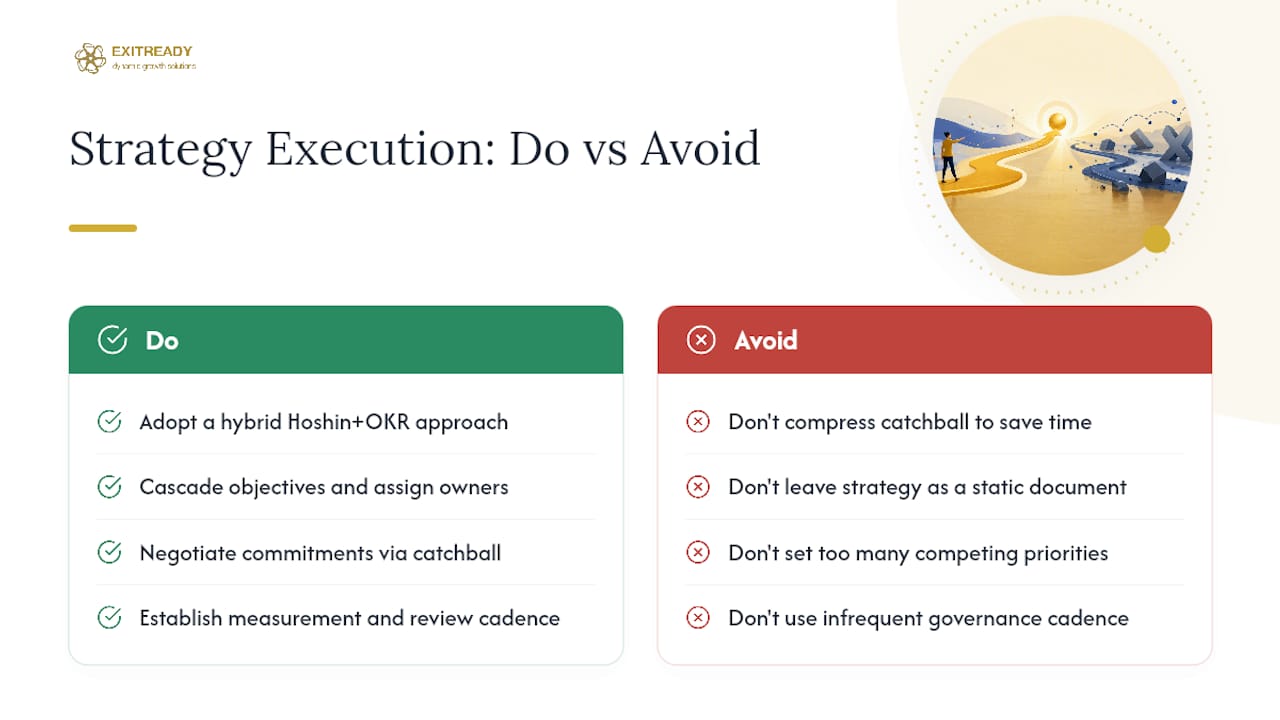
Pro Tip: Do not compress catchball to save time. A negotiation phase rushed to two weeks produces commitments nobody actually believes, and you will pay for that in month four when the numbers slip and no one owns the fix.
How Do Hoshin Kanri, OKRs, and Balanced Scorecard Compare?
Choosing a strategy deployment framework depends less on which methodology sounds most sophisticated and more on what your organization actually needs to fix: vertical alignment, team speed, financial linkage, or program complexity.
| Framework | Best for | Core cadence | Key artifacts | Governance rigor | Org fit |
|---|---|---|---|---|---|
| Hoshin Kanri | Deep vertical alignment, manufacturing/lean cultures | Annual cycle with PDCA reviews | X-matrix, catchball sessions | High | Mid-market to enterprise |
| OKRs | Fast-moving teams needing outcome focus | Quarterly cycles | OKR sheets, weekly check-ins | Light to moderate | Any size, especially fast-growth |
| Balanced Scorecard | Linking strategy to financial and customer metrics | Quarterly/annual | Scorecard dashboards | Moderate | Established mid-market and up |
| IIBA Strategy-to-Execution | Complex, multi-stream transformation programs | Program-based milestones | Execution roadmaps, sponsorship charters | High | Larger programs, multiple stakeholders |
| CADAP | Holistic capability and culture gaps | Ongoing, capability-driven | Capability assessments, alignment maps | Moderate to high | Organizations facing structural change |
The CADAP framework is worth a closer look if your execution problem isn’t really about planning cadence at all, but about whether your people and structure can support the plan you already wrote. It treats capability, agility, design, alignment, and people as one interconnected system rather than five separate initiatives.
Most mid-market leaders don’t need to pick just one. A hybrid works best in practice: Hoshin-style catchball and an X-matrix for vertical alignment, with OKR cadence running underneath at the team level for speed.
Which Tools and Artifacts Make Execution Visible?
You need fewer tools than you think, and more discipline about using them consistently. Start with these:
- A one-page strategic intent document everyone in leadership can recite from memory.
- An execution roadmap broken into quarterly outcomes, not task lists.
- A simplified X-matrix or mapping table connecting objectives, owners, and metrics.
- OKR-style sheets for team-level targets.
- A3 problem reports for any metric that stalls.
- One monthly review pack and one dashboard, not five competing spreadsheets.
Software platforms like Planview and Workboard show up often in execution literature for portfolio visibility and OKR tracking at scale. For the first 90 days, resist the pull toward a heavy enterprise platform. A shared one-page template and a single dashboard beat a half-configured portal that nobody trusts yet.
Who Should Own Governance and Review Cadence?
Three governance tiers keep the cascade honest without turning into theater. Executive steering meets monthly to protect the breakthrough objectives. A program or portfolio board meets bi-weekly or monthly to unblock cross-functional dependencies. Delivery teams run weekly stand-ups to catch problems before they age.
- Weekly stand-ups at the delivery level.
- Monthly owner reviews tied to leading indicators.
- Quarterly planning and catchball settlement.
- Annual PDCA review of the whole cycle.
Assign a sponsor, a program lead, an initiative owner, and someone accountable for cross-functional dependencies. Write one decision rights rule: if an initiative misses its leading indicator twice, the owner escalates to the sponsor within a week, no exceptions.
Common Execution Pitfalls and How to Fix Them
Four traps account for most of the failed rollouts leaders describe after the fact.
- Too many priorities. Enforce visible deselection publicly and cap breakthrough objectives at 3 to 5.
- Skipping catchball. Block a full quarter for negotiation and lock owners to their commitments before moving forward.
- Activity reporting instead of outcomes. Replace hours-logged reports with one outcome metric per initiative.
- Weak sponsorship. Require the sponsor’s physical attendance at every monthly steering meeting and write an escalation rule that doesn’t depend on their availability.
Pro Tip: If sponsorship keeps slipping, put the review on the sponsor’s calendar for the entire year in one sitting. A recurring invite survives busy quarters better than a “let’s find time” email.
Your 90-Day Starter Plan for Locking Alignment
Weeks 1 to 2: confirm strategic intent, pick your 3 to 5 breakthrough objectives, and produce the one-page document.
Weeks 3 to 6: run catchball across every function. At real scale, expect this negotiation to consume most of a fiscal quarter. Build the execution roadmap and a simplified X-matrix mapping alongside it, and name owners for each objective.

Weeks 7 to 12: launch monthly reviews, deploy your dashboard showing leading indicators, and require an A3 problem report for any metric that misses its target two months running.
Given that poor execution derails up to 67% of strategies, the 90-day window matters less as a deadline and more as a forcing function. It gets the negotiation done before year-end pressure makes leaders skip it.
A Practitioner’s Note on What Actually Moves the Needle
Running alignment sprints for mid-market firms teaches you fast that the framework matters less than the willingness to say no to good ideas. Visible deselection and naming a real owner, by name, fix more execution gaps than any new software rollout. Dynamicgrowthsolutions built its AOS playbooks around exactly that discipline.
How Dynamicgrowthsolutions Helps You Operationalize This Framework
Dynamicgrowthsolutions replaces the guesswork of building your own cascade from scratch with a documented operating system already mapped to each step above: strategic intent definition, a capability assessment, roadmap creation, governance setup, and review cadence implementation.
Instead of spending months figuring out what your X-matrix should look like or who owns what, the Accelerated Operating System gives mid-market leaders a proven structure they can adapt in weeks. Clients working through the AOS adoption process typically report faster alignment across leadership teams, fewer active initiatives competing for attention, clearer ownership on every objective, and visible progress against leading indicators instead of activity counts.
If your organization is still running strategy off a slide deck nobody opens between quarterly meetings, start with a business transformation assessment to see exactly where your execution gap sits before you commit to a 90-day sprint.
Frequently Asked Questions
What is a strategy execution framework?
It’s a structured process that turns strategic objectives into operational work through cascading, negotiation, and measurement, rather than leaving strategy as a document that sits untouched after the planning meeting.
How is a strategy execution framework different from a strategic plan?
A strategic plan states what you want to achieve. A strategy deployment framework, like Hoshin Kanri or a hybrid OKR model, defines how objectives get negotiated down through the organization, who owns each piece, and how progress gets reviewed.
Which strategy execution model works best for a mid-market company?
A hybrid approach usually performs best: Hoshin-style catchball and an X-matrix for vertical alignment, paired with OKR cadence at the team level. It gives you the discipline of a deployment framework without the overhead a much larger enterprise would need.
How long does catchball actually take?
Plan for close to a full fiscal quarter if you’re settling commitments across multiple levels and functions. Compressing it to save time tends to produce commitments teams don’t actually believe in.
What causes most strategy execution failures?
The laddering gap, where daily work at the operational level never connects to top-level objectives, plus too many competing priorities and governance cadence that’s too infrequent to catch problems early.
Sources
- Strategy deployment — Lean Enterprise Institute
- Organizational Strategy Execution: A New Approach – Wharton@Work