

A decision rights matrix assigns exactly one Decider per decision category and documents who Recommends, Consults, and is Informed. Start there. Before you pick a framework or build a template, list the 10–20 decisions that repeatedly slow your team, then force a single accountable owner onto each one. That single act removes more organizational drag than any restructuring memo.
Three concrete next steps you can take this week:
- Audit recent decisions. Pull the last 30–50 real decisions your team made. Cluster them into recurring types: pricing changes, hiring, vendor contracts, budget approvals, feature ship/kill calls, emergency operational changes.
- Name one Decider per type. For each cluster, write one name. Not a committee. Not “leadership.” One person. HBR research shows that explicitly naming who decides and who provides input correlates with faster execution and better outcomes.
- Document delegates and thresholds. Record who steps in when the Decider is unavailable and at what dollar or risk threshold a decision escalates. The ACC’s sample authority matrix shows exactly how to encode these authority levels in a single document.
Key Takeaways
A decision rights matrix works when every recurring decision type has exactly one named Decider, a documented delegate, a defined threshold, and a scheduled review date.
| Point | Details |
|---|---|
| One Decider per decision type | Assign a single named owner per row; shared D cells produce deadlock, not shared accountability. |
| Match framework to complexity | Use RACI for task-level clarity, RAPID for cross-functional strategic decisions, DACI for mid-complexity program calls. |
| Build from real decisions | Map the last 30–50 actual decisions, not an idealized org chart, to expose hidden overlaps and real ownership gaps. |
| Limit Consult entries | Cap Consulted roles at roughly two to three per row; over-consulting is a primary source of decision delay. |
| Dynamicgrowthsolutions AOS | Embeds the decision rights matrix into a full operating system, supporting 90-day pilots and exit-readiness certification for mid-market owners. |
90-day pilot checklist:
- Weeks 1–2: collect 30–50 real decisions; interview key stakeholders
- Weeks 3–4: draft matrix; assign Deciders; choose framework
- Weeks 5–6: stakeholder validation; resolve ownership conflicts; add delegates and thresholds
- Weeks 7–10: live pilot; track decision lead time and escalation rate
- Weeks 11–12: review metrics; revise to version 1.1; set quarterly review cadence
Table of Contents
- What is a decision rights matrix and why do teams use it?
- How does RACI work, and where does it fall short?
- What is RAPID and when should you use it?
- What about DACI and decision-rights architecture?
- Which framework fits your situation?
- How to design a decision rights matrix for your team
- Rollout plan, timeline, and training
- How do you know it’s working?
- Practical example matrices you can copy
- How Dynamicgrowthsolutions implements decision rights
- What good actually looks like in practice
- Dynamicgrowthsolutions: built for mid-market decision clarity
- Sources
What is a decision rights matrix and why do teams use it?
A decision rights matrix is a structured document where rows represent decision types and columns represent organizational roles. Each cell contains an authority code: Decide, Recommend, Consult, or Inform (or the RACI equivalents). The result is a single-page reference that tells anyone in the organization who owns which call, who feeds into it, and who gets notified after.
Teams use it because ambiguity is expensive. When two people both believe they own a pricing decision, one of three things happens: they relitigate it in every meeting, they stall waiting for the other to move, or they make conflicting calls that downstream teams have to reconcile. A well-built matrix eliminates all three failure modes by making ownership visible before the decision arrives.
The decision categories worth mapping first tend to cluster around:
- Pricing changes above a defined threshold
- Feature ship or kill decisions in product development
- Vendor contracts above a dollar value
- Hiring and backfill approvals
- Budget reallocations mid-cycle
- Emergency operational changes that bypass normal approval chains
These categories surface the most friction in mid-market organizations because they cross functional lines. A product manager, a finance lead, and a sales director all have legitimate stakes in a pricing change, but only one of them should hold the final call. The matrix makes that explicit without requiring a meeting to figure it out each time.
How does RACI work, and where does it fall short?
RACI is the most widely used responsibility assignment matrix in U.S. organizations, and for good reason: it is simple, fast to build, and works well for operational task lists and project activity tracking.
The four roles:
- Responsible ®: Does the work or executes the task
- Accountable (A): Owns the outcome; the one person who answers for the result
- Consulted ©: Provides input before the decision or action
- Informed (I): Notified after the fact
For a single-team project with clear task boundaries, RACI delivers fast clarity. A project manager can map a 20-task sprint in an afternoon and hand every team member a reference that removes the “who’s doing what” question entirely.
The problems appear at scale. McKinsey documents RACI’s limits and recommends a decision-rights architecture that maps clear owners and governance layers where RACI leaves ambiguity. The most common failure modes:
- Multiple Accountable entries. When two people share the A cell, neither truly owns the outcome. Deadlock follows.
- Overloaded Responsible cells. Listing six people as Responsible for one task means no one is.
- No escalation path. RACI tells you who does what but not what happens when the Accountable person is unavailable or when a decision exceeds their authority.
- Blurred decision vs. execution lines. RACI was designed for tasks, not decisions. It does not distinguish between the person who executes a choice and the person who makes it.
Pro Tip: When your RACI chart stops working, look at the Accountable column first. If any row has more than one name, consolidate immediately. If the Accountable person cannot actually make the call without approval from above, you need a different framework for that decision type.
What is RAPID and when should you use it?
RAPID is a five-role decision framework developed by Bain & Company to remove bottlenecks in complex, cross-functional decisions. Where RACI maps task ownership, RAPID maps decision authority. The distinction matters because the person who executes a decision is rarely the same person who should make it.
The five roles:
- Recommend ®: Proposes the decision with supporting analysis
- Agree (A): Must sign off before the recommendation moves forward (veto power)
- Perform (P): Implements the decision once made
- Input (I): Provides data or perspective that informs the recommendation
- Decide (D): Makes the final call; owns the outcome
Bain’s RAPID framework separates who proposes from who decides and who implements, which is the core structural insight that makes it work for high-stakes decisions.
When to choose RAPID over RACI:
- The decision crosses two or more functions (product, finance, legal, sales)
- Getting it wrong has material consequences: revenue impact, regulatory risk, or significant resource commitment
- The same decision type has stalled or been relitigated more than twice in the past year
- Multiple stakeholders believe they hold veto power and nobody has clarified who actually does
How a RAPID sequence works in practice (product go/no-go example):
- Product manager (Recommend) builds the business case and recommendation
- Finance and Legal (Input) provide cost modeling and compliance review
- Chief Revenue Officer (Agree) reviews and signs off or flags blockers
- CEO or Division Head (Decide) makes the final call
- Engineering and Operations (Perform) execute the launch plan
The sequence prevents the common failure where the Decider gets pulled into every input conversation and thus becomes a bottleneck. Input providers feed the Recommender, not the Decider directly.
RAPID suits strategic pricing reviews, M&A gating decisions, and enterprise vendor selections. For day-to-day operational tasks, it is heavier than necessary. Use it where decisions repeatedly stall or where the cost of a wrong call justifies the extra role clarity.
What about DACI and decision-rights architecture?
Two additional models fill the space between RACI’s task-level simplicity and RAPID’s structured cross-functional rigor.
DACI (Driver, Approver, Contributors, Informed) sits between the two. The Driver owns the process and moves the decision forward. The Approver makes the final call. Contributors provide input without veto power. Informed parties receive the outcome. DACI is particularly useful for product and program teams that need faster cycle times than RAPID allows but more explicit ownership than RACI provides. It removes the Agree role’s veto dynamic and consolidates authority in a single Approver, which speeds execution.
Decision-rights architecture operates at a different level entirely. Rather than mapping individual decisions, it maps governance layers: which decisions belong to the team level, which belong to the program or business-unit level, and which require enterprise sign-off. Deloitte explains that decision-rights models must align with operating model and talent implications, and offers frameworks to diagnose decision bottlenecks across those layers. This is the approach McKinsey recommends for organizations where RACI has been tried and found insufficient.
Quick selection heuristics:
- Task-level clarity on a project → RACI
- Cross-functional strategic decision with multiple stakeholders → RAPID
- Product or program team needing faster approvals than RAPID → DACI
- Enterprise governance across business units or governance layers → Decision-rights architecture
The decision-driven organization model from HBR argues that decision rights must be explicit and linked to organizational capabilities, not just org-chart position. That framing applies to all four models: the framework is only as good as the capability of the person holding the Decide role.
Which framework fits your situation?
The right choice depends on three variables: decision complexity, stakeholder count, and how much speed matters relative to inclusiveness.
| Framework | Best for | Decision complexity | Speed vs. inclusiveness | Accountability clarity | Implementation effort |
|---|---|---|---|---|---|
| RACI | Operational tasks, project activity lists | Low to medium | Fast, minimal consultation | Moderate (A cell can blur) | Low |
| RAPID | Cross-functional strategic decisions | High | Slower, structured input | High (single Decider) | Medium to high |
| DACI | Product/program decisions, mid-complexity | Medium | Moderate | High (single Approver) | Medium |
| Decision-rights architecture | Enterprise governance, multi-layer organizations | Very high | Slower, policy-driven | Very high | High |
Selection checklist:
- How many functions does this decision touch? (More than two → consider RAPID or DACI)
- What is the cost of a wrong call? (High cost → invest in RAPID’s structured input)
- How often does this decision type recur? (Daily/weekly → RACI; quarterly/annual → RAPID)
- Is speed the primary constraint? (Yes → DACI or simplified RACI)
- Does the decision cross governance layers? (Yes → decision-rights architecture)
Pro Tip: Run RACI for everything that happens inside a single function. Reserve RAPID-style structures for the five to ten decision types that have caused the most organizational friction in the past 12 months. Over-engineering day-to-day decisions with RAPID creates bureaucracy faster than it creates clarity.
How to design a decision rights matrix for your team
Building from an idealized org chart produces a matrix that looks clean and reflects nothing about how decisions actually get made. Build from reality instead.

Step 1: Gather real decisions. Pull the last 30–50 decisions your team made. Include the ones that went smoothly and the ones that stalled. Cluster them into 10–20 recurring decision types. This approach, recommended by StandIn’s decision authority mapping methodology, forces single ownership per type and exposes hidden overlaps that an org chart would never reveal.
Step 2: Choose your authority model. For most mid-market teams, a four-code model works: Decide (D), Recommend ®, Consult ©, Inform (I). List your organizational roles as columns: CEO, CFO, VP Product, VP Sales, Legal, Operations. Keep the column count under eight or the matrix becomes unreadable.
Step 3: Assign one Decider per row. One name. One role. Fill supportive roles sparingly. Applied Frameworks recommends limiting true consensus decisions to roughly 10% of the matrix, because over-consulting is a primary source of delay. If a row has more than three C entries, you are building a committee, not a matrix.
Step 4: Validate and publish. Run a conflict-resolution pass with stakeholders. Look for rows where two people believe they hold the D. Resolve those before publishing. Add representation rules: who steps in when the Decider is traveling or offline. Publish version 1.0 with a review date.
Sample filled row:
Validation checklist before publishing:
- Every row has exactly one D
- No row has more than one A (if using RACI)
- Every Decider has a named delegate
- Thresholds are specific (dollar amounts, not “significant”)
- Decision windows are defined
- A review date is set
Rollout plan, timeline, and training
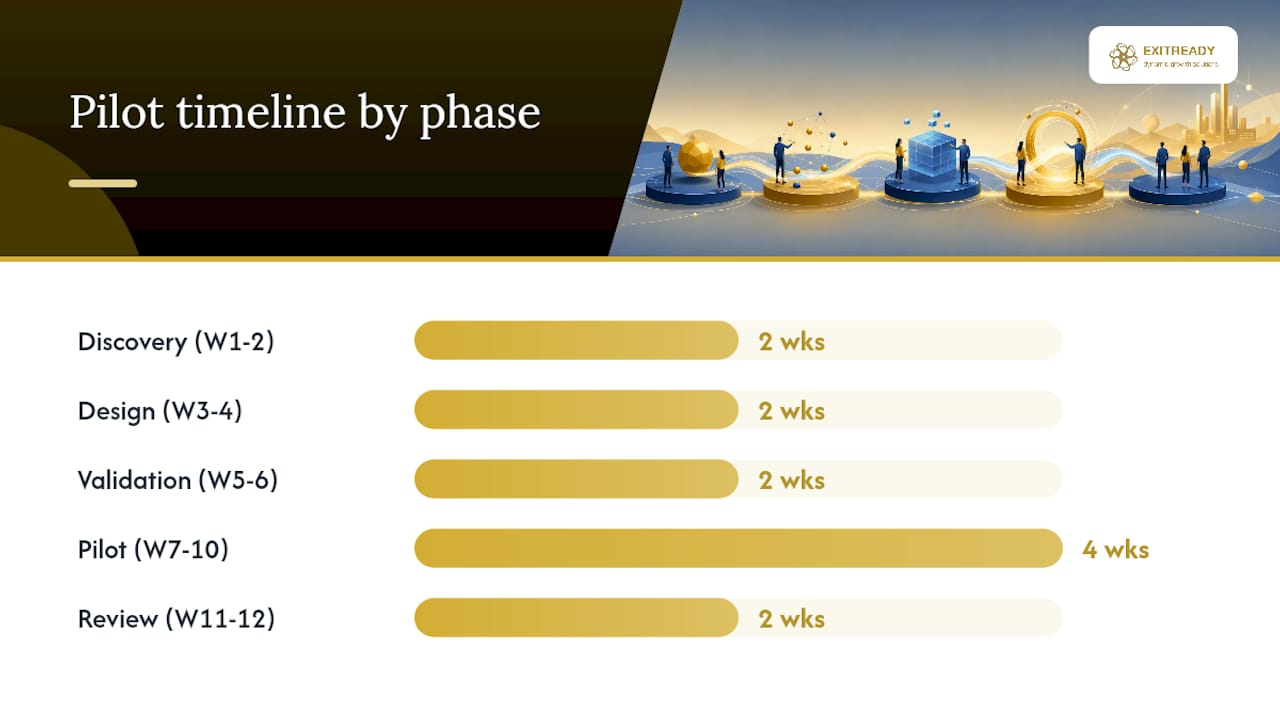
A 90-day pilot is the right scope for a first implementation. Longer and it becomes a strategy project. Shorter and you cannot collect enough real decisions to validate the matrix.
90-day milestone plan:
- Weeks 1–2 (Discovery): Collect the last 30–50 decisions. Interview five to eight stakeholders across functions. Document recurring decision types and current pain points.
- Weeks 3–4 (Design): Draft the matrix. Assign Deciders. Identify conflicts. Choose the framework (RACI, RAPID, DACI, or hybrid).
- Weeks 5–6 (Validation): Run a stakeholder review session. Resolve ownership conflicts. Add delegates, thresholds, and decision windows.
- Weeks 7–10 (Pilot): Publish version 1.0. Route real decisions through the matrix. Track decision lead time and escalation rate.
- Weeks 11–12 (Review): Measure against baseline. Identify rows that generated confusion. Revise and publish version 1.1.
Training and communication checklist:
- Stakeholder briefing (30 minutes): what the matrix is, why it exists, how to use it
- Role-specific workshop for Deciders: authority levels, delegate rules, escalation triggers
- FAQ document covering the five most common questions (who decides when the Decider disagrees with the Recommender; what happens when a decision falls between categories)
- Template for recording decisions: decision type, date, Decider, outcome, rationale
Cost and effort considerations for a mid-market organization: expect 40–80 internal hours across discovery, design, and validation. A spreadsheet (Google Sheets or Excel) handles the matrix itself for most teams. Lightweight platforms like Asana can document RAPID assignments and create transparency across distributed teams. Consultant support is worth considering when the rollout crosses more than three functions or when internal capacity to run the pilot is limited.
Governance after launch: version-control the matrix in a shared drive with a clear naming convention (v1.0, v1.1). Schedule a quarterly review. Bake the review into an existing operating rhythm, such as a quarterly business review or leadership offsite, rather than creating a new meeting.
How do you know it’s working?
Five metrics tell you whether the matrix is delivering:
- Decision lead time: average days from decision trigger to resolution. Track this before and after launch.
- Escalation rate: percentage of decisions that move above the designated Decider. A high rate signals that thresholds are wrong or that Deciders lack the authority they need.
- Named-owner coverage: percentage of recurring decision types with a documented Decider. Target 100% within 90 days.
- Implementation success rate: percentage of decisions that were implemented as made, without reversal or rework.
- Stakeholder satisfaction: a short quarterly pulse (three questions) on whether the matrix is making decisions faster and clearer.
The single most reliable signal that a matrix is working: decisions stop coming back. When the same question stops appearing in leadership meetings because the Decider resolved it at the right level, the matrix has done its job.
Common pitfalls and quick remedies:
- Over-consulting: too many C entries slow every decision. Audit any row with more than three Consulted roles and cut to the two most critical.
- Outdated matrix: a matrix that does not reflect the current org structure is worse than no matrix. Set a hard quarterly review date and assign one owner to maintain it.
- Missing delegates: when a Decider is unavailable and no delegate is named, decisions stall. Document representation rules in the matrix itself, not in a separate document.
- Co-decision makers: two people sharing the D cell is the most common failure mode. Resolve it by asking: if they disagree, who wins? That person holds the D.
- No decision windows: without a defined timeframe, decisions drift. Add a window (three business days, five business days) to every row.
Practical example matrices you can copy
Three sample matrices covering the most common decision types in mid-market organizations.
Product launch decision:
| Decision type | Decider | Delegate | Recommender | Consulted | Informed | Threshold |
|---|---|---|---|---|---|---|
| Product launch go/no-go | CEO | COO | VP Product | CFO, Legal, VP Sales | Board, All staff | Any new product |
Hiring and backfill approval:
Vendor contract approval:
| Decision type | Decider | Delegate | Recommender | Consulted | Informed | Threshold |
|---|---|---|---|---|---|---|
| Vendor contract approval | CFO | VP Finance | Procurement Lead | Legal, Operations | CEO | $50K+ annual value |
How to read these rows: the Decider column names the single person who makes the final call. The Delegate steps in when the Decider is unavailable. The Recommender builds the case. Consulted parties provide input before the decision. Informed parties receive the outcome after. Thresholds define when this row applies versus a lower-authority version.
For small teams (under 20 people), a single-tab spreadsheet with these columns covers most needs. For program-level governance across multiple business units, a tool like Asana or a dedicated governance platform adds version control and audit trails. The ACC’s authority matrix template is a strong starting point for encoding legal and financial authority levels.
Pro Tip: Build a “starter kit” version with just five to eight rows covering your highest-friction decision types. A complete matrix that nobody uses is less valuable than a partial one that teams actually reference.
How Dynamicgrowthsolutions implements decision rights
Dynamicgrowthsolutions embeds decision rights directly into its Accelerated Operating System (AOS), treating the matrix not as a standalone document but as a core governance layer within a company’s operating infrastructure.
The client process follows five stages:
- Discovery: Map the last 30–50 real decisions across the organization. Identify recurring types, current owners, and friction points.
- Design: Build the initial matrix using the authority model that fits the organization’s complexity (RACI for operational clarity, RAPID for cross-functional strategic decisions).
- Pilot: Run version 1.0 through a 90-day live pilot. Track decision lead time, escalation rate, and named-owner coverage.
- Embedment: Integrate the matrix into the AOS operating rhythm: quarterly reviews, leadership meeting agendas, and delegation playbooks.
- Certification: Validate that the organization can make decisions without owner dependency, a prerequisite for exit readiness and scalable growth.
Expected outcomes for clients who complete the full process: faster approvals at every governance layer, clearer delegation frameworks for owners, and a measurable reduction in escalations and leadership bottlenecks. For organizations preparing for exit, a documented decision-rights matrix signals to buyers that the business operates independently of any single individual.
When to engage Dynamicgrowthsolutions: complex cross-functional rollouts where internal capacity is limited, scaling programs ahead of a planned exit, or when a previous RACI implementation failed to resolve ownership conflicts. Business transformation best practices for mid-market executives show that embedding decision rights early in a transformation program reduces rework and accelerates adoption.
What good actually looks like in practice
Most decision-rights implementations fail not because the framework is wrong but because the cultural change required is underestimated. Naming a Decider on paper is easy. Getting that person to actually make the call without seeking consensus from five colleagues is the hard part.
Three things that separate organizations where the matrix works from those where it collects dust:
First, the Decider role must come with real authority. If the person in the D cell still needs informal approval from the CEO before acting, the matrix is decorative. Authority must match the label.
Second, the matrix must be built from real decisions, not aspirational ones. An idealized version of how decisions should flow produces a document that nobody recognizes as their actual organization. The decision-driven organization principle holds: design governance around the decisions that actually matter, not the ones that look clean on a slide.
Third, over-governance is as damaging as under-governance. A matrix with 40 rows and six Consulted parties per row creates a new bottleneck to replace the old one. The goal is clarity, not comprehensiveness.
Three actions you can take in the next seven days:
- List the five decisions that consumed the most leadership time in the past quarter. Name one Decider for each.
- Identify any decision type where two people currently believe they hold final authority. Resolve it in a 30-minute conversation.
- Add a delegate and a decision window to each of those five rows. That is your version 0.1.
Pro Tip: Protect decision speed by keeping the Consult list short. Consensus-driven cultures quietly kill execution speed — the matrix is the tool that gives you a principled reason to say “you’re Informed on this one, not Consulted.”
Dynamicgrowthsolutions: built for mid-market decision clarity
Mid-market organizations that have outgrown informal decision-making but have not yet built the governance infrastructure of a large enterprise face a specific problem: decisions pile up at the top because nobody below the owner has clear authority to make them. Dynamicgrowthsolutions solves that through its AOS, which treats a decision rights matrix as a foundational operating layer, not an HR exercise.

The AOS approach gives you a structured 90-day path from decision chaos to documented governance: a discovery phase that maps your real decision history, a design phase that assigns clear ownership, and an embedment phase that bakes the matrix into your operating rhythm so it stays current. For owners preparing for exit, a documented and functioning decision-rights system is one of the clearest signals of operational independence that buyers and advisors look for.
Three services that tie directly to this article:
- Decision-rights assessment: identify your highest-friction decision types and current ownership gaps
- 90-day pilot program: design, validate, and launch your first matrix with consultant support
- Governance handover: embed the matrix into your AOS so it runs without ongoing consultant involvement
Use the Business Scalability Checklist for Mid-Market Growth to assess where decision governance fits in your current scaling priorities, then book a consultation to map the next step.
Sources
Key sources used in this article, with a note on why each is worth reading directly:
- Getting organizational decision making right
- Who has the D? How clear decision roles enhance organizational performance
- Corporate Decision-Making Authority Matrix (ACC sample)
Internal resources from Dynamicgrowthsolutions: