

A business delegation framework is a documented system that defines who decides what, at what level of authority, with what information, and by when — replacing ad-hoc task handoffs with a repeatable structure your team can follow without you. The fastest first action: use the CLEAR framework to hand off your next task by stating the Context, Limits, Expectations, Accountability, and Review cadence in under 60 seconds.
The bottom line: owners who install a delegation framework stop being the bottleneck. Decisions move faster, fewer tasks bounce back for approval, and the business starts running on documented logic rather than your memory.
- A delegation framework differs from ad-hoc delegation the same way a hiring process differs from a gut-feel interview: it produces consistent, auditable results.
- The primary benefit owners notice first is time reclaimed from low-leverage decisions, which frees capacity for strategy, sales, and exit preparation.
- Delegation frameworks typically include four components: role assignments, decision rights, escalation rules, and a review cadence.
Table of Contents
- Why a delegation framework matters for scaling businesses
- Which delegation frameworks should you know?
- How do you choose the right delegation framework?
- Your 30–90 day implementation playbook and templates
- Why does delegation fail, and how do you fix it?
- What should you expect in the first 30–90 days?
- How do you measure whether your delegation framework is working?
- How do you get your team to actually adopt the framework?
- Legal and compliance considerations for delegation authority
- Key Takeaways
- Why systems beat willpower for owners
- How Dynamicgrowthsolutions accelerates delegation adoption for mid-market owners
- Useful sources and templates
Why a delegation framework matters for scaling businesses
Most owners hit a growth ceiling not because the market stalls, but because every significant decision still routes through them. A structured delegation model breaks that pattern at the root.
The core benefits for owners and leadership teams:
- Faster decisions. When authority levels are pre-defined, managers act without waiting for sign-off. Research on delegation and organizational performance confirms that role clarity paired with a review cadence measurably improves decision speed and organizational capacity.
- Fewer bottlenecks. Recurring tasks stop escalating upward once the team knows their approval limits. This is the core problem Dynamicgrowthsolutions addresses through its AOS — see how to overcome the owner bottleneck for a deeper breakdown.
A concrete before/after: an owner personally approving every vendor invoice under $10,000 spends roughly 3–4 hours per week on low-risk decisions. After installing a Delegation of Authority (DOA) with a $10,000 approval threshold for the operations manager, that time drops to a monthly audit review. The owner moves to working on the business rather than in it.
The measurable outcomes leaders track after framework adoption include decision turnaround time (how long from request to resolution), escalation frequency (how often decisions bounce back to the owner), and rework rate (how often completed tasks need correction).
Which delegation frameworks should you know?
Six frameworks cover the vast majority of use cases. Each solves a different problem, and most mid-market businesses end up combining two or three.
RACI matrix
RACI stands for Responsible, Accountable, Consulted, and Informed. It maps every task or decision to exactly one person who is Accountable (owns the outcome) and one or more who are Responsible (do the work). Consulted parties provide input; Informed parties receive updates.
Best for: cross-functional projects and recurring operational decisions where role overlap causes confusion.
Quick how-to: list every key decision or deliverable in a row; assign one of the four letters to each stakeholder in the columns. One “A” per row, always.
Starter template: Task | Responsible | Accountable | Consulted | Informed
Eisenhower matrix
A two-by-two grid sorting tasks by urgency and importance. Tasks that are important but not urgent belong on the owner’s calendar. Tasks that are urgent but not important belong on someone else’s plate — delegated immediately.
Best for: owners who struggle to identify what to delegate before they can decide how.
Quick how-to: spend 15 minutes each Monday sorting your task list into the four quadrants. Everything in the “urgent, not important” box gets a WHO/WHAT/BY WHEN assignment before noon.
5 Levels of Delegation
Popularized by Michael Hyatt, this model defines five escalating levels of autonomy: (1) Do exactly what I say; (2) Research and report back; (3) Recommend a course of action; (4) Decide and inform me; (5) Decide and act, no update needed. Matching the level to the task and the team member’s experience prevents both micromanagement and under-supervision.
Best for: calibrating how much autonomy to give a specific person on a specific task, especially during onboarding or when expanding a manager’s scope.
WHO / WHAT / BY WHEN model
The simplest handoff structure: name the person, define the deliverable precisely, and set a hard deadline. No ambiguity about ownership, no open-ended timelines.
Best for: daily operational delegation and quick task assignments where a full RACI would be overkill.
Example: “Maria (WHO) will deliver the Q3 vendor cost summary (WHAT) by Friday at 3 PM (BY WHEN).”
CLEAR framework
CLEAR stands for Context, Limits, Expectations, Accountability, and Review. It is a 30–60 second verbal or written handoff script designed to give the delegate everything they need to complete the work without coming back for clarification. According to Athena’s CLEAR framework guide, missing information at handoff is the primary cause of failed delegations and rework.
Best for: any delegation where you want the work back right the first time.
Script example: “The context is our Q4 audit prep. Your limit is approving expenses up to $5,000 without me. I expect a reconciled report by the 15th. You own the outcome. We review together on the 16th.”
Delegation Diamond / Delegation of Authority (DOA)
A Delegation of Authority is a formal, approved document that specifies decision categories, who holds authority at each level, dollar or risk thresholds, and escalation paths. The Delegation Diamond visualizes authority flowing from the board or owner down through layers of management.
Best for: governance-heavy environments, businesses preparing for exit or acquisition, and any situation where audit trails matter.
Starter template fields: Decision category | Authority holder | Approval limit | Escalation path | Review frequency
Framework crosswalk
| Framework | Best use | Quick template |
|---|---|---|
| RACI | Cross-functional roles and recurring decisions | Task × Stakeholder grid with R/A/C/I |
| Eisenhower | Identifying what to delegate first | Urgent/Important 2×2 sort |
| 5 Levels | Calibrating autonomy by person and task | Level 1–5 assignment per task |
| WHO/WHAT/BY WHEN | Daily operational handoffs | Name + deliverable + deadline |
| CLEAR | Any handoff where rework is costly | 5-element verbal or written script |
| DOA | Governance, exit-readiness, audit trails | Decision category + authority + threshold |
How do you choose the right delegation framework?
The right framework depends on four variables: task risk, role clarity, team maturity, and how often the task recurs. Run through this checklist before committing to a model.
- Task risk. High-stakes or high-dollar decisions need a DOA with explicit approval limits. Low-risk recurring tasks need only WHO/WHAT/BY WHEN.
- Role clarity. If your team is unclear on who owns what, start with RACI before adding any other layer.
- Team maturity. New managers or recently promoted team members benefit from the 5 Levels model — it gives them a clear signal of how much autonomy they actually have.
- Task frequency. One-off projects suit RACI. Daily operational tasks suit WHO/WHAT/BY WHEN. High-stakes recurring decisions suit a DOA.
- Required autonomy. If the goal is to remove yourself from a decision entirely, the CLEAR framework paired with a Level 4 or 5 assignment is the fastest path.
Recommended default starter combo for most mid-market owners:
- WHO/WHAT/BY WHEN for all daily operational handoffs
- CLEAR script for any task where rework is expensive or the delegate is new to the responsibility
- RACI for any cross-functional decision involving three or more people
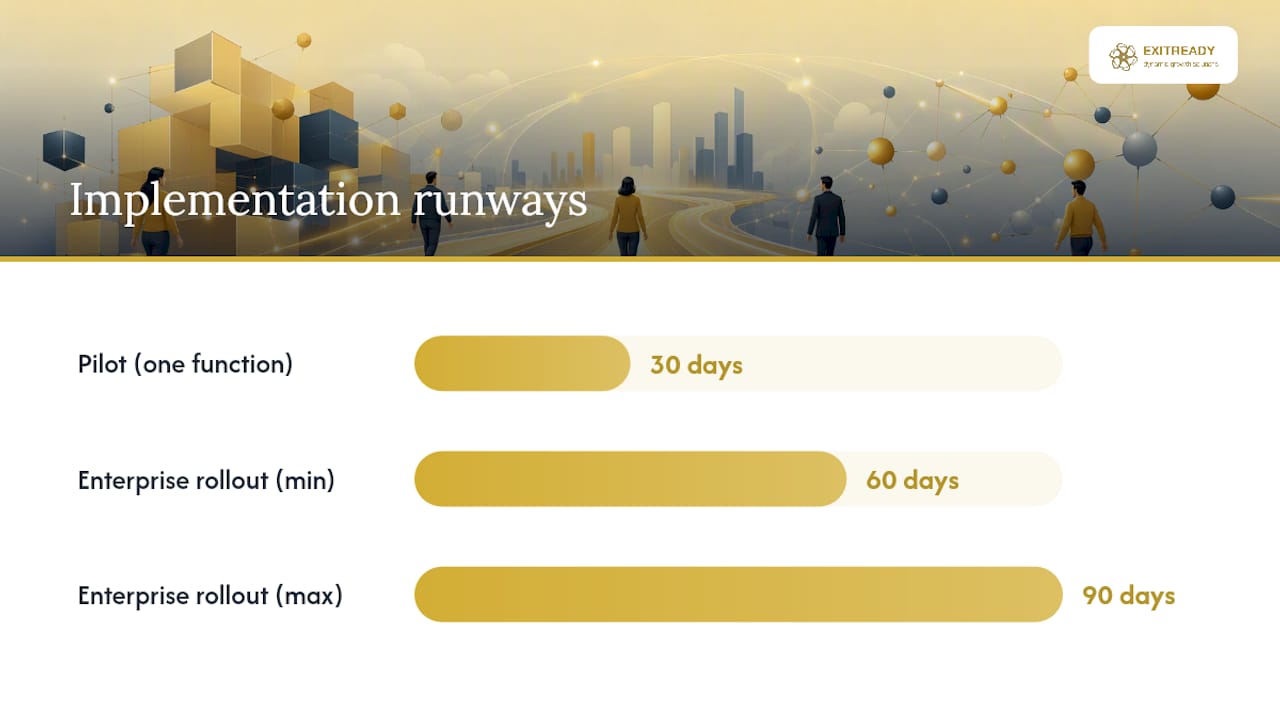
Pilot scope guidance: a 30-day pilot works best when limited to one function (operations, finance, or sales) and one manager. This keeps the feedback loop tight and makes it easy to measure rework and escalation changes before scaling. An enterprise-wide rollout across multiple departments typically requires a 60–90 day runway with a change management layer.
Pro Tip: Don’t try to implement all six frameworks simultaneously. Pick the one that solves your most painful current problem — usually role confusion (RACI) or rework from bad handoffs (CLEAR) — and add layers after the first 30 days.
Your 30–90 day implementation playbook and templates
A structured rollout prevents the most common failure mode: launching a framework with enthusiasm, then watching it quietly die because no one documented the rules or reviewed the results.
Delegation worksheet template
| Field | What to fill in |
|---|---|
| Task | Specific deliverable or decision |
| Outcome | What “done” looks like (measurable) |
| Decision rights | What the delegate can decide alone |
| Approval limit | Dollar or risk threshold before escalation |
| Inputs required | Data, access, or resources the delegate needs |
| Escalation trigger | Condition that requires owner involvement |
| Metrics | How success is measured |
| Review cadence | When and how you will check in |
A decision-rights matrix should always include approval limits, required inputs, and escalation triggers so owners can audit decisions after the fact.
Sample DOA snippet
“The Operations Manager is authorized to approve vendor contracts up to $25,000 annually without additional sign-off. Contracts exceeding this threshold require the CEO’s written approval. This authority is reviewed annually or upon a change in role.”
For full governance language and review cadence guidance, the Pearl Initiative DOA Guide provides a solid structural reference.
Pilot metrics to track
- Decision turnaround time (target: reduction from baseline by end of Month 1)
- Percentage of tasks delegated vs. handled by owner
- Rework rate (tasks returned for correction)
- Escalation frequency (decisions that bounced back to owner)
Pro Tip: Log escalations in a shared doc for the first 30 days. Patterns in what keeps bouncing back reveal either a missing CLEAR element or an approval limit set too low.
Why does delegation fail, and how do you fix it?
Most delegation breakdowns trace back to four root causes. Each has a precise fix.
- Missing information at handoff. Symptom: the delegate comes back with questions within 24 hours. Fix: run the CLEAR script before every handoff. Athena’s research on the CLEAR framework identifies missing context and undefined limits as the top two causes of failed delegations.
- Mismatched authority. Symptom: the delegate completes the task but can’t get the resources or approvals they need. Fix: delegation must include the associated authority — accountability without decision power creates frustration and stalls work. Update the DOA to match the responsibility.
Practical escalation script: “I need your input on [decision]. Here’s what I know: [context]. Here are the options I see: [options]. My recommendation is [X]. I need a decision by [date].”
Taking work back without blame: “I want to adjust the scope on this one — not because of your work, but because the business priority shifted. Here’s what I’m taking back and why.”
Pro Tip: Harvard Business Review’s research on why leaders avoid delegating points to behavioral patterns, not skill gaps, as the primary barrier. The fix is structural: pre-commit to a review cadence so you’re not tempted to take work back out of anxiety.
What should you expect in the first 30–90 days?
The first 30 days feel uncomfortable for most owners. You will catch yourself wanting to take work back. That is normal, and it is the exact moment the framework earns its value — because the structure gives you a reason to hold the line.
Days 1–30: Expect a short-term increase in questions from your team as they test the new authority boundaries. Rework may temporarily rise as delegates learn the new standards. Decision turnaround time often slows before it speeds up. This is the calibration phase, not a failure signal.
Days 31–60: Escalations start dropping. Managers begin making decisions without prompting. The owner’s daily decision load visibly shrinks. This is when most owners first feel the time-reclamation benefit.
Days 61–90: The framework becomes habitual. Review cadences replace ad-hoc check-ins. The DOA is tested against real decisions and refined. By the end of Month 3, a well-implemented framework produces a measurable reduction in owner involvement in operational decisions and a visible improvement in decision speed across the management team.
The key mindset shift: the 30–90 day window is not about perfection. It is about replacing implicit, owner-held decision logic with explicit, documented rules the team can follow independently.
How do you measure whether your delegation framework is working?
Measurement turns a delegation experiment into a delegation system. Without it, you are relying on gut feel — which is exactly what the framework was designed to replace.
Core KPIs to track:
- Owner hours on operational tasks. The most direct measure of time reclaimed. Pair this with CEO-level KPIs to confirm the owner is shifting toward strategic work.
Feedback loops that actually work:
Run a 15-minute weekly review with each pilot manager for the first 60 days. Ask three questions: What decision did you make this week that you would have escalated before? What did you need that you didn’t have? What would make the next handoff cleaner? Those answers refine your CLEAR scripts and DOA thresholds faster than any survey.
A monthly retrospective at the team level catches systemic gaps — recurring escalation patterns, approval limits that are consistently too low, or decision categories that need to be added to the DOA.
How do you get your team to actually adopt the framework?
A delegation framework fails at the human layer more often than the structural one. People resist not because the framework is wrong, but because the change feels like a test they might fail.
Lead with transparency. Tell the team exactly why you are implementing the framework and what you expect to change. “I’ve been a bottleneck. This system fixes that, and it gives you more authority, not less” lands better than a policy memo.
Start with volunteers. Identify one or two managers who are already operating with high autonomy and make them the pilot cohort. Their early success creates social proof for the rest of the team. This mirrors the management coaching principle of building delegation capability through guided practice rather than mandate.
Separate the framework from performance reviews. If managers believe the delegation system is a way to measure and punish mistakes, they will escalate everything to protect themselves. Make the first 60 days explicitly a learning period with no punitive consequences for escalations.
Reinforce ownership publicly. When a manager makes a good call using their delegated authority, name it in a team meeting. Behavioral reinforcement accelerates adoption faster than training sessions.
Address the “what if I’m wrong” fear directly. Build an explicit escalation trigger into every delegation so managers know exactly when they are expected to bring the owner in. Ambiguity about when to escalate is what drives over-escalation, not lack of confidence.
For a broader change management approach during operational transformation, business transformation best practices cover the full rollout sequence.
Legal and compliance considerations for delegation authority
Delegation of authority carries legal weight in a business context, and the documentation matters as much as the intent.
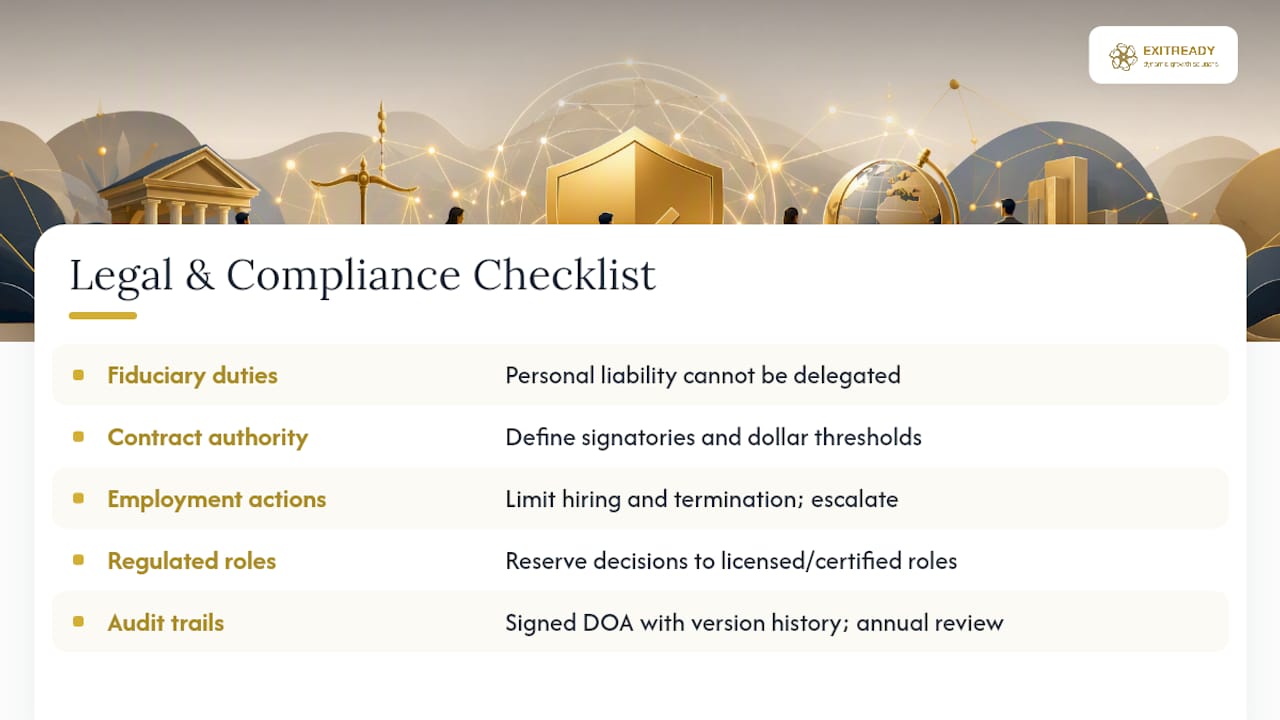
Fiduciary and corporate governance. In a US corporation or LLC, officers and directors carry fiduciary duties that cannot be fully delegated. An owner can delegate operational decision-making to a manager, but cannot delegate personal liability for decisions that fall within their fiduciary role. Any DOA should be reviewed by legal counsel to confirm it does not inadvertently transfer duties that carry personal liability.
Contractual authority. A manager who signs a vendor contract without documented authorization can create binding obligations for the business even if the owner did not intend to grant that authority. The DOA should explicitly define who is authorized to execute contracts, at what dollar threshold, and for what categories of agreement.
Employment decisions. Hiring, termination, and compensation changes carry legal exposure. Delegating these decisions requires clear documentation of authority limits and a defined escalation path to HR counsel or the owner for decisions above a defined threshold.
Regulatory and compliance functions. In regulated industries (financial services, healthcare, food production), certain compliance decisions cannot be delegated below a licensed or certified role. The DOA must reflect these constraints explicitly.
Audit trails. A signed, dated DOA with version history protects the business in disputes about who authorized a decision. The Pearl Initiative DOA Guide recommends formal review and re-authorization at least annually or upon any change in role.
This section provides general information, not legal advice. Confirm your DOA structure and authority assignments with a qualified business attorney before implementation.
Key Takeaways
A business delegation framework replaces owner-held decision logic with documented authority structures, review cadences, and escalation rules that the team can follow independently.
| Point | Details |
|---|---|
| Start with CLEAR | Use the CLEAR script on your next handoff to eliminate rework from missing information. |
| Match framework to task risk | Use DOA for high-stakes decisions, WHO/WHAT/BY WHEN for daily operations, RACI for cross-functional work. |
| Measure escalation frequency | Track how often decisions bounce back to you weekly — a downward trend confirms the framework is holding. |
| Expect 30–90 days to stabilize | Rework and questions spike in the first 30 days; measurable time reclamation typically appears by Day 60. |
| Dynamicgrowthsolutions AOS | Dynamicgrowthsolutions’ AOS provides pre-built delegation playbooks, DOA templates, and a structured rollout that compresses the typical 60–90 day DIY timeline to 30 days. |
Why systems beat willpower for owners
Every owner I’ve seen try to delegate “more” without a framework ends up back in the same place within 90 days. The intention is real. The follow-through collapses because willpower is finite and the pull of familiar control is strong. A documented framework removes the decision about whether to delegate — it makes delegation the default, not the exception.
The owners who build durable businesses are not the ones who work harder at letting go. They are the ones who install a system that makes holding on structurally inconvenient. When your DOA says the operations manager approves vendor contracts up to $25,000, you don’t need discipline to stay out of it. The document does that work for you.
That shift, from willpower to structure, is what separates a business that scales from one that plateaus at the owner’s personal capacity. And it is exactly what a well-implemented delegation framework, paired with the right operating system, produces.
How Dynamicgrowthsolutions accelerates delegation adoption for mid-market owners
Mid-market owners who try to build a delegation system from scratch typically spend the first 60 days designing templates, the next 30 days training the team, and another 30 days fixing what broke. That is a 90-day runway before the framework actually holds.

Dynamicgrowthsolutions’ AOS (Accelerated Operating System) compresses that timeline by arriving with pre-built delegation playbooks, DOA templates, RACI structures, and CLEAR handoff scripts already adapted for mid-market operations. The first engagement starts with an operational assessment that maps your current decision load, identifies the highest-leverage delegation opportunities, and produces a signed DOA within the first two weeks. Owners typically see a measurable reduction in operational decision involvement within 30 days, not 90.
The AOS also connects delegation to the broader goal most mid-market owners are working toward: a business that runs without them, commands a premium valuation, and is genuinely exit-ready. Delegation is not just a time-management tool in this context. It is a transferability asset.
If you are ready to stop designing the framework yourself and start running it, request a business operating system assessment to see exactly where your delegation gaps are and what a structured rollout looks like for your business.
Useful sources and templates
- The CLEAR Framework: How to Delegate So Your EA Can Actually Own the Work
- Delegation Frameworks for High-Performing Teams
- Delegation of Authority Guide
- Delegation of Authority Matrix – Denver Business Coach
- Delegation of authority: examples, templates & best practices | Careerminds
- Why Aren’t You Delegating? | HBR
- PMC article on delegation and organizational performance
- Delegation Framework: Let Go Without Losing Control