
Standard operating procedures (SOPs) are the core mechanism driving consistent performance, operational independence, and scalable growth in mid-market businesses. The role of SOPs in mid-market growth goes far beyond documentation. SOPs replace owner dependency with repeatable systems, protect institutional knowledge, and directly raise enterprise valuation. Businesses that implement SOP discipline experience a 1x–3x EBITDA increase by reducing founder dependency. That is not an operational detail. It is a financial outcome that belongs in every executive’s growth plan.
How do SOPs improve operational efficiency and sales growth in mid-market companies?
SOPs produce measurable sales results, not just cleaner processes. Mid-market companies that implement SOPs for sales processes see 15% higher quota attainment and 20% faster sales cycles. Those two numbers represent real revenue, not theoretical efficiency gains.
The reason is straightforward. Without documented processes, sales teams rely on tribal knowledge. Mid-market firms face a “RevOps gap” where tribal knowledge has a half-life of only 18 months. When a top performer leaves, their methods leave with them. SOPs capture that knowledge before it walks out the door.
The time reclaimed from undocumented processes compounds quickly. When every team member follows the same pipeline management steps, handoffs between sales and operations stop breaking down. Consistent outputs replace heroic individual effort. That shift is what makes a business scalable rather than owner-dependent.
- Pipeline management: Document every stage gate, follow-up trigger, and disqualification criteria.
- Onboarding: Standardize the first 30, 60, and 90 days so new reps reach quota faster.
- Handoff protocols: Define exactly when and how sales passes to delivery or account management.
- Objection handling: Record proven responses so institutional knowledge survives turnover.
Pro Tip: Start by recording your top performer’s process verbatim before building the SOP. Their actual behavior, not the ideal behavior, is your most accurate baseline.
What is SOP maturity and why does it matter for sustainable mid-market growth?

SOP maturity describes how deeply documented processes are embedded into daily operations. Most mid-market companies stop at level one: they write the process down. That is necessary but not sufficient for sustainable growth.
A four-level maturity model shows where most firms stall:
- Documented. The process exists in writing. It covers the basic steps but lacks ownership, metrics, or update schedules.
- Adopted. Teams actually follow the process. Training reinforces it, and managers check compliance during reviews.
- Measured. KPIs like conversion rates or cycle times are tied directly to the SOP. Deviations trigger reviews, not just complaints.
- Embedded. The SOP updates itself through a defined trigger. Owners are named. Audits are scheduled. The process is a living asset.
Most firms operate at level one or two. The gap between level two and level three is where growth stalls. Without embedded metrics and assigned owners, SOPs become historical documents rarely referenced after six months to a year. That is not a documentation problem. It is a governance problem.
“Measurement is the single most impactful improvement that $5M to $15M companies can make to operational quality. Without it, even well-written SOPs decay into compliance theater.”
The practical consequence of a maturity gap shows up in operations, not in documents. A sales SOP without a conversion rate benchmark cannot tell you whether the process is working. A hiring SOP without a 90-day retention metric cannot tell you whether the right candidates are being selected. Embedding KPIs into SOPs turns a passive document into a proactive management tool. That shift separates companies that grow predictably from those that grow chaotically.
SOP documentation is also critical for surviving leadership transitions. When a key executive or department head leaves, a mature SOP library keeps operations running. Without it, the business loses both the person and the process simultaneously.
What are the core components of effective SOPs for mid-market businesses?
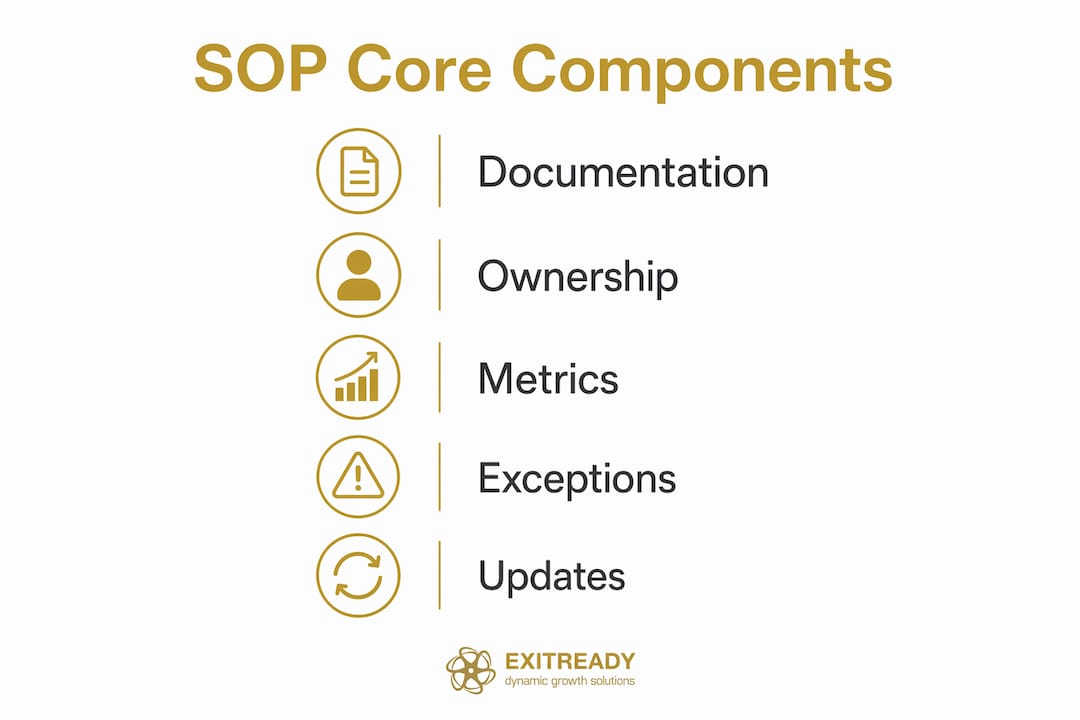
Every effective SOP contains five non-negotiable components. Missing any one of them creates ambiguity, and ambiguity is where compliance breaks down.
- Title and version number: Identifies the process and tracks changes over time.
- Purpose: States why the process exists and what outcome it produces.
- Scope: Defines which teams, roles, or situations the SOP applies to. Missing scope is a top cause of SOP misuse.
- Procedure: The step-by-step instructions, including decision points and escalation protocols.
- Responsibilities: Names the role or individual accountable for each step and for keeping the SOP current.
Beyond the five core components, format determines whether people actually use the document. Three formats serve different needs:
| Format | Best for | Key advantage |
|---|---|---|
| Step-by-step | Linear, sequential tasks | Easy to follow; minimal training required |
| Hierarchical | Complex processes with sub-tasks | Shows structure and dependencies clearly |
| Flowchart | Decision-heavy processes | Visualizes branching logic at a glance |
A customer onboarding process with multiple decision points benefits from a flowchart. A financial close checklist works better as a step-by-step list. Choosing the wrong format does not make the SOP wrong. It makes it harder to use, which means teams will skip it.
Pro Tip: Add a “common exceptions” section at the bottom of every SOP. Teams will encounter edge cases. Documenting the approved response in advance prevents improvised workarounds that undermine the process.
For financial processes specifically, pairing internal SOPs with outsourced accounting services can reduce the documentation burden while maintaining compliance standards.
How can mid-market leaders prioritize SOP development without overwhelming their teams?
Start with the two or three processes causing the most revenue leakage or operational confusion. Exhaustive documentation attempts fail because they spread effort too thin. Prioritizing high-impact processes first creates quick wins and builds momentum for broader SOP adoption.
The most effective approach shifts from calendar-based to trigger-based SOPs. A calendar-based SOP says “review quarterly.” A trigger-based SOP activates when a specific event occurs, such as a data quality threshold being breached or a deal stalling past a defined stage. Trigger-based SOPs are more responsive and harder to ignore.
Ownership is the single most important structural decision in SOP implementation. Unclear ownership is the primary reason SOP compliance fails, not lack of technology or skilled personnel. Every SOP needs one named owner who is responsible for updates, compliance checks, and escalation decisions.
Sustaining SOPs as living documents requires four habits:
- Assign a named owner for every SOP, not a team or department.
- Set update triggers based on process changes, not just annual reviews.
- Tie each SOP to at least one KPI so performance deviations surface automatically.
- Run quarterly audits on your top five highest-impact SOPs before expanding the library.
The business scalability checklist from Dynamicgrowthsolutions maps these priorities directly to mid-market growth stages, making it easier to sequence SOP development without creating a documentation backlog.
Pro Tip: When a process breaks down, treat it as an SOP audit trigger, not just a performance conversation. The breakdown is data. It tells you whether the SOP is missing, outdated, or simply not being followed.
Key Takeaways
SOPs drive mid-market growth by converting institutional knowledge into repeatable, measured, and owner-accountable processes that reduce dependency on individuals and raise enterprise value.
| Point | Details |
|---|---|
| SOPs raise valuation | SOP discipline produces a 1x–3x EBITDA increase by reducing founder dependency. |
| Sales performance improves | Documented sales SOPs deliver 15% higher quota attainment and 20% faster cycles. |
| Maturity level determines impact | SOPs without embedded metrics and named owners decay within six to twelve months. |
| Format must match the process | Step-by-step, hierarchical, and flowchart formats each serve different process types. |
| Ownership prevents failure | Unclear ownership is the primary cause of SOP non-compliance, not technology gaps. |
SOPs are assets, not administrative overhead
The most common mistake I see mid-market executives make is treating SOP development as a one-time project. They assign it to an operations manager, get a folder of documents, and consider the work done. Six months later, the folder is outdated and nobody references it.
SOPs are not administrative overhead. They are the operating infrastructure of a business that can grow without the owner in every room. The executives who understand this treat their SOP library the way a CFO treats the balance sheet: something to be maintained, measured, and updated on a defined schedule.
The second mistake is over-documentation. I have seen companies spend months writing SOPs for processes that happen twice a year. That effort belongs on the five processes that touch revenue every week. Get those right first. Build the habit of ownership and measurement. Then expand.
The third mistake is confusing documentation with adoption. A written SOP that nobody follows is not an asset. It is a liability, because it creates the illusion of operational control without the reality. The business operating manual framework addresses this directly by connecting documentation to accountability structures that actually change behavior.
The leaders who get this right share one habit: they review SOP compliance data in their weekly leadership meetings, not just in quarterly audits. That cadence keeps processes alive and keeps teams accountable without turning SOP management into a separate job.
— Andre
How Dynamicgrowthsolutions supports SOP implementation for mid-market owners
Dynamicgrowthsolutions works with mid-market owners who are ready to replace operational chaos with documented, measured systems. The AOS (Accelerated Operating System) is built specifically for companies that have outgrown informal processes but have not yet reached the operational maturity needed for predictable growth or a premium exit.
The program covers SOP development, ownership structures, and the metrics that keep processes current. Owners who complete the AOS program report reduced personal workload and improved team accountability without adding headcount. If you are ready to build the operating infrastructure your business needs, explore the business operating system framework that Dynamicgrowthsolutions uses with mid-market companies at every growth stage.
FAQ
What is the role of SOPs in mid-market growth?
SOPs convert institutional knowledge into repeatable processes that reduce owner dependency and support consistent revenue generation. They are the foundation of operational independence and higher enterprise valuation.
How do SOPs affect business valuation?
Businesses with strong SOP discipline experience a 1x–3x EBITDA increase by demonstrating that operations do not depend on any single individual. Buyers pay a premium for businesses that run without the founder.
What is SOP maturity?
SOP maturity describes how deeply a process is embedded into daily operations, ranging from basic documentation to fully measured and trigger-based systems with named owners and compliance audits.
How many SOPs should a mid-market company start with?
Start with two to three SOPs covering the processes that cause the most revenue leakage or operational confusion. Building momentum with high-impact processes is more effective than attempting to document everything at once.
Why do SOPs fail in mid-market companies?
SOPs fail primarily because of unclear ownership and missing metrics, not because of poor writing or lack of technology. Without a named owner and a tied KPI, even well-written SOPs become inactive within six to twelve months.