

A business growth roadmap is a strategic, visual document that maps your company’s growth goals, sequences the key initiatives required to reach them, assigns ownership, and defines timelines and dependencies for coordinated execution. Most owners confuse it with a business plan or a project plan. Those are different tools with different jobs. A growth roadmap sits between them, translating your long-term vision into a cross-functional plan your team can actually execute. According to Shopify’s roadmapping framework, roadmaps typically span 6 to 24 months and are designed to align teams around outcomes like revenue growth and market expansion.
What key components make up an effective business growth roadmap?
An effective growth roadmap is built from six interlocking components. Miss one and the whole structure weakens. Here is what each layer does and why it matters.
- Business outcomes. Start with measurable targets, not vague ambitions. “Grow revenue by 40% in 18 months” is an outcome. “Grow faster” is not. Your outcomes anchor every decision that follows.
- Strategic themes. Group your initiatives into two to four broad themes such as customer acquisition, operational capacity, or product expansion. Themes give your team a shared mental model for prioritizing work.
- Initiatives with named owners. Each initiative needs one accountable person. Missing ownership mechanics is the primary failure mode in growth roadmaps, according to Shopify. Without a named owner, accountability diffuses and nothing gets done.
- Dependencies. Some initiatives cannot start until others finish. Mapping these prevents parallel execution that stalls progress and wastes resources.
- Milestones and timelines. Realistic milestones create visible checkpoints. AHA notes that roadmaps can span anywhere from 6 months to 10 years, with both long- and short-term versions running concurrently for different planning horizons.
- KPIs and review cadence. Every initiative needs a metric that tells you whether it is working. Shopify recommends monthly team reviews and quarterly leadership reviews to keep the roadmap current and actionable.
Pro Tip: Link each KPI directly to a strategic theme, not just to an individual initiative. This forces your team to ask whether the work is moving the needle on the bigger goal, not just completing tasks.
The six components above are not bureaucratic overhead. They are the mechanics that turn a slide deck of goals into a system your business can run without you in every meeting.

How does a business growth roadmap differ from a business plan and a project plan?
Many owners treat these three documents as interchangeable. They are not. Each serves a distinct audience and a distinct purpose, and using the wrong one for the wrong job creates confusion.
A business plan is investor-facing. It makes the strategic and financial case for why your company exists and where it is going over three to five years. It answers “what and why.” A growth roadmap answers “what and when.” It is a mid-term visual plan that connects your strategy to cross-functional execution across teams. A project plan answers “who and how.” It manages tasks, deliverables, and deadlines for a specific initiative. Roadmaps serve as the bridge between the strategic goals in your business plan and the execution tasks in your project plans.
The table below makes the distinctions concrete.
| Document | Primary audience | Time horizon | Core focus | When to use it |
|---|---|---|---|---|
| Business plan | Investors, lenders | 3 to 5 years | Strategic and financial case | Fundraising, founding, major pivots |
| Growth roadmap | Leadership, cross-functional teams | 6 to 24 months | Goals, initiatives, ownership, timelines | Ongoing strategic execution |
| Project plan | Delivery teams | Days to months | Tasks, resources, deadlines | Managing specific initiatives |
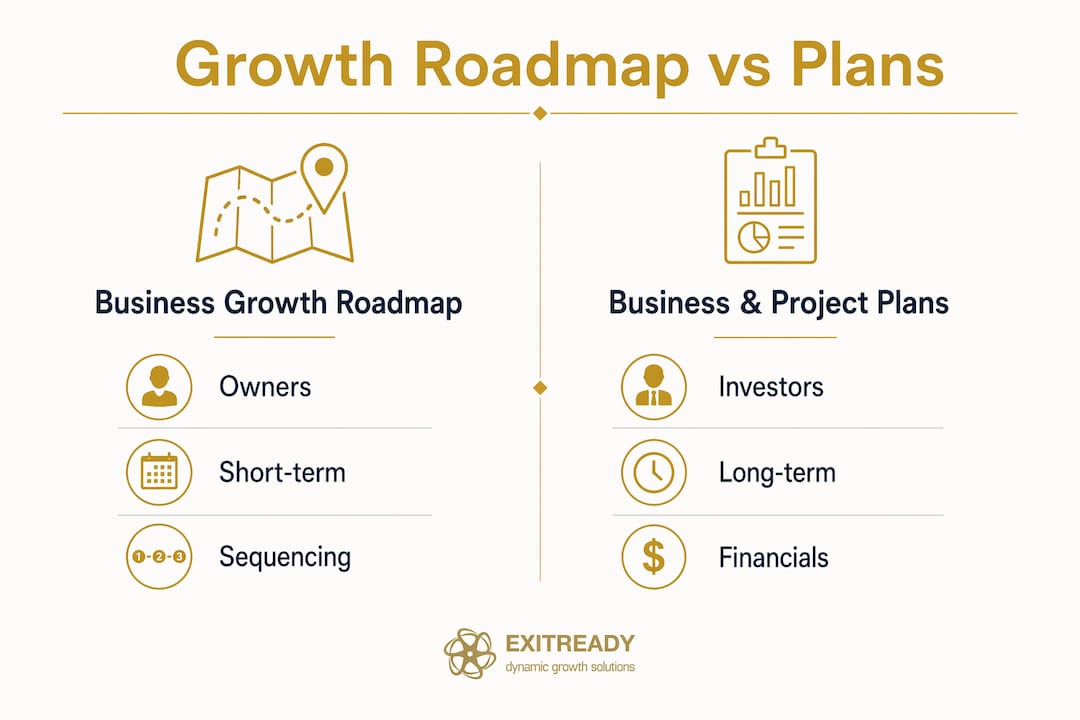
The practical implication is this: you need all three, but you use them at different moments. Your business plan sets the destination. Your growth roadmap plots the route. Your project plans manage each leg of the journey.
Why a living roadmap is critical for scalability and operational independence
A static roadmap becomes obsolete the moment market conditions shift or a key hire falls through. Truist describes two distinct phases of roadmap management: setup and continuous refinement. Most owners invest heavily in setup and then let the document sit untouched for six months. That is where the value disappears.
The living roadmap concept means your document is updated as new information arrives, not just at annual planning. When a competitor launches a product that changes your acquisition strategy, your roadmap should reflect that within weeks, not at next year’s offsite. This adaptability is what separates companies that scale from those that plateau. AHA’s research shows that separating strategic long-term horizons from short-term iterative execution cycles, with KPI-driven reviews, enables agile course correction without losing sight of the bigger goal.
For mid-market owners specifically, a living roadmap does something even more valuable. It reduces owner dependency. When your roadmap has named owners, documented dependencies, and a regular review rhythm, the business can execute without you being in every decision. That is the foundation of scalable business infrastructure and the precondition for a premium exit valuation.
Pro Tip: Schedule a 30-minute roadmap review on the last Friday of every month. Bring the initiative owners, review KPI progress, and update any dependencies that have shifted. This single habit prevents the roadmap from becoming a shelf document.
How to create a growth roadmap that drives sustainable results
Building a growth roadmap is a structured process, not a brainstorming session. Follow these steps in sequence and you will have a document your team can actually use.
- Define your business growth outcomes. Start with two to three measurable targets tied directly to your vision. Revenue, market share, customer retention, or EBITDA margin all work. Avoid vague goals. Specificity is what makes outcomes useful as decision filters.
- Develop and prioritize strategic themes. Identify the two to four areas of the business that must improve to hit your outcomes. Prioritize themes based on impact and current growth constraints. MarketingJuice stresses that roadmaps fail without sequencing priorities around true growth constraints and clear success metrics.
- Map initiatives with named owners and dependencies. For each theme, list the specific initiatives required. Assign one owner per initiative. Then map which initiatives depend on others being completed first. This sequencing step is where most roadmaps either succeed or collapse.
- Set milestones and timelines. Assign realistic completion dates to each initiative. Build in buffer for dependencies. Milestones should be visible to the whole team, not buried in a spreadsheet.
- Define KPIs for each initiative. Choose one to two metrics per initiative that signal progress. Tie them back to the strategic theme they support. This is how you know whether the work is producing the intended outcome.
- Establish a review rhythm. Monthly reviews with initiative owners and quarterly reviews with leadership keep the roadmap current. This cadence is what transforms a static document into a living growth plan.
For visualization and maintenance, tools like Aha!, Miro, Notion, and Productboard each offer roadmap templates suited to different team sizes and complexity levels. The tool matters less than the discipline of keeping it updated.
Here is what a well-sequenced roadmap looks like in practice for a mid-market services firm targeting 35% revenue growth in 18 months:
- Theme 1: Sales capacity. Initiative: hire two senior account executives by Q2. Owner: VP of Sales. Dependency: compensation structure finalized by Q1.
- Theme 2: Delivery scalability. Initiative: document and systematize top three service delivery processes by Q3. Owner: COO. Dependency: sales capacity initiative complete.
- Theme 3: Client retention. Initiative: launch quarterly business review program for top 20 accounts by Q4. Owner: Customer Success Lead. Dependency: delivery systematization complete.
Notice how each theme builds on the previous one. That sequencing logic is what makes a roadmap commercially sound rather than just a list of good ideas. For owners working to reduce their own operational involvement, resources like common bottlenecks in business growth can help identify where sequencing typically breaks down.
Key takeaways
A business growth roadmap works because it connects measurable outcomes to named owners, sequenced initiatives, and a regular review cadence that keeps execution aligned with strategy.
| Point | Details |
|---|---|
| Core definition | A growth roadmap maps goals, initiatives, owners, timelines, and dependencies for coordinated execution. |
| Six essential components | Outcomes, strategic themes, named owners, dependencies, milestones, and KPIs are all required. |
| Distinct from a business plan | A roadmap answers “what and when” for teams; a business plan answers “what and why” for investors. |
| Living document discipline | Monthly team reviews and quarterly leadership reviews prevent the roadmap from becoming obsolete. |
| Operational independence | Named ownership and documented dependencies allow the business to execute without owner involvement in every decision. |
Why most growth roadmaps fail before they start
I have worked with dozens of mid-market owners who built a roadmap in a two-day offsite and never looked at it again. The document was thorough. The problem was that no one owned it after the retreat ended.
The most common mistake I see is treating the roadmap as a deliverable rather than a management system. Owners spend weeks building a beautiful visual, present it to the leadership team, and then return to running the business the same way they always have. The roadmap becomes a PDF on a shared drive. Six months later, the company is off-track and no one can explain why.
What actually works is simpler than most people expect. Assign one person, not a committee, to own the roadmap as a whole. That person is responsible for running the monthly reviews, updating dependencies, and flagging when an initiative is at risk. Without that single point of accountability, the roadmap drifts.
The second mistake is building a roadmap that reflects what owners want to be true rather than what the business can actually execute. I have seen companies list 14 strategic initiatives for a 12-month period with a team of 8 people. That is not a roadmap. That is a wish list. A credible roadmap requires honest capacity assessment before any initiative gets added. If you want to build a scalable business model, the roadmap has to reflect what your current infrastructure can support, not just what your ambition demands.
The owners who get the most from their roadmaps treat it like a financial statement. They review it regularly, they hold people accountable to it, and they update it when reality changes. That discipline is what separates companies that scale from those that stay stuck.
— Andre
Take your growth roadmap from concept to execution
Building a growth roadmap is the first step. Executing it without burning out or losing control of your business is the harder part. Dynamicgrowthsolutions works with mid-market owners to build structured growth plans backed by the AOS (Accelerated Operating System), a proprietary framework that replaces owner dependency with documented processes and accountable teams.

If you want to see where your business stands before building your roadmap, the 360-ProfitDriver analysis gives you a data-driven baseline across profitability, operations, and growth capacity. For owners ready to accelerate, the EXITREADY events program connects you with advisors, fractional executives, and proven frameworks for scaling toward operational independence and a premium exit.
FAQ
What is a business growth roadmap in simple terms?
A business growth roadmap is a visual strategic plan that outlines your company’s growth goals, the initiatives required to reach them, who owns each initiative, and the timelines and milestones for execution. It typically spans 6 to 24 months and connects your long-term strategy to day-to-day team action.
How is a growth roadmap different from a business plan?
A business plan makes the financial and strategic case for your company, primarily for investors, over a three to five year horizon. A growth roadmap is an internal execution tool that maps what your teams need to do and when, typically over 6 to 24 months.
How often should you update a business growth roadmap?
Shopify and AHA both recommend monthly reviews with initiative owners and quarterly reviews with leadership. This cadence keeps the roadmap current as market conditions, team capacity, and priorities shift.
What causes a growth roadmap to fail?
Growth roadmaps fail most often due to missing ownership, poor sequencing of initiatives, and lack of a regular review cadence. Without named owners and dependency mapping, initiatives run in parallel and delay each other, reducing overall execution speed.
What tools can you use to build a growth roadmap?
Aha!, Miro, Notion, and Productboard each offer roadmap templates suited to different team sizes. The choice of tool matters less than maintaining a consistent review rhythm and keeping ownership assignments current.