

Most business owners have heard the advice to work on the business, not just in it. But understanding what does working in versus on business mean in practice is where things get murky. The distinction is not about which mode is better. Both are necessary, and confusing them is what keeps talented founders stuck. This article breaks down both concepts clearly, shows you how to transition between them at the right times, and gives you a practical framework for integrating both without dropping the ball on either.
Table of Contents
- Key takeaways
- What working in versus on your business actually means
- Why both modes are necessary, not competing
- How to transition from working in to working on your business
- Balancing and integrating both modes effectively
- Common mistakes owners make with these two modes
- My honest take on this distinction
- Ready to shift from operator to owner?
- FAQ
Key takeaways
| Point | Details |
|---|---|
| Two distinct modes exist | Working in covers daily operations; working on covers strategy, systems, and leadership design. |
| Neither mode is superior | Ignoring operational realities creates blind spots; ignoring strategy causes stagnation. |
| Delegation means ownership transfer | Giving someone a task is not the same as giving them the authority to own outcomes. |
| Structured routines make it real | Weekly one-to-two hour blocks and monthly audits turn strategic intent into consistent practice. |
| Transitions happen in phases | Early-stage businesses are nearly 100% operational; growth requires a deliberate shift in how founders spend time. |
What working in versus on your business actually means
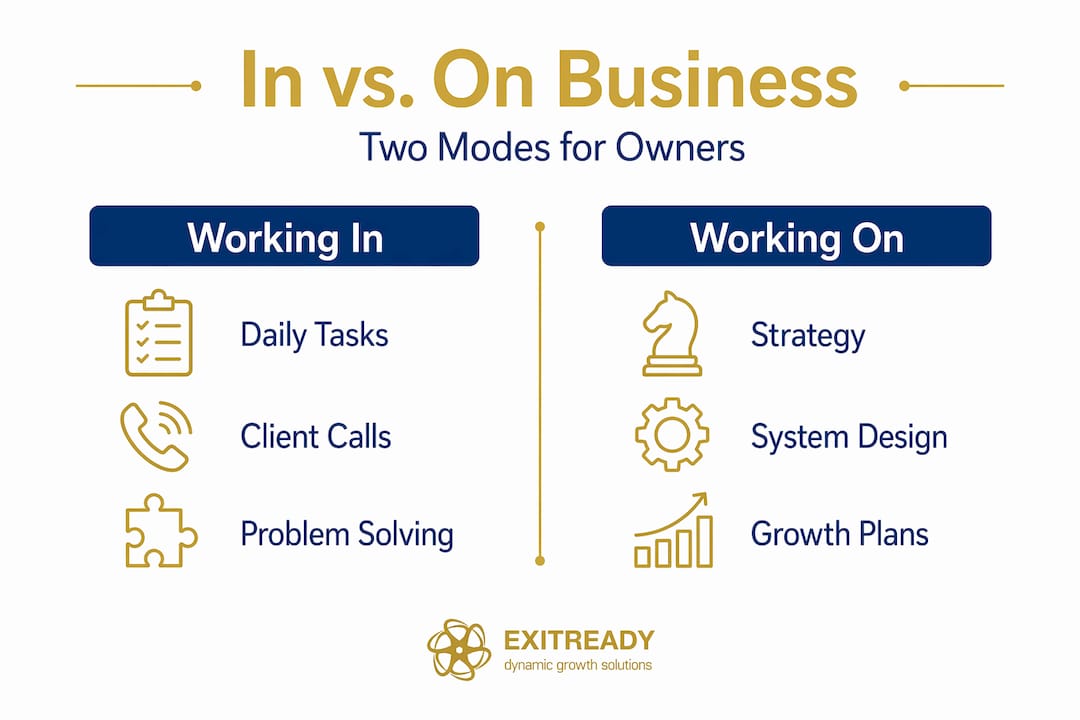
The difference between working in and on business is simpler than most people make it. Working in your business means you are doing the work that produces the product or service. You are answering customer calls, running the job site, reviewing invoices, managing the schedule, and fixing the problems that show up every day. You are the operator.
Working on your business means you are designing the system that runs those operations. You are building the processes, hiring the right people, setting the direction, and creating the conditions for growth. You are the architect.

Here is what that looks like in practice:
Working in the business:
- Handling customer inquiries and complaints directly
- Producing deliverables or managing production
- Solving the day’s urgent problems
- Training individual employees one by one
- Running weekly team meetings as the sole decision maker
Working on the business:
- Documenting processes so others can handle operations consistently
- Hiring and developing leaders who own entire departments
- Reviewing financial performance and adjusting strategy
- Identifying new markets, partnerships, or revenue streams
- Building the culture, structure, and systems that outlast your daily presence
According to research on early-stage business labor, working “in” the business composes almost 100% of a founder’s time in the early phase. That is not a failure. It is a feature of getting a business off the ground. The problem is when it never changes.
Pro Tip: If your business would stop functioning the moment you took a two-week vacation, you are working exclusively in it. That is your baseline measurement.
Why both modes are necessary, not competing
Here is where popular business advice gets it wrong. The framing that working “on” is smarter or more evolved than working “in” creates a false hierarchy. The truth is that both modes are complementary and necessary for sustainable success.
Without spending time in your business, you lose touch with reality. You make decisions based on assumptions instead of ground-level knowledge. Products drift. Teams disconnect. Customers notice before you do. Leaders who never engage with operations are often the last to know when something is breaking.
Without spending time on your business, you become the ceiling. Growth stalls because everything runs through you. The company cannot scale past your personal bandwidth. You end up doing the same work year after year while wondering why nothing changes.
“Without working ‘in’ your business, leaders risk losing touch with product reality leading to poor decisions, while skipping ‘on’ work causes stagnation.” — OrganizationBuilders
The goal is not to abandon one mode for the other. It is to earn the right to spend more time on strategic work by building systems that handle operations without your constant presence. That shift requires:
- Recognizing where you currently spend your time
- Identifying which operational tasks only you can do versus which ones can be delegated
- Building toward a ratio that fits your business stage, not someone else’s ideal
The right balance also changes over time. A business generating $1 million in revenue needs its founder in the work far more than one generating $20 million. Understanding operating model inflection points is what tells you when that shift should happen and how fast to make it.
How to transition from working in to working on your business
Most founders know they need to shift. They just do not know how to do it without everything falling apart. The transition is not about doing less. It is about changing the level at which you work. As Forbes experts note, moving from operator to leader means moving from doing the work to designing the system that does the work.
Here is how to approach that shift deliberately:
- Audit where your time actually goes. Track your week in 30-minute blocks for two weeks. Most owners are shocked by how much of their time goes to tasks a $40-per-hour employee could handle.
- Hire for operational ownership, not task completion. The difference matters enormously. A general manager or department head who owns an outcome is not the same as an employee who follows a to-do list. Business owners who hire a dedicated operational leader report significantly better focus and reduced stress.
- Transfer decision rights, not just tasks. When you delegate, the goal is to give someone the authority to make decisions within a defined scope, not just execute your instructions. Delegating ownership with decision rights prevents you from remaining the bottleneck even after you technically “let go.”
- Formalize your strategic work time. Block time for strategy the way you block time for a client meeting. If it is not on the calendar, it will not happen.
- Document before you delegate. Create written processes for the tasks you are handing off. This is not bureaucracy. It is the difference between delegation that works and delegation that fails and sends everything back to you.
- Accept the discomfort. Stepping back from daily heroics feels wrong at first. The urgency of operational problems is compelling, and solving them feels rewarding. True strategic leadership requires tolerating that discomfort and trusting the systems you built.
Pro Tip: Start with one lane of the business. Pick the function where you are the least specialized and build a system there first. Delegation gets easier once you see it work.
Balancing and integrating both modes effectively
Knowing the difference between working in and on business is one thing. Making it a consistent practice is another. The research is clear on what structure actually works for mid-market owners.
| Cadence | Activity | Time Commitment |
|---|---|---|
| Weekly | Focused strategic thinking block | 1 to 2 hours |
| Monthly | Progress audit of systems, finances, and team | Half day |
| Quarterly | Strategic review and course correction | Full day |
| Annually | Off-site planning session with leadership team | 1 to 2 days |
Experts recommend allocating 1 to 2 hours weekly for focused strategic work and a half-day monthly for progress auditing. These are not long commitments, but they require protecting that time against the constant pull of operational demands.
A few practices that help owners hold this structure:
- Schedule strategic blocks at the start of the week, not the end. Energy is higher and the week has not yet consumed your attention.
- Use the monthly audit to review your time audit alongside your financials. Both tell you what is actually happening.
- Treat the annual off-site as non-negotiable. Distance from the daily operation gives you the perspective you cannot get from inside it.
- Use a mid-market owner’s guide to set realistic benchmarks for how much strategic time you should be spending at your current revenue stage.
The structured cadence recommended by TVA works because it embeds strategic leadership into your operating rhythm rather than treating it as something you do when things calm down. Things never calm down. The structure has to come first.
Common mistakes owners make with these two modes
Understanding the concept is not enough if the execution misses the mark. Here are the mistakes that trip up even experienced business owners:
Treating “on” work as another task. Strategic thinking is not a line item on your to-do list. It is a different mode of operating that requires mental space and time free from operational interruptions. Owners who schedule “strategy” between back-to-back operational meetings are not actually doing strategic work. They are just labeling it differently.
Delegating tasks without delegating ownership. This is the most common mistake. You hand someone a responsibility, but you keep making every decision within it. The person becomes a clerk instead of a leader, and you stay the bottleneck. True ownership means they define how the work gets done, not just that they do it.
Chasing the visible reward. Strategic work lacks urgency and social reward compared to solving a customer crisis or closing a deal. The dopamine hit from operational wins is real, and it pulls founders back into the weeds constantly. Without deliberate accountability, most owners deprioritize the work that actually builds long-term value.
Pro Tip: Find an accountability partner, a peer group, or an advisor who will ask you every month what you actually did to work on the business. External accountability closes the gap between intention and execution faster than willpower alone.
My honest take on this distinction
I have worked with enough founders to know that the “work on your business” advice gets repeated constantly and applied rarely. The people who nod along have usually heard it so many times it has lost all meaning.
What I find genuinely challenging about this topic is the emotional weight of stepping back. Founders who built something from nothing have an identity tied to being the person who solves problems. Telling them to design systems instead of saving the day is not just a tactical shift. It is an identity shift. And that is far harder than any operational change.
The framing that “on” is superior to “in” makes the situation worse. It creates guilt around operational involvement instead of clarity about when each mode serves the business best. I have seen owners who were so focused on being “strategic” that they missed obvious operational breakdowns that any floor-level employee could have spotted.
What actually works is treating both modes as legitimate, recognizing which one the business needs more of right now, and building toward a structure where your time in operations becomes intentional rather than default. The goal is not to escape the work. It is to design the work so that it does not require you to be present for everything.
Founders who make this shift do not just build better businesses. They become better leaders, because the skill of designing systems that empower others is the same skill that makes any organization worth running.
— Andre
Ready to shift from operator to owner?
If you recognize yourself in the “working in” trap, the good news is the path out is structured and repeatable. Dynamicgrowthsolutions has helped mid-market owners make exactly this transition through proven operating frameworks and leadership development programs built specifically for your stage of growth.

Start with the 360-ProfitDriver analysis to uncover where your business is losing revenue and time because of owner dependency. Then explore CEO retreats and mastermind events designed to accelerate your shift into genuine strategic leadership. If you want to understand how scalability connects to exit value, that resource will reframe how you think about building your business entirely.
FAQ
What does working in versus on business mean?
Working in the business means doing the day-to-day operational work that keeps things running. Working on the business means designing the systems, strategy, and structure that allow the business to grow without depending on the owner’s constant involvement.
What are examples of working in a business?
Common examples include answering customer inquiries, managing production, scheduling staff, and solving daily operational problems. These are tasks that directly deliver the product or service rather than developing the business’s capacity to scale.
What is operational work in business?
Operational work covers all the activities required to deliver products or services consistently, including fulfillment, customer service, quality control, and day-to-day team management. It is the execution layer of the business.
How do you start working on your business instead of just in it?
The most effective starting point is auditing where your time goes, then delegating one operational area with full decision rights to a capable hire. Structured weekly blocks of one to two hours reserved for strategic work create the habit over time.
What are the benefits of working on your business?
Working on the business creates scalability, reduces owner dependency, increases valuation, and frees up time for growth activities. Owners who make this shift report significantly less stress and better long-term outcomes than those who remain purely operational.