

Most growing businesses don’t stall because of bad products or weak demand. They stall because the owner becomes the system. Understanding how business systems create scalability is the difference between a business that grows with you and one that grows dependent on you. When every decision, process, and quality check runs through a single person, growth hits a ceiling fast. This article breaks down what scalable systems actually look like, how to build them, and why they matter more than any single hire you’ll ever make.
Table of Contents
- Key takeaways
- How business systems create scalability
- What makes a system actually scalable
- Building systems that actually get used
- Governance and cadence that sustain growth
- Real outcomes from system-driven growth
- My take on why systems beat people as a growth strategy
- Take the next step toward operational independence
- FAQ
Key takeaways
| Point | Details |
|---|---|
| Systems replace owner dependency | Documented, repeatable processes free the owner to focus on strategy instead of daily operations. |
| Poor systems erode revenue | Manual process failures can cost businesses up to 20% of their revenue potential. |
| Structure beats talent alone | Scaling people without scaling systems creates operational chaos instead of sustainable growth. |
| Governance sustains scale | A structured cadence of objectives, sprints, and standups keeps systems aligned with business goals. |
| Systems increase exit value | Buyers pay a premium for businesses with documented, owner-independent operations. |
How business systems create scalability
Scalability means your business can handle significantly more volume, customers, or revenue without a proportional increase in cost, complexity, or owner involvement. That’s a precise definition, and most businesses miss it entirely.
The usual assumption is that you scale by adding more people. Hire a sales manager, bring on another operations lead, expand the team. But scaling people without systems just creates more chaos at a higher payroll. People need processes to execute consistently. Without them, you get variability, rework, and the same bottlenecks at a larger scale.
Scalable systems show up in specific forms: cloud platforms that handle increased transaction volume without added infrastructure cost, supply chains built with flexible vendor tiers, and documented standard operating procedures (SOPs) that allow any trained team member to deliver consistent results. The common thread is repeatability. The output stays consistent regardless of who is doing the work.
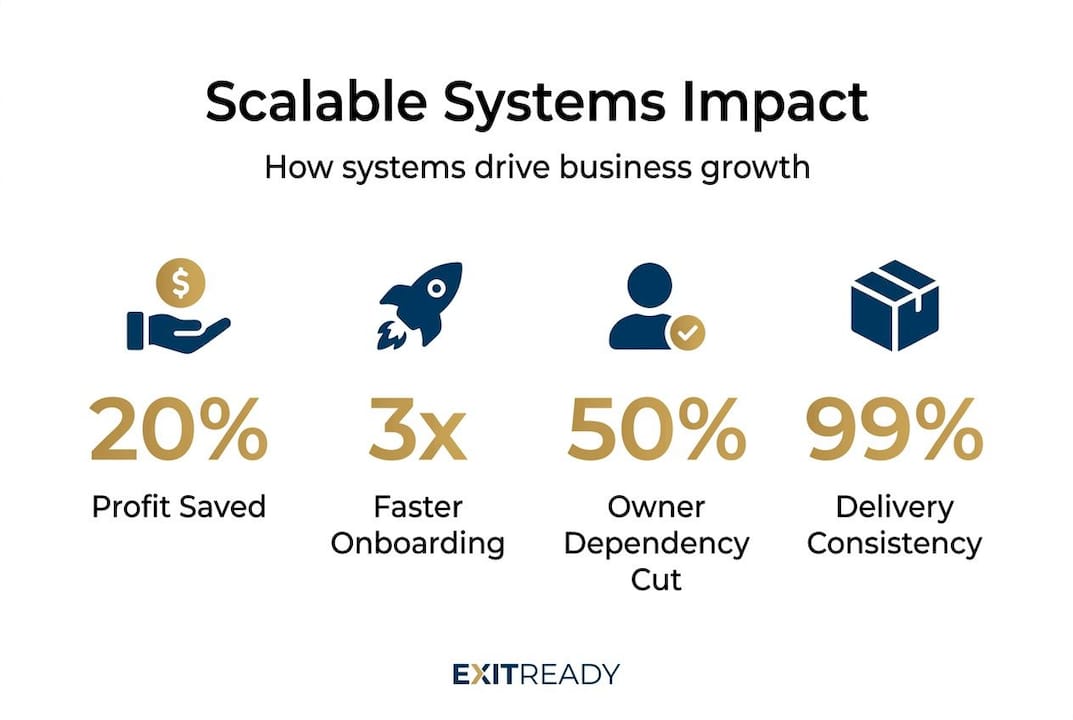
The hidden cost of skipping this step is significant. Companies relying on manual processes lose up to 20% of potential revenue when you factor in owner time, admin overhead, and internal failures. That’s not a rounding error. For a $10 million business, that’s $2 million sitting on the table because the back-end infrastructure can’t support what the front end is trying to produce.
Scalable systems also protect profitability as you grow. Without them, every new customer or product adds friction. With them, the marginal cost of serving one more customer drops over time. That’s the economic argument. The operational argument is just as strong: consistent systems produce consistent quality, and consistent quality retains customers.
What makes a system actually scalable
A system is not a checklist. It’s not even a collection of SOPs, though those are part of it. A scalable system produces consistent output meeting quality standards without founder involvement, and it includes feedback loops that trigger improvement.
The components that make this work together are:
- Processes and procedures: The documented steps for how work gets done, in what order, by whom.
- Tools and platforms: The technology that enforces or supports the process rather than leaving it to memory.
- Roles and decision rights: Who owns each part of the system, including who can make which decisions without escalation.
- Quality standards: The defined output criteria that tell you whether the process worked.
- Performance feedback: The metrics and review cadence that surface when something is breaking down.
The difference between isolated SOPs and an integrated system is significant. A single SOP tells someone how to onboard a client. An integrated system connects that onboarding SOP to a CRM trigger, a quality checklist, a 30-day review meeting, and a client satisfaction metric. Each piece references the others. When one breaks, the feedback loop catches it.
Systems also operate at different levels of the business. Delivery systems handle the core product or service. Support and management systems cover HR, finance, and operations. Strategic and improvement systems handle planning, performance reviews, and organizational learning. For true business process scalability, you need coverage at all three levels, not just the delivery layer.

| System level | Examples | Primary purpose |
|---|---|---|
| Delivery | Service delivery SOPs, production workflows | Consistent client or product output |
| Support and management | HR onboarding, financial reporting, IT ops | Keep the business running reliably |
| Strategic and improvement | OKRs, performance reviews, planning cadence | Align growth with organizational capacity |
Pro Tip: When mapping your systems, start at the delivery layer first. It has the most direct impact on revenue and quality, and wins there create momentum for building out the other levels.
Building systems that actually get used
The most common reason systems fail is not poor design. It’s poor adoption. A system that lives in a Google Drive folder nobody opens is not a system. It’s a document graveyard.
Here’s how to build systems that stick:
- Document while doing. The best time to capture a process is when the founder or expert is actually performing it. Have someone shadow you and write the steps in real time. Trying to reconstruct a process from memory weeks later produces gaps and inaccuracies.
- Keep it concise. A 40-page SOP will not be read. A one-page visual workflow with a short reference guide will. Test every document with a new employee before calling it final.
- Involve the people doing the work. Systems built in isolation by leadership rarely reflect reality. The team executing the process knows the shortcuts, the exceptions, and the actual sequence. Their input produces accuracy and buy-in simultaneously.
- Embed systems into your tools. Automated workflows enforce consistent execution far better than documentation alone. If your CRM sends the onboarding email automatically, the step doesn’t get skipped. If your project management tool requires a quality check before a task closes, the standard gets met. Scaling with technology solutions means making the right behavior the path of least resistance.
- Schedule regular reviews. Systems decay. Markets change, teams evolve, and what worked two years ago may be producing friction today. Quarterly reviews of core systems catch this before it costs you customers or revenue.
Pro Tip: Treat your first version of any system as a draft, not a decree. The team will surface improvements in the first 30 days of use that you could never anticipate from the design phase alone.
Building scalable business infrastructure early also costs far less than retrofitting it later. Building systems early reduces cost and disruption compared to waiting until organizational complexity forces the issue.
Governance and cadence that sustain growth
A system without a governance model is a car without a steering wheel. You might move forward for a while, but direction is an accident.
The governance structures that keep scalable systems aligned with growth are specific and deliberate. The VRM Group’s Business 102 Plan provides a practical model: a 90-day objective and 30-day sprint cadence with weekly leadership standups creates three interlocking loops that connect strategy to daily execution. Most businesses either plan too far out and lose connection to execution, or they’re so heads-down operationally that strategy never gets revisited. This cadence solves both problems.
Effective governance also includes:
- Clear decision rights: Documented RACI matrices that define who is responsible, accountable, consulted, and informed for each major process. This prevents decisions from piling up on the owner’s desk.
- Aligned KPIs: Metrics tied to each system’s purpose, owned by the person running that system, reviewed on a predictable schedule.
- Transparent documentation: Decision logs and risk registers that give leadership visibility without requiring everyone to attend every meeting.
The common pitfalls are worth naming directly. Meeting overload is real. When governance becomes a calendar full of status updates, it consumes the time it was meant to free up. Clear governance reduces noise and speeds execution by making fewer, better-structured meetings do more work. Shadow processes are equally dangerous: when teams work around official systems because the official systems are broken or ignored, you lose visibility and control. The fix is not more documentation. It’s involving the team in system design and maintaining senior leadership commitment to the cadence.
Real outcomes from system-driven growth
The business case for systems is not theoretical. Here’s what actually changes when scalability through business systems is built properly:
- Revenue retention improves. Consistent delivery means fewer service failures, fewer chargebacks, and lower churn. The revenue you’ve already earned stays earned.
- Owner time reclaims. When documented systems run operations, the owner shifts from daily firefighting to quarterly strategy. That shift is where the highest-value work happens.
- Employee turnover drops. Ambiguity is one of the top drivers of voluntary attrition. Clear roles, documented processes, and predictable decision rights give employees what they need to succeed without constant escalation.
- Buyer appeal increases. Documented repeatable processes increase business valuation because buyers purchase operational machines, not individuals. A business that depends on the owner is a job, not an asset.
- New markets become reachable. Expanding into a new geography or product line with a documented operational model is a replication exercise. Without that model, every expansion reinvents the wheel at full cost.
Businesses with strong systems function independently of the owner, yield predictable cash flow, and scale without structural failure. That’s the destination. The path there is building systems before you need them desperately.
My take on why systems beat people as a growth strategy
I’ve worked with enough mid-market owners to know the pattern. Revenue is growing, the team is expanding, and everything feels like progress. Then the wheels come off. Deadlines are missed, quality dips, and the owner is back in the weeds doing work three levels below their pay grade.
Almost every time, the problem is not the people. The people are fine. The problem is that the business scaled bodies without scaling the operating model underneath them. Scaling talent without systems just gives you more people experiencing the same friction, and now the payroll is higher.
What I’ve found is that owners who build systems early, before they feel the pain, end up with dramatically better businesses than those who wait for the crisis. There’s a discipline required here that doesn’t feel urgent when things are going well. That’s exactly when to do it.
The other thing most articles won’t tell you: system building is a cultural act, not just an operational one. When leadership commits visibly to documented processes, governance cadence, and metrics accountability, the team follows. When leadership treats systems as optional, the team treats them the same way. The owner’s behavior toward the system is the signal everyone else reads.
Start with your highest-revenue, highest-variability process. Document it, test it, improve it, and then move to the next one. Don’t try to systematize everything at once. Sustainable scale comes from building the discipline one system at a time, not from a single transformation project that nobody follows after the consultant leaves.
— Andre
Take the next step toward operational independence
If what you’ve read here reflects where your business is right now, you’re not alone. Most mid-market owners are running on a combination of tribal knowledge, personal relationships, and sheer willpower. That works until it doesn’t.

Dynamicgrowthsolutions built the AOS (Accelerated Operating System) specifically to address this. The 360-ProfitDriver analysis identifies where your business is losing revenue and operational efficiency right now, with specific data on which systems need to be built or fixed first. If you want a structured environment to work through this with other CEOs, the CEO mastermind events bring together owners at exactly this stage of growth. Both are designed to move you from owner-dependent to operationally independent, with measurable results attached.
FAQ
What does “scalability through business systems” mean?
Scalability through business systems means your business can grow revenue and output without requiring proportional increases in cost or owner involvement. It’s achieved by replacing manual, person-dependent processes with documented, repeatable systems.
Why do business systems matter more than hiring?
Hiring adds capacity but not structure. Without documented systems, new hires experience the same ambiguity and variability as everyone else. Systems make talent effective by giving people clear processes, decision rights, and quality standards to work within.
How do I start building scalable business systems?
Start by documenting your highest-revenue or highest-variability process while it’s being performed, not from memory afterward. Keep documentation concise, test it with new users, and embed it into the tools your team already uses daily.
How do systems improve business valuation and exit readiness?
Buyers assess operational independence as a core valuation factor. A business with documented processes and consistent output commands a higher multiple because it doesn’t require the seller to stay involved post-acquisition.
What is the role of governance in scaling operations?
Governance provides the structured cadence and decision-making framework that keeps systems working over time. Without it, even well-designed systems drift as teams develop workarounds and leadership attention shifts to other priorities.