
Owner bottlenecks stall growth because the business can only move as fast as one person can approve, decide, and execute, limiting revenue, hiring, and market expansion. This is the core mechanic behind what researchers call the “founder bottleneck”: the slow drift from doing everything to having to do everything, a transition that typically caps growth once the business reaches a certain small size. The business isn’t failing because the market dried up. It’s failing because the owner became the constraint leading to slow growth.
Here’s what that looks like in practice:
- Every significant decision waits for the owner’s approval
- Team members stop solving problems and start queuing questions
- New hires don’t reduce workload because processes live only in the owner’s head
- Growth comes in bursts, then stalls when owner capacity maxes out
- The business cannot function normally during the owner’s absence
Why owner bottlenecks stall growth: the control trap
The most common cause isn’t laziness or poor hiring. It’s what MIT Executive Education identifies as ineffective delegation: owners bring people on but never transfer real decision rights, so work escalates right back to them.
Harvard Business Review research points to something deeper. Owners unconsciously cling to tasks because those tasks validate their competence. The belief that “I can do it faster” or “quality will slip if I hand this off” feels rational, but it’s emotional attachment dressed as a standard. Service businesses face this acutely: clients often expect the founder personally, which reinforces the idea that stepping back costs revenue.
Structural gaps compound the psychology. Without a decision-rights framework, every gray-area call defaults to the owner. Without documented playbooks, the team literally cannot act without asking. Hiring reactively, only when overwhelmed, produces rushed onboarding and more work landing back on the owner’s desk “just until they figure it out.”
Pro Tip: Audit one week of your calendar. Sort every task into four buckets: decisions only you can make, decisions you happen to be making, work you do out of habit, and work you hide behind. Categories three and four are your bottleneck.
How growth stalls when the owner is the constraint
The damage compounds fast. Stalled decision flow means lost deals. A prospect waiting three days for a pricing approval often doesn’t wait at all. A supplier swap that needs your sign-off delays a project that delays a client that delays a referral.

Burnout follows. Owners carrying the full operational load past the point their week can hold it don’t just slow down: they make worse decisions, miss strategic opportunities, and eventually stop enjoying the business they built. The barriers to business expansion most commonly cited by business owners, including difficulty recruiting and high operating costs, are often downstream of this same problem. An owner who is the bottleneck can’t build the infrastructure to hire well or manage costs strategically.
Owner bottlenecks also kill competitive agility. When the owner is consumed by day-to-day approvals, there’s no bandwidth left for market positioning, product development, or responding to a competitor’s move. The business becomes less able to innovate and expand into new opportunities.
Key growth impacts at a glance:
- Slow approvals cause missed sales and delayed delivery
- Owner burnout degrades decision quality at the top
- Teams become passive, waiting rather than acting
- Innovation stalls because strategic thinking gets crowded out
- Business value drops because buyers won’t pay a premium for a company that stops working when the owner leaves
Strategies that actually reduce owner dependency
The fix starts with an honest inventory, not a new hire. Without infrastructure to run without the owner, any hiring or tool adoption just adds cost without removing the bottleneck.
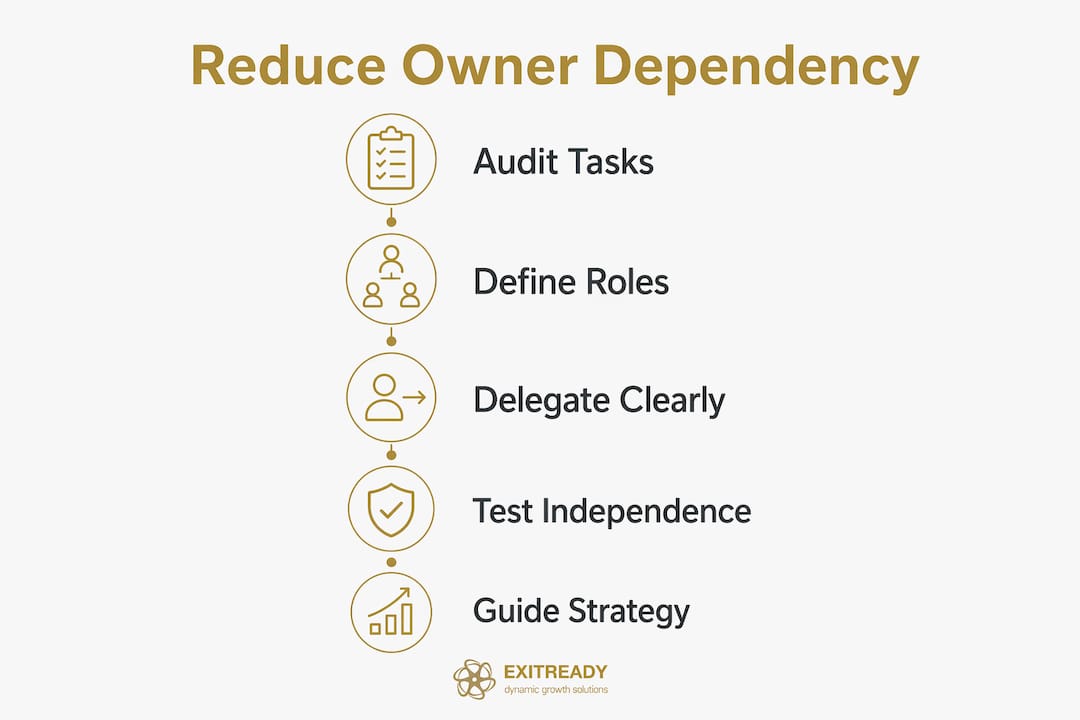
Start by auditing where your hours actually go. Most owners feel busy but don’t have the data. Once you see the pattern, classify work by decision type: what genuinely requires your judgment versus what you’re doing out of habit or anxiety.
From there, build the infrastructure that makes delegation real:
- Document processes as playbooks. If the method lives only in your head, your team can’t execute without you. Written standards turn your expertise into a transferable asset.
- Define decision rights explicitly. A simple framework, “you decide,” “bring me options,” or “I decide,” eliminates the ambiguity that sends every gray-area question to your inbox.
- Build leadership roles early. Project leads, operations coordinators, and client success managers distribute responsibility before you’re underwater, not after.
- Hand off responsibility, not just tasks. Effective delegation means transferring ownership of outcomes, with context, clear expectations, and room for the team to make calls.
Owners who shift from approving every action to guiding strategy consistently report better throughput and less stress. The team gets better faster when they’re allowed to own outcomes. You can also explore founder psychology resources to understand the identity shifts that make letting go genuinely difficult.
Pro Tip: The “two-week test” is the most honest diagnostic available: step away completely for two weeks with no check-ins. If performance stalls, your systems are undocumented and the bottleneck is structural, not personal.
What you gain when the bottleneck is gone
Removing owner dependency doesn’t just free up your calendar. It changes what the business is worth.
Buyers and investors price owner-dependent businesses at a discount because the asset walks out the door with the owner. Documented systems, distributed leadership, and a team that operates independently are what improve valuation and exit readiness, according to Dynamicgrowthsolutions’s EXITREADY program data. A business that runs without you is a business someone else can confidently buy or invest in.
Operationally, throughput improves immediately. Decisions get made faster, client response times drop, and the team stops waiting for permission. Owners who make this shift also report a measurable reduction in stress and a recovery of strategic thinking time, the hours previously consumed by approvals and routine questions.
Benefits that compound over time:
- Faster decisions improve customer experience and retention
- Leadership depth reduces key-person risk across the organization
- Owner reclaims time for strategy, relationships, and growth planning
- Business becomes attractive to buyers, partners, and investors
- Scalability opens new markets and revenue streams that were previously out of reach
Signs you’re already the bottleneck
Most owners don’t recognize the pattern until it’s costing them real money. The common signs of owner-reliant businesses include working more hours while profits stay flat, growth that spikes then stalls, and a team that asks permission before acting on anything routine.
The clearest signal is the two-week test. If you can’t step away without the business degrading, the systems aren’t there yet. Other tells: you’re the only one who knows how to handle a specific client, you review and approve content before it goes out, and new hires slow you down instead of taking work off your plate.
What stalled growth looks like in practice
A mid-market consulting firm with 15 staff hits a revenue ceiling not because clients stop coming, but because the founder is still the primary delivery resource on every engagement. The team is capable, but the founder never documented the methodology, so clients always request her directly. She can’t take on more work. She can’t delegate the work she has. Revenue flatlines.
A manufacturing business with 22 employees can’t expand into a second product line because every operational decision still routes through the owner. The operations manager is competent but has no authority to approve supplier changes or adjust production schedules. The owner is the single point of failure, and the expansion plan sits on hold for 18 months.
These aren’t edge cases. They’re the standard pattern for businesses that grew past 15 people without building the systems to match.
How to delegate without losing control of quality
Delegation fails most often because of ambiguity, not incompetence. Before handing anything off, define what “done” looks like in writing. Set a decision threshold: below this dollar amount or risk level, the team decides. Above it, they bring options.
Give context, not just instructions. A team member who understands why a standard exists will apply it correctly in situations you didn’t anticipate. One who only knows the rule will break it the first time the situation looks slightly different.
Expect a learning curve and budget for it. The first time someone handles a task you’ve always owned, it will take longer and may not be perfect. That’s the cost of building capacity. Owners who treat early delegation mistakes as proof that “it’s easier to do it myself” never break the cycle. Check the scalability checklist for a structured approach to building delegation infrastructure.
Risks to watch when reducing owner dependency
Moving too fast creates its own problems. Handing off critical client relationships before the team has the context to manage them can damage revenue. Delegating financial approvals without clear thresholds can expose the business to costly errors.
The other common pitfall is delegating tasks without transferring accountability. The owner stays emotionally involved, second-guesses decisions, and quietly takes work back. The team learns that delegation isn’t real, and the bottleneck reasserts itself within weeks.
Perfectionism is the quietest saboteur. Standards matter, but “I know it when I see it” is not a standard you can teach. If you can’t articulate what excellent looks like in writing, you can’t delegate it. Build the standard first, then hand off the work.
Dynamicgrowthsolutions’s AOS gives you the infrastructure to scale
The reason most delegation efforts fail isn’t willpower. It’s the absence of a system that makes independence possible.
Dynamicgrowthsolutions’s proprietary AOS (Accelerated Operating System) is built specifically for mid-market owners who are ready to stop being the bottleneck. AOS documents your critical workflows, defines decision rights at every level, and builds the leadership infrastructure that lets your team operate without routing everything through you. The result is a business that runs on systems, not on the owner’s availability. Owners who implement AOS report faster decisions, reduced workload, and measurably improved business operating system performance. If you’re preparing for a premium exit or simply want your business to grow past your personal capacity, AOS provides the documented framework to get there.
Key Takeaways
Owner bottlenecks stall growth because the business can only scale as fast as the owner can decide, approve, and execute, and that ceiling is always lower than the market opportunity.
| Point | Details |
|---|---|
| The core bottleneck mechanic | Growth caps at the owner’s personal capacity when decisions and processes aren’t distributed. |
| The control trap | Emotional attachment and fear of quality decline keep owners doing work that should belong to the team. |
| Infrastructure before delegation | Hiring alone doesn’t remove dependency; documented playbooks and decision rights must come first. |
| Valuation impact | Businesses with documented systems and distributed leadership attract buyers and command higher exit multiples. |
| Dynamicgrowthsolutions AOS | The AOS methodology documents workflows, defines decision rights, and builds the leadership depth that makes owner independence real. |