
Blog post: Why consensus kills companies — and what to build instead
LEADERSHIP & GROWTH
Thank you for reading this post, don't forget to subscribe!Most small businesses don’t fail because the market turned against them. They fail because of a decision they made long before the trouble started — usually around a table, with three partners, trying to agree on everything.
It sounds noble at first. Equal voices. Shared ownership. Democratic leadership. In practice, it is one of the most reliable ways to stall a growing company.
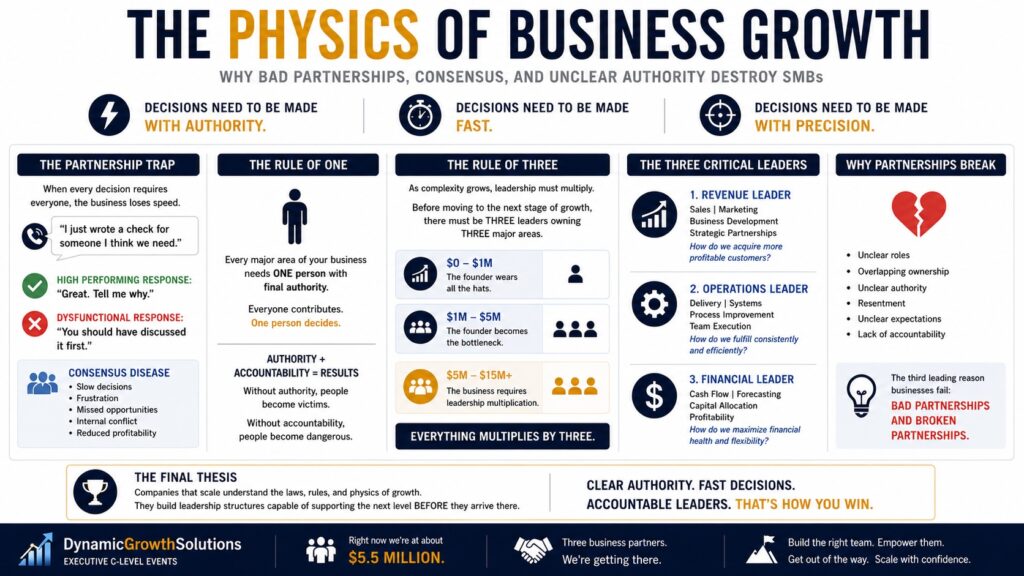
Business growth follows physical laws as predictable as gravity. And one of those laws is this: as a company grows, authority must become clearer, decisions must become faster, and accountability must land on one person per function. Violate these rules, and eventually the organization breaks — not with a bang, but with a slow, frustrating plateau.
THE PARTNERSHIP TRAP
When every decision needs a vote
Picture the scene: three co-founders around a table. A hiring decision needs to be made. A new market opportunity has surfaced. Instead of acting, the partners begin discussing. Then debating. Then scheduling another meeting.
The moment every decision requires consensus, the organization starts losing its most valuable competitive edge: speed.
Consider a simple test. One partner calls another and says: “I just hired someone I think we need.” The response to that call tells you everything about the organization’s future. A high-performing company says, “Great — tell me why.” A dysfunctional one says, “You should have asked first.”
One values authority and accountability. The other values permission and politics. One grows. One stagnates.
SCALING LEADERSHIP
The rule of three
At around $1 million in revenue, a founder wearing every hat is exhausting but manageable. At $3–5 million, that same founder becomes the bottleneck. At $5–15 million, a founder who remains the center of everything becomes fatal to the business.
The company needs three leaders — each owning a distinct domain, each empowered to make decisions, each accountable for results. Not input. Not a seat at every meeting. Final authority.
01 — Revenue
Revenue leader
“How do we acquire more profitable customers?”
02 — Operations
Operations leader
“How do we fulfill consistently and efficiently?”
03 — Finance
Financial leader
“How do we maximize financial health?”
When these three functions are clearly owned, growth becomes sustainable. When they overlap — when two people technically “own” the same domain — conflict becomes inevitable. Not because the people are difficult, but because the structure invites it.
THE REAL DANGER
Why partnerships fracture
Partnerships rarely fail because people are bad actors. They fail because roles were never clearly defined. When authority overlaps, conflict emerges. When accountability overlaps, resentment builds. One partner feels they’re doing all the work. Another feels ignored. Another feels controlled.
The business becomes a battlefield — and the problem isn’t the people. It’s the structure they’re trapped in.
Founders often create the very problems they later complain about. They hire people but won’t delegate authority. They appoint leaders but require approval for everything. Then they wonder why decisions are slow.
You cannot decentralize responsibility while centralizing authority. Either empower people or expect to become the bottleneck — there is no middle ground.
THE TAKEAWAY
Businesses aren’t democracies
The hidden reason most SMBs plateau isn’t market conditions or competition. It’s the failure to evolve the leadership structure as complexity increases.
Complexity grows faster than revenue. Leadership must grow faster than complexity. Accountability requires authority. And every major function needs exactly one accountable leader — not a committee, not a consensus, one person who owns it and lives with the outcome.
The companies that successfully scale from $1 million to $10 million and beyond aren’t necessarily smarter, better-funded, or luckier. They just respect the physics — and they build the leadership structure the next stage of growth demands before they actually need it.
BOTTOM LINE
The moment every decision requires a vote, growth slows. Build clear ownership now — before the complexity forces the conversation.