

A dysfunctional business system is defined as any operational structure that consistently fails to deliver its intended outcomes, despite active effort and apparent compliance from the people inside it. The standard industry term for this condition is “systemic dysfunction,” and it differs from isolated process failure in one critical way: the system itself is producing exactly the results it was designed to produce. The problem is not the people. The problem is the architecture. Recognizing this distinction is the first step toward fixing it, and business systems thinking gives leaders the framework to see it clearly.
What is a dysfunctional business system, and how do you know you have one?
Systemic dysfunction rarely announces itself. Signs of a dysfunctional business appear 6–12 months before financial failure, showing up first in behavioral changes rather than balance sheets. Communication volume drops. Decisions slow to a crawl. Meetings multiply without producing results. By the time revenue declines, the system has been broken for a long time.

The behavioral signals are measurable. Communication volume drops 15–20% over 60 days without any headcount change, and decision velocity slows from two days to two weeks. That shift means information is no longer flowing freely, and people have stopped trusting the system enough to act within it.
Three categories of early warning signals stand out:
- Communication collapse. Fewer emails, shorter meetings, and less cross-functional coordination signal that people are working around the system rather than through it.
- Decision paralysis. When approvals that once took 48 hours now take two weeks, the system has lost its authority structure.
- Vanity meetings. Meetings that produce no decisions, no owners, and no deadlines are a sign that accountability has left the building.
- Revenue concentration risk. 40–50% of revenue from one or two clients is a major risk threshold for mid-market businesses. It signals that the sales system has not built a diversified pipeline, which is a structural failure, not a sales team failure.
Pro Tip: Track decision velocity as a leading indicator. Log how long it takes from a decision being raised to a decision being made. If that number doubles over a quarter, your system has a structural problem.
Why your system is not broken — it is working exactly as designed
The most counterintuitive insight in organizational management is this: most dysfunctional systems are not broken. They are producing outcomes consistent with their incentives and structural design. The system is doing its job. The job is just wrong.
“Changing people alone does not fix systemic dysfunction. The underlying rules, incentives, and information flows must change first. A system will always produce behavior that is rational within its own constraints, regardless of how irrational that behavior looks from the outside.”
This is why replacing a manager or firing a team rarely fixes the problem. The next person steps into the same structure and produces the same results. Intervention planning must focus on how the system rewards or protects dysfunctional behaviors before any personnel or process change is made.
The practical implication is that leaders need to map two things before acting:
- Reward structures. What behaviors does the current system reward? If salespeople are paid on revenue booked rather than revenue collected, the system incentivizes bad deals.
- Information flows. Who sees what, and when? If frontline managers do not have access to real-time performance data, they cannot make good decisions. Improving transparency shifts behavior without top-down mandates, and it is one of the lowest-barrier interventions available.
The difference between a symptom and a root cause matters enormously here. High employee turnover is a symptom. The root cause might be a compensation structure that caps earnings at a level below market rate. Fixing the symptom by improving onboarding does nothing. Fixing the root cause by redesigning the pay structure changes the system.
How to diagnose dysfunction in your business systems
Diagnosing systemic dysfunction requires a structured approach. The following four-step process gives business owners a repeatable method for finding where their systems are leaking value.
- Map your feedback loops. Every system has feedback channels: customer complaints, employee suggestions, financial reports, and operational metrics. Identify who owns each channel and whether feedback actually reaches a decision-maker.
- Apply a dissonance detector. A dissonance detector reveals hidden failures by showing where feedback is being suppressed or ignored. Ask: where are people not raising problems they clearly see? That silence is the signal.
- Assign feedback owners with response timelines. A 72-hour response requirement for feedback channels improves feedback closure and forces the system to process information rather than bury it.
- Rate system health on a 1–5 scale. Score each core process on clarity of expectation, ownership, and follow-through consistency. Any process scoring below 3 on two or more dimensions is a failure point.
The System Health Visualizer (SHV) framework uses three lenses to assess operational health: dissonance detection, feedback loop integrity, and local maxima traps. A local maximum is a point where a system has optimized for a metric that no longer serves the business goal. For example, a customer service team that optimizes for call resolution time may sacrifice customer satisfaction to hit the number.
| Indicator | Early behavioral signal | Lagging financial signal |
|---|---|---|
| Decision velocity | Approvals taking 10+ days | Missed market opportunities |
| Communication volume | 15–20% drop over 60 days | Project delays and cost overruns |
| Revenue concentration | 40–50% from 1–2 clients | Cash flow volatility |
| Feedback closure rate | Unresolved issues older than 72 hours | Customer churn increase |
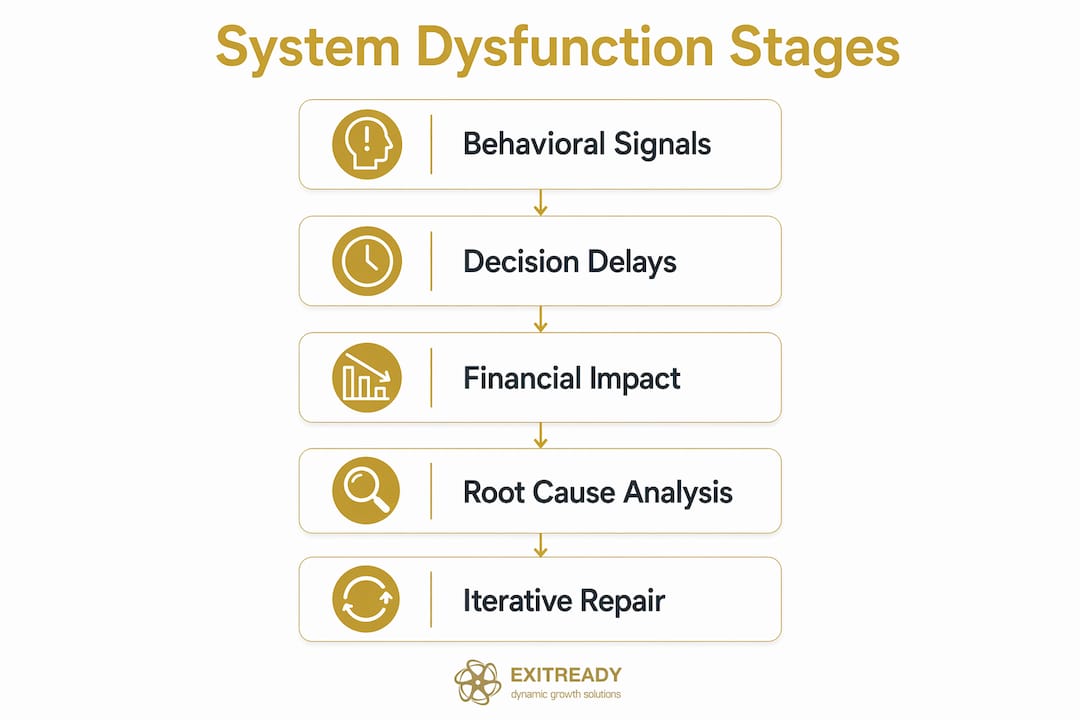
Pro Tip: Use the business scalability checklist from Dynamicgrowthsolutions to audit your system health indicators against mid-market benchmarks. Early behavioral signals are far cheaper to fix than lagging financial ones.
What practical steps fix a dysfunctional system without starting over?
Systems rarely fail altogether. They fail at specific points where expectation, ownership, or follow-through breaks down. That means targeted repair is almost always more effective than a full reset. A full reset destroys institutional knowledge, disrupts client relationships, and creates the illusion of progress without addressing root causes.
The repair sequence that works follows a clear pattern:
- Isolate the failure point. Do not treat the whole system as broken. Identify the specific process, handoff, or decision node where value is leaking. Use your system health ratings from the diagnostic step to prioritize.
- Restore clarity on expectations. Unclear expectations, weak ownership, and inconsistent follow-through are the three structural failures that cause system drift. Write down what “done” looks like for every critical process. If it is not written, it does not exist as a standard.
- Assign single-point ownership. Every process needs one person who is accountable for its outcome. Shared ownership is no ownership. The moment two people are responsible, neither is.
- Build rhythms for follow-through. Weekly check-ins, monthly reviews, and quarterly audits create the cadence that keeps systems honest. Without rhythm, accountability decays within weeks.
- Modify structural elements last. Change incentives, reporting lines, and information flows only after you have clarity on what the system needs to produce. Individual motivation cannot overcome a misaligned system. Durable improvement demands redesign of the structure, not just the people.
The iterative repair approach also protects against misdiagnosis. When you change one variable at a time, you can see what actually moved the needle. When you overhaul everything at once, you cannot learn from the result. For mid-market businesses considering an exit, exit-ready business systems require documented, repeatable processes that function without owner intervention. That standard is also the standard for a healthy system.
Outsourcing specific functions, such as outsourced accounting services, can reduce operational load during a repair phase and eliminate one category of systemic risk while internal processes are being rebuilt.
Key Takeaways
A dysfunctional business system is defined by its incentive architecture, not its people, and fixing it requires changing the structure rather than replacing individuals.
| Point | Details |
|---|---|
| Behavioral signals come first | Communication drops and decision slowdowns appear 6–12 months before financial failure. |
| Systems produce designed outcomes | Dysfunction reflects flawed incentives and structure, not individual failure. |
| Diagnose before intervening | Map feedback loops and assign ownership before changing any process or personnel. |
| Repair beats replacement | Target specific failure points rather than resetting entire systems to preserve institutional knowledge. |
| Transparency shifts behavior | Improving information flows changes decisions without requiring top-down mandates. |
The uncomfortable truth about system design most owners miss
I have worked with enough mid-market business owners to know that the hardest conversation is not about the numbers. It is about the system they built. Most owners designed their systems during a growth phase, when speed mattered more than structure. Those systems worked then. They do not work now.
The trap I see most often is what I call “symptom chasing.” An owner sees high turnover and hires an HR consultant. They see missed deadlines and hire a project manager. They see flat revenue and hire a sales trainer. None of it sticks, because the underlying architecture still rewards the wrong behaviors and withholds the information people need to make good decisions.
The shift that actually produces results is moving from “who is failing?” to “what does this system reward?” That question changes everything. It removes blame, reveals structure, and points directly at what needs to change. The owners who make this shift stop being surprised by recurring problems. They start seeing their business as a system that produces predictable outputs, and they realize they have the power to redesign those outputs.
The other misconception worth addressing is that fixing a dysfunctional system requires a complete overhaul. It almost never does. The most durable repairs I have seen come from restoring three things: clarity, ownership, and follow-through. Those three elements are the skeleton of any healthy system. When they are present, even imperfect processes tend to self-correct over time.
— Andre
How Dynamicgrowthsolutions helps you rebuild from the inside out
Identifying dysfunction is one thing. Building a system that stays healthy under pressure is another challenge entirely.

Dynamicgrowthsolutions works with mid-market business owners to diagnose operational dysfunction and replace it with documented, owner-independent systems through the AOS (Accelerated Operating System). The business transformation framework used by Dynamicgrowthsolutions addresses the exact failure points covered in this article: incentive misalignment, broken feedback loops, and unclear ownership. The 360-ProfitDriver diagnostic tool identifies hidden revenue leaks and operational gaps before they become financial problems. If your business is producing results you did not design for, that is the signal to act. The AOS entrepreneur application is the starting point for owners ready to build systems that perform without them.
FAQ
What is a dysfunctional business system?
A dysfunctional business system is an operational structure that consistently fails to deliver its intended outcomes because its incentives, information flows, or ownership structures are misaligned. The system produces results, but not the results the business needs.
What are the first signs of business system dysfunction?
The earliest signs are behavioral: communication volume drops 15–20% over 60 days, decision velocity slows from days to weeks, and meetings multiply without producing decisions or owners.
Can you fix a dysfunctional system without replacing it entirely?
Yes. Systems fail at specific points, not all at once. Restoring clarity on expectations, assigning single-point ownership, and building consistent follow-through rhythms repairs most dysfunction without a full reset.
What causes business systems to become dysfunctional over time?
Systems become dysfunctional when their incentive structures and information flows no longer match the business’s goals. Growth changes what the business needs, but the system architecture often does not change with it.
How long does it take to fix a dysfunctional business system?
The timeline depends on how many failure points exist and how deeply they are embedded in the culture. Behavioral improvements from structural changes typically appear within one to two quarters when the right failure points are targeted first.