
A business health diagnosis is a holistic, evidence-based evaluation of your company’s performance across financial, operational, commercial, people, and strategic dimensions, designed to surface root causes rather than just symptoms, and to deliver a prioritized action plan you can execute. Unlike a financial audit, which confirms whether your numbers are accurate, a diagnosis asks why those numbers look the way they do and what to do about it.
Two things a diagnosis produces:
- A health scorecard by pillar (financial, operational, commercial, people, strategy) that shows where you are strong, where you are fragile, and which gaps carry the most risk
- A prioritized 30/90/180-day roadmap that separates quick operational fixes from deeper structural problems requiring longer-term investment
Who acts on it: the owner, the leadership team, or an external consultant, depending on complexity and whether owner bias is a risk.
Immediate next step: Pull your last three months of income statements, your most recent balance sheet, and your cash flow statement. That 30-minute exercise will surface the first set of questions a full business health assessment is designed to answer.
Practitioners like Dynamicgrowthsolutions structure these evaluations using a formal framework, the Accelerated Operating System (AOS), which scores each pillar and sequences remediation by impact and urgency. The Bain & Company guide to diagnosing a business makes the same point from a consulting perspective: the most valuable diagnostic output is not the score itself but the prioritized action sequence that follows.
Table of Contents
- What does a business health diagnosis actually measure?
- How is a business health diagnosis typically performed?
- Which KPIs should you track in each diagnostic dimension?
- What do real diagnostic findings look like?
- When should you run a business health checkup?
- DIY check or professional diagnostic: which one do you need?
- What should a diagnostic report actually include?
- How does a professional framework structure a business health diagnosis?
- What are the real challenges and limitations of a business health diagnosis?
- How to prepare your business for a health diagnosis
- Common misconceptions about business health diagnosis
- How to implement recommended changes after a diagnosis
- Key Takeaways
- Why most business owners run diagnostics too late
- Dynamicgrowthsolutions helps you turn diagnostic findings into results
- Useful sources and further reading
What does a business health diagnosis actually measure?
A diagnosis covers seven core dimensions. Each one captures a different layer of business performance, and each can mask problems in the others if examined in isolation.
- Financial and capital health: Cash flow, margins, liquidity, and debt structure. Profitability alone is misleading without cash flow and balance sheet context. A business can show a healthy net margin and still run out of cash within 90 days.
- Operations and processes: Throughput, cycle time, error rates, and the degree to which processes are documented versus dependent on specific people. Owner dependency is one of the most common operational risks in mid-market firms.
- Commercial, customers, and market: Customer acquisition cost (CAC), lifetime value (LTV), churn, net revenue retention (NRR), and pipeline health. These are the metrics that tell you whether growth is sustainable or borrowed.
- People and leadership: Team capability, retention, employee net promoter score (NPS), and whether the leadership bench can operate without the owner in the room.
- Strategy and positioning: Competitive differentiation, market share trends, and whether the business model is built for the next stage of growth or optimized for the last one.
- Technology and data: System reliability, data quality, and whether the tech stack supports or constrains scale.
- Governance and risk: Compliance posture, concentration risks (customer, supplier, key-person), and whether the board or advisory structure provides genuine oversight.
The distinction between leading and lagging indicators matters here. Net profit is a lagging indicator: it tells you what happened. CAC, churn rate, and operating cash flow are leading indicators: they tell you what is about to happen. Bain’s consulting guidance is explicit on this point, noting that leading indicators are more predictive of future performance than revenue or profit figures alone.
Pro Tip: If you are a growth-stage company, weight your diagnostic toward commercial and people metrics. If you are preparing for an exit, financial and governance dimensions carry the most weight with buyers.
Stage also changes what you prioritize. A startup needs to validate unit economics before worrying about governance. A mid-market firm preparing for a sale needs documented processes, clean financials, and a leadership team that can run the business without the founder.
How is a business health diagnosis typically performed?
The process follows a logical sequence. Whether you run it internally or hire a consultant, the steps are the same; what changes is who does the analysis and how independent the perspective is.
- Scope and objectives: Define which dimensions to cover, what decisions the diagnosis will inform (growth, exit, turnaround), and what data is available.
- Data collection: Gather three years of financials (income statement, balance sheet, cash flow), operational metrics, customer data, and HR records. Harvard Business School’s guidance on financial statement analysis is a useful framework for the financial layer.
- Stakeholder interviews: Talk to the owner, department heads, and ideally a sample of frontline employees and customers. Interviews surface what the data cannot show: cultural friction, informal workarounds, and leadership blind spots.
- Process mapping: Document key workflows to identify bottlenecks, redundancies, and single points of failure.
- Benchmarking: Compare your metrics against stage-appropriate industry benchmarks. Applying enterprise benchmarks to a mid-market firm produces misleading conclusions, as stage-calibrated benchmarks are essential for accurate interpretation.
- Root-cause analysis: Trace symptoms back to their origin. Falling sales often mask causes in pricing, process, or team execution rather than market demand. Spending on marketing before diagnosing the root cause wastes money.
- Prioritized recommendations: Rank findings by impact and urgency. A good diagnostic separates fixable inefficiencies from existential structural risks and maps a 30/90/180-day roadmap accordingly.
- Implementation support: Assign ownership for each action, set measurable success criteria, and schedule a follow-up review.
Typical timelines: a focused triage covering financial and commercial dimensions takes two to four weeks. A full multi-pillar diagnostic with stakeholder interviews and benchmarking runs four to eight weeks for a mid-market firm.
Pro Tip: The biggest risk in a self-led diagnostic is confirmation bias. Owners unconsciously frame data to support existing beliefs. Build in at least one external review of your findings before finalizing recommendations, even if it is just a peer or advisor who will push back.

Which KPIs should you track in each diagnostic dimension?
The table below maps the most diagnostic metrics to each pillar, with definitions and the benchmark ranges most relevant to mid-market US businesses. Treat these as starting points, not universal standards.
| Dimension | Metric | Why It Matters | Sample Benchmark |
|---|---|---|---|
| Financial | Gross margin | Measures pricing power and cost structure | Varies widely by industry; track trend |
| Financial | Operating cash flow | Shows whether the business generates real cash | Positive and growing quarter-over-quarter |
| Financial | Current ratio | Liquidity: can you cover short-term obligations? | Above 3:1 is generally healthy |
| Financial | Debt-to-equity (D/E) | Solvency and leverage risk | Below 3:1 for most mid-market firms |
| Commercial | CAC | Cost to acquire one customer | LTV:CAC ratio above 3:1 |
| Commercial | LTV | Total revenue a customer generates | Should exceed CAC by a meaningful margin |
| Commercial | Churn rate | Pace of customer loss | Under 5% annually for B2B SaaS |
| Commercial | Net revenue retention (NRR) | Growth from existing customers | Above 100% signals expansion |
| Operations | Throughput / cycle time | Speed and efficiency of core processes | Benchmark against prior period |
| People | Employee NPS | Team engagement and retention risk | Above 20 is a reasonable baseline |
| People | Owner dependency index | Risk concentration in the owner | Aim for under 30% of decisions requiring owner input |
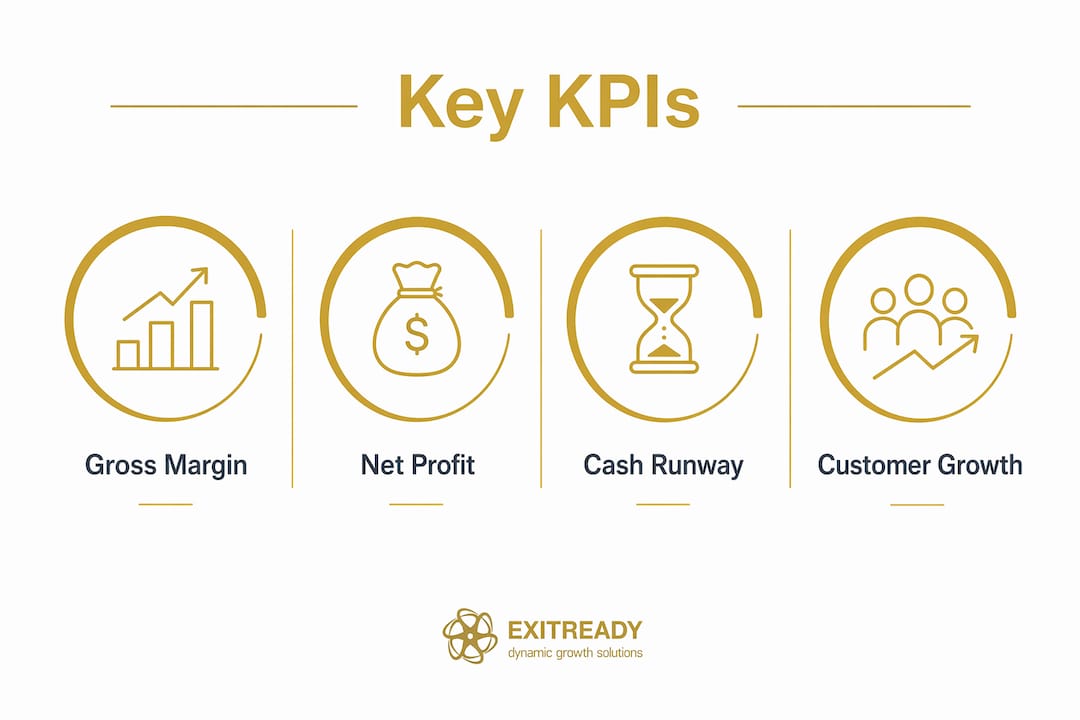
Net profit margin is a useful single indicator, but the US Chamber of Commerce recommends benchmarking it against industry peers rather than using it as a standalone verdict.
Three early-warning metrics deserve special attention: cash runway (months of operating expenses covered by current cash), declining cohort retention (customers acquired in a given period who stop buying over time), and LTV:CAC ratio trending below 3:1. These three, tracked monthly, will surface most crises before they become emergencies.
Benchmarks have real limits. Industry context, business model, and growth stage all affect what a “good” number looks like. A SaaS business and a manufacturing firm have completely different gross margin profiles. Use benchmarks to ask better questions, not to render final verdicts.
What do real diagnostic findings look like?
These mini examples show how a symptom connects to a root cause and a specific remedy. None of these are hypothetical in the sense that they represent patterns practitioners encounter routinely.
Case 1: Profitable but owner-dependent
- Symptom: Strong margins, but the owner is involved in every client decision and cannot take a two-week vacation without revenue dropping.
- Root cause: No documented processes, no delegation framework, all client relationships held personally by the owner.
- Immediate action: Map the five highest-frequency decisions the owner makes and draft a decision authority matrix.
- 30/90/180-day: Document top three workflows, hire or promote an operations lead, pilot delegation on a defined client segment.
Case 2: Steady revenue, falling NPS
- Symptom: Revenue is flat year-over-year, but customer satisfaction scores have dropped two consecutive quarters.
- Root cause: Delivery quality has slipped as the team scaled; no quality control checkpoint exists post-onboarding.
- Immediate action: Run a five-question survey with the last 20 customers to identify the specific friction point.
- 30/90/180-day: Introduce a post-delivery review step, assign a customer success owner, track NPS monthly.
Case 3: Cash flow positive, margins eroding
- Symptom: The bank account looks fine, but gross margin has declined three points over 18 months.
- Root cause: Input costs have risen, but pricing has not been adjusted; discounting has become informal practice.
- Immediate action: Pull a margin-by-product or margin-by-client analysis to identify where the erosion is concentrated.
- 30/90/180-day: Reprice the bottom 20% of clients or products, formalize a discount approval process, review supplier contracts.
Case 4: Growth plateau after a strong run
- Symptom: Revenue grew significantly two years ago, then stalled. The team is working harder but results are flat.
- Root cause: The original sales motion saturated the initial market segment; no second channel or segment has been developed.
- Immediate action: Segment the customer base and identify which cohort has the highest LTV and lowest CAC.
- 30/90/180-day: Test one new acquisition channel, build an ideal customer profile, redirect marketing spend accordingly.
Root-cause analysis prevents wasted investment. Spending on marketing when the real problem is pricing or delivery quality is a common and expensive mistake.
When should you run a business health checkup?
The short answer: before a major decision, and on a regular cadence regardless of whether anything feels wrong.
Common triggers that should prompt an immediate diagnostic:
- Revenue growth has stalled or reversed for two or more consecutive quarters
- Cash pressure is appearing despite reported profitability
- You are preparing to raise capital, take on debt, or bring in an investor
- A leadership change has occurred or is planned
- You are 12–24 months from a potential exit or sale
- A major market shift (new competitor, regulatory change, technology disruption) has altered your competitive position
- Post-acquisition integration is underway
Cash issues are among the most common triggers. Industry reporting consistently identifies cash flow as a critical operational problem for small and mid-market businesses, and many owners discover the problem later than they should because they rely on lagging financial indicators.
Recommended cadence by stage:
- Monthly: A health dashboard covering the five to seven metrics most predictive of your current risk profile (cash runway, pipeline, churn, margin trend).
- Quarterly: A mini-check covering all seven dimensions at a summary level, with a review of the prior quarter’s action items.
- Annually: A full diagnostic with benchmarking, stakeholder interviews, and a refreshed 12-month roadmap.
A quick triage (financial and commercial dimensions only) takes two to four hours of focused work if your data is organized. A full diagnostic with interviews and benchmarking is a four-to-eight-week engagement for a mid-market firm.
DIY check or professional diagnostic: which one do you need?
The decision comes down to three variables: complexity, owner bias, and what the findings will be used for.
DIY is sufficient when:
- The scope is narrow (one or two dimensions, a specific symptom)
- You have clean, organized data and a clear hypothesis to test
- The stakes are low (internal process improvement, not a capital raise or exit)
- You have a trusted advisor who can review your conclusions
Hire a professional when:
- The root cause is unclear or spans multiple dimensions
- Owner dependency is itself one of the problems (you cannot objectively assess your own dependency)
- You are preparing for a sale, merger, or capital raise and need defensible, third-party findings
- Your data is incomplete, inconsistent, or siloed across systems
- You need stage-appropriate benchmarks you do not have access to internally
Decision checklist:
- Can you access and trust your own data without significant cleanup?
- Do you have a clear hypothesis, or are you genuinely unsure what is wrong?
- Will the findings be shared with external parties (investors, buyers, lenders)?
- Is the owner a central part of the problem being diagnosed?
- Do you have the bandwidth to run the analysis without it becoming a distraction?
If you answered “no” to questions 1 or 5, or “yes” to questions 3 or 4, a professional diagnostic will produce more reliable and more useful results.
The clearest sign that a DIY approach will mislead you: you already know what you expect to find. Confirmation bias is the most common reason owner-led diagnostics miss the real problem. An independent framework or third-party review surfaces blind spots in people, process, and technology dependencies that owners routinely overlook.
What should a diagnostic report actually include?
A diagnostic without a structured output is just a conversation. The deliverables are what make it useful.
Standard deliverables to expect or demand:
- Executive summary (one page): Overall health score, top three risks, and the single most urgent action.
- Health score by pillar: A scored view of each dimension with a red/amber/green rating and a brief narrative explanation.
- Red-flag register: A prioritized list of findings that represent either immediate risk or structural weakness.
- Root-cause analysis: For each red flag, a documented explanation of the underlying cause, not just the symptom.
- 30/90/180-day roadmap: Sequenced actions with owners assigned, resource requirements estimated, and success criteria defined.
- KPI monitoring list: The five to ten metrics to track going forward, with target ranges and review frequency.
- Supporting analysis (10–15 pages): The data, benchmarks, and interview findings that support the executive summary.
The distinction between a scorecard and an implementation plan is where most diagnostics fall short. A scorecard tells you where you stand. An implementation plan tells you what to do about it, in what order, with what resources, and how you will know it is working. A good diagnostic must include both.
For exit-preparation diagnostics, deliverables should also include a valuation-ready scorecard and a gap plan focused on margin improvement, recurring revenue, and documented processes, because those are the factors that most directly affect buyer confidence and exit multiples.
How does a professional framework structure a business health diagnosis?
The AOS (Accelerated Operating System) framework used by Dynamicgrowthsolutions provides a concrete example of how a practitioner organizes a full diagnostic.
AOS diagnostic pillars and approach:
- Pillar scoring: Each of the seven dimensions receives a quantified score based on data inputs and benchmarks calibrated to the business’s stage (startup, growth, mid-market, scale).
- Ownership matrix: Maps which processes, decisions, and relationships are owner-dependent versus team-executed, quantifying the dependency risk.
- Playbook gap analysis: Identifies which workflows are undocumented and sequences documentation by operational impact.
- Prioritized action sequencing: Ranks recommendations by a combination of impact, urgency, and resource requirement, so the first 30 days focus on the highest-leverage moves.
The Growth Readiness Score Card from Dynamicgrowthsolutions applies this scoring approach and produces a stage-calibrated view of where a business stands across the core pillars. For owners preparing for an exit, the exit readiness assessment adds a valuation-ready scorecard and a gap plan tied to buyer expectations.
What are the real challenges and limitations of a business health diagnosis?
A diagnosis is only as good as the data behind it and the objectivity of the people interpreting it.
Data quality issues are the most common practical obstacle. Many mid-market businesses have financials spread across multiple systems, inconsistent categorization across periods, or operational metrics that have never been formally tracked. Garbage in, garbage out applies directly here. Before a diagnostic can produce reliable findings, data cleanup is often required, and that takes time.
Interpretation risks are subtler. Even with clean data, benchmarks can mislead if they are not stage-appropriate. A gross margin that looks low against an industry average may be entirely appropriate for a business in a capital-intensive growth phase. Without context, a number can trigger the wrong response.
Stakeholder bandwidth is a practical constraint that is frequently underestimated. A thorough diagnostic requires meaningful time from the owner and key leaders for interviews, data gathering, and review sessions. In a business where everyone is already stretched, that time is hard to find, and shortcuts in the process produce incomplete findings.
Scope creep is another risk. A diagnostic that tries to cover everything in equal depth often produces a long list of observations rather than a prioritized set of decisions. The most useful diagnostics are deliberately scoped to the questions that matter most right now.
Finally, a diagnostic is a point-in-time snapshot. Markets shift, teams change, and a finding that was accurate in January may be outdated by June. The cadence of review matters as much as the quality of the initial analysis.
How to prepare your business for a health diagnosis
Preparation determines how much value you extract from the process.

Organize your data first. Gather three years of financial statements (income statement, balance sheet, cash flow), your current customer list with revenue by client, and whatever operational metrics you track. If you do not track operational metrics formally, start with a simple spreadsheet covering throughput, cycle time, and error rates for your two or three core processes.
Brief your team honestly. If stakeholder interviews are part of the process, your team needs to understand the purpose and feel safe giving candid answers. A diagnostic that produces only politically safe responses misses the most important findings.
Identify your top three questions before you start. What decisions will this diagnosis inform? What do you suspect but cannot confirm? What would change your strategy if it turned out to be true? Scoping the diagnostic around real decisions makes the output far more useful than a generic health check.
Set aside protected time. Block two to four hours per week for the duration of the diagnostic, for yourself and for the key leaders involved. A diagnostic that gets squeezed into leftover time produces squeezed results.
Suspend your conclusions. The most valuable thing you can do going in is commit to following the data wherever it leads, even if it contradicts what you believe about your business.
Common misconceptions about business health diagnosis
“It’s just a financial audit.” A financial audit verifies that your numbers are accurate. A business health diagnosis asks why those numbers look the way they do and what to do about it. The two serve completely different purposes.
“We only need one when something is wrong.” Waiting for a crisis to run a diagnostic is like waiting for chest pain to schedule a physical. The most valuable diagnostics happen when the business feels fine, because that is when you have the time and resources to act on what you find.
“A high revenue number means we’re healthy.” Revenue is one of the least diagnostic metrics in the set. A business can grow revenue while simultaneously destroying margin, burning cash, and building an unsustainable dependency on a handful of clients. The financial metrics that reveal true health go well beyond the top line.
“We can do it ourselves objectively.” Owner-led diagnostics are useful for routine monitoring. For a full diagnostic, especially one that will inform a major decision, the owner’s proximity to the business is a liability, not an asset. The findings you most need are often the ones you are least likely to surface yourself.
“The report is the outcome.” The report is the starting point. A diagnostic that produces a document nobody acts on is an expensive exercise in documentation. The outcome is the implementation of the roadmap, measured by specific KPIs at defined intervals.
How to implement recommended changes after a diagnosis
The gap between a good diagnostic and a good outcome is execution. Most implementation failures are not failures of insight; they are failures of prioritization, ownership, and follow-through.
Start with the 30-day actions. These are typically the highest-leverage, lowest-resource moves: fixing a pricing anomaly, assigning ownership to an undermanaged process, or stopping a practice that is actively destroying margin. Do not wait until the full roadmap is socialized before acting on the obvious quick wins.
Assign a single owner to each recommendation. Shared ownership is no ownership. Every action item needs one person who is accountable for the outcome, with a defined deadline and a measurable success criterion.
Build a monthly review ritual. Set a standing 60-minute monthly meeting to review the five to seven KPIs from the diagnostic, assess progress on the roadmap, and surface new issues before they compound. A business growth roadmap gives this ritual structure and keeps the team aligned on priorities.
Treat the 90-day and 180-day actions as a second project. The longer-horizon actions typically require resource allocation, hiring, or structural change. Treat them as a separate workstream with their own milestones, not as a list to revisit when the 30-day work is done.
Revisit the diagnostic findings at 90 days. Some findings will have been resolved. Others will have evolved. New information will have surfaced. A 90-day review keeps the roadmap current and prevents the diagnostic from becoming a historical document rather than a living guide.
Key Takeaways
A business health diagnosis is most valuable when it produces a prioritized roadmap with assigned ownership and measurable outcomes, not just a scorecard.
| Point | Details |
|---|---|
| Definition and scope | A diagnosis evaluates seven dimensions holistically, producing a health score and a 30/90/180-day action plan. |
| Leading indicators first | Track CAC, churn, and operating cash flow monthly; these predict problems before net profit reflects them. |
| Stage-calibrated benchmarks | Apply benchmarks appropriate to your business stage; enterprise benchmarks mislead mid-market firms. |
| DIY vs. professional | Hire a professional when the root cause is unclear, owner dependency is the problem, or findings will be shared with external parties. |
| Dynamicgrowthsolutions AOS | The AOS framework scores each pillar, maps owner dependency, and sequences remediation by impact, producing playbooks that reduce owner reliance and support scale. |
Why most business owners run diagnostics too late
The conventional wisdom is that you run a business health diagnosis when something breaks. A revenue drop, a cash crisis, a key employee leaving. That framing is backwards, and it costs owners real money.
The businesses that get the most value from a diagnostic are the ones that run it before the pressure hits, when they still have options. A diagnostic in a crisis tells you what went wrong. A diagnostic in a period of relative stability tells you what is about to go wrong and gives you time to do something about it.
There is also a subtler issue: the metrics most owners watch closely, revenue and net profit, are the last to reflect a deteriorating business. By the time those numbers move, the underlying causes have usually been compounding for 12 to 18 months. CAC creeping up, NPS sliding, a key process that only one person knows how to run. None of that shows up in the income statement until it is already a problem.
The other thing practitioners consistently find is that owner dependency is almost always underestimated by the owner. It feels like involvement. From the outside, it looks like a single point of failure. A diagnostic that surfaces that dependency early, before a sale process or a leadership transition, gives the owner time to build the systems and team that make the business genuinely transferable.
The diagnostic is not the destination. The playbook that comes out of it is.
Dynamicgrowthsolutions helps you turn diagnostic findings into results
Running a diagnosis is one thing. Knowing what to do with the findings, and actually doing it, is where most owners stall. Dynamicgrowthsolutions works with mid-market business owners to convert diagnostic findings into a structured implementation program through the AOS (Accelerated Operating System), replacing owner dependency with documented systems, delegation frameworks, and a leadership team that can operate without the founder in every decision.

The program covers the full arc from initial assessment through business transformation: health scoring across all seven pillars, root-cause analysis, playbook development, and a prioritized roadmap with guaranteed milestones. For owners preparing for an exit, the EXITREADY track adds a valuation-ready scorecard and a gap plan built around what buyers actually pay a premium for: recurring revenue, documented processes, and a business that runs without the owner.
If you are ready to move from diagnosis to execution, apply for the AOS program and get a structured path from where your business is now to where it needs to be.
Useful sources and further reading
- How to Determine the Financial Health of Your Company — Harvard Business School Online: a practical guide to financial statement analysis covering balance sheet, income statement, cash flow, and ratio analysis.
- The New Leader’s Guide to Diagnosing the Business — Bain & Company: consulting-grade framework for distinguishing leading from lagging indicators and structuring a business diagnosis.
- Financial Metrics That Reveal Your Business’s True Health — US Chamber of Commerce: accessible overview of key financial health indicators and the importance of industry benchmarking.
- Business Health Check Tool — SCORE: a free, practical self-assessment tool for small business owners covering key improvement topics with tips and templates.
- Small Business Health Check — Philip Smith: practitioner guide connecting symptoms to root causes across money, customers, pricing, workflow, systems, and people.
- Business Health Diagnostic Playbook — Claude Code Playbooks: structured diagnostic framework with stage-calibrated benchmarks, health score patterns, and prioritized action planning.
- How to Assess Your Business Financial Health — K38 Consulting: practical advice on tracking income statement, balance sheet, and cash flow together with ratio-based early warning signals.