

A business continuity system is a management framework that enables organizations to maintain critical operations during disruptions and restore them within acceptable timeframes. The industry standard term for this framework is a Business Continuity Management System, or BCMS. ISO 22301 defines business continuity as the capability to deliver products and services within acceptable timeframes during a disruption. This is not a binder on a shelf. It is a living system of policies, processes, plans, and controls that governs how your business survives when things go wrong. For mid-market owners, understanding what a business continuity system actually requires is the difference between recovery and permanent closure.
What is a business continuity system and how is it structured?
A BCMS is the formal framework that houses every element of your continuity program. It connects governance, risk management, operational procedures, and recovery plans into one coordinated system. The distinction matters because most owners build a plan, not a system. A plan is a document. A system is an ongoing capability.
The core components of a BCMS include:
- Policies and governance: Executive ownership, defined scope, and accountability structures that drive the program
- Business Impact Analysis (BIA): A structured assessment that identifies which operations are critical and how long the business can survive without them
- Recovery objectives: Recovery Time Objective (RTO) defines the maximum acceptable downtime for a function; Recovery Point Objective (RPO) defines the maximum acceptable data or transaction loss
- Business Continuity Plans (BCPs): Documented procedures that assign roles, responsibilities, and step-by-step actions for maintaining or resuming operations
- Supplier and communications protocols: Procedures covering vendor dependencies, customer notifications, and internal communications during an incident
- Testing and review cycles: Scheduled exercises, audits, and management reviews that keep the system current
BIA and recovery objectives are the analytical engine of the entire system. Without them, your plans are built on assumptions rather than evidence.
Pro Tip: Map your RTO and RPO targets to specific business functions, not to the company as a whole. Payroll processing and customer order fulfillment have very different tolerance thresholds. Treating them identically creates dangerous blind spots.

ISO 22301 requires organizations to plan, implement, monitor, review, and improve their BCMS continuously. That requirement reflects a fundamental truth: the threats your business faces in 2026 are not the same ones it faced three years ago.
How does a business continuity system differ from disaster recovery?
Business continuity and disaster recovery are related but not interchangeable. Conflating them leads to preparation gaps that show up at the worst possible moment.
| Concept | Focus | Scope | Trigger |
|---|---|---|---|
| Business continuity | Maintaining operations during disruption | People, processes, facilities, suppliers, communications, IT | Any operational disruption |
| Disaster recovery | Restoring IT infrastructure and data | Technology systems, data, applications | Technology failure or cyberattack |
| Business resilience | Long-term adaptive capacity | Organizational culture, strategy, systems | Ongoing strategic capability |
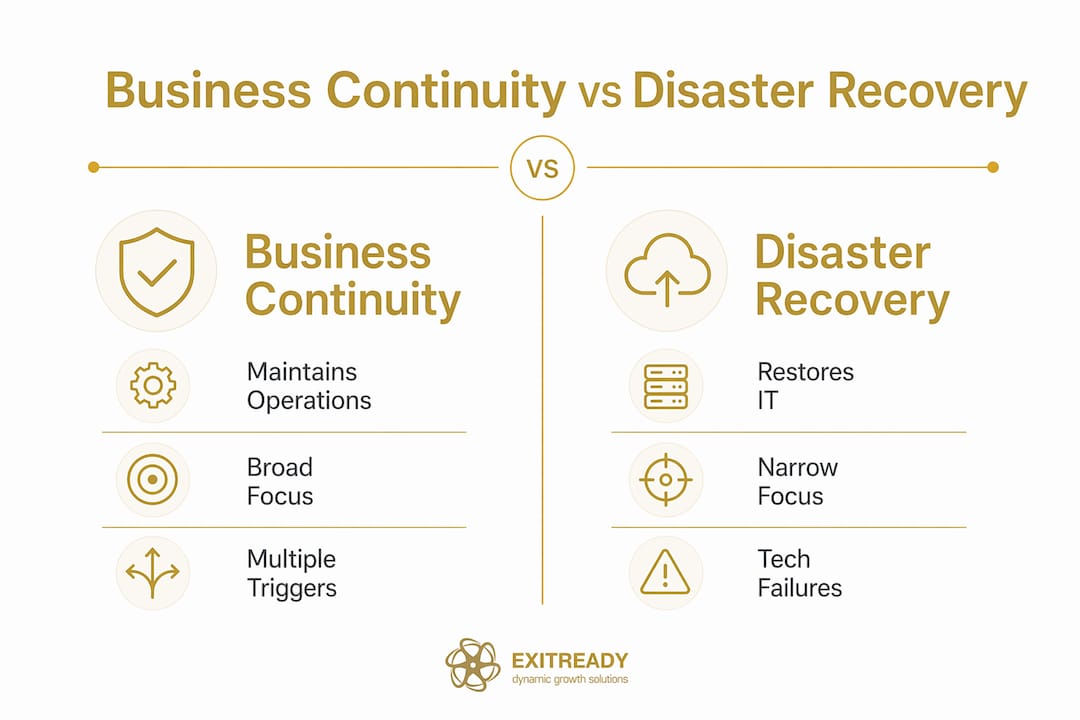
Disaster recovery is a subset of broader business continuity. It focuses narrowly on IT infrastructure restoration. Business continuity covers the full operational picture: your people showing up, your suppliers delivering, your facilities being accessible, and your customers being informed.
A manufacturer whose servers are fully restored after a ransomware attack still faces a continuity failure if its production floor is offline because key operators were not reached, or if a critical parts supplier cannot deliver. Conflating these concepts produces plans that look complete on paper but fail in practice. Business resilience sits above both. It describes an organization’s ongoing capacity to adapt and absorb disruption, not just respond to specific incidents.
How do you implement and maintain a business continuity system?
Building a BCMS follows a defined sequence. Skipping steps produces plans that address the wrong risks or set unrealistic recovery targets.
-
Conduct a threat and risk assessment. Identify the disruptions most likely to affect your specific business. These include natural disasters, cyberattacks, supply chain failures, key person dependencies, and facility loss. A business risk assessment at this stage prevents the system from being built around generic threats rather than real ones.
-
Complete a Business Impact Analysis. The BIA maps every critical business function and determines how long the organization can operate without it. This step produces your RTO and RPO targets. Process sequencing from threat assessment through BIA ensures plans focus on actual critical needs rather than assumptions.
-
Set recovery objectives for non-IT dependencies. RTO and RPO targets must include staffing availability, supplier lead times, and facility access. Owners who set recovery objectives only for IT systems discover the gap when a real incident hits.
-
Develop and document Business Continuity Plans. Each BCP assigns specific roles and step-by-step procedures. BCPs identify risks, impacts, and processes to minimize disruption and keep critical functions running until full restoration. Document these in a format that works without the owner present.
-
Test the plans with realistic exercises. Tabletop discussions are a starting point, not an endpoint. Testing must validate activation capabilities, including whether decision-makers can execute first-hour responses under pressure. Functional drills reveal gaps that document reviews never catch.
-
Review, update, and document governance evidence. Organizations must continuously improve their BCMS per ISO 22301:2019. Management reviews, corrective action records, and updated BIAs constitute the governance evidence that proves your system is operational, not decorative.
Pro Tip: Schedule your annual BIA update immediately after any significant change to your business: a new supplier, a key hire or departure, a new product line, or a facility move. Changes invalidate recovery assumptions faster than most owners realize.
Why is a business continuity system critical for survival?
The data on business failures after disruptions is stark. 43% of businesses never reopen after a disaster. Of those that do reopen, 51% close within two years, and 75% fail within three years. These numbers describe businesses that had no integrated continuity system in place.
“Continuity planning empowers businesses to adapt, recover, and thrive. Without it, disruption becomes a terminal event rather than a manageable setback.” — UNDRR
The importance of business continuity extends well beyond surviving a single incident. A functioning BCMS delivers several compounding advantages:
- Stakeholder confidence: Customers, lenders, and investors assess operational risk when evaluating your business. Documented continuity systems signal that leadership manages risk professionally.
- Competitive position: When a disruption hits an industry, businesses with continuity systems resume operations faster. Competitors without them lose customers permanently.
- Valuation impact: Buyers conducting due diligence on a mid-market acquisition treat documented continuity systems as a risk-reduction asset. Businesses with exit-ready operating systems command higher multiples.
- Insurance and compliance: Many insurers and regulated industries require evidence of continuity planning. A BCMS provides that evidence in an auditable format.
Effective continuity planning prioritizes maintaining acceptable service levels during disruptions, not just recovering after them. That distinction separates organizations that retain customers through a crisis from those that lose them to competitors who stayed operational.
Key Takeaways
A business continuity system is a managed, living framework, not a static document, and organizations without one face a statistically high probability of permanent closure after a major disruption.
| Point | Details |
|---|---|
| BCMS vs. a single plan | A Business Continuity Management System governs policies, processes, and governance; a BCP is just one output within it. |
| BIA drives everything | The Business Impact Analysis identifies critical functions and sets RTO and RPO targets that make recovery plans realistic. |
| Non-IT dependencies matter | Staffing, suppliers, and facilities must be included in recovery objectives, not just IT systems. |
| Testing proves readiness | Functional exercises that simulate first-hour activation reveal gaps that tabletop reviews miss entirely. |
| Survival statistics are severe | 43% of businesses never reopen after a disaster; a documented continuity system is the primary defense against that outcome. |
What most owners get wrong about continuity systems
The most common mistake I see mid-market owners make is treating business continuity as a compliance exercise. They commission a plan, file it, and consider the job done. That approach produces documentation, not capability.
A business continuity system only works if leadership owns it. Not the IT director. Not the operations manager. The owner or CEO must drive the governance cycle: reviewing BIA outputs, approving recovery objectives, and signing off on test results. Documented governance evidence, including BIAs, tested plans, reviews, and corrective action records, is what separates a real system from a binder that fails on day one of an actual incident.
The second mistake is scoping continuity around IT alone. I have worked with owners who invested heavily in data backup and cloud failover, then discovered their business could not operate because three key employees had no documented procedures to follow, or because a single supplier had no alternative. Operational continuity requires addressing non-IT elements with the same rigor applied to technology.
The third mistake is the “set and forget” cycle. A BCMS that was accurate in 2022 reflects a business that no longer exists. Treat your continuity system the way you treat your financial statements: review it regularly, update it when the business changes, and hold someone accountable for its accuracy. A living management system that your team can execute without you present is the real measure of continuity readiness.
— Andre
How Dynamicgrowthsolutions supports operational continuity for owners
Operational stability requires more than good intentions. It requires documented systems, clear governance, and processes your team can execute without you in the room.

Dynamicgrowthsolutions works with mid-market owners to build the kind of business operating system that makes continuity a built-in capability rather than an afterthought. The AOS (Accelerated Operating System) integrates policies, process documentation, and governance structures directly into how your business runs day to day. That means your organization is prepared before a disruption occurs, not scrambling after one. If you want to see where your business stands today, the 360-ProfitDriver assessment identifies operational gaps, including continuity risks, that most owners do not see until it is too late.
FAQ
What is the difference between a BCMS and a BCP?
A Business Continuity Management System (BCMS) is the full governance framework covering policies, processes, and controls. A Business Continuity Plan (BCP) is a single documented output within that system.
What does ISO 22301 require for business continuity?
ISO 22301 requires organizations to plan, implement, monitor, review, and continuously improve their BCMS. It treats business continuity as a managed system, not a static document.
What is disaster recovery vs. business continuity?
Disaster recovery focuses on restoring IT infrastructure and data after a technology failure. Business continuity covers the full operational picture, including people, suppliers, facilities, and communications.
What is a business impact analysis?
A Business Impact Analysis (BIA) identifies which business functions are critical and determines how long the organization can operate without each one. It produces the RTO and RPO targets that drive recovery planning.
How often should a business continuity system be updated?
A BCMS should be reviewed at least annually and updated after any significant business change, such as a new supplier, facility move, key hire, or product launch. Outdated plans create false confidence and real operational risk.