

Business acceleration is the deliberate process of increasing your company’s growth velocity by fixing internal operations, aligning your revenue engine, and building systems that scale without adding proportional cost or headcount. Unlike general business growth, which can happen passively over time, acceleration is intentional and high-intensity. It targets businesses that already have traction and want to move faster. Understanding what does business acceleration mean separates owners who grow steadily from those who scale decisively.
Dynamicgrowthsolutions defines this process through its AOS (Accelerated Operating System), a framework that replaces owner dependency with documented, self-sustaining operations. The goal is not just more revenue. It is faster revenue, higher margins, and a business that runs without you in every decision.
What does business acceleration mean in practice?
Business acceleration is the intentional speeding up of growth through operational improvement, revenue alignment, and systematic scaling. The industry term most closely associated with this concept is “revenue acceleration,” which shortens the path from prospect to revenue by aligning marketing, sales, and customer success around shared data. That alignment matters because most mid-market businesses lose speed not from lack of leads but from internal friction.

A formal business accelerator program is a fixed-term, cohort-based structure lasting 3–6 months that provides mentorship, resources, and expert feedback, typically in exchange for 5–10% equity. That is the startup context. For established business owners, the concept applies differently. Acceleration means compressing the timeline between where your business is now and where it needs to be, using systems rather than sheer effort.
The distinction matters. Acceleration is not working harder. It is building the infrastructure that makes growth repeatable.
What are the core components of a business growth strategy for acceleration?
Four pillars drive acceleration in any business: visibility, velocity, expansion, and intelligence. These four elements must align to maximize pipeline, conversion, deal speed, and retention for faster revenue growth. When one pillar breaks down, the others slow with it.
Here is what each pillar requires in practice:
- Visibility: Your market positioning must be clear enough that ideal buyers find you without heavy manual outreach. Evergreen content, referral systems, and brand authority all compound over time.
- Velocity: Sales cycles shorten when your qualification process is tight. AI-powered lead scoring and funnel attribution tools remove guesswork from the pipeline.
- Expansion: Existing customers are your fastest revenue source. Retention, upsell, and cross-sell programs cost far less than new customer acquisition.
- Intelligence: Decisions made on real-time data beat decisions made on gut instinct. Dashboards tracking sales velocity, churn rate, and customer lifetime value give you the feedback loop acceleration requires.
True acceleration comes from improving internal operational speed through AI and automation, not just increasing lead volume. Smaller, agile teams with well-built systems consistently outperform larger teams running broken workflows. That is a counterintuitive truth most owners learn too late.
Pro Tip: Before you increase your marketing spend or hire more salespeople, audit your internal conversion rate. If your close rate is below 20%, more leads will only expose the leak faster.
How does business acceleration differ from incubators and general growth?
Business acceleration, incubation, and organic growth are three distinct concepts that owners frequently confuse. Getting the distinction right determines which approach fits your current stage.
Business accelerators target companies with MVPs or early traction that are ready to scale rapidly. Incubators, by contrast, support earlier-stage ideas with no fixed timeline. Organic growth is simply what happens when a business improves gradually without a structured push. Acceleration is the middle path: structured, time-bound, and high-intensity.
| Concept | Timeframe | Primary focus | Resource commitment |
|---|---|---|---|
| Incubation | Open-ended | Idea validation and early development | Low to moderate |
| Business acceleration | 3–6 months (programs) or ongoing (internal) | Scaling speed and revenue growth | High and concentrated |
| Organic growth | Years | Gradual market expansion | Moderate and distributed |
| General growth strategy | Annual planning cycles | Resource allocation and milestone tracking | Moderate |
Growth is a deliberate, analytical process that aligns resource allocation with performance milestones rather than aspirational goals. That framing from Harvard Business School frameworks applies directly to acceleration. You are not setting a vision and hoping. You are setting a target, measuring weekly, and adjusting fast.
The key nuance: acceleration is a medium-term, high-intensity process. It is not a permanent operating mode. Businesses that treat acceleration as a sprint, then build sustainable systems afterward, outperform those that try to sprint indefinitely.
What pitfalls should you avoid when trying to accelerate business growth?
The most common mistake in acceleration is premature scaling. Over-hiring or expanding customer demand beyond your infrastructure leads directly to operational failure. Owners see a revenue opportunity, hire fast to meet it, and then watch margins collapse under payroll weight when the opportunity normalizes.
Three other pitfalls consistently derail acceleration efforts:
- Confusing acceleration with marketing spend. Pouring budget into ads before your sales process converts reliably is burning money. Fix conversion first, then scale traffic.
- Ignoring internal bottlenecks. A business that cannot fulfill orders, onboard clients, or retain staff at speed cannot accelerate. The constraint is almost always internal, not external.
- Measuring the wrong metrics. Vanity metrics like website traffic or social followers do not predict revenue. Sales velocity, customer acquisition cost, and net revenue retention do.
Effective acceleration requires ruthless focus on high-leverage activities that compound revenue and reduce costs. The 80/20 principle applies directly: identify the 20% of activities generating 80% of your revenue, and stop funding the rest.
Pro Tip: Map your revenue sources before your next planning cycle. If three clients or one channel generates most of your income, your acceleration plan must protect and expand that source first, not diversify away from it.
Growth is not uniform across business phases. Different stages demand different acceleration strategies and resource allocation. What works at $2M in revenue rarely works at $10M. Owners who apply the same playbook across every growth stage stall out.
How can you practically apply acceleration to achieve scalable growth?
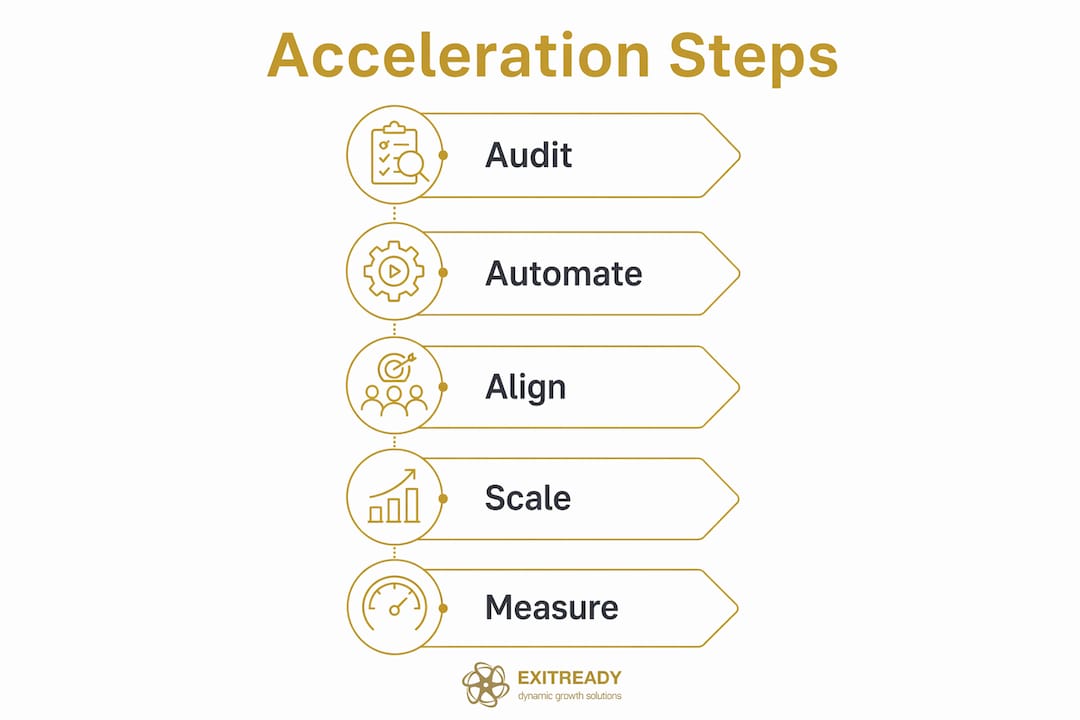
Practical acceleration follows a sequence. You measure first, then fix, then scale. Skipping the measurement step is why most acceleration efforts fail within 90 days.
Here is a proven sequence for applying acceleration concepts in your business:
- Set velocity metrics. Define your current sales cycle length, close rate, and average deal value. These three numbers tell you exactly where speed is being lost.
- Audit your workflow for manual drag. AI agents and no-code automation can replace manual workflows and increase scaling velocity without adding headcount. Tools like Zapier, Make, and AI-powered CRM sequences remove hours of admin per week.
- Build compound assets. Evergreen content, documented sales playbooks, and repeatable onboarding processes pay dividends long after the initial investment. These assets let your team move faster without reinventing the wheel.
- Align your revenue team around shared data. Marketing, sales, and customer success must track the same metrics. Misalignment between these three functions is the single biggest drag on conversion velocity.
- Apply strategic finance discipline. Scalable growth requires cash flow forecasting and resource allocation tied to performance milestones, not just revenue targets.
The fastest path to scale is not adding headcount but implementing breakthrough systems like funnel attribution, AI qualification, and positioning shifts. Dynamicgrowthsolutions applies this principle through its 360-ProfitDriver assessment, which identifies hidden revenue opportunities and operational gaps before any scaling investment is made.
Efficiency has become more critical than sheer volume in the current competitive environment. Operational speed now drives competitive advantage more than market size or brand awareness alone. Owners who build faster internal systems win the deals that slower competitors lose on execution.
For a deeper look at how mid-market companies apply these principles, the proven mid-market growth examples from Dynamicgrowthsolutions show what acceleration looks like across different industries and revenue stages.
Key Takeaways
Business acceleration delivers results only when operational infrastructure, revenue alignment, and performance metrics are built before scaling spend increases.
| Point | Details |
|---|---|
| Define acceleration clearly | Acceleration means increasing growth velocity through systems, not just more effort or budget. |
| Fix internal speed first | Audit conversion rates and workflows before increasing lead volume or headcount. |
| Distinguish from incubation | Acceleration targets businesses with traction; incubation supports early-stage ideas with no fixed timeline. |
| Avoid premature scaling | Over-hiring before infrastructure is ready collapses margins and stalls growth. |
| Measure velocity, not vanity | Track sales velocity, customer acquisition cost, and net revenue retention as your core acceleration metrics. |
What I’ve learned about acceleration after years of consulting
Business acceleration is necessary. It is not sufficient. That distinction took me years of consulting work to fully internalize, and I still see owners miss it every quarter.
The pattern is consistent. An owner attends a program, gets fired up, increases ad spend, hires two salespeople, and expects revenue to follow. Sometimes it does, briefly. Then the cracks show. The onboarding process cannot handle the new volume. The sales team is not trained on the positioning. The owner is still in every decision. Acceleration programs prepare companies but do not guarantee success without founder execution after the preparation phase.
What actually works is slower to start and faster to compound. You document the process. You build the playbook. You install the metrics. Then you push on the accelerator. Businesses that skip the foundation phase burn out fast. The ones that build first, then scale, are the ones I see exit at premium multiples.
My honest advice: treat acceleration as a phase, not a permanent state. Sprint for 90 days, measure what moved, then consolidate. Repeat. That rhythm produces compound growth. Perpetual sprinting produces burnout and broken teams.
If you are working with a consulting partner or applying acceleration frameworks in a professional services context, the same principle holds. Systems before speed. Always.
— Andre
How Dynamicgrowthsolutions supports your acceleration goals
Owners who want to move from concept to execution need more than a framework. They need a structured process with accountability built in.
Dynamicgrowthsolutions works with mid-market business owners to install the AOS (Accelerated Operating System), a documented operating framework that replaces owner dependency with repeatable, scalable processes. The 360-ProfitDriver business analysis identifies hidden revenue and operational gaps before you scale, so you invest in the right areas first. For owners ready to go deeper, the CEO mastermind events bring together growth-focused leaders to work through acceleration strategy in a structured, high-accountability environment. Both paths are built for owners who are serious about scaling with intention.
FAQ
What does business acceleration mean for an established business?
Business acceleration means deliberately increasing your company’s growth speed by fixing internal operations, aligning your revenue team, and building systems that scale without proportional cost increases. It applies to businesses with existing traction, not just startups.
How is business acceleration different from a business accelerator program?
A formal accelerator program is a fixed-term, cohort-based structure lasting 3–6 months that takes 5–10% equity in exchange for mentorship and resources. Business acceleration as a strategy is an internal process any owner can apply without joining a program.
What is the biggest mistake owners make when trying to accelerate growth?
Premature scaling is the most common mistake. Hiring ahead of infrastructure or increasing marketing spend before your conversion process is solid leads to margin collapse and operational breakdown.
How do you measure business acceleration?
The core metrics are sales velocity, close rate, customer acquisition cost, and net revenue retention. These four numbers reveal exactly where your growth engine is losing speed.
How long does it take to see results from acceleration efforts?
Most businesses see measurable changes in sales velocity and conversion rates within 60–90 days of fixing internal bottlenecks and aligning their revenue team. Compound results from system-building typically appear over 6–12 months.