
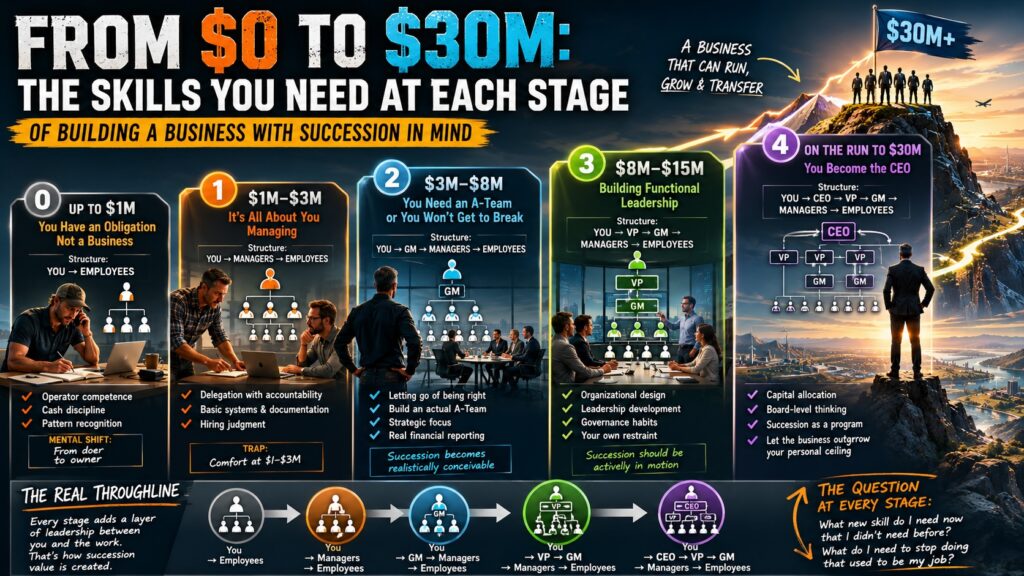
From $0 to $30M: The Skills You Need at Each Stage of Building a Business With Succession in Mind
Most owners build a job, not a business. They wake up one day at $2M in revenue and realize that if they disappeared for a month, the company would fall apart. That’s not a business — it’s a high-paying obligation with their name on the door.
Thank you for reading this post, don't forget to subscribe!A business with succession potential is different. It can run, grow, and eventually transfer — to a buyer, a partner, a family member, or a management team — without your hands on every lever. Getting there isn’t an accident. It’s a sequence of deliberate stages, and each one demands a different version of you.
Here’s the map.
Stage 0: Up to $1,000,000 — You Have an Obligation, Not a Business
Structure: You → Employees
Below $1M, you are the business. You’re selling, delivering, fixing problems, and probably doing the books on Sunday night. There is no “working on the business” yet — there’s barely time to breathe.
This stage isn’t shameful or a failure to “scale faster.” It’s foundational. The skills here are:
- Operator competence. You need to be genuinely good at the work itself, because you can’t yet pay someone better than you to do it.
- Cash discipline. At this size, one bad month can be fatal. Tight cash management is a survival skill, not a finance department function.
- Pattern recognition. You’re learning what actually works — which clients are profitable, which offers sell, which problems repeat. This is the data you’ll later turn into systems.
The big mental shift required to leave this stage: stop thinking like a freelancer with a logo and start thinking like an owner. That means asking “could someone else do this if I documented it?” about every task you touch.
Stage 1: $1,000,000 to $3,000,000 — It’s All About You Managing
Structure: You → Managers → Employees
This is the first real inflection point, and it’s the one most businesses get stuck at. Revenue has outgrown what you can personally deliver, so you’ve hired people. But you haven’t yet built leadership — you’ve built helpers.
At this stage, your job shifts from doer to manager of doers. The required skills change completely:
- Delegation with accountability. Not “here, take this off my plate,” but defined roles, clear expectations, and follow-up. Most owners delegate tasks but not outcomes — meaning they’re still secretly responsible for everything.
- Basic systems and documentation. If your best salesperson quit tomorrow, would the sales process survive? At $1–3M, you need just enough process that the business doesn’t run purely on tribal knowledge in your head.
- Hiring judgment. Your hiring mistakes are expensive now, not just personally painful. You need to get better at hiring for this stage, not the next one.
The trap here is comfort. $1–3M with you managing everyone can feel like “made it.” But it’s still entirely dependent on you. There’s no succession value yet — buyers and successors are buying you, not a business.
Stage 2: $3,000,000 to $8,000,000 — You Need an A-Team or You Won’t Get to Break
Structure: You → GM → Managers → Employees
This is the stage where most businesses plateau, and it’s the hardest transition on the whole map. The skills that got you from $1M to $3M — hands-on management, being the smartest person in every room — actively work against you here.
To break through, you need to install a layer between you and your managers: a General Manager (or equivalent) who can run day-to-day operations so you stop being the bottleneck for every decision.
Required skills shift again:
- Letting go of being right. Your GM will make calls you wouldn’t have made. Some will be wrong. You have to tolerate that, or you’ll never get leverage.
- Building an actual A-Team, not just a bigger team. This is about upgrading talent density — fewer mediocre managers, more genuinely strong ones who can own outcomes without you checking their work.
- Strategic focus. Your job becomes setting direction, allocating capital, and removing obstacles — not solving every operational fire.
- Real financial reporting. You need dashboards and numbers your GM and managers can run the business by, not just numbers you personally understand.
This is also typically the first stage where succession starts to become realistically conceivable — because for the first time, the business has a layer of leadership that doesn’t include you in the daily operating loop. It’s still early. But the skeleton of a transferable business starts to exist here.
Stage 3: $8,000,000 to $15,000,000 — Building Functional Leadership
Structure: You → VP → GM → Managers → Employees
Past $8M, a single GM usually can’t hold the whole operation alone — the business has enough complexity (multiple departments, more locations, more product lines) that it needs functional leadership: a VP of Operations, Sales, or similar, sitting above the GM layer.
Skills needed now:
- Organizational design. You’re not just hiring people anymore — you’re designing the org chart, defining how departments interact, and clarifying decision rights.
- Leadership development, not just leadership hiring. At this size, you can’t only hire your way to a strong team; you need to actively develop your GM and managers into better operators, because the talent market for “already great at your specific business” doesn’t really exist.
- Governance habits. Regular leadership meetings, KPI reviews, succession conversations about who’s ready for what — these become real disciplines, not nice-to-haves.
- Your own restraint. The biggest skill at this stage is often doing less. The more capable your VP and GM are, the more your hands-on instincts need to be suppressed.
By the top of this range, succession isn’t just conceivable — it should be actively in motion. You should know who, internally or externally, could plausibly run this business without you.
Stage 4: On the Run to $30,000,000 — You Become the CEO
Structure: You → CEO function → VP → GM → Managers → Employees
Note the shift: at this stage, “You” and “CEO” start to become functionally separate, even if you still hold the title. You may install an actual CEO (succession in action), or you evolve into operating as a CEO rather than as an owner-operator — meaning your daily inputs into the business shrink dramatically.
The skills here are almost unrecognizable from Stage 0:
- Capital allocation. Your highest-leverage decisions are now about where money goes — acquisitions, new markets, reinvestment — not operational execution.
- Board-level thinking. Whether or not you have a formal board, you need the discipline of being accountable to a structure bigger than your own judgment.
- Succession as an active program, not a someday idea: identifying, developing, and testing the people (or evaluating the buyers) who could eventually hold your role.
- Letting the business outgrow your personal ceiling. This is the real test of whether you built a business or just a very large job. If growth still depends on your personal energy, attention, or relationships, you haven’t actually arrived here — you’ve just built a bigger version of Stage 0.
The Real Throughline
Look at the structural progression again:
- You → Employees
- You → Managers → Employees
- You → GM → Managers → Employees
- You → VP → GM → Managers → Employees
- You → CEO → VP → GM → Managers → Employees
Every stage adds a layer of leadership between you and the work. Succession potential isn’t a single decision you make near the end — it’s the cumulative result of how many of those layers actually function without you holding them up.
The owners who never build succession potential are usually the ones who kept doing Stage 0 or Stage 1 skills well past the point those skills stopped being useful — staying the smartest, hardest-working person in the building long after the business needed them to be something else.
The owners who build something transferable are the ones who treated each revenue jump as a cue to ask: “What skill do I need to develop now that I didn’t need before — and what do I need to stop doing that used to be my job?”