

Your exit strategy is the single most important financial decision you will make as a business owner. Choosing the right exit strategy type determines how much you walk away with, how your legacy is preserved, and how smoothly the transition unfolds. The four factors that drive every good exit decision are liquidity needs, control preferences, legacy goals, and timing. Get those four right and the path forward becomes clear. Get them wrong and you risk leaving seven figures on the table. This guide breaks down the primary exit paths, the decision criteria that separate them, and the step-by-step process for identifying the option that fits your business in 2026.
What are the main types of business exit strategies?
Seven exit paths cover the vast majority of business transitions. Each one delivers a different cash outcome, requires a different timeline, and fits a different owner situation.
| Exit Type | Cash to Owner | Typical Timeline | Best Use Case |
|---|---|---|---|
| Third-party sale | 90–100% at close | 6–24 months | Owner wants full exit, maximum liquidity |
| Family succession | Partial, phased | 3–10 years | Legacy preservation, long-term involvement |
| ESOP | 60–100%, phased | 12–36 months | Employee legacy, tax advantages |
| Management buyout | Partial to full | 12–24 months | Strong internal team, owner wants clean exit |
| IPO | Partial, locked up | 2–5 years | High-growth company, large scale |
| Liquidation | Below market value | 3–12 months | No viable buyer, wind-down scenario |
| Partner buyout | Negotiated | 6–18 months | Ownership disagreement or partner departure |

The most important distinction is internal versus external transfer. Internal transfers, including family succession, ESOPs, and management buyouts, preserve culture and continuity but typically deliver lower immediate liquidity. External transfers, including third-party sales and private equity buyouts, maximize cash at close but end your operational involvement faster.
Business size and owner involvement timeline strongly influence which path is viable. A $2 million EBITDA business with no management depth is not a realistic IPO candidate. A founder who wants to stay involved for five more years is not a good fit for a full strategic sale.
Pro Tip: Match your exit type to your readiness level before you match it to your financial goal. A strategy you cannot execute is not a strategy.
How do your goals and priorities shape the right exit path?
Selecting the right exit path starts with four honest questions about yourself, not your business.
- How much cash do you need at close? Liquidity needs determine strategy viability more than any other factor. If you need 90% or more of your business value liquid at closing, a strategic sale or private equity full buyout is your realistic range. If you can accept 50–80% upfront, options like PE recapitalizations, ESOPs, or gradual sell-downs open up.
- How much control do you want post-exit? Some owners want a clean break. Others want to stay involved in an advisory or operational role. A management buyout or ESOP allows you to stay connected. A third-party sale to a strategic acquirer typically does not.
- How important is legacy preservation? TIGER 21, the peer network for ultra-high-net-worth entrepreneurs, notes that exit planning must align owner goals across wealth, legacy, control, and timing. For owners who built a brand or community around their business, an ESOP or family succession often scores higher than a pure financial analysis would suggest.
- What is your realistic timeline? Experts recommend starting formal exit planning 3–5 years before your target exit date. That window gives you time to fix operational gaps, build management depth, and position the business for maximum value.
WSFS Bank’s framework for exit decision-making identifies the same four key factors: liquidity needs, control level, legacy importance, and timing and readiness. Running your answers through that lens narrows seven exit types down to two or three realistic candidates fast.
Pro Tip: Write your answers to these four questions before you speak to any advisor or broker. Advisors optimize for what you tell them you want. If you have not decided, they will decide for you.
How to choose the right exit strategy type: a step-by-step process
The process for exit strategy decision making is not linear, but it does follow a logical sequence. Skipping steps is where owners lose money.
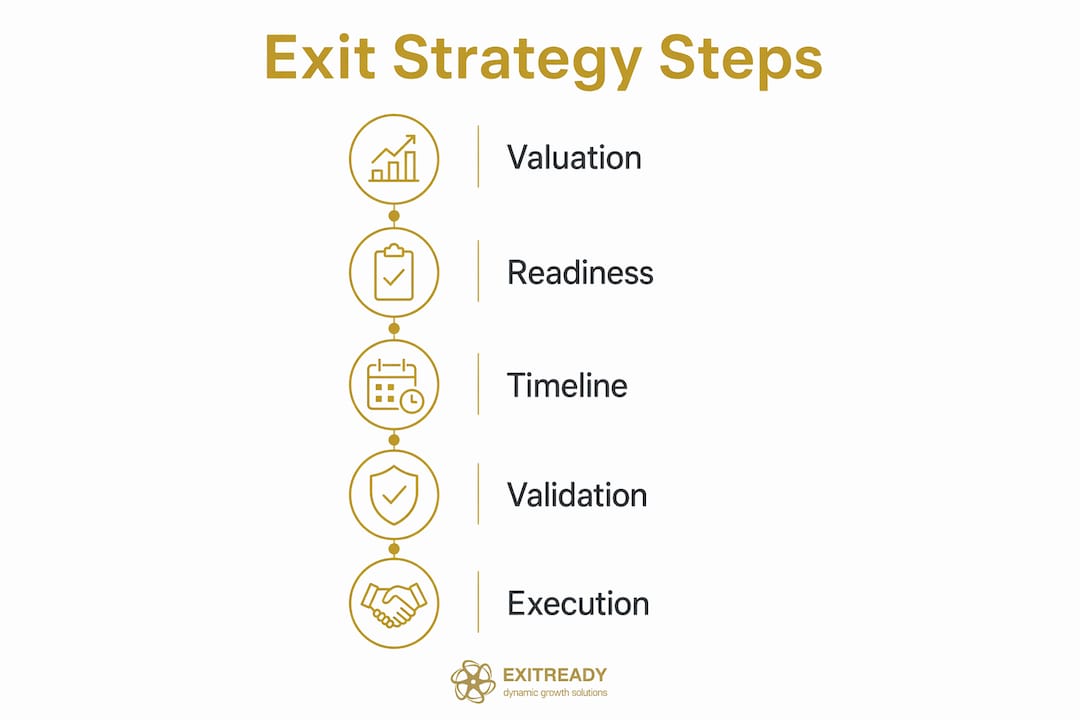
Step 1: get a formal business valuation
An objective, certified valuation is the foundation of every exit decision. Owners consistently overestimate their business’s market value. A formal valuation gives you a defensible number to negotiate from and immediately rules out exit paths that do not make financial sense at your actual value.
Step 2: assess operational readiness
Buyers and successors pay premiums for businesses that run without the owner. If your revenue depends on your relationships, your processes live in your head, or your management team cannot operate independently, your exit options narrow and your valuation drops. Dynamicgrowthsolutions addresses this directly through its AOS (Accelerated Operating System), which replaces owner dependency with documented systems and self-sustaining operations before an exit event.
Step 3: run the decision tree
Answer these questions in order:
- Do you have a qualified family member willing and able to take over? If yes, family succession is viable. If no, eliminate it.
- Does your management team have the capability and capital access to buy you out? If yes, a management buyout is viable.
- Is your business generating $1 million or more in EBITDA with growth potential? If yes, private equity and strategic buyers become realistic.
- Are there co-owners with conflicting goals? If yes, a partner buyout may be the first step before any other exit.
- Is the business not viable as a going concern? If yes, liquidation is the honest answer.
Step 4: match timeline to involvement preference
Planning 12–24 months ahead correlates with 20–40% higher net proceeds compared to rushed exits. That gap is not a coincidence. Prepared businesses command higher multiples, attract better buyers, and close faster. If your timeline is shorter than 12 months, your viable exit paths shrink to liquidation, a quick third-party sale, or a partner buyout.
Step 5: validate with an advisor before committing
The role of advisors in exit transactions is to pressure-test your assumptions, not just execute your plan. A good M&A advisor or exit planning specialist will challenge your valuation assumptions, identify gaps in your management team, and surface buyer types you have not considered.
What are the biggest mistakes in selecting an exit strategy?
Most exit failures trace back to a short list of avoidable errors.
- Anchoring on one path too early. Premature anchoring on an exit path before clarifying goals can cost seven figures. Owners fall in love with the idea of a family succession or an IPO before they have verified whether the business or the successor is actually ready.
- Waiting too long to plan. Only 30% of family succession transitions succeed, and the biggest reason is late planning beyond the 3–5 year window. The same timing problem affects every exit type. Rushed exits produce compressed valuations and limited buyer pools.
- Overestimating business value. Owners who skip formal valuation enter negotiations with inflated expectations. That gap between expectation and reality kills deals or forces last-minute concessions that erode net proceeds.
- Choosing a strategy that does not match your energy. The best exit strategy varies by owner objectives and the energy available for transition involvement. A family succession that requires five more years of active management is the wrong choice for an owner who is burned out today.
- Ignoring tax structure until the deal is signed. Different exit types carry dramatically different tax treatments. An ESOP, for example, offers significant tax advantages that a straight asset sale does not. Structuring decisions made after a letter of intent is signed leave money on the table.
Pro Tip: Get a preliminary valuation check 3–5 years before your target exit date. The number will surprise you, and the gap between where you are and where you need to be is exactly what your exit plan should close.
Key takeaways
The right exit strategy type is determined by four factors: liquidity needs, control preferences, legacy goals, and timing readiness.
| Point | Details |
|---|---|
| Four factors drive every exit decision | Assess liquidity, control, legacy, and timing before evaluating any specific exit path. |
| Early planning multiplies proceeds | Starting 12–24 months ahead correlates with 20–40% higher net proceeds than rushed exits. |
| Formal valuation is non-negotiable | Owners consistently overestimate value; a certified valuation prevents costly negotiation failures. |
| Anchoring early destroys value | Committing to one exit path before clarifying goals can cost seven figures in lost alternatives. |
| Match strategy to your energy level | The best exit option fits both your financial goals and the involvement you can realistically sustain. |
What i have learned about exit strategy decisions that most guides skip
Most exit strategy content focuses on the mechanics: what each path looks like, how deals are structured, what the tax treatment is. That information matters. But the owners I have worked with who got the best outcomes shared one trait that had nothing to do with mechanics. They were brutally honest about what they actually wanted before they started the process.
The failure mode I see most often is not a bad deal. It is an owner who chose the right deal for the wrong goals. A founder who sold to a strategic acquirer for maximum liquidity and then spent three years miserable because they missed the business. A family succession that dragged on for seven years because the owner could not let go, even though the financial case for a third-party sale was obvious.
The four-factor framework, liquidity, control, legacy, and timing, is not just a checklist. It is a forcing function. It makes you commit to priorities before advisors, brokers, and buyers start shaping your thinking. Once a process is in motion, it is very hard to change direction without losing credibility or value.
My honest recommendation: spend more time on the goal-setting phase than feels necessary. Write it down. Share it with your spouse, your CFO, or a trusted peer. The types of exit strategies available to you are not the hard part. Knowing what you want from the exit is.
— Andre
How Dynamicgrowthsolutions helps you exit on your terms
Choosing the right exit path is only half the work. The other half is making your business worth what you believe it is.

Dynamicgrowthsolutions works with mid-market owners to close the gap between current operations and exit-ready performance. The AOS program builds the documented systems, management depth, and financial clarity that buyers and successors pay premiums for. If you are 2–5 years from a target exit, now is the time to start. Explore the exit planning resources on the Dynamicgrowthsolutions platform, or register for an upcoming EXITREADY event to connect with advisors and owners navigating the same decisions you are facing.
FAQ
What is the most common exit strategy for small business owners?
A third-party sale is the most common exit for small and mid-market business owners because it delivers the highest immediate liquidity. Strategic buyers and private equity firms are the primary buyer pools for businesses generating $1 million or more in EBITDA.
How early should i start planning my business exit?
Experts recommend starting formal exit planning 3–5 years before your target date. Owners who plan 12–24 months ahead see 20–40% higher net proceeds than those who exit without preparation.
What is the difference between an ESOP and a management buyout?
An ESOP transfers ownership to a broad employee trust, often with significant tax advantages for the seller. A management buyout transfers ownership specifically to the existing leadership team, typically financed through debt or private equity.
How do i know if my business is ready for a third-party sale?
Your business is ready when it operates without owner dependency, has documented processes, shows consistent revenue growth, and carries a formal valuation. Buyers pay premiums for businesses that do not require the founder to function.
Can i change my exit strategy after i start the process?
Changing direction mid-process is possible but costly. It signals uncertainty to buyers and advisors and can compress your final valuation. The best practice is to clarify your goals and validate your chosen path before engaging any external parties.