Talent development supports scaling by building the leadership capacity, workforce resilience, and operational alignment that mid-market businesses need to grow without breaking. Companies that prioritize employee growth see 58% higher retention rates and 28% productivity gains, and organizations with highly engaged employees are 23% more profitable and 18% more productive. The connection is direct: when your people grow faster than your headcount, you scale smarter.
Here is what that looks like in practice:
- Leadership capacity expands. Formal development programs build leaders who can manage complexity, not just execute tasks, giving you the management depth scaling demands.
- Formal talent planning replaces gut hiring. McKinsey recommends systematically mapping growth plans against required skills and behaviors before adding headcount.
- Growth pathways retain critical talent. Career progression is the second-biggest reason employees quit, right after pay. Development programs close that gap before your best people start looking.
- Culture and purpose stay intact. Talent initiatives woven into daily operations keep teams aligned as headcount multiplies and founder influence dilutes.
- Scaling metrics improve measurably. Productivity, internal fill rates, and leadership pipeline strength all respond to deliberate workforce development.
Table of Contents
- How talent development supports scaling: the strategic framework
- Integrating talent development with operational systems for exit readiness
- The Accelerated Operating System puts talent development at the center of scaling
- Key takeaways
How talent development supports scaling: the strategic framework
The most overlooked dimension of workforce development in mid-market companies is vertical development. Horizontal development adds skills. Vertical development expands how leaders think. The Center for Creative Leadership describes vertical development as growing the capacity to hold contradictions, think systemically, and find new solutions under pressure. That is exactly what your leadership team needs when revenue doubles and operational complexity triples.
Scaling talent development across an entire organization creates what the Center for Creative Leadership calls “protective scaffolding.” When development reaches all levels, individual and collective potential fuse. Leaders fall back on what they have already learned during their most challenging moments, which means the organization itself becomes more agile and resilient, not just the people at the top.
Formal talent planning is the operational counterpart to this. McKinsey’s research on hypergrowth companies found that founder CEOs must move beyond instinct-driven hiring and systematically review their scaling ambitions against the skills, behaviors, and capabilities required to execute them. Gut instinct works at 10 people. It fails at 50.
Pro Tip: Before your next hiring sprint, map your 12-month growth plan against the specific capabilities your current team lacks. That gap analysis is your talent development roadmap, not just your recruiting brief.
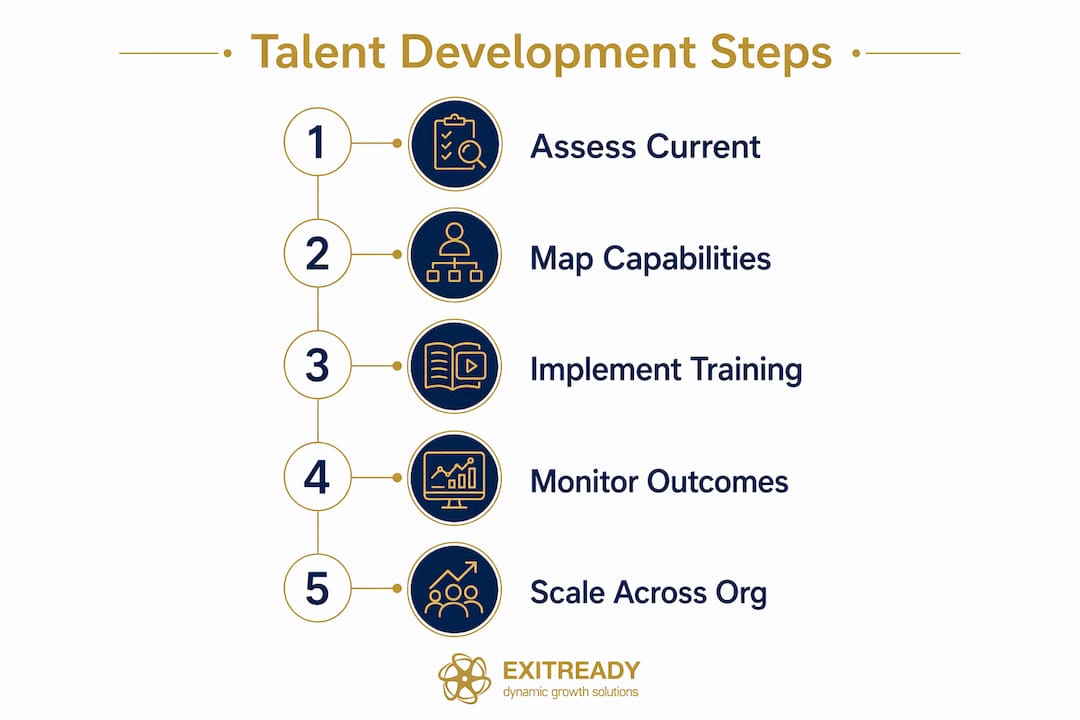
Measuring the impact of workforce development requires tracking outcomes leadership actually cares about: internal fill rate, time to proficiency for new hires, voluntary turnover, and revenue per employee. Completion rates and training hours are activity metrics. Retention, promotion readiness, and leadership pipeline strength are business metrics. The distinction matters when you are making the case for continued investment.
| Metric Category | What to Track |
|---|---|
| Workforce outcomes | Retention rate, internal fill rate, time to proficiency |
| Skill effectiveness | Skill application within 30 days, promotion readiness |
| Business impact | Revenue per employee, productivity gains, profitability |
| Program efficiency | Cost per learner, manager satisfaction with training |
Proactive HR investment also prevents what one framework calls “compounding dysfunction.” Fixing people operations reactively costs far more than building compensation architecture, culture systems, and manager development during stable periods. The companies that wait until attrition spikes or culture fractures pay a steep price to repair what early investment would have prevented.
Integrating talent development with operational systems for exit readiness
Talent development does not scale in isolation. It has to be wired into your operational systems, or it stays a side project that loses budget at the first sign of pressure. The practical integration point is documented processes. When your people know how work gets done, and those methods are written down, you stop depending on specific individuals to carry institutional knowledge. That is the foundation of an owner-independent business.
Scaling from founder-led to system-led execution requires formalizing processes, roles, and management layers before the organization hits chaos points, typically around 20–30 employees. Talent development accelerates this transition by building the management layer that can actually run those documented systems without the founder in the room.

Upskilling and reskilling during rapid growth phases deserve specific attention. Upskilling sharpens employees for their current roles. Reskilling prepares them for entirely different ones. Both matter when your business model evolves faster than your hiring pipeline. Companies that grow revenue 40% while expanding headcount only 12–15% do so by building systems and developing existing talent rather than defaulting to external hiring for every new capability need.
Exit readiness is where talent development pays its biggest dividend. A business that runs on documented workflows, a capable management team, and a strong internal leadership pipeline commands a higher valuation multiple than one where the owner is the system. Buyers and investors price owner dependency as risk. Talent development, when integrated with operational systems, removes that risk systematically. You can explore what middle management’s role looks like in a scaling organization to see how this layer becomes the connective tissue between strategy and execution.
Replacing costly external hiring with internal mobility is another compounding benefit. Replacing an employee can cost up to four times their annual salary. Internal candidates ramp faster, stay longer, and already carry your culture. A formal internal mobility program is one of the highest-return investments available to a scaling mid-market business.
The Accelerated Operating System puts talent development at the center of scaling
Dynamicgrowthsolutions built the EXITREADY Accelerated Operating System (AOS) specifically for mid-market owners who need more than a talent program. They need a complete operating framework where people development, documented processes, and strategic delegation work together as one system.
The AOS framework addresses the core problem most mid-market businesses face: growth that depends on the owner’s presence rather than the organization’s capability. By embedding talent development into documented workflows, leadership growth programs, and systematic delegation structures, AOS builds companies that operate independently and attract premium valuations. The business operating system replaces founder dependency with self-sustaining operations, which is exactly what acquirers and investors want to see.
Dynamicgrowthsolutions works with owners who are ready to move from running their business to building one that runs without them. If you are scaling a mid-market company and want to integrate talent development into a proven operational framework, the AOS Entrepreneur Application is the starting point. Apply for the AOS program and see how the framework maps to your specific growth stage.
Key takeaways
Talent development is the strategic lever that connects workforce capability to scalable, exit-ready operations in mid-market businesses.
| Point | Details |
|---|---|
| Retention and productivity gains | Companies prioritizing development see 58% higher retention and 28% productivity gains, making it a direct growth lever. |
| Vertical leadership development | Building leaders who think systemically, not just execute tasks, is what sustains growth through complexity. |
| Formal talent planning | Replacing gut hiring with skills-mapped planning, as McKinsey recommends, aligns your team with your actual scaling ambitions. |
| Operational integration | Talent development tied to documented workflows and delegation structures builds owner-independent, exit-ready businesses. |
| Dynamicgrowthsolutions AOS | The Accelerated Operating System integrates talent growth, documented processes, and strategic delegation into one framework for mid-market scaling. |