
Most mid-market owners believe a strong profit year is their best argument at the negotiating table. It isn’t. Buyers and investors look past last quarter’s earnings and ask a harder question: can this business grow without the owner in the room, and can it scale without everything falling apart? That distinction separates companies that command premium multiples from those that stall in due diligence. This guide breaks down what real scalability looks like, how to build the operational backbone that supports it, and how to measure progress in ways that move the valuation needle.
Thank you for reading this post, don't forget to subscribe!Table of Contents
- What does true scalability mean for mid-market companies?
- Building the operational backbone: Standardization and automation
- Controlling growth: KPIs, measurement, and the ‘bridge’ to valuation
- Avoiding pitfalls: Scaling initiatives that actually work
- Perspective: Why exit-ready scalability means institutionalization, not just automation
- Unlocking scalable value with expert support
- Frequently asked questions
Key Takeaways
| Point | Details |
|---|---|
| Operational maturity boosts valuation | Standardized processes and systems signal lower risk to buyers and can increase your exit value. |
| KPIs guide successful scaling | Focusing on strategic KPIs and proper cadence helps keep scaling under control and measurable. |
| Automation delivers fast ROI | Mid-market companies can automate workflows in weeks and see payback in about six months. |
| Avoid pilot-only scaling pitfalls | Scaling initiatives succeed only when workflows and measurement bridges are reengineered for scale, not just repeated. |
| Institutionalization trumps short-term growth | Buyers value businesses with repeatable, documented operations more than those with just impressive profit spikes. |
What does true scalability mean for mid-market companies?
Scalability is not just a synonym for growth. A business can grow and still be fragile. Revenue increases. Headcount rises. Costs climb almost as fast. The owner works 70-hour weeks to hold everything together. That is growth, but it is not scalability.
True scalability means the company can increase output and revenue without a proportional increase in cost, labor, or complexity. The business has an operating model inflection point where systems, not people, carry the operational load. Processes are documented, repeatable, and teachable. Decisions follow frameworks rather than gut instinct.
For mid-market companies specifically, this distinction matters enormously when you approach an exit or seek investment. Buyers look at both financial performance and the risk/growth profile, including scalable operations, standardized processes, and integration readiness. A company that requires six months of hand-holding post-acquisition is priced accordingly. A company that runs on documented systems is priced as an asset, not a project.
Here is a quick contrast of how scalable and merely growing companies differ in practice:
| Characteristic | Scalable business | Growing (but fragile) business |
|---|---|---|
| Process documentation | Fully documented, accessible | In people’s heads |
| Owner dependency | Low, decisions are delegated | High, owner is the bottleneck |
| Cost structure | Costs grow slower than revenue | Costs track revenue closely |
| Integration risk | Low, systems are transferable | High, knowledge walks out the door |
| Buyer confidence | Strong, due diligence is clean | Weak, surprises in the data room |
The following factors consistently differentiate companies buyers want from those they walk away from:
- Standardized SOPs (Standard Operating Procedures) that any trained employee can follow
- Documented workflows across sales, fulfillment, finance, and customer service
- A management layer that makes decisions without owner involvement
- Technology systems that store institutional knowledge rather than relying on individuals
- Reporting infrastructure that makes performance visible and verifiable
“The companies that close at premium multiples aren’t always the most profitable. They’re the ones where a buyer can walk in and run the business on day one.”
Building those integration-ready strategies requires intentional design, not just organic growth. That is where most mid-market owners leave money on the table.
Building the operational backbone: Standardization and automation
Operational complexity is the silent killer of mid-market scalability. As companies grow past $10 million in revenue, informal coordination stops working. Tasks that used to get done through tribal knowledge and hallway conversations start falling through the cracks. Quality dips. Customer complaints rise. The owner gets pulled back into firefighting.

The solution is a two-layer approach: standardization first, automation second. Standardization means documenting every critical workflow before you try to automate it. Automation applied to a broken or undocumented process just produces broken results faster.
Automation as a game changer for mid-market operations is well established. It compresses cycle times, reduces manual error rates, and frees skilled staff for higher-value work. But the real payoff is systemic. When workflows are automated, they become auditable. You can see where bottlenecks occur, measure throughput, and identify where capacity is being wasted.
Here are the key metrics to track when evaluating automation ROI in a mid-market environment:
| Metric | What it measures | Target benchmark |
|---|---|---|
| Workflows completed per hour | Throughput improvement | 30-50% increase vs. manual |
| Error rate | Quality control | Less than 2% post-automation |
| Time-to-value | Speed from initiation to output | Reduction of 40% or more |
| Labor hours recovered | Capacity freed for growth work | 15-25 hours per week per department |
| Payback period | Financial return | Typically 4-6 months |
Scalability metrics and operating controls can directly improve throughput and capacity, and automation along with institutional-grade systems are often the mechanism for avoiding cash and quality breakdowns during growth. The companies that build this infrastructure early capture a significant competitive advantage by the time they reach an exit conversation.
A practical implementation sequence looks like this:
- Audit your top 10 workflows for volume, error rate, and owner involvement. Prioritize by impact.
- Document each workflow in a step-by-step format that a new hire could follow without assistance.
- Identify automation opportunities within those documented workflows, starting with repetitive, rules-based tasks.
- Deploy automation tools in a controlled environment and measure against baseline metrics.
- Track leadership KPIs for automation at weekly cadence during the first 90 days.
- Expand automation to adjacent workflows once the initial deployment proves stable.
Pro Tip: Don’t automate everything at once. Target the workflows that touch the most revenue, carry the most risk, or consume the most owner time. Wins in those areas fund the next phase of investment.
Initial workflow automation benefits typically appear within two to four weeks of deployment. Full payback, measured against the total cost of implementation, typically arrives inside six months for mid-market firms that approach it systematically.
Controlling growth: KPIs, measurement, and the ‘bridge’ to valuation
Building great operational systems is only half the equation. If you cannot measure what is happening inside those systems, you cannot steer the business, and you certainly cannot demonstrate operational maturity to a prospective buyer.
A common bridge for exit and valuation is building measurable management infrastructure, including KPIs, cadence, and targets, so that scaling progress is controllable rather than anecdotal. Buyers do not want to hear stories. They want dashboards, trend lines, and variance explanations.
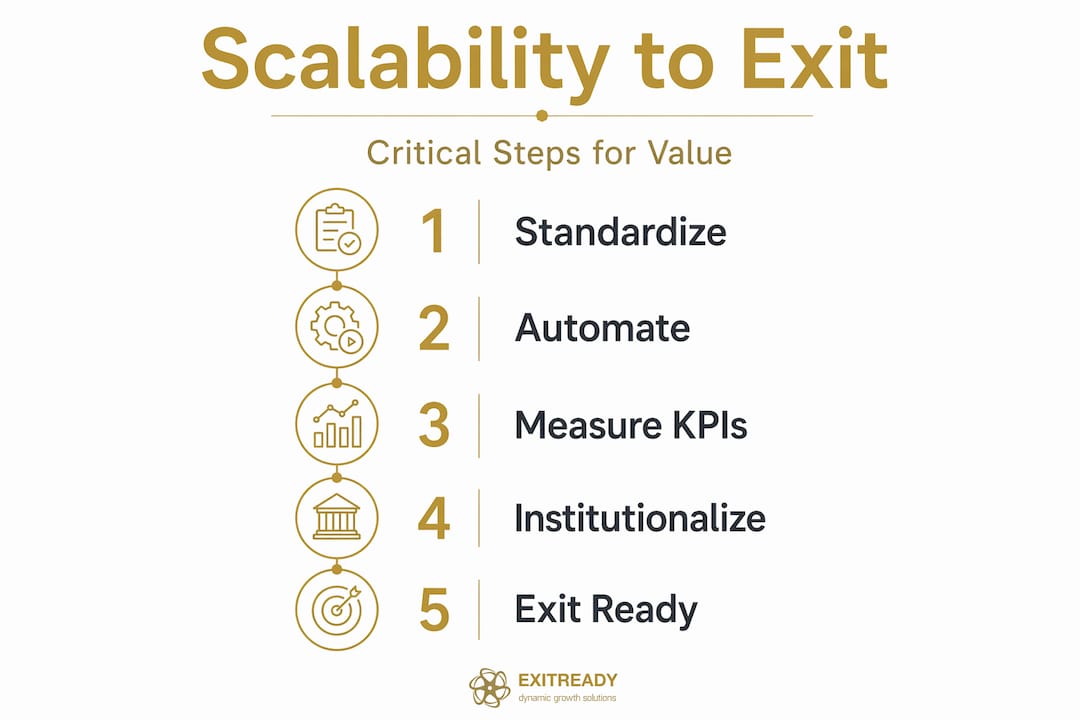
The mistake most mid-market owners make is tracking too many metrics. When everything is measured, nothing is prioritized. The strongest operators choose two to four KPIs that connect directly to strategic outcomes, not just activity levels.
Here is what a strong KPI framework looks like in practice:
- Revenue per employee: a direct proxy for operational leverage and scalability
- Gross margin by product line or service category: reveals where the business is actually profitable
- Customer acquisition cost vs. customer lifetime value: determines whether growth is economically sustainable
- Time to close or time to deliver: measures operational efficiency in core value-creation processes
Each KPI needs three elements to be useful: a realistic target, a review cadence aligned to how the business operates, and a stop rule. The stop rule is often overlooked. It defines the performance threshold below which you pause or abandon a scaling initiative rather than doubling down on something that isn’t working.
Strategic finance for scaling is the connective tissue between your KPI framework and the valuation story you tell buyers. When a sophisticated acquirer sees clean, consistent reporting with clearly defined targets and variance explanations, they assign a lower risk premium to your business. That lower risk premium translates directly into a higher multiple.
Using cloud analytics services can accelerate this process significantly. Modern analytics platforms make it possible to build executive dashboards in days rather than months, turning raw operational data into the kind of reporting infrastructure buyers expect from institutionalized businesses.
Pro Tip: Run a quarterly “buyer simulation” where you present your KPI dashboard as if you were in a due diligence meeting. If you cannot explain every metric trend in under two minutes, your reporting infrastructure needs work.
A striking reality: companies that enter the M&A process with formalized KPI reporting and defined management cadence close deals significantly faster and with fewer price reductions than those that reconstruct their metrics during due diligence. The preparation is the premium.
Avoiding pitfalls: Scaling initiatives that actually work
Many mid-market companies run a successful pilot and then assume scaling is just a matter of replication. It isn’t. What works in a controlled environment with dedicated resources and senior attention rarely transfers cleanly to the broader organization without deliberate redesign.
Scaling AI initiatives fails when teams scale pilots without redesigning workflows and measurement bridges. Success depends on defining how technical performance maps to business outcomes. This is not just an AI problem. It applies to any significant operational or technology initiative.
The pattern plays out like this: a team runs a pilot in one department, achieves impressive results, and the executive team decides to roll it out company-wide. But the workflow in the pilot was optimized for that team’s specific conditions. The technology, the people, and the adjacent processes in other departments are different. Without redesigning the workflow for each context, the rollout produces inconsistent results and eventually stalls.
Here is a proven sequence for scaling initiatives that actually stick:
- Define business outcomes before scaling, not just technical metrics. What does success look like in revenue, cost, or time terms?
- Map the current workflow in the target department before introducing any change. Understand the inputs, handoffs, and outputs.
- Redesign the workflow to incorporate the new process or technology. Do not graft the pilot onto an unchanged workflow.
- Set a measurement bridge: specific KPIs that connect the technical implementation to the business outcome.
- Run a controlled expansion in one additional department before full rollout. Treat it like a second pilot, not a replication.
- Define stop rules and escalation triggers in advance. If the KPI bridge shows the initiative is not mapping to business outcomes, you have a pre-agreed decision framework.
AI strategy consultation is increasingly relevant here because AI deployments are the most common place where this pilot-to-scale gap appears. But the same logic applies to CRM rollouts, pricing changes, and operational restructuring.
“The goal isn’t to replicate what worked in the pilot. The goal is to understand why it worked and rebuild that logic at scale.”
Scaling AI for growth requires this kind of systematic thinking. The companies that do it well build a repeatable methodology for initiative scaling, which itself becomes a competitive advantage and a signal of operational maturity to buyers.
Perspective: Why exit-ready scalability means institutionalization, not just automation
Here is something most consultants won’t say directly: automation alone will not make your business exit-ready. We’ve seen companies spend heavily on technology, automate dozens of workflows, and still struggle to command a premium multiple because the underlying business knowledge lived in people, not systems.
The distinction that actually moves the valuation needle is institutionalization. From a valuation perspective, the most exit-ready scalability is visible as institutionalization: documented processes, standardized systems, and reporting structures that reduce integration risk and post-deal transformation discounts.
Buyers are not just buying your revenue. They are buying their confidence that the revenue continues after the deal closes. Every undocumented process is a risk. Every decision that lives in the owner’s head is a discount on your purchase price.
The companies that achieve the best exits are the ones that treat their operational knowledge like a product. They document it, test it, refine it, and make it transferable. They build management layers that make decisions independently. They create reporting structures that tell the story of the business without anyone narrating.
This is a harder discipline than buying software. It requires leadership consistency over months and years, not a one-time project. But the payoff is substantial. Companies with genuine institutionalization close deals faster, negotiate from strength, and retain more of the headline price through due diligence.
Business exit preparations should begin at least two to three years before you intend to sell. That is enough time to build the documentation, the management infrastructure, and the track record of consistent performance that sophisticated buyers require.
Unlocking scalable value with expert support
Building a truly scalable, institutionalized business is achievable, but it requires the right framework and the right support at each stage of the journey.
At Dynamic Growth Solutions, the 360-ProfitDriver program is specifically designed to help mid-market owners build the operational backbone, measurement systems, and documentation infrastructure that drive premium valuations. Whether you are two years from an exit or actively exploring options, the EXITREADY platform gives you a structured path from operational chaos to institutionalized, buyer-ready performance. Join us at one of our upcoming EXITREADY events for hands-on frameworks and direct access to the advisors, fractional executives, and buyers who understand what true scalability looks like at the mid-market level.
Frequently asked questions
What makes a company truly scalable for buyers or investors?
A scalable company has standardized processes, measured results, and systems that reduce risk and integration costs for buyers. Buyers look beyond latest earnings and value standardized processes that signal operational maturity.
How long does it typically take to see ROI from workflow automation?
Mid-market companies often see initial workflow automation benefits in two to four weeks and full payback in roughly six months. Large manual-work reductions and a roughly six-month payback are common benchmarks for systematic automation programs.
Why do scaling initiatives fail after a successful pilot?
Initiatives fail when workflow redesign and true measurement aren’t embedded, so teams can’t map success at scale. Scaling initiatives fail when pilots are replicated rather than redesigned for the broader operational context.
What are the most important KPIs for scaling mid-market companies?
Choose two to four KPIs that directly link to strategic objectives and review them on a cadence aligned with how your business operates. A framework tied to objectives, not vanity metrics, keeps measurement actionable and buyer-ready.
How does automation impact company valuation during an exit?
Automation shows buyers your operations can scale efficiently and reduces transformation risks after acquisition. Automation and institutional-grade systems reduce post-acquisition transformation needs and directly increase the multiple buyers are willing to pay.