
Business brokers and M&A advisors are distinct transaction professionals separated primarily by deal size, process sophistication, and the type of buyer each one reaches. Understanding how business brokers differ from advisors is not an academic exercise. It is a decision that directly determines how much money you walk away with and how smoothly the sale runs. Hire the wrong professional for your deal size and you either overpay for services you don’t need or leave significant proceeds on the table. This guide breaks down every meaningful distinction so you can match the right professional to your specific situation.
Thank you for reading this post, don't forget to subscribe!How do transaction size and type influence the choice?
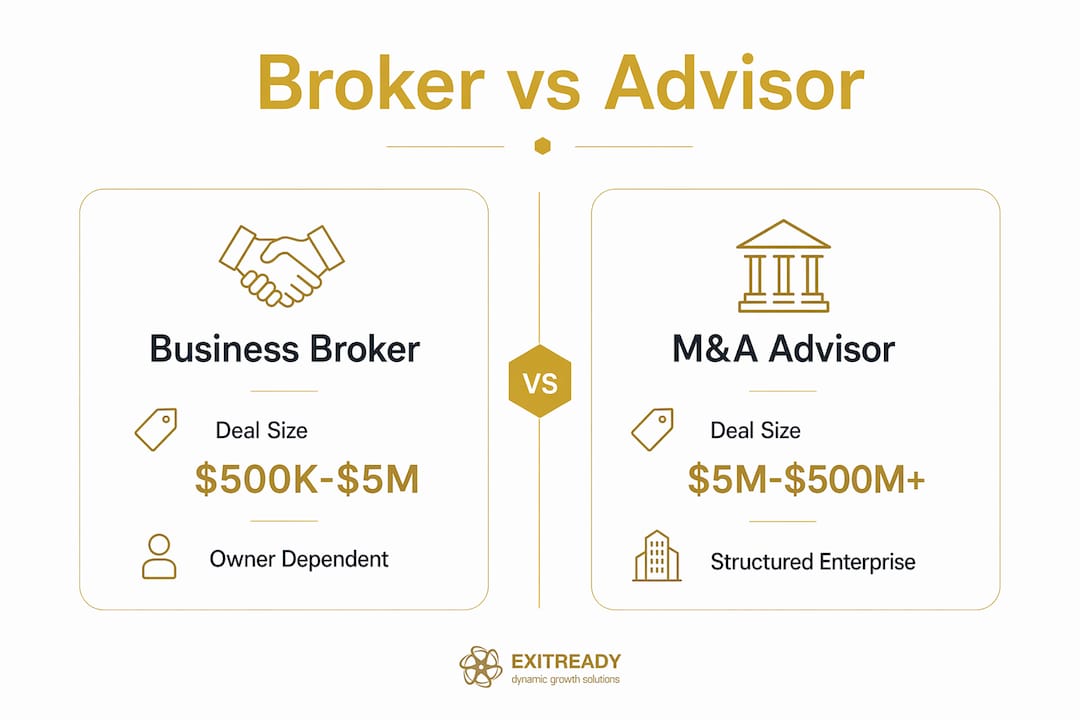
Business brokers typically handle transactions valued between $500K and $5M, while M&A advisors manage deals starting at $5M and reaching $500M or more. That gap is not arbitrary. It reflects the structural complexity of the businesses being sold and the sophistication of the buyers involved.
Brokers specialize in what the industry calls Main Street businesses. These are owner-operated companies where the owner is the business. Think a regional HVAC company, a single-location dental practice, or a family-owned restaurant group. The owner handles client relationships, vendor negotiations, and daily operations. When that owner leaves, the business faces real continuity risk, and buyers price that risk into their offers.

M&A advisors work with structured enterprises. These are mid-market companies with documented processes, a management team that runs operations independently, and financials that can withstand institutional scrutiny. A $15M specialty manufacturer with a VP of Operations, a CFO, and a documented production system is a fundamentally different asset than a $1.5M owner-run landscaping business.
| Factor | Business broker | M&A advisor |
|---|---|---|
| Typical deal size | $500K to $5M | $5M to $500M+ |
| Business type | Owner-dependent, Main Street | Structured enterprise, mid-market |
| Buyer type | Individual buyers, owner-operators | Private equity, strategic acquirers, family offices |
| Timeline | 6 to 12 months | 9 to 18 months |
| Process style | Sequential, reactive | Competitive auction, proactive |
Broker-led transactions typically close in 6 to 12 months. M&A advisor engagements run 9 to 18 months because the process is more structured and the due diligence more intensive. That extra time is not inefficiency. It is the cost of running a process designed to maximize price rather than simply find a willing buyer.
Pro Tip: Before you contact any transaction professional, calculate your business’s approximate value using a simple EBITDA multiple. If your adjusted EBITDA is under $1M, a broker is almost certainly the right fit. If it exceeds $2M, an M&A advisor will likely generate better net proceeds even after higher fees.
What distinct services do brokers and M&A advisors provide?
The service gap between these two professionals is wider than most sellers expect. Broker services focus on operational transfer, covering valuation, listing, buyer screening, and transaction coordination. M&A advisors deliver a fundamentally different product.
Here is what a business broker typically provides:
- Valuation using rules of thumb: Brokers apply industry-standard multiples (often 2 to 4 times seller’s discretionary earnings) to arrive at a listing price. This is fast and practical for smaller deals but lacks the depth of a formal financial model.
- Public listing and marketing: Brokers list businesses on platforms like BizBuySell and BusinessBroker.net, generating inbound inquiries from individual buyers actively searching for acquisitions.
- Buyer screening and qualification: Brokers verify that prospective buyers have the financial capacity to close, filtering out unqualified inquiries before the seller invests time.
- Transaction coordination: Brokers manage the paperwork, timelines, and communication between buyer, seller, attorneys, and accountants through to closing.
M&A advisors provide strategic services that include detailed financial modeling, Confidential Information Memorandum (CIM) preparation, targeted buyer outreach, and negotiation of complex deal terms including earn-outs, working capital adjustments, and rolling equity structures. A CIM is a 30 to 60 page document that presents the business’s financials, market position, growth thesis, and management team to sophisticated buyers. No broker produces one. The CIM alone signals to institutional buyers that the process is serious and the seller is prepared.
The confidentiality difference is also significant. Brokers list businesses publicly, which means employees, customers, and competitors can discover the sale before it closes. M&A advisors use blind teasers, which describe the business without identifying it, and only disclose the company name after a buyer signs a non-disclosure agreement. For mid-market businesses where key employee retention and customer relationships are critical to value, that confidentiality protection is not optional. It is a core part of protecting the asset being sold.
How do fee structures and incentives differ?
Fee structure shapes behavior, and behavior shapes outcomes. Business brokers charge 8 to 12% success fees with minimal or no upfront costs. M&A advisors charge monthly retainers of $5,000 to $15,000 plus a success fee of 1 to 5%, often calculated on a tiered basis using the Lehman Formula or a modified version of it.
| Professional | Upfront cost | Success fee | Total cost on $5M deal |
|---|---|---|---|
| Business broker | Minimal | 8 to 12% | $400K to $600K |
| M&A advisor | $5K to $15K/month | 3 to 5% | $150K to $250K + retainer |
On a $5M deal, an M&A advisor is meaningfully cheaper in absolute fee terms than a broker. That surprises most sellers who assume advisors are always more expensive. The retainer creates a different incentive structure as well. Brokers are incentivized to close any deal because they earn nothing until closing. Advisors are paid monthly regardless of outcome, which means they are hired to run a competitive process rather than simply find the first willing buyer.
That incentive difference has real consequences. A broker working on commission has a financial reason to encourage you to accept the first reasonable offer. An advisor running a competitive auction has a financial reason to generate multiple bids and push each one higher. Neither professional is acting unethically. They are responding rationally to their incentive structure.
Pro Tip: When evaluating M&A advisor fees, ask for a fee schedule that shows exactly how the success fee percentage changes at different deal value thresholds. Some advisors use a flat rate; others use a declining scale. The structure matters more than the headline percentage.
What buyer pools and negotiation processes set them apart?
The type of buyer each professional reaches is arguably the most consequential difference between brokers and advisors. Understanding this distinction helps you see why the same business, sold through different channels, can produce dramatically different outcomes.
- Brokers reach individual buyers through public listings. These are typically owner-operators, first-time business buyers, or small holding companies searching BizBuySell, BusinessBroker.net, or responding to direct outreach. The process is sequential: the broker finds one interested buyer, negotiates a letter of intent, and moves toward closing. If that deal falls through, the process restarts.
- M&A advisors reach institutional buyers through confidential, targeted outreach. Advisors maintain curated lists of qualified buyers including private equity firms, strategic acquirers, and family offices. They run staged processes from indications of interest to management presentations to final bids. Multiple buyers compete simultaneously, which creates price tension and reduces the seller’s dependence on any single buyer.
- The auction model produces measurably better outcomes. A structured advisory process can generate 20 to 40% higher net proceeds on deals sized $3M to $10M compared to a sequential broker process. That premium exists because competitive bidding forces buyers to price aggressively rather than negotiate from a position of strength.
- Brokers manage volume; advisors manage depth. Brokers manage multiple listings simultaneously, focusing on speed and throughput. Advisors handle one engagement at a time with intensive hands-on management from the first buyer contact through closing. That focus is why advisor timelines are longer and why the outcomes tend to justify the wait.
Understanding the types of business buyers that M&A advisors target, including private equity groups and strategic acquirers, helps sellers appreciate why the advisor’s buyer network is a genuine competitive advantage rather than a marketing claim.
Key takeaways
Business brokers suit owner-dependent businesses under $5M, while M&A advisors generate superior outcomes for structured mid-market companies through competitive processes that attract institutional buyers and produce 20 to 40% higher net proceeds.
| Point | Details |
|---|---|
| Deal size determines the right professional | Brokers handle $500K to $5M deals; M&A advisors manage $5M to $500M+ transactions. |
| Services differ fundamentally | Brokers coordinate operational transfers; advisors produce CIMs, financial models, and run competitive auctions. |
| Fee structures shape incentives | Brokers close any deal on commission; advisors run competitive processes on retainer plus success fee. |
| Buyer pools are not interchangeable | Brokers reach individual buyers via public listings; advisors reach private equity and strategic acquirers confidentially. |
| Dual hires destroy value | Hiring both professionals for the same sale creates buyer confusion and redundant fees. |
Why the category mistake costs more than you think
Most sellers I work with arrive at this decision having already formed an opinion. They’ve heard “broker” and “advisor” used interchangeably, and they assume the difference is mostly about price. It isn’t.
The real cost of hiring a broker for a $7M deal isn’t the 10% commission. It’s the 20 to 40% in proceeds you never see because the process never created buyer competition. I’ve seen sellers leave $1.5M on the table not because they negotiated poorly, but because they never had more than one buyer at the table. A broker’s sequential process makes that outcome structurally likely.
The reverse mistake is equally damaging. Hiring an M&A advisor for a $1.2M owner-operated business wastes money and time. The advisor’s institutional buyer network has no interest in a deal that size. The retainer fees accumulate while the process stalls.
Hiring both professionals simultaneously for the same sale is the worst outcome. Buyers receive conflicting signals, negotiations become disorganized, and the redundant fees reduce net proceeds without adding value. Pick one professional based on your deal size and business structure. Then commit to the process.
The choice also depends on how much time you can invest. An M&A advisor process requires significant seller involvement: management presentations, due diligence responses, and strategic positioning conversations. If you want to hand off the process and stay out of it, a broker’s more transactional approach may suit you better regardless of deal size. Know your own capacity before you sign an engagement letter.
Reviewing your exit strategy options before engaging any transaction professional gives you the context to evaluate what each one is actually offering.
— Andre
Prepare your business before you engage anyone

The single factor that determines whether a broker or advisor can deliver maximum value is how well your business is prepared before the sale process begins. A business with documented systems, a management team that operates independently, and clean financials commands a premium regardless of which professional you hire. Dynamicgrowthsolutions works with mid-market owners to build exactly that foundation through the AOS (Accelerated Operating System), a proprietary framework that replaces owner dependency with self-sustaining operations. If you want to understand what a business operating system actually does for your valuation and exit readiness, start there.
FAQ
What is the main difference between a business broker and an M&A advisor?
Business brokers handle smaller, owner-dependent transactions typically under $5M using public listings and individual buyer outreach. M&A advisors manage larger, complex deals through confidential, competitive processes targeting institutional buyers like private equity firms and strategic acquirers.
When should I use a business broker instead of an M&A advisor?
Use a business broker when your business is valued under $5M, is owner-operated, and your primary goal is a clean, efficient transfer to an individual buyer. Brokers are cost-effective and well-suited for Main Street businesses where speed matters more than maximizing competitive tension.
Do M&A advisors always produce better sale prices?
A structured M&A advisor process can produce 20 to 40% higher net proceeds on deals sized $3M to $10M compared to a broker-led process. That premium comes from competitive bidding among multiple institutional buyers, not from the advisor’s negotiating skill alone.
Can I hire both a broker and an M&A advisor at the same time?
Hiring both professionals for the same sale creates buyer confusion, disorganized negotiations, and redundant fees that reduce net proceeds. Choose one professional based on your deal size and business structure, then commit fully to that process.
How long does each type of sale process take?
Broker-led transactions typically close in 6 to 12 months. M&A advisor engagements run 9 to 18 months due to the structured competitive process, deeper due diligence, and the time required to run a staged auction with multiple institutional buyers.