

Succession Planning Lessons From Navy SEAL Selection: How Elite Organizations Identify Future Leaders
Most people assume Navy SEAL selection exists to find the strongest athlete, the fastest runner, or the toughest individual in the room.
It doesn’t.
And that single misconception is exactly why so many business succession plans fail before they ever get off the ground.
Former SEAL leaders consistently say selection was never primarily about physical performance. Physical fitness is just the price of admission. The real objective — the one every business owner planning an ownership transition or leadership succession strategy should care about — is identifying people who can perform under extreme pressure while making the team better.
For manufacturing leaders, founders nearing exit planning, and succession-minded entrepreneurs, the parallels between SEAL selection and building a leadership pipeline are almost too on-the-nose to ignore.
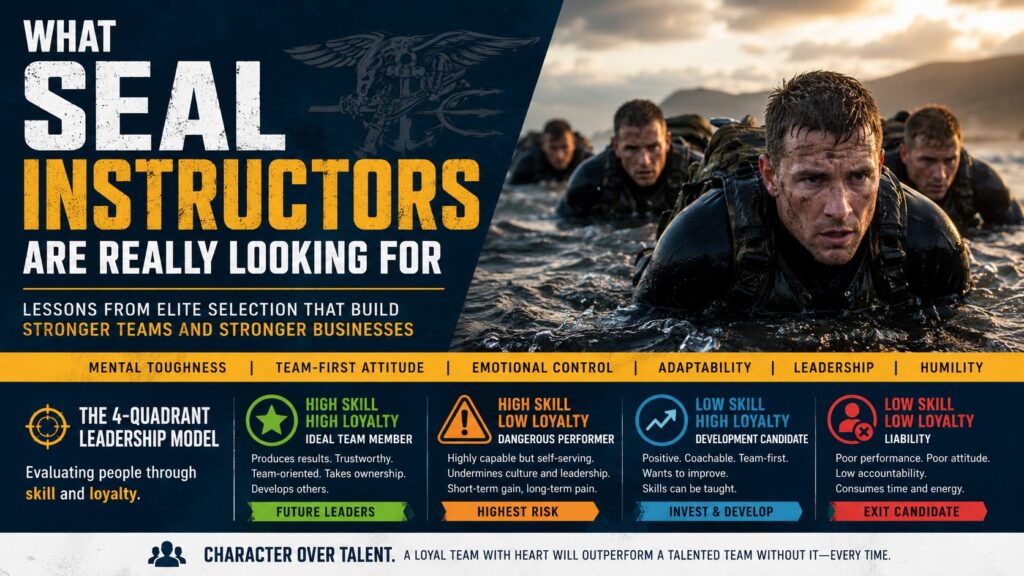
The 6 Traits SEAL Instructors Actually Evaluate
Throughout selection, instructors are watching for six traits that have nothing to do with how fast someone runs:
- Mental Toughness
Can this person keep functioning when exhausted, uncomfortable, and under stress? Anyone performs well in good conditions. The real test — and the real test of a future business leader — happens when things go wrong.
- Team-First Attitude
Does this person prioritize team results over personal credit? In a business context, this is the difference between a manager who builds a self-sufficient department and one who creates a key-person dependency that becomes a liability during a sale or transition.
- Emotional Control
Can they stay calm when everyone else is panicking? This is a non-negotiable trait for any second-in-command or successor who will eventually run the business through a downturn, supply chain disruption, or leadership change.
- Adaptability
Can they solve problems when the plan falls apart? No strategic plan survives first contact with reality — not in combat, and not in business.
- Leadership
Can they influence people without relying on a title? Real leadership is informal authority earned through trust, not org-chart position.
- Humility
Can they take feedback and keep improving? Arrogance creates blind spots. Coachability is one of the strongest predictors of long-term leadership potential.
Many physically elite athletes still fail SEAL selection — because they optimize for individual performance instead of team performance. The strongest person in the room is not always the person you want leading your company.
What This Means for Business Owners and Succession Planning
Character Over Talent
Skills can be taught. Systems can be documented. Technical expertise can be developed on the job. Character is the hard part. This is precisely why character — not competence — is usually the deciding factor in choosing a successor.
Pressure Doesn’t Create Weakness — It Reveals It
SEAL instructors deliberately create high-stress scenarios to expose gaps before they matter in a real mission. Smart business leaders do the same: they pressure-test their leadership bench strength before a recession, a key employee’s departure, or a customer loss forces the issue.
Team Before Individual
Organizations that quietly reward “heroics” end up with a culture that doesn’t scale. When one person becomes indispensable, the business becomes fragile — and far less attractive in a business valuation or sale process. High-performing companies reward systems and knowledge-sharing, not lone-wolf performance.
Leaders Eat Last
Popularized by author Simon Sinek and rooted in observations of elite military units, this principle shows up in business as: taking the blame when things go wrong, giving credit when things go right, and making decisions for the long-term health of the organization rather than short-term personal upside.
The Real Test for Future Leaders
The real question isn’t “Can this person perform?”
It’s: “Can this person perform when cold, tired, uncertain, and responsible for other people?”
That single question is often what separates entrepreneurs who successfully scale and exit their companies from those who stay trapped running them forever.
The Skill vs. Loyalty Framework for Leadership Hiring
A simple two-axis framework helps clarify how to evaluate talent for any leadership role:
High Loyalty | Low Loyalty | |
High Skill | Ideal Team Member | Dangerous Performer |
Low Skill | Development Candidate | Liability |
Quadrant 1: High Skill + High Loyalty — The Ideal Team Member
Produces results, trustworthy, team-oriented, takes ownership, develops others. These are your future department heads, directors, partners, and succession candidates. Elite organizations aggressively identify, retain, and develop this group.
Quadrant 2: High Skill + Low Loyalty — The Dangerous Performer
Highly capable but self-serving, political, or prone to creating drama. Often your top salesperson or top technician — which is exactly why leaders tolerate the behavior for too long. The long-term cultural cost (hoarded information, undermined leadership, unhealthy dependency) usually exceeds the short-term revenue benefit. This is the most dangerous quadrant in any organization.
Quadrant 3: Low Skill + High Loyalty — The Development Candidate
Coachable, reliable, team-first, eager to improve. Because skill is teachable and character isn’t, many elite organizations would rather invest here than tolerate a Quadrant 2 performer. Hire for character. Train for skill.
Quadrant 4: Low Skill + Low Loyalty — The Liability
Poor performance, poor attitude, resistant to coaching. Consumes disproportionate management time with little return.
Priority Order for Elite Organizations
- High Skill + High Loyalty
- Low Skill + High Loyalty
- High Skill + Low Loyalty
- Low Skill + Low Loyalty
Character consistently outranks talent — a highly skilled person with poor loyalty can damage a team faster than a loyal person with limited skills can build one.
Applying the Framework to Your Succession Plan
For business owners working through an ownership transition or family business succession, swap “Skill vs. Loyalty” for Competence vs. Commitment:
High Commitment | Low Commitment | |
High Competence | Future Successor | Flight Risk |
Low Competence | Invest & Develop | Exit Candidate |
When evaluating a potential successor, ask four questions:
- Can they run the business? (competence)
- Will they protect the culture? (character)
- Do they put the organization ahead of themselves? (commitment)
- Would I trust them with my family’s name on the door? (loyalty)
The Succession Mistake Most Owners Make
Many owners become fixated on finding the most technically capable successor available. That’s usually the wrong starting point.
Once a candidate clears a minimum competence threshold, commitment becomes the deciding factor. A successor with 80% of the required skill and 100% commitment will almost always outperform someone with 100% of the skill and 50% commitment over a multi-year horizon — because businesses aren’t built on talent alone. They’re built on trust, accountability, resilience, and a willingness to put the mission ahead of the individual.
That’s exactly what elite organizations — from Navy SEALs to high-performing manufacturing companies — have been selecting for all along.
Ready to evaluate your own leadership bench strength and succession readiness? A ProfitDriver Analysis can help identify the gaps before they become costly — whether that’s a key-person dependency, a culture risk, or a successor who isn’t quite ready yet.