
 Lessons Learned.
Let me be straight with you. Most people who want to buy a business have no idea what they’re walking into. And most sellers? They’re not ready to sell. Only about 2–4% of businesses listed actually change hands. The rest just… fade out. Owners who spent decades building something valuable close the doors one day and walk away with nothing. That’s not a tragedy of the market—it’s a failure of preparation.
But here’s what that means for you: opportunity. Real opportunity, if you know what you’re looking for.
Learn the Recipe—Or Fail Fast
I’ve watched buyers get burned because they skipped this step. Every business runs on a recipe—a formula of systems, processes, and know-how that makes it work. The danger is when that recipe lives entirely inside the owner’s head. The moment they leave, the whole thing starts to unravel.
Before you sign anything, you need to know: is this documented? Is it repeatable without the founder in the room? If the answer is no, you’re not buying a business. You’re buying a job with extra risk attached.
And look at the financial trend honestly. I’ve seen buyers talk themselves into “turnaround potential” deals that had no business being acquired. Distressed businesses are seductive—they’re cheaper, they feel like a challenge, they appeal to your ego. I get it. But a plane already losing altitude doesn’t care how confident you are. Buy businesses that work, not businesses you hope to fix.
Don’t Overreach. I Did.
There’s a real difference between a $1–2 million Main Street business and a $15–20 million enterprise. I know people who jumped straight to the big deal because they had corporate experience and thought it would translate. It doesn’t—not automatically. Running a business touches five pillars at once: leadership, operations, finance, people, and sales. Miss one and you feel it everywhere.
Start smaller. Win there. Build your confidence and your competence before you try to go to the moon. This isn’t about limiting your ambition—it’s about surviving long enough to act on it.
Debt Isn’t the Enemy
One of the biggest mental blocks I see is around financing. People think they need to pay cash or they’re not ready to buy. That’s backwards. Income-producing debt—backed by a business that generates real cash flow—is fundamentally different from consumer debt. Use it. Just make sure the business can service it comfortably and still leave you a cushion for the unexpected. Because the unexpected will show up.
The Human Part Is Everything
Here’s what nobody talks about enough: the relationship with the seller matters as much as the financials. Maybe more.
You’re stepping into someone’s life’s work. If you walk in with the attitude that you’re going to tear it down and rebuild it your way, you’ll lose the one person who can actually save you—the person who knows where everything is buried. Approach it like you’re walking into a MasterChef’s kitchen for the first time. You’re there to learn, not to perform.
Sellers who feel respected share more. They mentor you. They fill in the gaps no due diligence process ever could. That goodwill is worth more than any discount you’d squeeze out of a combative negotiation.
Once You’re In, Move Carefully
The first thing I tell every buyer after close: get the accounting right. You can’t make good decisions without accurate numbers. Everything else waits until you can see clearly.
Then learn how the business actually runs day-to-day. Resist the urge to change things. I know it’s hard—you’re excited, you have ideas, you want to make your mark. But stabilize first. Understand the recipe completely before you start improvising. Map the processes, evaluate your people, and then—only then—start building.
Win-Win or Walk Away
The buyers who struggle are usually the ones who treated negotiation like a war. Squeeze the seller, win every point, get the lowest price possible. And then what? You’ve got a resentful former owner who has zero incentive to help you succeed.
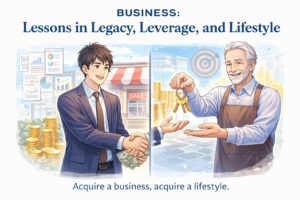
The buyers who thrive understand that sellers aren’t just selling a business—they’re handing off a legacy. Honor that. Ask questions that show you’ve actually listened. Give them a reason to feel proud about what comes next. That approach costs you nothing and buys you everything.
The path is simple, even if it isn’t easy: find businesses that already work, understand what makes them run, respect what was built before you arrived, and use smart financing to make it happen. Do that, and you’re not just buying a business. You’re buying your way out of someone else’s schedule—and into a life you actually chose.