
Growth stalls when your business runs on instinct rather than infrastructure. Many mid-market companies hit a ceiling not because of weak products or bad talent, but because the systems connecting strategy to daily execution simply don’t exist. Decisions pile up on the owner’s desk. Processes vary by who’s in the room. Metrics get tracked in spreadsheets that nobody reviews. The result is a business that grows harder to run the bigger it gets. This guide walks you through everything you need to build a management system that scales with you, from foundational prerequisites through continuous improvement.
Thank you for reading this post, don't forget to subscribe!Table of Contents
- What you need before building a management system
- Step-by-step: Building your business management system
- Avoiding common pitfalls in system implementation
- Measuring, monitoring, and refining for lasting results
- The reality: What most guides miss about business management systems
- Take the next step: Implement your scalable business management system
- Frequently asked questions
Key Takeaways
| Point | Details |
|---|---|
| Strategy is the backbone | Effective management systems always start with clear strategy and closed-loop alignment. |
| Data quality is non-negotiable | Scalable systems rely on consistent, governed, and high-quality information. |
| BPM is ongoing, not one-off | Business process management is a continual discipline, not just automation or software. |
| Refine and monitor constantly | Regular reviews and updates keep your management system delivering real results. |
| Avoid system sprawl | Limiting KPIs and maintaining a feedback loop prevents wasted effort and complexity. |
What you need before building a management system
Most business owners jump straight to software when they hear “management system.” They buy a project management tool, set up a dashboard, and call it done. Six months later, nothing has changed except the monthly software bill. The real work happens before you touch any tool.
A business management system should link strategy to execution using a closed-loop management cycle. That means your system isn’t a collection of standalone apps. It’s a disciplined cycle where strategy informs objectives, objectives drive plans, plans generate data, and data feeds back into strategy. If any link in that chain is missing, you don’t have a system. You have a process.

Prerequisites that actually matter
Before you build anything, you need four things in place:
| Prerequisite | What it means in practice | Why it matters |
|---|---|---|
| Strategic clarity | A documented strategy with 3 to 5 core priorities | Systems without strategy just automate chaos |
| Leadership buy-in | Executives committed to reviewing and acting on data | No review cycle means no improvement |
| Data quality | Clean, consistent data across core business functions | Bad data produces misleading signals |
| Resource allocation | Dedicated time and budget for implementation | Underfunded builds stall and get abandoned |
Data quality deserves extra attention here. Scalable systems depend on consistent, accessible information and underlying governance pillars. That means defining who owns each data source, how it gets updated, and what standards it must meet before it feeds into your reporting. Without this, your management system will produce numbers that leaders argue about rather than act on.
Here’s a quick checklist before you move forward:
- Leadership has agreed on the top 3 to 5 strategic priorities
- You have a clear owner for each business function
- Core data sources (financials, operations, sales) are centralized and current
- You’ve reviewed strategic finance fundamentals to align financial data with strategic goals
- A review cadence has been tentatively scheduled
Pro Tip: Don’t try to fix every data quality problem before you start. Identify the two or three data streams that directly affect your top priorities and get those clean first. You can expand from there.
The business management insights that separate high-growth companies from stagnant ones almost always trace back to this preparation phase. Owners who skip it spend the next year troubleshooting a system that was broken before it launched.
Step-by-step: Building your business management system
With essentials in place, you’re ready to start building. Here’s how to approach the process systematically rather than reactively.
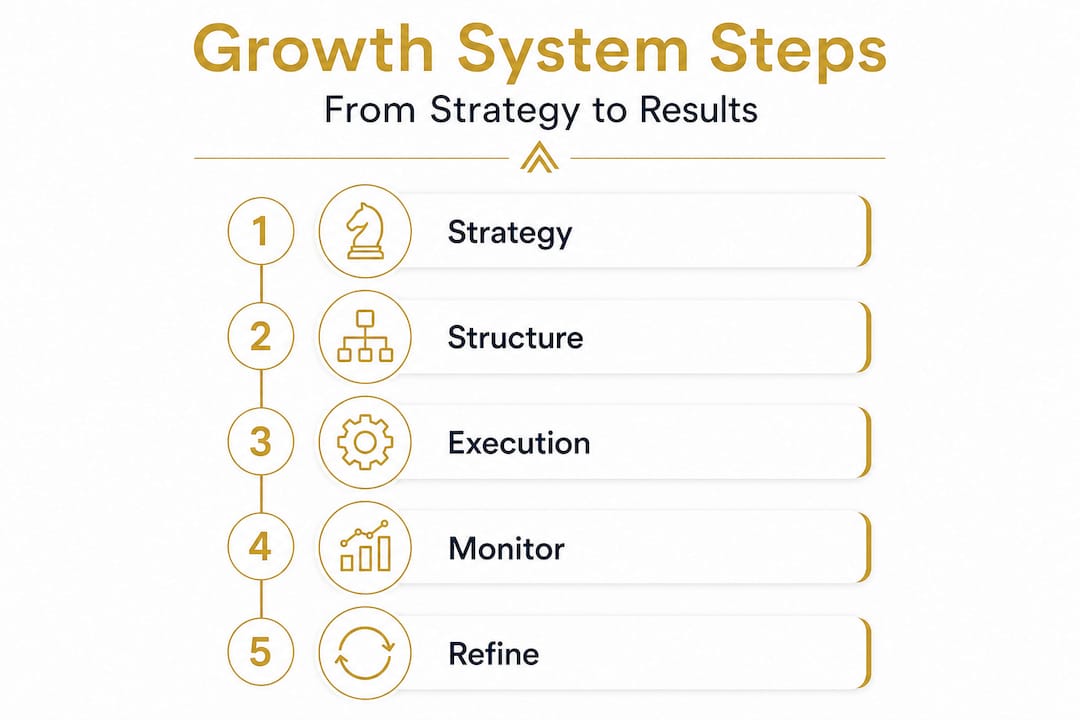
The most useful framework for mid-market companies comes from Kaplan and Norton’s research on management systems. They describe five management system stages: strategy development, translating strategy into objectives and initiatives, operational planning, monitoring effectiveness, and testing and updating the strategy. This isn’t theory. It’s a repeatable cycle that high-performing organizations run on a quarterly and annual basis.
Here’s how to execute each stage:
- Develop your strategy. Document your market position, core value proposition, and the three to five priorities that will drive growth over the next 12 to 36 months. Keep it short enough to fit on a single page. If your leadership team can’t agree on what the strategy says, no management system will fix that misalignment.
- Translate strategy into objectives and initiatives. Each strategic priority becomes a measurable objective. Each objective gets one to three specific initiatives attached to it. This is where many companies get vague. “Improve customer retention” is not an objective. “Increase 12-month customer retention rate from 72% to 85% by Q4” is.
- Build your operational plan. Assign owners, timelines, and resource requirements to each initiative. This is the bridge between strategy and daily execution. Without it, strategy stays on the wall and operations run on habit.
- Monitor effectiveness. Set a regular cadence, monthly at minimum, to review progress against objectives. Use leading indicators (activities you control) alongside lagging indicators (results you’re measuring). This distinction matters enormously in practice.
- Test and update the strategy. At least once per year, and ideally every quarter, review whether your strategic assumptions still hold. Markets shift. Competitors move. Customer needs evolve. Your system needs a built-in mechanism to catch those changes before they become crises.
Closed-loop vs. ad hoc: Why it matters
| Dimension | Closed-loop system | Ad hoc approach |
|---|---|---|
| Strategy connection | Every metric ties to a strategic objective | Metrics tracked without clear purpose |
| Review cycle | Structured, scheduled, and documented | Informal, inconsistent, reactive |
| Improvement process | Built into the system as a defined stage | Happens when a crisis forces it |
| Accountability | Owners assigned to each objective | Responsibility diffuses across the team |
| Scalability | System grows with the business | Complexity increases without structure |
For companies serious about quality management, ISO 9001 principles offer a concrete blueprint for continual improvement that maps directly onto this cycle. The standard’s emphasis on documented processes, management review, and corrective action aligns with what mid-market companies need to build operational independence.
Pro Tip: When you review operating model changes during your annual strategy update, document what changed and why. This creates an institutional memory that survives leadership transitions and makes your business significantly more attractive to buyers.
Use profit driver tools to identify which operational levers have the highest impact on your key objectives. Not every initiative deserves equal attention. The ones connected to your highest-leverage profit drivers should get disproportionate focus.
Avoiding common pitfalls in system implementation
Even the best-intentioned system builds are prone to several classic missteps. Knowing them in advance is the difference between a system that drives results and one that quietly gets abandoned after six months.
System sprawl is the most common killer. It happens when each department builds its own tracking process, leadership adds new metrics every quarter, and the “system” becomes a loose collection of disconnected dashboards. The antidote is discipline: start from a strategy and operations loop, define a limited set of objectives and KPIs, and connect monitoring reviews directly to updates of the strategy and its underlying assumptions.
The other major trap is treating business process management (BPM) as a software problem. BPM is an ongoing discipline for monitoring, optimizing, and controlling processes across the enterprise. When companies treat it as workflow automation, they get efficiency gains in isolated pockets but lose the discipline’s monitoring and optimization cycle entirely. The software runs. The system doesn’t.
Here are the most common mistakes we see in mid-market implementations:
- Too many metrics. If your monthly review covers more than 10 to 12 KPIs, nobody is accountable for any of them. Cut ruthlessly.
- Ignoring data quality. Launching a system on top of unreliable data produces confident-sounding reports that lead to bad decisions.
- Skipping the review phase. Building the system and then not scheduling structured reviews is like installing a smoke detector and removing the batteries.
- No owner for the system itself. Someone needs to be responsible for maintaining the management system, not just the functions it tracks.
- Confusing activity with progress. Tracking that initiatives are “in progress” is not the same as measuring whether they’re producing results.
“The mechanics that reduce system sprawl are straightforward: start from a strategy and operations loop, define a limited set of objectives and KPIs, and connect monitoring reviews to updates of the strategy and its assumptions. Fewer, better metrics outperform comprehensive dashboards every time.”
If you’re evaluating business sale readiness, a well-documented management system is one of the most powerful value drivers you can demonstrate to a buyer. It signals that the business runs on process, not on the owner.
Measuring, monitoring, and refining for lasting results
Having implemented your system and avoided the common pitfalls, the final piece is ensuring it actually drives results and that improved performance is sustainable over time.
Continual improvement requires ongoing monitoring, measurement, and updates based on real operational data. That’s not a one-time exercise. It’s a rhythm. Companies that build this rhythm into their calendar outperform those that treat reviews as optional.
Here’s the cycle that works:
- Measure. Collect data on your defined KPIs at a consistent frequency. Weekly for operational metrics, monthly for strategic metrics, quarterly for financial performance against objectives.
- Review. Bring leadership together on a scheduled basis to interpret the data. The goal isn’t to report numbers. It’s to identify what the numbers are telling you about whether your strategy is working.
- Identify gaps. Compare actual performance to targets. For every gap, ask whether the issue is execution (the initiative isn’t being done well) or assumption (the initiative was the wrong choice to begin with).
- Refine. Update initiatives, adjust targets, or revise strategic assumptions based on what the data shows. Document every change and the reasoning behind it.
- Communicate. Share updates with the broader team. Employees who understand how their work connects to strategic objectives are more engaged and more effective.
Stat to know: Organizations that conduct formal management reviews on a quarterly basis are significantly more likely to achieve their annual strategic objectives than those that review performance only at year-end.
Pro Tip: Use profit driver insights to build your KPI set around the metrics that actually move profit, not the ones that are easiest to track. Vanity metrics feel good in a review meeting and do nothing for your business.
The review cadence is where most systems either take root or quietly die. Block the time on the calendar before you launch the system. Treat it as non-negotiable. A management system that nobody reviews is just expensive documentation.
The reality: What most guides miss about business management systems
Here’s the uncomfortable truth most implementation guides skip: the majority of management system failures have nothing to do with the wrong software or the wrong framework. They fail because leadership treats the system as a reporting tool rather than a decision-making discipline.
We’ve worked with mid-market companies that had beautiful dashboards, sophisticated KPI libraries, and detailed process documentation. None of it moved the needle because nobody was using the data to challenge assumptions. The reviews happened. The numbers got reported. And then everyone went back to running the business the same way they always had.
High-performing organizations do something different. They build discipline around reviewing their own assumptions and adapting strategy rapidly, not just tracking lagging metrics. They ask hard questions in review meetings: “Is this initiative actually working, or are we just busy?” “Did we get the result we expected? If not, was our assumption wrong?” That kind of intellectual honesty is what separates companies that scale from companies that plateau.
The other thing most guides won’t tell you is that leadership metric selection is a strategic act, not a technical one. Choosing what to measure is choosing what to manage. When you track too many things, you manage nothing well. When you track the right five to seven metrics, you create clarity and accountability at every level of the organization.
Fewer, better KPIs plus a real feedback loop will always outperform a comprehensive dashboard that nobody acts on. The goal isn’t visibility. It’s decision velocity. The faster your organization can detect a gap, understand its cause, and adjust, the more competitive you become. That’s what a real management system delivers.
Take the next step: Implement your scalable business management system
Building a management system that actually drives growth is one of the highest-leverage investments you can make as a business owner. The steps in this guide give you a clear path forward, but execution is where most companies need support.

At Dynamic Growth Solutions, we help mid-market owners implement proven frameworks that replace owner dependency with self-sustaining operations. The 360-ProfitDriver program gives you the tools to identify your highest-impact levers and build the monitoring cycle around them. If you’re thinking longer term, the Exit Ready framework positions your business for a premium exit by documenting the systems that make it valuable without you. Start by understanding what’s holding your business back from a successful sale or scale, and build from there.
Frequently asked questions
What is a closed-loop business management system?
A closed-loop system links strategy to execution through continuous cycles of planning, monitoring, and improvement rather than static, one-directional processes. It ensures that real operational data feeds back into strategic decisions on a regular basis.
Do I need special software to implement BPM?
No. BPM is an enterprise-wide discipline focused on optimizing and controlling processes, not a software application. Tools can support the work, but the discipline and review cycle are what drive results.
How do I make sure my system scales as my business grows?
Prioritize data quality, build in a continual improvement cycle, and update your strategy based on what monitored results actually show. Scalable systems depend on consistent, accessible information governed by clear ownership and standards.
What’s a common mistake when setting up management systems?
Tracking too many metrics without a structured review cycle is the most common failure mode. Reducing system sprawl requires a limited set of objectives and KPIs tied directly to strategy, with monitoring reviews connected to strategic updates.