
Most business owners treat exit planning like a fire drill, something to scramble through when a buyer shows up or retirement suddenly feels real. That’s a costly mistake. Business exit planning is the structured, multi-year process of preparing both the owner and the business for an ownership transition, and it touches everything from your management team to your tax structure to how your financials are documented. Done right, it doesn’t just help you sell, it makes your business worth significantly more, reduces deal risk, and puts you in control of the outcome.
Thank you for reading this post, don't forget to subscribe!Table of Contents
- What is business exit planning?
- Core pillars of premium exit planning
- Reducing owner dependence for seamless transitions
- How enterprise value building works in exit planning
- The professional exit planning ecosystem
- What most exit planning advice misses: hard truths and smarter shortcuts
- Ready to future-proof your business and maximize your exit?
- Frequently asked questions
Key Takeaways
| Point | Details |
|---|---|
| Start early | Begin exit planning at least 3–5 years out to close valuation gaps and solve legal/tax complexities. |
| Prioritize operational independence | Reducing owner dependence increases transferability and buyer confidence in your business. |
| Build enterprise value | Improve financials, processes, and risk controls to achieve premium pricing at exit. |
| Engage the right advisors | A professional exit team maximizes value and reduces costly oversights. |
| Document and systematize | Business systems, leadership depth, and documentation are key to seamless transitions. |
What is business exit planning?
Exit planning is not a checklist you hand to your accountant six months before you want to close a deal. It’s a holistic, multi-year strategy that prepares your business and your personal finances for a transition of ownership, whether that means a sale to a third party, a management buyout, a family transfer, or even an IPO.
The confusion usually starts with terminology. People use “exit planning,” “exit strategy,” and “succession planning” interchangeably, but they mean different things. As exit planning and succession planning differ, exit strategy describes the chosen route out, while succession planning focuses on people and leadership continuity. Exit planning is the broader framework that contains both. It also layers in financial goals, tax optimization, legal structuring, and operational readiness.
Here’s a quick breakdown of how these three terms relate:
| Term | Focus | Scope |
|---|---|---|
| Exit planning | Full ownership transition readiness | Broadest, multi-year |
| Exit strategy | The specific route chosen (sale, merger, etc.) | Narrower, transactional |
| Succession planning | Leadership and people continuity | People-focused, can be internal |
The core objectives of solid business exit preparations include maximizing enterprise value, mitigating transaction risk, and aligning the business outcome with your personal and financial goals. These three objectives rarely happen on their own. They require intentional work, often starting years before you’re ready to transition.
Key things exit planning addresses:
- Financial normalization and clean reporting
- Legal and entity structure optimization
- Leadership depth and management independence
- Customer and revenue concentration risks
- Documented systems and operational playbooks
- Personal wealth and tax planning for the owner
Understanding why structured planning matters is the first step toward building a business that commands a premium, regardless of when you decide to exit.
Core pillars of premium exit planning
With a clear definition in place, it’s time to dig into the main building blocks that high-value exit plans rely on. These pillars are not independent of each other. They reinforce one another, and weakness in one will drag down the rest.
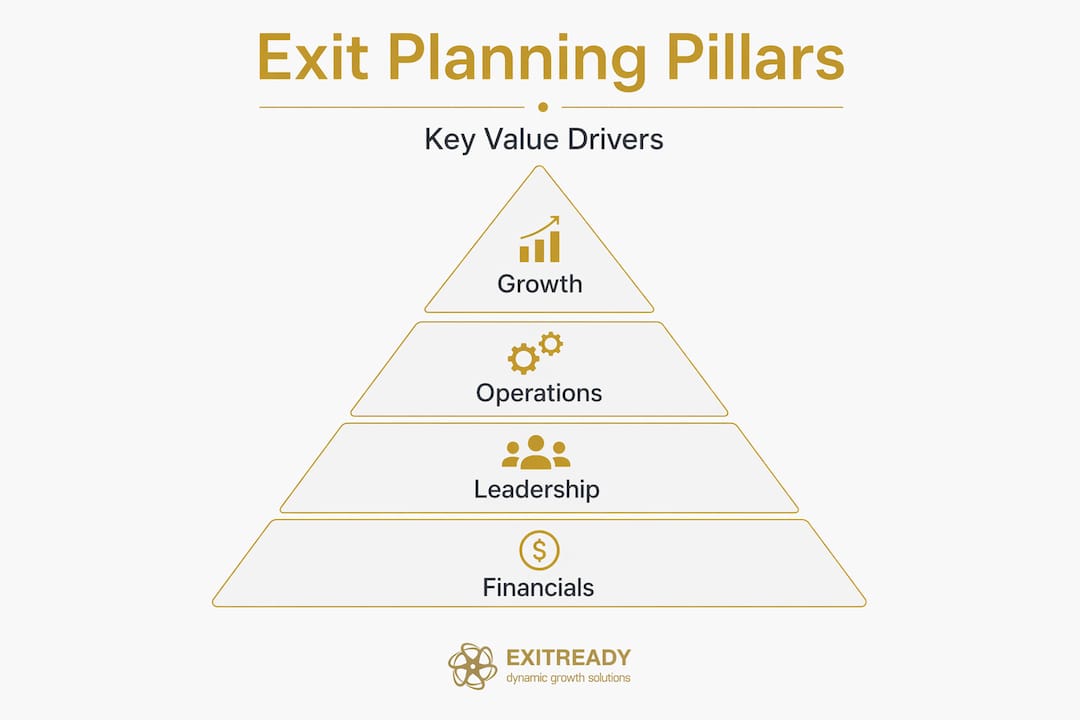
Premium exit planning for valuation typically includes enterprise value build work such as financial normalization, quality of earnings improvements, risk containment, and legal and tax structuring, all before the transaction process even begins. Buyers and their advisors will scrutinize every one of these areas during due diligence, and surprises discovered at that stage almost always result in price reductions or deal failures.
Here are the four core pillars every mid-market owner should build:
- Operational independence. Your business must be able to run without you. Buyers underwrite risk, especially whether the business can perform without the founder or owner. A company that falls apart when the owner takes a two-week vacation is not a company a sophisticated buyer wants to pay a premium for.
- Enterprise value building. This means proactively improving the financial metrics, revenue quality, and structural factors that drive your valuation multiple. It includes reducing customer concentration, improving recurring revenue, and demonstrating consistent EBITDA growth.
- Legal and tax structuring. The entity structure you operate under today may not be the right one for a tax-efficient exit. This pillar involves working with tax strategists and attorneys to optimize your structure years in advance.
- Risk mitigation. Buyers look for reasons to lower the price. Addressing concentration risks, key-person dependencies, pending litigation, and weak contracts before going to market protects your valuation.
“The businesses that command the highest multiples are not just profitable, they’re predictable, documented, and transferable. Those qualities are built over years, not weeks.”
Pro Tip: Use your operational model inflection point as a trigger to start formal exit planning work. When your business crosses a revenue or team size threshold where complexity increases, that’s the moment to install systems and governance that will hold up under buyer scrutiny.
Tracking your progress across these pillars gives you a clear picture of where your valuation gaps are and what levers to pull. Your profit driver levers are a practical starting point for identifying which financial and operational improvements will move the needle most.
Reducing owner dependence for seamless transitions
Securing your core pillars starts by addressing the most common value drag in mid-market businesses: owner dependence. This is the single issue that kills more deals, lowers more valuations, and creates more post-closing problems than almost any other factor.
Owner dependence shows up in four main risk areas:
- Management depth. If your leadership team cannot make decisions without you, buyers see a liability, not an asset.
- Customer concentration. If your top three clients know you personally and would leave if you did, that’s a major red flag.
- Financial and system maturity. If your financials require your personal interpretation to understand, they’re not diligence-ready.
- Documentation gaps. If your processes live in your head rather than in written playbooks, your business is not transferable.
Operational diligence readiness is a major driver of outcomes, and documented systems, clean financial reporting, and addressing owner-dependency issues are recurring themes in every successful transaction. Buyers and their advisors know exactly what to look for, and they will find the gaps.
Steps to systematically reduce owner dependence:
- Document every core process in a written playbook, including client onboarding, service delivery, and financial reporting
- Develop a second tier of leadership capable of running day-to-day operations independently
- Automate recurring tasks using technology so the business runs on systems, not people
- Transition key client relationships to account managers or team leads well before any sale process begins
- Build a management dashboard that gives any buyer real-time visibility into performance without needing to ask you
Pro Tip: Start your leadership succession plan at least three years before you intend to exit. The role of founder independence in valuation is often underestimated. Buyers pay for certainty, and a proven leadership team that has operated without the founder is one of the clearest signals of certainty available.
“Owner dependency is not just a valuation problem. It’s a dealbreaker. Buyers don’t want to acquire a job, they want to acquire a business.”
Your exit readiness overview can help you assess exactly where your business stands today and what gaps need to close before you’re ready to go to market.
How enterprise value building works in exit planning

With structure in place and owner dependence addressed, high-value exits require focused, long-term enterprise value building. This is where many owners get confused because they assume valuation is something that happens at the end, when the banker runs the numbers. In reality, valuation is built or destroyed over years of operational and financial decisions.
There are two frameworks owners commonly use when approaching this work:
| Framework | Primary Focus | Typical Outcome |
|---|---|---|
| Valuation-first | Financial metrics, EBITDA, multiples | Strong on paper, weak in diligence |
| Transferability-first | Systems, team, customer independence | Holds up through diligence, commands premium |
Premium pricing requires both financial and structural work. A business that looks great on a spreadsheet but falls apart during due diligence will not close at the asking price. The best outcomes come from owners who pursue both frameworks simultaneously.
Here’s a practical sequence for building enterprise value over a 3 to 5 year horizon:
- Normalize your financials. Remove personal expenses, one-time items, and owner compensation adjustments so your EBITDA reflects true business performance.
- Improve revenue quality. Shift toward recurring, contracted, or subscription-based revenue streams that buyers value at higher multiples.
- Reduce customer concentration. No single customer should represent more than 10 to 15 percent of revenue if you want to avoid a valuation haircut.
- Strengthen your management team. Document roles, responsibilities, and performance metrics for every key leader.
- Fix legal and entity structure. Major tax decisions must be made years ahead, not at the letter of intent or closing stage.
- Conduct pre-diligence. Hire an advisor to find the issues before buyers do, then fix them proactively.
Key stat: Mid-market owners should start planning 3 to 5 years in advance to close valuation gaps and implement entity and tax work. Owners who start this process late consistently leave money on the table or face deal complications that could have been avoided.
Pro Tip: Treat pre-diligence like a dress rehearsal. Hire an outside advisor to review your financials, contracts, and operations exactly as a buyer’s team would. The issues they find are the issues that will cost you at the negotiating table if left unaddressed. Enterprise value preparation done early is always cheaper than value lost in a deal.
Understanding the buyer perspective is also invaluable here. Knowing what buyers actually look for, and what makes them walk away or reduce their offer, gives you a clear target to build toward.
The professional exit planning ecosystem
Leveraging the right ecosystem and advisors who know the latest benchmarks is often the difference between leaving money on the table and maximizing your outcome. Exit planning is not a solo exercise, and the most successful transitions involve a coordinated team of specialists.
ExitMap’s 2025 survey of exit planning professionals, which contacted 7,267 advisors and received 434 responses, confirms the sector’s breadth across advisory disciplines and the growing standardization of professional focus areas. This is a mature, specialized field, and the right advisors bring benchmarks, buyer networks, and transaction experience that most business owners simply don’t have access to on their own.
Here’s a breakdown of the key advisor types and what they contribute:
| Advisor Type | Primary Role | When to Engage |
|---|---|---|
| Exit consultant | Overall strategy and readiness | 3 to 5 years before exit |
| CPA/accountant | Financial normalization, quality of earnings | Ongoing, intensify 2 years out |
| Deal attorney | Transaction structure, contracts, reps and warranties | 12 to 18 months before sale |
| Tax strategist | Entity structure, capital gains optimization | 3 to 5 years before exit |
| Wealth manager | Personal financial planning post-exit | 2 to 3 years before exit |
When choosing advisors, look for professionals who specialize in your business size and industry. A generalist accountant who has never worked on a mid-market transaction is not the same as a CPA who has closed dozens of them. Ask for references from clients who have completed exits, not just those who are planning them.
An outside perspective also uncovers hidden value gaps and risks that owners simply cannot see from the inside. You’re too close to your own business to spot the patterns that concern buyers. Exit advisor lessons from owners who have been through the process confirm this consistently: the advisors who push back hardest are usually the ones who add the most value.
What most exit planning advice misses: hard truths and smarter shortcuts
Here’s what we see repeatedly working with mid-market owners: the obsession with valuation multiples often becomes a distraction from the work that actually moves the number. Owners spend hours debating whether they’ll get 6x or 8x EBITDA while ignoring the operational and leadership gaps that will cause a buyer to retrade the deal at 4x during due diligence.
The most expensive mistakes happen when founders wait too long to detach from day-to-day operations. Not because they’re lazy or uninformed, but because they genuinely believe their involvement is a feature, not a bug. Buyers see it differently. A business that requires the founder’s daily judgment is a business with a single point of failure, and sophisticated buyers price that risk aggressively.
The real-world exit lessons that matter most are rarely about financial engineering. They’re about the owner who waited until year one of the sale process to start delegating, only to discover that their management team had never made a major decision independently. Or the owner who discovered during due diligence that three of their top five clients had verbal agreements, not signed contracts. These are fixable problems, but only if you find them early.
The smarter shortcut is this: start acting as if you’re not needed tomorrow. Build the systems, develop the team, and document the processes as if you were handing the keys over next quarter. Your valuation will grow, your deal options will expand, and your stress during any eventual transaction will drop dramatically. Even if you’re five years away from selling, fixing operational weak spots now is the only shortcut that actually works. Everything else is just preparation for a negotiation you’re not ready to win.
Ready to future-proof your business and maximize your exit?
If this article has made one thing clear, it’s that premium exits are built long before any buyer shows up. The gap between a good outcome and a great one is almost always filled with operational systems, leadership depth, and financial clarity that took years to build.
Dynamic Growth Solutions helps mid-market owners build exactly that foundation through programs like the 360-ProfitDriver program, which identifies and activates the financial and operational levers that drive valuation. Whether you’re three years out or just starting to think about your options, our upcoming events give you direct access to the frameworks and advisors that make premium exits possible. Ready to take the first step? Start with our entrepreneur application and find out exactly where your business stands today.
Frequently asked questions
How far in advance should business owners start exit planning?
Most experts recommend starting exit planning at least 3 to 5 years before you want to transition ownership, giving you enough time to close valuation gaps and implement tax and legal structures that can’t be rushed.
What’s the difference between exit planning and succession planning?
Exit planning broadly prepares the business and owner for any type of ownership transition, while succession planning focuses specifically on leadership continuity and who will run the business going forward.
Why is owner dependence such a big risk for buyers?
Buyers discount businesses that rely too heavily on one person because it raises serious questions about future performance. Operational independence is central to how buyers assess and price risk during any acquisition.
What professionals should be involved in exit planning?
Exit planning teams typically include exit consultants, accountants, deal attorneys, tax specialists, and wealth advisors. The exit-planning ecosystem is large and growing, with professionals who specialize in mid-market transactions across every advisory discipline.