
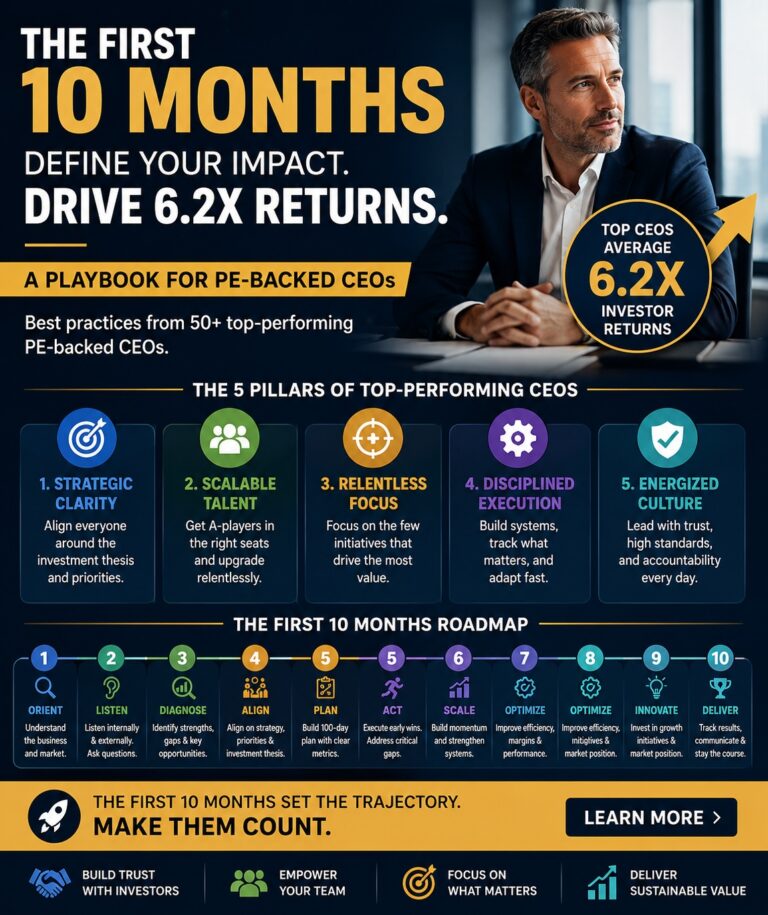
The First 10 Months: A Strategic Leadership Thesis on Value Creation for Private Equity–Backed CEOs
Thank you for reading this post, don't forget to subscribe!Executive Summary
The first 10 months of a private equity–backed CEO’s tenure represent the highest leverage period in the lifecycle of a PE investment. Research derived from interviews, case studies, and observations of high-performing PE-backed CEOs — averaging 6x investor returns — reveals that early-stage CEO effectiveness is less about charismatic leadership and more about designing systems that institutionalize accountability, strategic clarity, disciplined execution, and scalable talent management.
This thesis argues that PE-backed CEOs who outperform do not operate primarily as “problem solvers,” but rather as organizational architects who create operating systems capable of scaling value creation rapidly under compressed timelines. The first 10 months determine whether the investment thesis gains traction or deteriorates into organizational drift. Research indicates that PE firms begin questioning leadership viability after approximately 10 – 12 months of underperformance.
The central conclusion of this thesis is:
The highest-performing PE-backed CEOs achieve superior outcomes by rapidly aligning the organization around the investment thesis, aggressively upgrading critical talent, simplifying strategic execution, institutionalizing accountability, and creating cultures that balance high performance with transparency and adaptability.
Introduction
Private equity environments differ fundamentally from traditional corporate leadership contexts. Time compression, aggressive growth targets, leveraged capital structures, and investor expectations create an environment where execution speed becomes a competitive weapon.
Unlike public-company CEOs optimizing quarterly predictability, PE-backed CEOs operate within a finite investment horizon — often a 3–5 year sprint toward value realization. The first 10 months establish whether the organization can execute the investment thesis at the speed required by institutional capital.
Research findings demonstrate:
- Over 50% of PE-backed CEOs fail before the investment cycle concludes.
- PE investors begin evaluating CEO replacement after sustained underperformance within roughly 10 months.
- Top-performing CEOs exhibit extraordinary mastery in five disciplines:
- Strategic Clarity
- Scalable Talent
- Relentless Focus
- Disciplined Execution
- Energized Culture
This thesis explores these findings and converts them into a structured operating model for PE-backed leadership.
Chapter 1: The CEO as a Dynamic Systems Architect
The defining insight from the research is that elite PE-backed CEOs behave differently from conventional executives.
Average CEOs:
- Solve operational problems personally
- Become bottlenecks
- Operate reactively
- Control information flow
Elite CEOs:
- Design systems
- Institutionalize accountability
- Push decision-making downward
- Create scalable organizational architecture
The best CEOs function less like firefighters and more like architects or watchmakers — building mechanisms that continue operating effectively without constant intervention.
Examples include:
- Reverse executive feedback sessions
- Forced collaboration ranking systems
- KPI-based management rhythms
- Strategic communication frameworks
The implication is profound:
Sustainable value creation in PE environments is not dependent on heroic leadership. It is dependent on scalable organizational design.
Chapter 2: Strategic Clarity and Investment Thesis Alignment
The first responsibility of a PE-backed CEO is validating and operationalizing the investment thesis.
This involves:
- Understanding why investors acquired the company
- Translating the thesis into executable strategic priorities
- Aligning the board, leadership team, and employees
- Ensuring every initiative supports value creation objectives
Key Best Practices
- Validate the Investment Thesis Immediately
High-performing CEOs spend the first 90 days validating assumptions through:
- Customer interviews
- Former customer interviews
- Operational immersion
- Market diagnostics
- Build Extreme Alignment
Elite CEOs create “extreme alignment” between:
- Investors
- Board members
- Leadership teams
- Front-line employees
- Create Strategic Simplicity
Top CEOs communicate strategy using:
- One-page strategic plans
- Repeatable communication rhythms
- Consistent messaging across the organization
The research found that employees require repeated exposure to strategic messaging before true organizational alignment occurs.
Chapter 3: The First 90 Days — Listening Before Leading
The research strongly emphasizes that the first 90 days are a protected learning window.
Successful CEOs:
- Listen extensively
- Avoid premature assumptions
- Diagnose organizational realities
- Resist immediate over-control
Critical First-90-Day Behaviors
Internal Listening
- Leadership interviews
- Employee listening tours
- Operational observation
- Talent assessments
External Listening
- Customer immersion
- Lost-customer analysis
- Market feedback
- Competitive analysis
Cultural Assessment
CEOs assess:
- Organizational energy
- Accountability levels
- Strategic understanding
- Execution bottlenecks
The research describes this period as a “honeymoon” that CEOs never get back.
Chapter 4: Scalable Talent and the A-Player Imperative
Research repeatedly identified talent quality as a decisive differentiator.
The best CEOs:
- Ruthlessly prioritize A-player talent
- Identify 10–15 critical value-driving roles
- Upgrade talent aggressively
- Remove underperformers quickly
Key Findings
Critical Roles Matter More Than Organizational Hierarchy
The most important roles are not always in the C-suite.
Value-driving positions may exist:
- Two layers below leadership
- Within operations
- Inside revenue functions
- In technical implementation teams
Slow Talent Decisions Destroy Momentum
One of the strongest recurring themes:
“No CEO regretted making a talent change too quickly.”
The A-Method Framework
The research integrates structured hiring principles:
- Role scorecards
- Defined outcomes
- Competency mapping
- Objective hiring standards
Chapter 5: Relentless Focus and Elimination of Complexity
The most dangerous leadership failure identified in the research was organizational overextension.
Average CEOs:
- Chase too many initiatives
- Spread resources too thin
- Create strategic confusion
Elite CEOs:
- Say no aggressively
- Simplify priorities
- Eliminate distractions
- Focus organizational energy on a few critical drivers
Strategic Focus Principles
Focus on the Few
The best CEOs prioritize:
- 3–5 enterprise-critical initiatives
- Core value creation drivers
- Highest ROI strategic actions
Remove Noise
Elite CEOs demonstrate exceptional ability to:
- Filter irrelevant information
- Separate signal from noise
- Avoid reactive management
Protect CEO Time
Research showed elite CEOs maintained approximately:
- 50% scheduled time
- 50% unscheduled strategic time
This enables:
- Strategic thinking
- External relationship building
- Coaching
- Market analysis
Chapter 6: Disciplined Execution Systems
Execution failure is rarely caused by strategy failure alone.
The research found that execution breakdowns usually originate from:
- Weak operating systems
- Poor accountability
- Inadequate meeting cadence
- Lack of KPI visibility
Best Practices in Execution
Build Management Operating Systems
High-performing CEOs institutionalize:
- Weekly execution reviews
- KPI dashboards
- Accountability frameworks
- Clear decision rights
Push Decision-Making Downward
Weak CEOs centralize decisions.
Elite CEOs distribute decision authority.
Maintain Execution Rhythm
Winning organizations develop:
- Predictable communication cadence
- Strategic review cycles
- Rapid adaptation loops
Chapter 7: Culture as a Value-Creation Multiplier
The research strongly rejects the idea that culture is secondary to performance.
Instead:
Culture determines the speed and sustainability of execution.
Elite CEOs:
- Create psychologically safe accountability
- Encourage transparency
- Reward issue escalation
- Eliminate blame cultures
Key Cultural Findings
Transparency Outperforms Politics
PE investors consistently identified lack of transparency as a major CEO failure point.
Core Values Must Be Enforced
One CEO in the research terminated a senior executive after a violation of two core values:
- Confidence
- Kindness
The symbolic enforcement strengthened organizational trust.
High Standards + Followership
The best CEOs:
- Maintain extremely high standards
- Simplify complexity
- Create followership rather than fear-based compliance
Chapter 8: Board and Investor Relationships
The PE-backed CEO must manage both:
- Downward organizational execution
- Upward investor alignment
The research found that elite CEOs:
- Overcommunicate
- Share bad news early
- Seek alignment proactively
- Build trust continuously
Best Practices
No Surprises
Investors consistently value:
- Transparency
- Speed of communication
- Problem visibility
Establish Operating Agreements Early
Successful CEOs define:
- Communication expectations
- Feedback mechanisms
- Escalation processes
- Decision boundaries
Conclusion
The first 10 months of a PE-backed CEO’s tenure represent a compressed leadership proving ground where strategic clarity, talent quality, operational systems, and cultural alignment determine whether value creation accelerates or collapses.
The research demonstrates that elite CEOs do not merely “work harder.”
They:
- Architect scalable systems
- Simplify complexity
- Build organizational alignment
- Upgrade talent decisively
- Institutionalize accountability
- Create cultures capable of sustaining aggressive execution velocity
Most importantly, they understand that:
Private equity leadership is not a marathon. It is a controlled sprint requiring strategic precision, organizational discipline, and relentless adaptability.
The CEOs who master these disciplines dramatically outperform their peers and create extraordinary investor returns.
Core Thesis Statement
The first 10 months of a PE-backed CEO’s tenure determine the trajectory of enterprise value creation, and CEOs who achieve exceptional outcomes do so by rapidly transforming strategic intent into scalable organizational systems centered around alignment, accountability, talent density, disciplined execution, and cultural clarity.