

If you want buyers to pay a premium, adopt an AOS-style internal documentation platform now. That means a centralized SOP and playbook library with version history, named process owners, access controls, and an exportable due-diligence package. The immediate next step: block 30 minutes this week to inventory your top 10–15 revenue and operations workflows, then assign a named owner to each one.
The justification is straightforward. Buyers use documentation to judge whether your business runs on systems or on you. A platform that captures process ownership, audit trails, and training evidence answers that question before the buyer ever asks it.
- Run a 30-minute process inventory covering your top 10–15 workflows
- Assign a named owner to every process you identify
- Flag which processes touch revenue, cash flow, or customer delivery first
- Schedule a 90-day documentation sprint before you engage any advisor or broker
Pro Tip: Prioritize processes that touch revenue, cash flow, and customer delivery. Those three categories produce the fastest valuation impact because they are exactly what buyers stress-test first in diligence.
Table of Contents
- What do buyers actually use documentation to judge?
- What core platform features do buyers expect to see?
- How do you build a buyer-ready documentation system in 90–120 days?
- How do you keep documentation credible after you build it?
- What documentation mistakes reduce your valuation?
- What does a buyer-ready due-diligence package actually contain?
- Dynamicgrowthsolutions AOS: built for exactly this outcome
- Key Takeaways
- What owners get wrong about documentation and exit timing
- Selected sources and further reading
What do buyers actually use documentation to judge?
Buyers do not read every SOP. They look for evidence that the business repeats its results without the founder in the room. Well-documented SOPs signal reduced key-person risk, faster post-close integration, and a management team that can operate independently. That signal alone shifts a buyer’s risk perception and, by extension, their offer.
Three specific signals drive that perception:
- Owner independence: Can the business execute its core processes if the founder leaves on day one?
- Measurable processes: Are outputs tracked, and do the numbers in the documents match what employees actually do?
- Training evidence: Is there proof that the team was trained on these processes, not just handed a binder?
“Digital files alone are not enough. Documentation must be intentionally organized, regularly updated, and independently reviewed to be credible in diligence.” — Legacy Advisors
Windsor Drake reports that top-quartile valuation transactions complete systematic preparation in roughly 91 days. That figure matters because it confirms that a focused sprint, not a multi-year documentation project, is what actually moves the needle. Buyers also evaluate both macro artifacts (org charts, contracts, financials) and micro artifacts (step-by-step SOPs) when judging transferability, so the documentation library needs both layers to be complete.
Documented SOPs and operational readiness are hidden value drivers that can justify premium offers because they make a business feel plug-and-play to an acquirer.
What core platform features do buyers expect to see?
Three feature groups are non-negotiable: provenance and auditability, structured process playbooks, and evidence plus training artifacts. Everything else is secondary.
- Centralized SOP and playbook library: One searchable location for all documented processes, organized by function (sales, ops, finance, HR)
- Version history and audit trail: Every edit timestamped and attributed; buyers use this to confirm the documentation is maintained, not assembled for show
- Owner and role mapping: Each process carries a named owner and a backup; this directly answers the key-person risk question
- Access controls and permissions: Sensitive processes (financial controls, HR) restricted to appropriate roles
- Exportable due-diligence package: PDF and CSV exports with version headers; buyers and their advisors need a portable, structured package they can review offline
- Searchable taxonomy: Processes tagged by department, risk level, and review date so a buyer’s team can navigate quickly
- Integrations with CRM, ERP, and HRIS: Documentation that connects to the systems of record (Salesforce, NetSuite, Workday) proves the processes are live, not theoretical
- Training evidence: Completion logs, video walkthroughs (Loom works well here), and checklist sign-offs that prove the team actually uses the documented processes
Version history is the feature buyers’ attorneys scrutinize most. A process document with no edit history looks like it was written last Tuesday for the data room. One with 18 months of timestamped revisions and owner sign-offs looks like a business that actually runs on systems.
Pro Tip: Require independent peer review or a second-approver sign-off for any process that touches cash, customer contracts, or compliance. That metadata alone upgrades a document from “internal reference” to “auditable evidence.”

How do you build a buyer-ready documentation system in 90–120 days?
Top-quartile transactions complete systematic preparation in roughly 91 days. Here is how to structure that sprint for a mid-market company targeting 10–15 core processes.
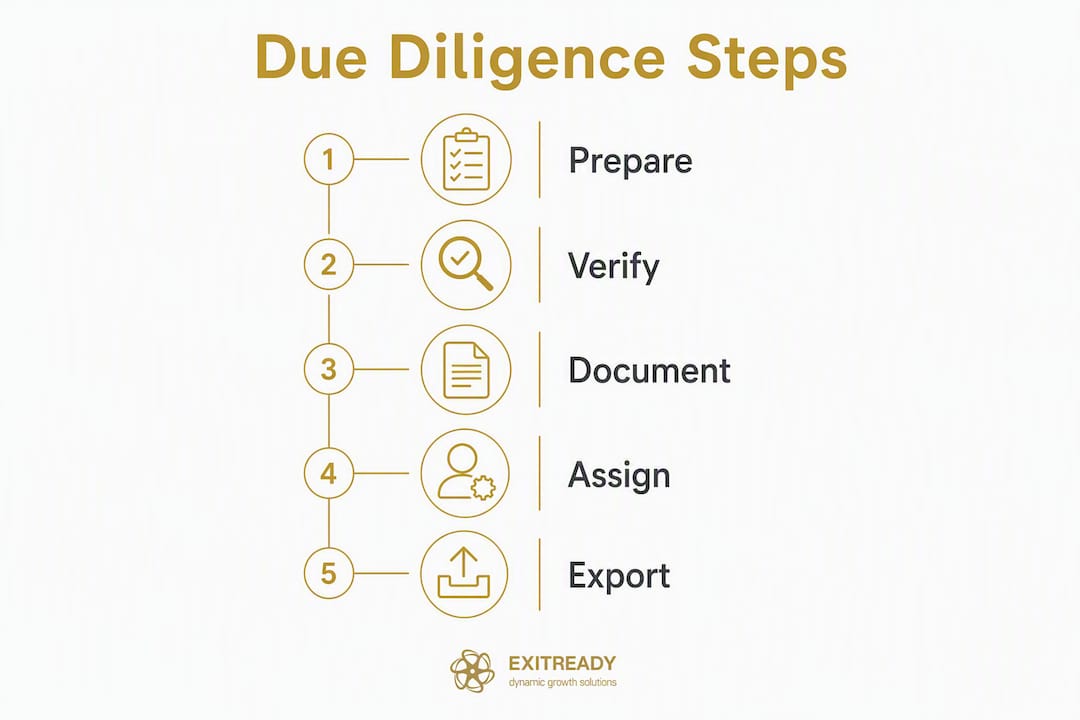
- Days 1–30: Inventory, prioritize, and template. List every process that affects revenue, customer delivery, compliance, cash flow, or team continuity. Rank them by risk (what breaks if this person leaves?). Build or adopt a standard SOP template with fields for owner, version, review date, and approval signature.
- Days 31–60: Draft, evidence, and integrate. Write the top 10–15 SOPs. Attach supporting evidence: screenshots, Loom video walkthroughs, and checklist sign-offs. Connect documentation to your CRM, ERP, or HRIS so process steps reference live system data.
- Days 61–90+: Validate, sign off, train, and export. Have each process owner review and formally approve their SOP. Run manager walkthroughs to confirm the written process matches actual practice. Generate the exportable due-diligence package and run a gap check against the deliverable checklist below.
Resource budgeting for mid-market companies typically runs $15,000–$50,000 for a guided implementation, depending on process complexity, the number of integrations required, and whether you use internal staff or a fractional operator to lead the sprint. DIY approaches using existing tools cost less upfront but frequently stall at the validation phase because no one owns the finish line.
- Assign one internal project lead with authority to hold process owners accountable
- Budget two to four hours per SOP for drafting, review, and evidence capture
- Set a hard deadline for the export package, not just for the drafts
How do you keep documentation credible after you build it?
Continuous governance is what separates a documentation library from a documentation archive. Buyers can tell the difference in about 20 minutes of diligence.
- Named owners: Every process has one person responsible for accuracy, not a team or a department
- Quarterly reviews with timestamps: Each SOP carries a “last reviewed” date and the reviewer’s name; quarterly cadence is the minimum buyers find credible
- Independent spot-checks: An internal audit or a third-party reviewer validates a sample of processes against actual practice at least once before you enter a sale process
- Version release notes: When a process changes, the change log explains why; this proves the documentation is a living system, not a static file
- Performance review tie-ins: Process ownership appears in manager performance reviews so accountability has teeth
Pro Tip: Commission a short internal audit of your top five processes before you engage a broker or investment banker. If those five hold up under scrutiny, the rest of the library gains credibility by association.
Digital files alone are not sufficient without organization, update cadence, and independent review. Buyers who find a well-maintained process library with consistent review timestamps and owner sign-offs move faster through diligence and negotiate from a position of confidence rather than suspicion.
What documentation mistakes reduce your valuation?
The most damaging mistakes are treating documentation as an archive, leaving processes without owners, letting SOPs go stale, and creating documents that contradict what employees actually do.
- No version history: A folder of undated Word files signals the documentation was assembled for the sale, not maintained for the business
- Missing owners: “Owned by Operations” is not an owner; buyers want a name and a title
- Stale SOPs: A process last reviewed 18 months ago raises an immediate question: does this still reflect reality?
- Conflict with employee testimony: Buyers interview employees. If what the team describes differs from what the SOP says, the documentation loses all credibility
- No exportable audit evidence: Buyers need a portable package; a SharePoint folder they cannot access after the call is not a diligence package
“A smaller set of credible, actively used SOPs is more persuasive than a comprehensive binder created only for sale. Credibility comes from usage and evidence.” — Viking Mergers & Acquisitions
Fix each red flag concretely:
- Assign a named owner to every process this week, even before the SOP is written
- Set a calendar reminder for quarterly reviews and log the completion date in the document itself
- Run a manager walkthrough: have the process owner narrate the steps while a colleague checks them against the written SOP
- Build an evidence log (training completions, checklist sign-offs, change notes) as a separate tab or attachment
What does a buyer-ready due-diligence package actually contain?
Buyers expect a compact, exportable package that proves processes, ownership, and currency. Assemble it before you enter any sale process.
| Deliverable | Purpose in diligence | Preferred format |
|---|---|---|
| Executive process map | Shows business functions and interdependencies at a glance | PDF or PowerPoint |
| Top 10–15 SOP PDFs with version headers | Proves process maturity and maintenance cadence | PDF with version, date, owner |
| Training completion logs | Evidence that the team uses the documented processes | CSV or PDF export |
| Role mapping and org chart | Answers key-person risk and management depth questions | |
| Key contracts index | Confirms transferability of revenue relationships | PDF with redaction notes |
| KPI dashboards (exported) | Ties documented processes to measurable outcomes | PDF or CSV |
| Financial folder index | Orients buyers to financial records without exposing raw data | |
| Exportable audit trail | Proves version history and review cadence | CSV with timestamps |
Deliver the package through a password-protected virtual data room (VDR). Include a redaction checklist to confirm that personally identifiable information and competitively sensitive data are masked before sharing. Structuring sale materials for strategic buyers requires both the content and the delivery workflow to be airtight.
- Use a VDR with granular access controls (view-only, no-download options for sensitive files)
- Include a cover index so buyers can navigate the package without asking for a guide
- Version the package itself: “Diligence Package v1.0, [Date]” so all parties reference the same snapshot
Dynamicgrowthsolutions AOS: built for exactly this outcome
Mid-market owners who want to move from operational chaos to a buyer-ready business in 90–120 days need more than a documentation tool. They need a system that tells them what to document, who should own it, how to validate it, and how to package it for a buyer.
Dynamicgrowthsolutions’ Accelerated Operating System (AOS) is that system. It provides a production-ready playbook framework that replaces owner dependency with documented, delegated processes. AOS capabilities map directly to what buyers look for: centralized playbooks with version control, owner assignment workflows, training evidence capture, and an exportable due-diligence package. The program also includes an operational assessment, exit-readiness certification, and access to a network of buyers, advisors, and fractional executives who understand what a buyer-grade documentation library looks like from the other side of the table.
The clearest next step: book a business exit readiness assessment to identify exactly which processes carry the most valuation risk and where your documentation library has gaps. Or, if you want to understand the full AOS framework first, the business transformation best practices page walks through the methodology in detail.
Key Takeaways
An AOS-style documentation platform with versioning, named owners, and an exportable due-diligence package is the fastest path to acquisition readiness for a mid-market business.
| Point | Details |
|---|---|
| Start with 10–15 processes | Focus on revenue, cash flow, and customer delivery workflows first for maximum valuation impact. |
| 91-day sprint outperforms long projects | Windsor Drake data shows top-quartile transactions complete systematic preparation in roughly 91 days. |
| Governance makes docs credible | Named owners, quarterly reviews, and independent spot-checks turn a file library into auditable evidence. |
| Exportable package is non-negotiable | Buyers need a portable, versioned package (PDF/CSV) delivered through a secure VDR before diligence closes. |
| Dynamicgrowthsolutions AOS | The AOS program provides the platform, playbook, certification, and buyer network to make this happen end-to-end. |
What owners get wrong about documentation and exit timing
Most owners assume documentation is a pre-sale task. It is not. By the time a buyer’s letter of intent lands on your desk, you have roughly 60–90 days to produce a credible diligence package. If your documentation library does not exist yet, that timeline is impossible.
The owners who get the best outcomes start 12–18 months before they intend to sell, not because buyers demand a long history, but because a library with 12 months of review timestamps and change logs looks fundamentally different from one assembled in six weeks. Buyers are not naive. They know when documentation was created for the sale versus maintained for the business.
The other thing owners underestimate is the gap between having processes and having evidence of processes. A well-run business with no documentation is worth less than a slightly less efficient business with a clean, auditable process library. That is not a documentation problem. It is a valuation problem. And it is entirely fixable, given enough lead time.
Selected sources and further reading
The sources below back the claims in this article and provide practical next steps for owners building a documentation library.
- Documenting SOPs for Business Sale — Viking Mergers & Acquisitions: authenticity, buyer interviews, and why credibility beats volume
- How to Package Business Assets for Sale Effectively — Compass Business Acquisitions: VDR readiness, redaction checklists, and structured sale materials
- The Role of SOPs in Mid-Market Growth — Dynamicgrowthsolutions: how SOPs affect buyer confidence and due-diligence outcomes
- Business Exit Readiness Assessment: What Owners Must Know — Dynamicgrowthsolutions: the assessment used to evaluate exit readiness and identify documentation gaps
- Benefits of Exit Planning Early: Maximize Value and Control — Dynamicgrowthsolutions: why starting documentation 12–18 months before sale produces better outcomes
- Examples of Systematized Business Processes That Scale — Dynamicgrowthsolutions: concrete process examples for the deliverable checklist and core features sections