A business transformation framework is a structured methodology that connects strategic intent to operational change across five core dimensions: strategy, structure, processes, culture, and technology. Unlike incremental improvement programs, a business change framework drives non-linear, organization-wide shifts that typically span 6–24 months and touch every layer of how a company operates. The standard lifecycle moves through readiness, definition, design, implementation, and benefits realization. Each phase has distinct deliverables, and skipping any one of them is the most common reason transformations stall. For business leaders and change agents, understanding this structure is the difference between a managed shift and an expensive false start.
What is a business transformation framework, and what are its core dimensions?
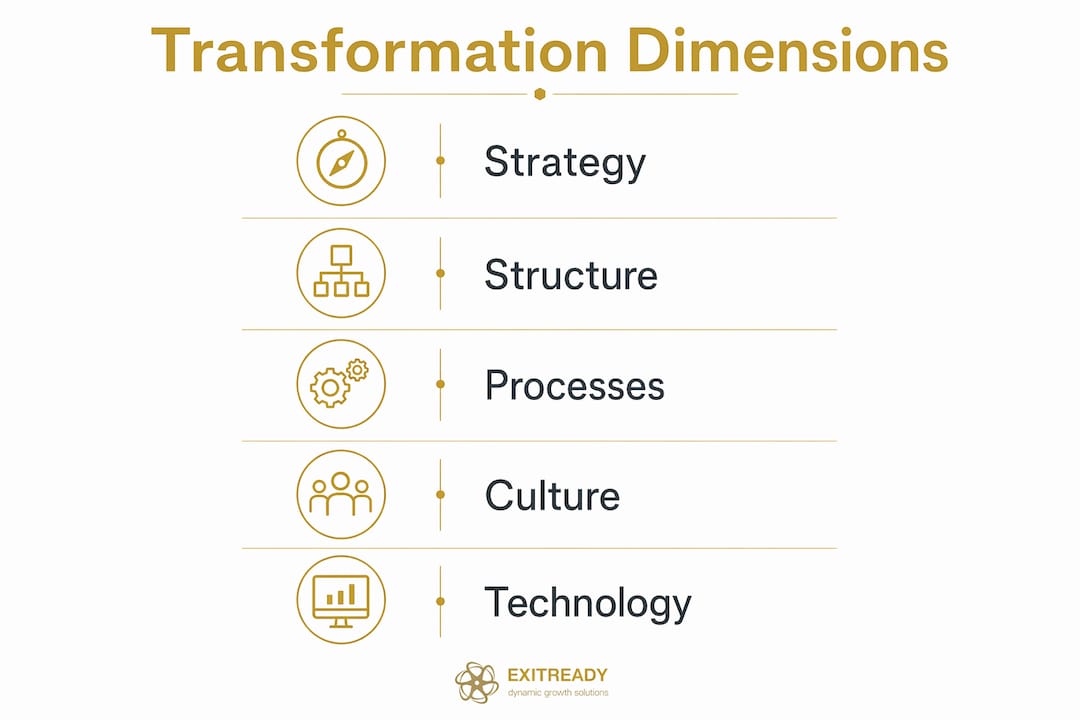
A business transformation framework organizes change across five dimensions that must move together. Treating any one dimension in isolation produces partial results at best and organizational confusion at worst.
Strategy defines the “why” and the destination. Without a clear strategic rationale, every downstream decision lacks a reference point. Leaders who articulate a specific outcome, such as doubling recurring revenue or reducing owner dependency, give their teams a filter for every trade-off.
Structure covers how the organization is designed: reporting lines, decision rights, and team configurations. Structural redesign often lags behind strategic intent, which creates friction. A company that declares itself customer-centric but keeps a product-siloed org chart will underperform its stated goals.

Processes are the documented workflows that convert inputs into outputs. Process redesign is where transformation becomes visible to employees. Without documented, repeatable processes, even the best strategy stays trapped in the heads of a few key people. Dynamicgrowthsolutions calls this replacing owner dependency with self-sustaining operations, and it is the foundation of their AOS (Accelerated Operating System).
Culture is the hardest dimension to shift and the most consequential. Culture determines whether new behaviors stick after the initial rollout energy fades. Transformation programs that ignore culture tend to see regression within 12 months.
Technology acts as an enabler, not a goal. Technology bridges business principles with practical employee workflows in 9 out of 10 transformation models, yet the organizations that treat tech adoption as the transformation itself consistently underdeliver. The tool should serve the process, not define it.
| Dimension | Primary focus area |
|---|---|
| Strategy | Purpose, goals, and competitive positioning |
| Structure | Org design, decision rights, and reporting |
| Processes | Documented workflows and operational playbooks |
| Culture | Behaviors, norms, and change readiness |
| Technology | Systems that enable and reinforce new ways of working |
Pro Tip: Before selecting any software or platform, write a one-page statement of the business problem you are solving. If you cannot articulate it clearly, the technology will not fix it.
What are the typical phases of a business transformation lifecycle?
A business transformation process follows a sequence of phases, each with a specific purpose. Rushing through them does not accelerate results. It delays them.
-
Readiness (Assessment). The organization audits its current state: financial performance, operational gaps, cultural health, and leadership alignment. This phase produces a baseline. Without it, leaders cannot measure progress or identify where resistance will emerge.
-
Definition (Planning). Leaders translate the strategic rationale into a transformation roadmap. Key outputs include a case for change, a governance structure, and a set of success metrics. This is where KPIs get defined, not after implementation begins.
-
Design. Teams build the future-state model: new processes, updated org structures, technology requirements, and cultural interventions. Pilot groups often test designs here before broad rollout.
-
Implementation. The organization executes the designed changes at scale. This phase carries the highest risk of adoption failure. Simulations and pilots identify friction points before they become company-wide problems.
-
Benefits Realization. The organization measures actual outcomes against the metrics defined in the planning phase. Productivity typically dips before it stabilizes at a new, higher baseline. Leaders who exit the program before this stabilization occurs declare victory prematurely.
The critical insight is that transformation must be cyclical, not linear. Organizations that treat it as a one-time project find themselves repeating the same change effort three years later. Embedding change into daily operations, until a new productivity baseline is stable, is what separates organizations that transform from those that merely reorganize.
Pro Tip: Map each phase to a named owner and a measurable exit criterion before you begin. A phase without an exit criterion never officially ends, and scope creep fills the vacuum.
How do leadership alignment and change capability drive transformation success?
Leadership alignment is the single most powerful predictor of transformation outcomes. Transformation initiatives fail primarily because executive compensation and departmental KPIs are not tied to transformation success metrics. Middle managers resist change when their performance reviews reward the old behavior. The incentive structure must change before the operating model can.
Only 9% of organizations consistently embed continuous change as a core competency. These organizations, identified as “Reinventors,” develop a Change Capability Quotient that combines foundational change skills with the capacity to generate genuinely new approaches. The other 91% treat change as a project, which means they are perpetually behind.
McKinsey’s refreshed operating model framework includes 12 elements and 9 golden rules that prioritize leader alignment, deep process investment, and explicit incentive linkage. The model’s core argument is that strategy-to-performance gaps are almost always a leadership and incentive problem, not a strategy problem.
Best practices for leaders driving transformation:
- Tie executive bonuses and team KPIs explicitly to transformation milestones, not just financial results.
- Appoint a dedicated transformation lead with authority to make cross-functional decisions.
- Communicate the “why” before the “what.” Teams that understand the rationale adopt new behaviors faster.
- Build CEO-level performance metrics that track transformation adoption, not just output.
- Conduct quarterly alignment checks to catch drift before it becomes resistance.
Organizational change maturity depends on three factors: strategic change leadership, business change readiness, and project change management. Weakness in any one of these constrains the organization’s ability to adapt. Leaders who assess all three before launching a transformation program make far better decisions about where to invest first.
What practical steps help leaders implement a transformation framework effectively?
The most common implementation mistake is selecting tools before defining the problem. Jumping prematurely into solutions like software selection, without first clarifying the “why,” leads directly to adoption failure. The sequence matters more than the speed.
Practical steps for effective implementation:
- Map the “why” first. Write a clear problem statement that a frontline employee can understand. If the rationale requires a slide deck to explain, it is not clear enough.
- Run pilots before scaling. Test new workflows with a small group and measure adoption effort by comparing training hours against the time required to restore productivity.
- Embed change into daily operations. Assign transformation tasks within existing team rituals, such as weekly standups and monthly reviews, rather than creating separate change programs that compete for attention.
- Link incentives explicitly. Redesign performance reviews so that adopting new behaviors is rewarded at every level, from the executive team to frontline staff.
- Customize the framework. Transformation is a strategic challenge that requires tailoring to organizational context and history. A framework that worked for a 500-person manufacturer will not transfer unchanged to a 50-person services firm.
- Monitor productivity stabilization. Track output metrics weekly during implementation. A dip is expected. The goal is to identify when the new baseline stabilizes, which signals that the change has been absorbed.
For mid-market owners specifically, the five growth stages to scale provide a practical map for sequencing transformation investments. Knowing which stage your business occupies tells you which dimension to address first, rather than trying to change everything simultaneously.
Pro Tip: Use a business scalability checklist to assess your current state before committing to a transformation roadmap. Baseline data prevents the most expensive implementation mistakes.
Key Takeaways
A business transformation framework succeeds when all five dimensions move together, leadership incentives align with transformation goals, and change is embedded as a permanent operating discipline rather than a one-time project.
| Point | Details |
|---|---|
| Five dimensions must move together | Strategy, structure, processes, culture, and technology each reinforce the others. |
| Lifecycle phases are non-negotiable | Skipping readiness or definition phases is the leading cause of implementation failure. |
| Incentives drive adoption | Executive KPIs must be explicitly tied to transformation outcomes, not just financial results. |
| Cyclical beats linear | Transformation that ends at go-live regresses. Embed change until a new productivity baseline is stable. |
| Context determines the approach | No universal formula exists. Tailor the framework to your organization’s size, history, and change maturity. |
Why most transformation programs fail before they begin
The uncomfortable truth I have seen repeatedly is this: most transformation programs fail in the planning room, not on the shop floor. Leaders arrive at the design phase already committed to a technology platform or an org structure they read about in a case study. The “why” gets retrofitted around the solution they already want. That sequence guarantees resistance.
The organizations that get this right treat the readiness phase as the most important investment they make. They spend real time understanding where their culture actually is, not where they wish it were. They measure leadership alignment honestly, including whether the executive team’s compensation actually rewards the behaviors the transformation requires. That kind of honesty is uncomfortable, and most leadership teams skip it.
The other pattern I find underappreciated is the productivity dip. Every transformation produces one. Leaders who have not been told to expect it interpret the dip as evidence that the program is failing, and they either abandon it or pivot to a new initiative. The dip is not failure. It is the organization learning. The job of leadership during that period is to hold the line, keep communicating the “why,” and trust the process long enough for the new baseline to emerge.
Frameworks are not magic. They are discipline made visible. The leaders who master them are not smarter than the ones who struggle. They are simply more willing to do the unglamorous work of alignment, documentation, and measurement before they chase the exciting work of execution.
— Andre
How Dynamicgrowthsolutions supports your transformation
Mid-market owners who want to apply a business transformation framework without starting from scratch have a direct path forward with Dynamicgrowthsolutions. The AOS (Accelerated Operating System) is built specifically to align strategy, structure, processes, culture, and technology for owners who need their business to run without them at the center of every decision.
Dynamicgrowthsolutions works with owners to replace operational chaos with documented systems, align leadership incentives with growth goals, and build the kind of self-sustaining operations that command premium valuations. If you are ready to move from reactive management to a business that scales on its own terms, the business operating system for owners is the place to start. You can also explore business management systems designed for sustainable, mid-market growth.
FAQ
What is a business transformation framework?
A business transformation framework is a structured methodology that guides organizations through fundamental changes across strategy, structure, processes, culture, and technology. It connects strategic intent to operational execution through defined lifecycle phases, typically spanning 6–24 months.
How is business transformation different from change management?
Business transformation addresses non-linear, organization-wide shifts across multiple dimensions simultaneously. Change management typically focuses on managing people through a specific, bounded change within an existing operating model.
Why do most business transformation initiatives fail?
Transformation initiatives fail primarily because leadership incentives are not aligned with transformation outcomes, and because organizations skip the readiness and definition phases to move faster. Adoption failure follows when the “why” is unclear to the people being asked to change.
How long does a business transformation process take?
Most transformation frameworks span 6–24 months from readiness assessment to benefits realization. The timeline depends on organizational size, change maturity, and the number of dimensions being addressed simultaneously.
What role does technology play in a transformation framework?
Technology acts as an enabler that bridges business principles with employee workflows. It appears in 9 out of 10 transformation models but should serve the process design, not define it. Organizations that treat technology adoption as the transformation itself consistently underdeliver on their goals.